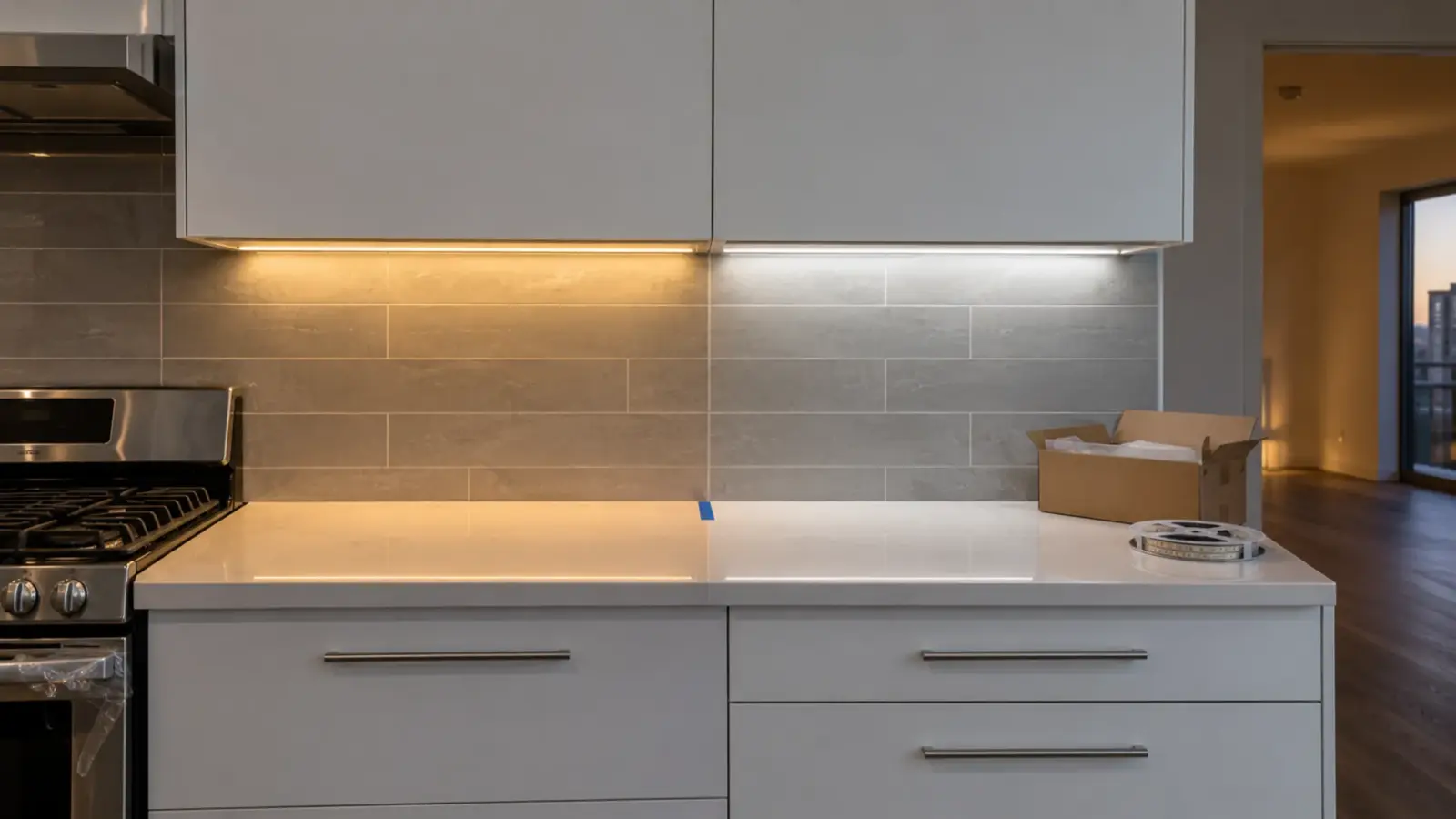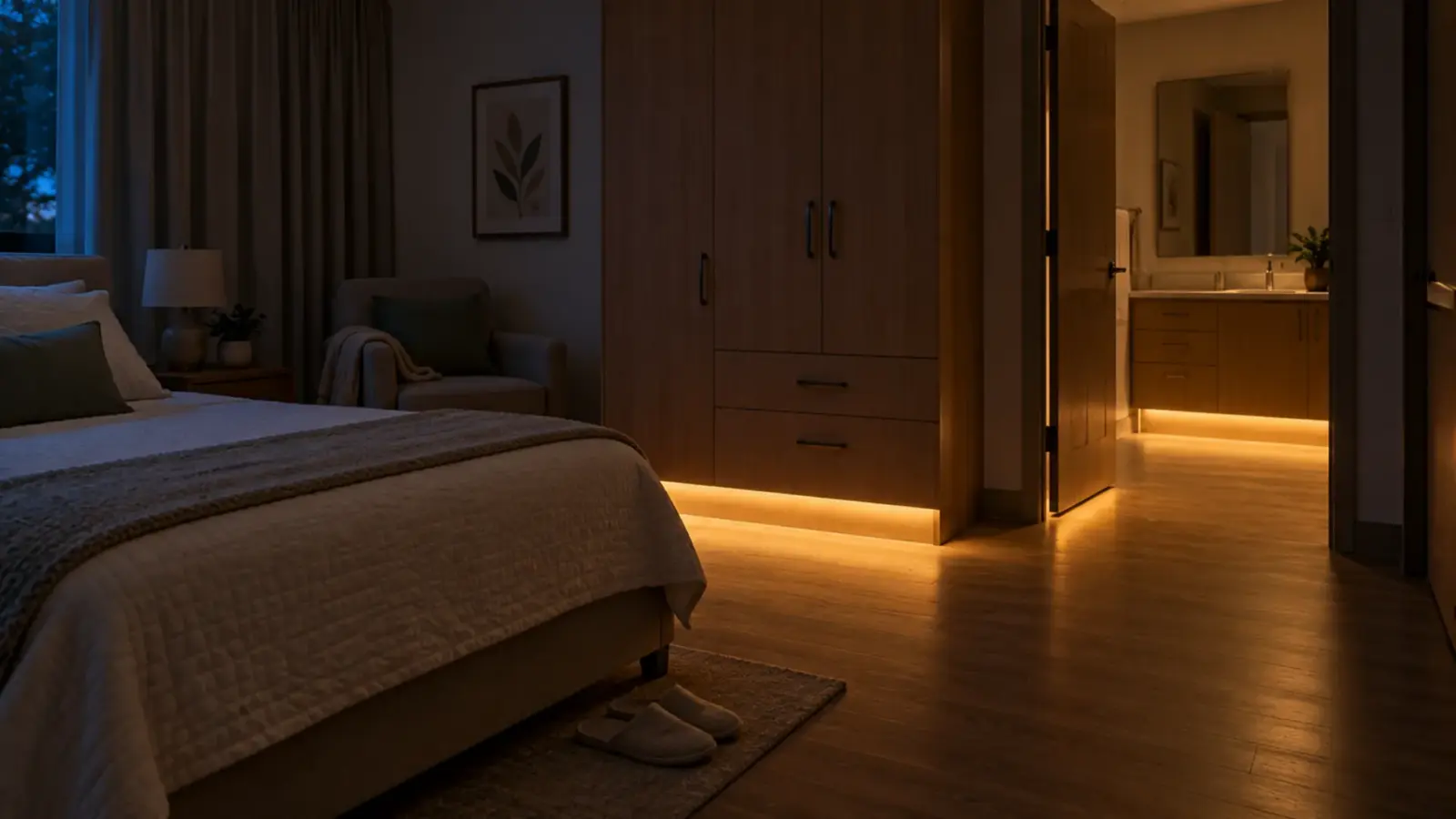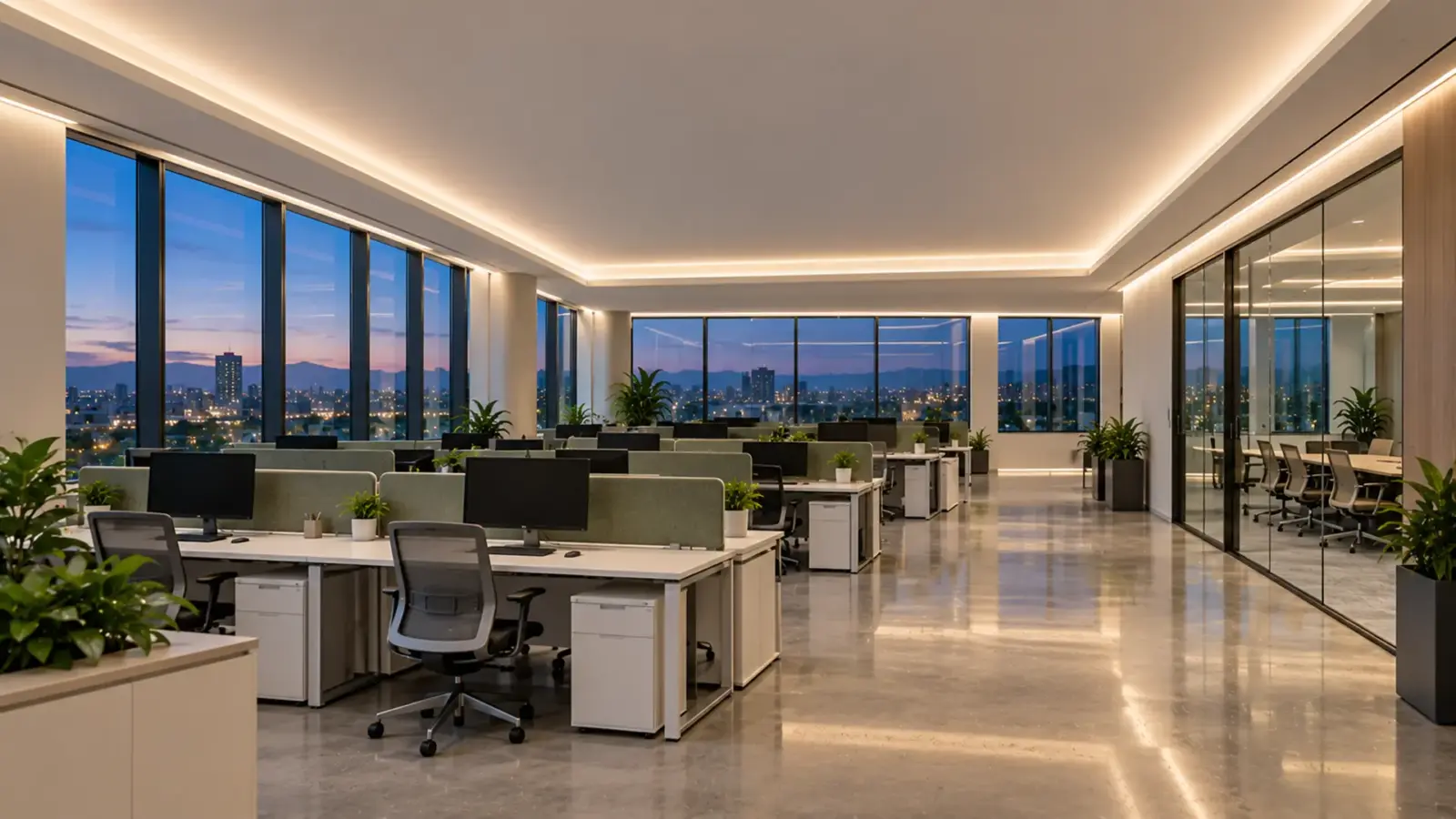
Is 5000K too cold for an office? For the open floor where people sit all day, usually yes; for a lab bench, an exam room or a stockroom, often no. Choosing 4000K vs 5000K LED strip is about the task and the hours spent under the light, and many projects use both.
The short version:
- 4000K for spaces people occupy for hours: open offices, meeting rooms, waiting rooms, classrooms, most retail floors.
- 5000K for spaces built around a task that needs contrast or color checking: exam and procedure areas, inspection benches, workshops, garages, warehouses, showrooms.
- Tunable white for rooms that need both at different times.
The Lumens Barely Move; the Room Does
A common assumption is that 5000K is the brighter choice. On the same strip at the same power, the output changes very little with color temperature. Our UT-CSP-512-CCT tunable CSP strip shows it on one board: 238 lm/ft at 2700K and 244 lm/ft at 6500K, a difference of a few percent across the whole white range.
What changes is how the space reads. 5000K looks crisper and more clinical; surfaces look whiter and contrast looks sharper. 4000K looks neutral and calmer. LEDVANCE points out that the two are hard to tell apart unless they are seen side by side. In a room lit by one of them, the choice shows in the mood and in how materials look, not in a light meter reading.
So pick by the task and the hours, then set the brightness with lumens per foot. Our lumens per foot guide covers output.
Offices: 4000K on the Floor, 5000K at the Bench
| Office space | Strip application | CCT |
|---|---|---|
| Open-plan work floor | Linear slots, perimeter coves | 4000K |
| Conference and boardrooms | Coves, slots | 4000K, or tunable white |
| Reception and lobby | Desk front, feature wall | 4000K, or warmer to match the brand |
| Labs, inspection, IT and print rooms | Bench task strip | 5000K |
| Break rooms | Coves, under-cabinet | 4000K |
| Corridors | Slots, coves | 4000K |
4000K is the default on the work floor because people sit under it for eight or more hours. One commercial lighting guide notes that 5000K can start to feel harsh in an office later in the day. At a bench where people check small parts, color or print, 5000K gives the extra crispness the task wants, and the time spent there is shorter.
Keep one CCT per sightline. An open floor with 4000K slots and a 5000K strip at a nearby bench looks like a mistake from across the room; put the cooler white inside the lab or behind a partition. Under-cabinet task strip at a kitchenette or a print station follows the same rule: match the room unless the task area is closed off from it.
Clinics and Healthcare: Two Answers in One Building
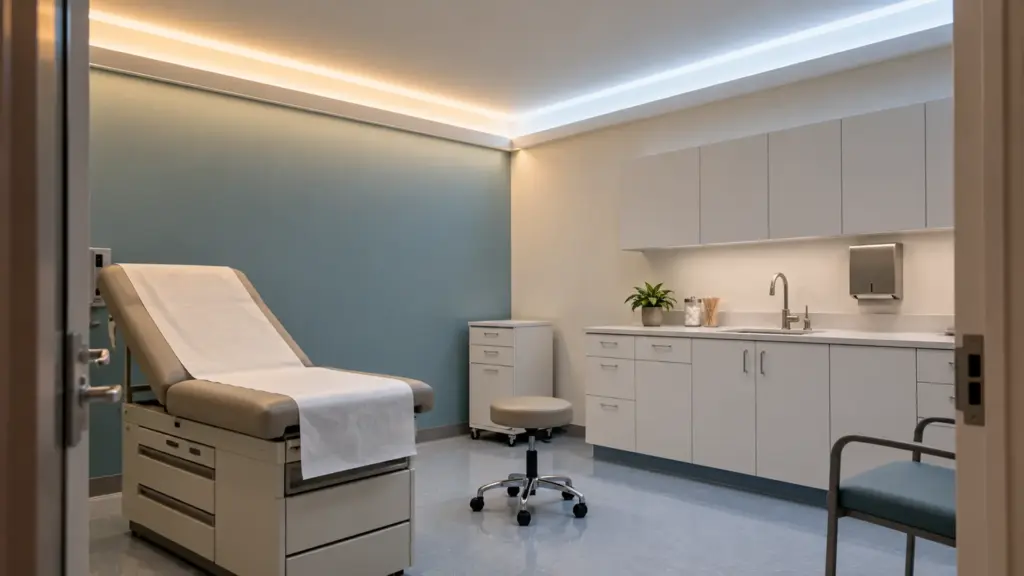
Healthcare is where the sources disagree. Some put medical spaces at 4000K overall; others recommend 5000K for exam rooms and inspection areas where color discrimination matters. We found no single standard that settles it, so the practical answer splits the building by task.
| Clinic space | Strip application | CCT |
|---|---|---|
| Waiting room | Coves, feature walls | 4000K |
| Reception and nurse station | Counter front, under-counter task | 4000K |
| Outpatient corridors | Slots, coves | 4000K |
| Exam and procedure rooms | Task strip, coves | 5000K, or tunable white |
| Pharmacy prep and lab | Under-shelf and bench task | 5000K |
| Staff break rooms | Coves | 4000K |
In exam rooms, Color Rendering Index, 0–100: how truthfully the light shows colors next to a reference source. Ra≥90 is the usual bar for interiors. matters as much as CCT, because skin tone is part of what is being looked at. Confirm the final choice with the clinical staff and any facility standard the owner uses. Tunable white lets an exam room run 4000K for conversation and 5000K for examination from one strip.
Retail: Grocery, Pharmacy, Hardware, Showroom
| Retail space | Strip application | CCT |
|---|---|---|
| Grocery aisles and shelving | Shelf-edge, gondola toppers | 4000K |
| Produce, deli and bakery cases | Case lighting | 4000K with high CRI |
| Pharmacy shelving | Shelf-edge | 4000K or 5000K |
| Hardware and home center | Aisle and end-cap | 5000K |
| Auto and electronics showroom | Coves, display plinths | 5000K |
| Apparel and boutique | Wall and fixture lighting | Warmer: see our 2700K vs 3000K guide |
5000K in retail works where the goods are hard-edged and the brand is cool: tools, cars, electronics. On food, a 5000K strip with ordinary color rendering makes bread and meat look flat; 4000K with a high-CRI strip usually sells better. Match the shelf-edge strip to the store’s general lighting so the shelves do not read as a different color from the aisle.

Back-of-House, Warehouses and Garages
Stockrooms, loading docks, mechanical rooms and parking garages are where 5000K is the easy default: the tasks are visual, the time spent is short and nobody is setting a mood. JQZ Lighting, a vendor, describes the common split in one building: 5000K on the warehouse floor, 4000K in the offices and break rooms. Labs, cold storage and clean rooms often go cooler still, to 6000K or 6500K.
CRI Matters More at 5000K
At cooler color temperatures the light carries less red to begin with, so a strip with weak red rendering makes skin, wood and food look flat and gray. That is why a 5000K strip deserves a look at CRI and R9, not just Ra.
Our standard SMD and COB strip is Ra≥90. For color-critical spaces at 5000K, UT-S2216-300 is Ra≥95 across 2700–6500K. The full-spectrum UT-SFS series (Ra≥95, R1–R15 ≥90) comes only in 2700K, 3000K and 4000K, so a full-spectrum specification at 5000K needs a different family. Our high-CRI guide explains the tiers.
Tunable White When a Room Does Both
Some rooms change job during the day: a conference room used for presentations and for long meetings, an exam room used for consultation and examination, a school library used for study and for events. Tunable white strip covers both whites from one run.
Our options at different levels of control:
- Two-channel tunable white, such as UT-T168-10 (2835, 10 mm) or UT-T640-10 (COB, 10 mm), 2700–6500K on a tunable controller (DALI DT8, 0-10V or RF).
- Step tuning from a wall switch, UT-T240-10-OF, which steps through preset whites in 2700–6500K without a separate controller.
Our tunable white strip page lists the controllers each model needs.
Schools, Libraries and Training Rooms
Education spaces follow the office pattern, with one difference: the same room serves very different activities across a day. Classrooms, lecture halls, libraries and corridors generally sit at 4000K, which keeps whiteboards, paper and faces neutral without the edge of 5000K over a full school day. Science labs, maker spaces and art rooms where color is judged lean to 5000K at the bench.
Libraries are a good example of mixing by sightline: 4000K in the reading rooms and stacks, a cooler task strip in the archive or conservation room behind a closed door. A training room that switches between video and hands-on work is a candidate for tunable white.
Daylight and Glazing
Rooms with a lot of glass have a third white in them: daylight, which changes through the day and with the weather. Strip that sits in the same view as a large window is compared with daylight all day long. 4000K tends to sit comfortably beside it; a warm 3000K strip next to a glass wall can look yellow in the afternoon, and a 5000K strip can look harsh once the daylight fades.
Daylight also changes what the strip has to do. Near the glass, perimeter slots often run dimmed through the day; deeper in the plan, they carry the space. Dimming the perimeter zone separately keeps the white consistent while the level follows the daylight.
Glare at Cooler Whites
Cooler light makes glare more noticeable. Auvolar, a commercial lighting maker, notes that 5000K has higher glare potential if the source is not diffused. For strip, that means three things: keep the LEDs out of direct view at 5000K, use an opal or frosted cover on any strip within the sightline, and aim task strip at the work surface rather than across the room. Our diffuser guide covers the covers.
Renovations: Matching Existing Lighting
On a tenant improvement or a clinic refit, the new strip often sits beside lighting that stays: troffers, downlights, display fixtures. Their color temperature varies with age and type, and the label on an older fixture is not always a reliable guide. Before choosing, light a sample of 4000K and 5000K strip beside the fixtures that stay, in the evening and in daylight, and pick the one that reads as part of the same system. If the existing lighting is itself mixed, use the refit to settle on one white per space.
Product Families at 4000K and 5000K
| Family | 4000K | 5000K | Note |
|---|---|---|---|
| SMD 2835, 5050, 2216 | Yes | Yes | 2700–6500K |
| Full-spectrum SMD (UT-SFS) | Yes | No | 2700K, 3000K, 4000K only |
| COB, 12V/24V | Yes | Yes | Most series 2700–6000K or 2700–6500K |
| CSP | Yes | Yes | 2700–6500K on most families |
| Wall washer bars (UT-WB27) | Yes | No | 2700K, 3000K, 4000K, 6500K |
| Wall washer silicone strip (UT-WS) | Yes | Yes | 2700K to 6000K steps |
| Tunable white | Yes | Yes | 2700–6500K |
Check the CCT column for the exact model; a family that offers 5000K on one model may not on another. The full range of our SMD LED strip is listed by CCT and CRI tier.
FAQ
Is 5000K brighter than 4000K?
Not in output. On the same strip at the same power, lumens change only a few percent between color temperatures. 5000K looks crisper and whiter, which some people read as brighter, but a lumens-per-foot figure at each CCT is the honest comparison.
What color temperature is best for an office?
4000K for the open work floor, meeting rooms and corridors, where people spend long hours. 5000K suits labs, inspection benches and IT or print rooms, where tasks need contrast. Tunable white covers rooms that do both.
Can I mix 4000K and 5000K in one space?
Yes, if each sightline has one white. Change color temperature at a wall, a door or a partition, not along one ceiling plane. Two whites side by side on the same surface read as a mistake.
Mockup Before You Order
The difference between 4000K and 5000K is small on paper and obvious in a room. Before the order, light a meter of each in the real detail, next to the real finishes, at the level the space will run. Look at skin tones in a clinic, at produce in a store, at the desk surface in an office. Then write the chosen CCT and CRI next to every strip tag on the schedule.
A quick checklist for the mockup:
- Same strip model, cover and channel as the specification
- Both whites lit at the same time, side by side, then one at a time
- The real finishes beside them: desk laminate, floor sample, product on the shelf
- Daylight and evening, if the room has windows
- The client, the designer or the clinical lead in the room when the final choice is made
We send samples at both whites, and in the CRI tier the space needs, so the decision is made in the room rather than from a catalog. Send the drawings and the finish board and request a quote.