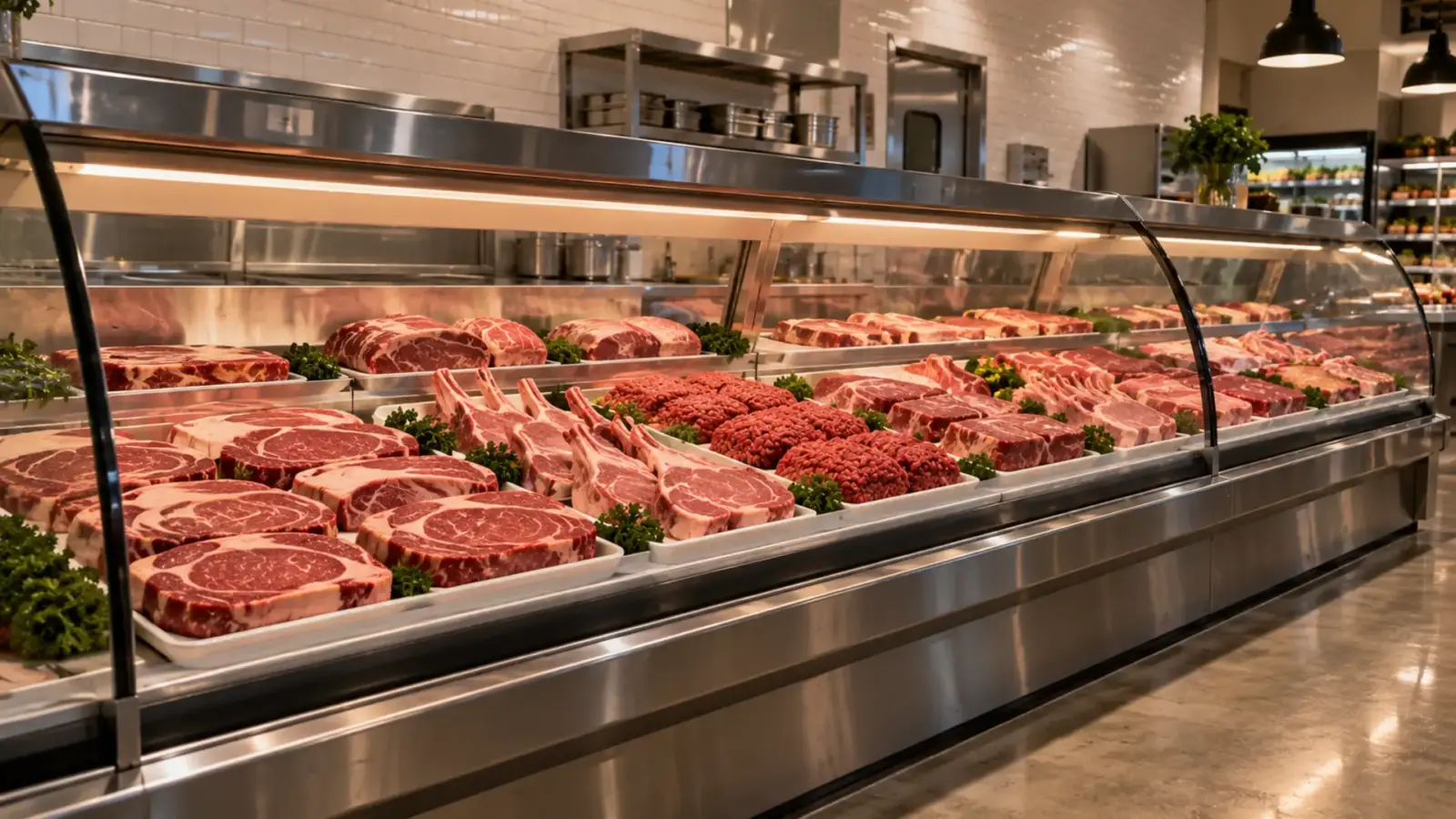
Why do meat cases use special-spectrum LED strip? Because a light with extra red makes red meat look redder, and a case that looks fresher sells. The better spec for most meat cases is a warm, high-Color Rendering Index, 0–100: how truthfully the light shows colors next to a reference source. Ra≥90 is the usual bar for interiors. white strip with strong red rendering, at a moderate level, built for the cold and wet inside a refrigerated case.
That answer has two halves, and contractors usually meet only the second one. The first is what the light does to the product and to the shopper’s judgment, where the research is more mixed than the sales sheets suggest. The second is what a refrigerated case does to the strip: cold, condensation, defrost cycles, washdown and a case that is itself a listed appliance. This page covers both.
Why Meat Lamps Exist
Red meat’s color comes from myoglobin. Fresh cuts exposed to air turn bright red as oxymyoglobin forms, and over days in the case the surface browns as metmyoglobin builds. Shoppers read that color as freshness. A light source with a strong red component makes the red brighter and the browning harder to see. That is the whole idea behind meat lamps: a spectrum tuned to flatter red.
Fluorescent “meat” tubes did this for decades with a pink tint. LED makes it easier, because a strip’s spectrum can be tuned more precisely than a phosphor tube’s. The question is whether it should be.
What the Research Says About Spectrum
A 2024 study on fresh pork display lamps tested exactly this. Participants rated pork of different freshness under four pork display lamps and two ordinary LED lamps, and took a standard color-discrimination test under the same lights. Perceived freshness was significantly higher under the display lamps, and color discrimination was poorer. The authors concluded that “improper component proportions of the light spectrum could influence observers’ assessment of meat quality and weaken the observers’ ability to distinguish the freshness level.”
In other words, a meat lamp can work as intended and still mislead. European guidance has long pointed the same way: according to a lighting maker’s summary of Commission Recommendation 89/214/EEC, lighting in meat establishments should not distort colors, and red-enhanced lamps belong only in sales cabinets. In the US we found no federal rule on display lighting, but store policies and local consumer rules vary, so the store’s own standard decides. A spectrum that flatters is a business choice for the retailer, not a default for the contractor.
Light, Heat and Discoloration
Light and heat both speed discoloration. The research on LED versus fluorescent is not one-sided. University of Missouri studies published in Meat and Muscle Biology found that LED display lighting accelerated surface discoloration of some beef steaks compared with high-UV and standard fluorescent lamps, with the most metmyoglobin under LED by day 7. A ground beef display trial reported the opposite on day 5, with LED-lit patties holding red better than fluorescent ones, and noted that fluorescent fixtures can raise the case temperature. In that trial, the case with no light at all kept the best color.
Two practical points survive the disagreement. Less light for less time is better for the product, so keep the level moderate and turn case lighting off when the store is closed. And heat matters, which favors strip mounted on aluminum, with the driver outside the case.
High CRI Instead of a Red Push
The alternative to a red-tuned spectrum is a white strip that renders red accurately: high CRI with a strong R9, the red sample in the color rendering test. Meat looks red because it is red, and a shopper can still see browning. Our high-CRI guide explains why the general CRI number alone does not say much about red, and why the R9 value should be on the datasheet you approve.
From our standard range, the full-spectrum SMD strip UT-S2835-480-FS is rated Ra≥98 and the UT-S2216-300 Ra≥95; both are on our SMD LED strip page. Where a retailer does want a tuned spectrum, we build special-spectrum strip to order on our standard series; custom builds add roughly two to three weeks.
Color Temperature and Level
Warm white is the norm for red meat. According to a summary of a meat lighting guide from Penn State, Kansas State and the University of Kentucky, the recommended range is about 2800 to 3500K with a CRI of 80 to 90, at 150 to 200 footcandles; the guide warns that 4000 to 6500K makes meat look too blue, and that high intensity and high UV accelerate discoloration. Our strip comes in 2700K and 3000K for this range; the retailer’s lighting standard decides between them.
Keep poultry, pork, seafood and prepared foods in mind when one case line holds several products. A strip that makes beef look good can make chicken look pink. Decide the CCT per case line, not per store. And measure the level at the product, not at the canopy: a strip that looks modest from the aisle can put far more light on the front trays than the back ones, and the front trays are the ones that brown first.
What Cold Does to LED Strip
Cold is good for LEDs: they run more efficiently and age more slowly at low temperature. It is harder on everything around them. Adhesive tape loses tack in the cold and lets go, so strip in a case belongs in a mechanically fixed aluminum channel, not on tape alone; our adhesive failure guide explains why. Some silicones and PVC jackets stiffen. Solder joints and connectors see expansion and contraction every defrost cycle.
Check the strip’s rated temperature range against the case. Fresh meat cases hold product cold, at or below 41 °F under the FDA Food Code, and service cases run colder than that at the product. Our silicone-construction outdoor strip is rated for permanent installation from -4 °F to +221 °F (-20 °C to +105 °C), which covers refrigerated cases; a freezer case colder than that needs a strip rated for its temperature. The driver should not be in the cold zone at all.
Condensation and Defrost
Refrigerated cases are wet. Warm, humid store air meets cold glass and metal and leaves condensation; defrost cycles melt frost into water; cases are cleaned with water and sanitizer. Inside the canopy, that means IP-rated strip: an IP65 silicone top coat at minimum where the strip sees splash and condensation, IP67 where water can sit. Our outdoor and waterproof LED strip covers IP65 to IP68; the wet location marking for a model is confirmed at quote, and our wet location guide explains why the IP code alone is not the marking.
Every cut end inside the case is resealed with a matching end cap, as our IP67 cut-end guide shows, and every joint sits above where water collects. A canopy channel should drain rather than trap water.
Seafood, Poultry and Deli
A case line rarely holds only beef. Poultry under a red-leaning light looks pink and undercooked, and seafood looks best under a cleaner white that keeps ice and fish skin from turning yellow. Deli and prepared foods sit in between. That is another reason a high-CRI warm white suits most of a fresh department: it renders each product as itself, while a meat spectrum flatters one product and distorts the others.
If the store wants different looks per case, change the CCT per case line, 2700K or 3000K over red meat and 3000K over poultry and deli, and keep the same high-CRI family so the department still reads as one. Seafood displays on ice are wet and cold at the surface, so the strip over them needs the same IP rating and channel detail as the meat case, with drainage planned for melt water.
The Case Is a Listed Appliance
A commercial refrigerated case is a listed appliance, built and labeled by its maker. Its lighting is part of what was evaluated. Replacing that lighting with field-installed strip can take the case outside its listing unless the case maker offers a retrofit kit or approves the change, the same question our guide on whether cutting LED strip voids its UL listing works through for strip systems.
So the first call on a case retrofit is to the case maker or the store’s refrigeration contractor: is there an approved LED retrofit kit, and if strip is used, what does the case maker allow? On new cases, the case maker usually supplies the lighting; strip work is then the custom additions around the case, such as a deli counter front, a back-wall merchandiser or a butcher shop service counter.
Installing in a Case Canopy
Where strip goes into a case canopy or shelf, the details follow from the cold and the wet:
- Channel, not tape. Aluminum channel fixed mechanically to the canopy, with a closed cover.
- Aim at the product, away from the shopper. The strip at the front of the canopy aimed back and down at the meat, with the source hidden from the aisle.
- Driver outside the cold zone. In the case base compartment or a dry location nearby, never in the canopy. Class 2 drivers on our range are IP20 and stay dry; potted IP67 drivers are for damp and wet locations. Mind the heat: our driver derating guide covers enclosed spaces.
- Wire path. Through the case’s existing wire ways, with drip loops, never across the cold glass.
- Controls. Case lighting on the store’s schedule, off when the store is closed.
- Spares. Same-lot spares for replacing a section without a color step between cases.
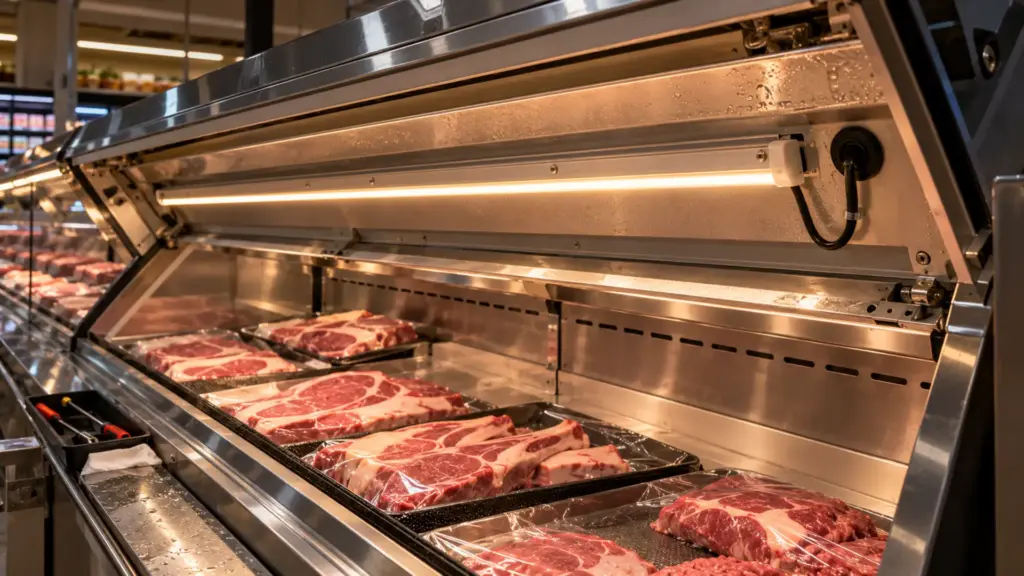
A Butcher Counter, Worked
A typical case, not a specific store: a 24 ft butcher service counter where the case maker approves strip in the canopy channels. With UT-S2835-480-FS at 5.5 W/ft, the canopy loads about 132 W. Our 24V Class 2 drivers are rated at 60 W, and at 80% each one carries 48 W, about 8.7 ft of this strip. So the canopy splits into three runs of 8 ft, about 44 W each, on three Class 2 drivers in the case base compartment, inside the 16 ft per feed the strip allows.
At 3000K and Ra≥98, the counter shows meat in its own color. The strip sits in a mechanically fixed channel with an IP65 top-coated version where condensation reaches it, every cut end resealed, the leads dropped through the case wire way with drip loops. The case lighting joins the store schedule and turns off at close. Spare strip from the same lot is kept for the day a section fails, so the replacement does not show as a color step between cases.
FAQ
What color temperature is best for meat display lighting?
Warm white. A meat lighting guide from Penn State, Kansas State and the University of Kentucky, as summarized, recommends about 2800 to 3500K with good color rendering, and warns that 4000K and above makes meat look too blue. 2700K or 3000K strip with high CRI and a strong R9 fits that range.
Are special meat display lights misleading?
They can be. A 2024 study found that fresh pork display lamps raised perceived freshness and reduced shoppers’ ability to tell fresh from less fresh pork. High-CRI white light renders red accurately without that effect.
Does LED lighting make meat turn brown faster?
Studies disagree. Some University of Missouri steak studies found faster surface discoloration under LED than under high-UV fluorescent, while a ground beef trial found LED better than fluorescent. Less light, shorter lighting hours and lower case temperatures help in every study.
Can LED strip go inside a refrigerated case?
Yes, if it is rated for the case temperature, IP-rated for condensation and washdown, mounted in a channel rather than on tape, and fed from a driver outside the cold zone. Check with the case maker first, since the case is a listed appliance.
What This Means on a Job
- Ask the retailer which spectrum policy applies before quoting: high-CRI white or a tuned meat spectrum.
- Default to 2700K or 3000K, high CRI with strong R9, at a moderate level, off when the store is closed.
- Check the strip’s rated temperature against the case, and use IP65 or IP67 inside it.
- Channels fixed mechanically, cut ends resealed, joints above the water line.
- Drivers outside the cold zone, in a dry, reachable place.
- On existing cases, get the case maker’s position before changing its lighting.