
The first reels matched the mockup; the phase-three reels, ordered nine months later, are a shade greener, and nothing in the purchase order forbids it. An LED strip supplier quality agreement closes that gap by writing down the approved sample, tolerances, lot rules, change notice, acceptance, defect handling and records before the first order.
A spec sheet describes a product. A purchase order buys a quantity. Neither says what happens when the product changes between orders, which on a multi-phase job is the likeliest problem. The seven items below, one section each, are what we would want in writing on any strip supply that runs longer than one delivery.
The Spec and the Approved Sample
Name the exact model and options: strip series, CCT, Color Rendering Index, 0–100: how truthfully the light shows colors next to a reference source. Ra≥90 is the usual bar for interiors., voltage, density, PCB width, IP rating, cut interval and reel length, plus the channel, cover and driver if they are part of the supply. Then tie everything to a physical approved sample, signed and dated by both sides.
The approved sample is the reference for every later delivery, so it has to be kept and findable. Write down who keeps it, where, and for how long; one supplier quality agreement we read keeps reserve samples for years after production starts. On our project supply jobs, samples ship for approval so color and output can be checked in the real space, and the approved sample is kept as the reference for later releases, as our project supply page describes. Keep your own half of the pair on site as well.
Test Conditions and Tolerances
A tolerance without a test condition is an argument waiting to happen. For each value that matters, write the value, the tolerance and how it is measured:
- Color consistency as an SDCM limit, such as SDCM ≤3 on our CSP LED strip, measured against the approved sample’s bin.
- Duv or tint where white walls will show it; our green tint guide explains why.
- CRI and R9 as minimums.
- Power in W/ft with a tolerance, measured at rated voltage on a full reel.
- Output in lm/ft from a photometric test; our LM-79 guide covers what that report contains.
Write the measurement conditions next to each value: voltage, temperature, warm-up time, and whether output is measured bare or in a channel. Our SDCM guide shows how to word the color limit.
Lots, Labels and Traceability
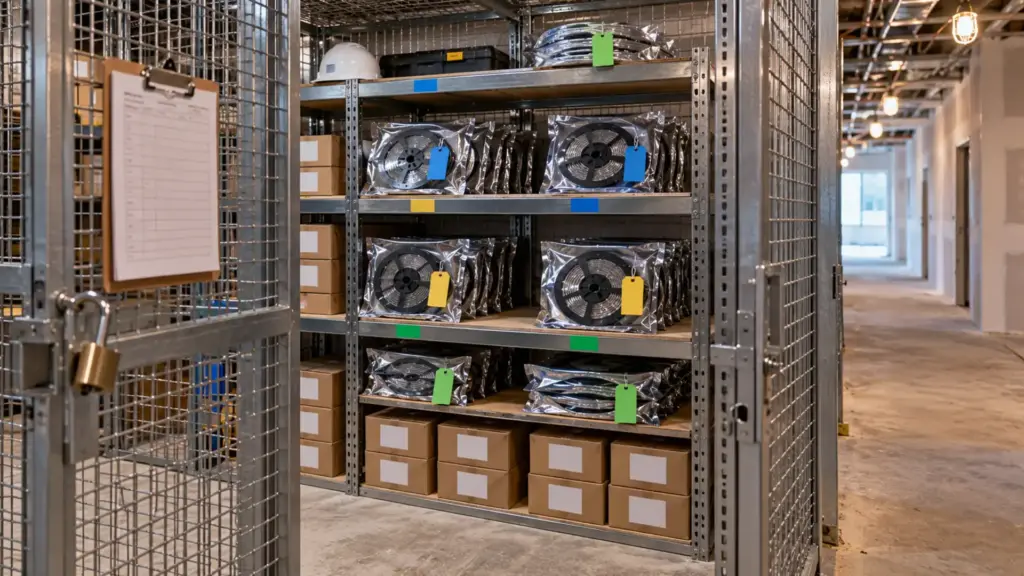
Every reel should carry a label that ties it to its production lot and color bin, and every delivery should list the lots it contains. That is what lets a contractor keep one corridor or one phase on one lot, and lets a supplier trace a defect back to its source.
Write three rules: what goes on the reel label (model, CCT, bin, lot, date, length), what goes on the packing list (lots per line), and how long the supplier keeps the production records behind a lot. Match the detail to the risk, as one industrial quality agreement puts it; a hotel chain with 300 identical rooms needs more than a single storefront. Agree also whether one area or phase may receive more than one lot, and what happens if it does. On our jobs, test reports and binning records are shared before anything ships, which gives the receiving crew something to match the labels against.
Change Notification
This is the item most often missing, and the one that causes the phase-three problem. LED strip changes quietly: the LED package maker, the phosphor, the PCB supplier, the adhesive, the silicone, the factory line, or the driver model can change between orders while the part number stays the same. Each can change color, output, life or fit.
Electronics suppliers have a model for this. JEDEC’s J-STD-046, as industry summaries describe it, asks suppliers of electronic products to notify customers of product or process changes at least 90 days before the first shipment of the changed product. Not every supplier keeps to it: one analysis of change notices found that most in its database were not issued within that window. A strip agreement can borrow the idea:
- List the changes that require notice: LED package, phosphor or bin, PCB, adhesive, coating, driver model, production site.
- Set the notice period and the samples that come with it.
- Require written approval before changed product ships to the project.
- Say what happens to open orders and to the remaining phases.
Substitutions belong here too. We put forward approved alternates ourselves, with the differences stated in CCT, CRI, output, run limit and IP rating, so the designer can accept or reject each one. Our value-engineering guide covers which substitutions hold up.
Acceptance at Delivery
Write down how a delivery is accepted, so neither side argues it later. Name the receiving checks: labels against the submittal, a visual check, a power test on a reel from each lot, and a color comparison against the approved sample. Set how many days the buyer has to report a nonconformance after delivery, and what evidence the report needs, such as photos, lot numbers and test results.
Keep it practical. A contractor’s site crew can count, read labels, unroll a reel and power it on a bench supply; few can run a spectrometer. Write acceptance checks the crew can actually run on a delivery day, and keep the instrument tests for the mockup and for disputes. If the job needs measured color acceptance, say who measures, with what instrument, and against which reference.
Nonconformance and Corrective Action
Decide in advance what happens when product fails: how nonconforming material is held and kept apart, who decides whether it is used, reworked, replaced or returned, how fast the supplier responds, and what the root-cause report looks like. Many manufacturers use an 8D report, an eight-step problem-solving format, for that; name it, or describe the steps you expect.
Keep the warranty in its own lane. A warranty covers defects after delivery for a stated period and sets the remedies. Under our warranty, the period is the one stated on the quotation and order confirmation, it varies by series, a claim includes photos or video of the affected product and the installation, and remedies are repair, replacement or credit at our option; removal, reinstallation and electrician labor are not covered. A quality agreement covers how the supply is controlled before and during delivery. Our warranty policy sets out the terms.
Records and Documents
List the documents that travel with each delivery and the ones kept on file: datasheets as approved, test reports, binning records, listing and certification documents for each model, and the change notices issued. On our project supply jobs, listing and certification documentation is available per model on request, and every release is tied to the approved drawing and spec revision, with a list of what changes and what has already shipped when a drawing changes.
Set how long records are kept, and how fast they are produced when asked. Name a contact on each side for quality questions, so a change notice or a nonconformance report goes to someone who acts on it. A replacement order in year six goes faster when the original lot, bin and test report can be pulled the same day. Our submittal package guide covers the documents at the front end of the job.
A Phased Hotel Order, Worked
A typical case, not a specific client: a 300-room hotel renovated in three phases over 14 months, with the same cove and headboard strip in every room. The agreement names the strip model, CCT and CRI, and the signed sample from the mockup room. It sets Color-consistency steps (MacAdam ellipses). Fewer steps means two strips from different reels look like the same white; 3-step is hard to tell apart by eye. ≤3 against that sample’s bin, with output and power tolerances measured at rated voltage. It asks for lot and bin on every reel label and a lot list on every packing list, one lot per floor.
It lists the changes that need notice, with 90 days and samples before any changed reel ships, and approval in writing. It gives the site five working days after each delivery to report a nonconformance with photos and lot numbers, with a supplier response in an agreed number of days. And it lists the documents per delivery and keeps records for the life of the warranty. Each phase then arrives as a repeat of the first, and any difference is a breach of a written term rather than a matter of opinion.
Reorders Years Later
The longest phase is the one nobody plans: the replacement order. A strip that fails in year five, in a hotel that has kept the same design, has to match its neighbors. The quality agreement is what makes that possible: the approved sample still on file, the bin and lot of the original reels on record, and a supplier obliged to say whether the product has changed since. Keep the agreement and the sample with the building’s records, not in a project folder that closes with the job.
What a Quality Agreement Is Not
It is not a warranty, a price agreement or a liability contract. Payment terms, freight, liability limits and indemnities belong in the purchase terms and with counsel, as one PCB quality-agreement checklist also notes. And it is not a replacement for a good supplier choice; our supplier selection guide covers that. A quality agreement makes the expectations explicit, so the same product arrives in phase three as in phase one.
Who Needs One
Not every order. A single storefront or a one-delivery job is usually covered by the approved submittal, the purchase order and the warranty. A quality agreement earns its paperwork on jobs with many deliveries over months: multifamily and hotel projects in phases, campuses, retail rollouts, healthcare buildings with long schedules, and any distributor or contractor program that reorders the same strip for years. Our guide to mixing strip brands shows what happens on long jobs when supply is not controlled.
- 1Spec and sampleitem 1Signed approved sample
- 2Tolerancesitem 2SDCM, CRI, W/ft, test conditions
- 3Lotsitem 3Labels, packing lists, records
- 4Changesitem 4Notice, samples, approval
- 5Acceptanceitem 5Checks and reporting window
- 6Nonconformanceitem 6Hold, disposition, 8D
- 7Recordsitem 7Documents and retention
Before You Sign
| Item | What to write | What to check on the job |
|---|---|---|
| 1 Spec and sample | Exact model and options; signed approved sample, who keeps it | Sample on site and with the supplier |
| 2 Tolerances | SDCM, Duv, CRI, R9, W/ft, lm/ft, each with its test conditions | Values match the submittal |
| 3 Lots | Label content, lots on packing lists, record retention | One lot per area where agreed |
| 4 Changes | Changes that need notice, notice period, approval before shipping | No changed product without approval |
| 5 Acceptance | Receiving checks, reporting window, evidence | Receiving report per delivery |
| 6 Nonconformance | Hold, disposition, response time, root-cause report | Failed material tagged and held |
| 7 Records | Documents per delivery and on file, retention, retrieval time | Records pulled on request |
The CSP strip and drivers mentioned here are in our drivers and controllers and CSP ranges; send your draft quality agreement with the quote request and we will mark which items our standard project supply process already covers.