A strip datasheet that says “Samsung LEDs” or “Nichia chips” gets read as a grade, the way “Grade 8” is read on a bolt. It is not a grade. It is a parts-list line that names the company that packaged the LED, says nothing about the bin ordered or the board under it, and is a lead, not a spec.
On most strips the name belongs to the packager, not to the company that grew the die, and never to the company that built the strip. Those are three different businesses, and the submittal has to reach all three.
The Myth: A Brand Name Is a Spec
The myth survives because it is half true. The large LED packagers publish datasheets, run LM-80 tests on their packages and hold their bins to a published structure, so a strip built on their parts starts from better-documented components than a strip built on parts nobody will name. That is worth something.
What the myth adds is the leap from “well-documented component” to “good strip”. A strip is a package, a phosphor, a drive current, a copper board and a reel of them that all came out of one lot. The brand name touches the first of those and influences the second. The other three are the strip assembler’s work, and the assembler is who you are buying from.
Three Companies Behind One Strip
Behind one reel of strip are usually three companies, and the datasheet names at most one of them.
| Layer | Who | What they control | What they cannot control | What proves it |
|---|---|---|---|---|
| Die | The company that grows the semiconductor wafer and cuts it into chips | Efficacy ceiling, forward voltage, the die’s own reliability | Color, CRI, how hot the chip runs on your strip | Rarely visible to a strip buyer; the die maker’s name appears only when the packager says so |
| Package | The company that mounts the die, adds the phosphor and seals it into a 2835, 5050 or similar body | CCT and CRI options, R9, bin structure, LM-80 data for that package at stated currents and temperatures | The bin the assembler bought, the current the assembler runs, the board | The package datasheet and its LM-80 report, by part number |
| Strip | The assembler that places packages on a flexible board, sets the current with the resistor or driver design, and reels it | Bin selection, lot consistency, W/ft and lm/ft, copper weight, thermal path, cut interval, IP coating | The package’s own limits | The strip datasheet, an LM-79 report on the finished strip, the reel label with lot and bin, the assembler’s quality agreement |
“Epistar chips” on a strip sheet is a die-maker claim: Epistar, renamed Ennostar in October 2025, sells dies that other companies package, so the line tells you the die and leaves the packager, the phosphor and the bin unnamed. “Samsung LEDs” or “Nichia LEDs” is a packager claim: those companies package their own dies, so the line covers two layers and still leaves the third, the strip, unnamed. Our guide to how LED strip is made walks through that third layer.
Who the Big Names Are
Two kinds of lists circulate. The vendor lists name twenty or so companies; the LEDYi list, for example, runs Cree LED, ams OSRAM, Nichia, Lumileds, Seoul Semiconductor, Samsung LED, Bridgelux, Everlight and Ennostar among its 21, without saying which make dies and which package them. The market rankings are shorter and dated: according to TrendForce’s 2025 ranking of LED package manufacturers by revenue, the top five are ams OSRAM, Nichia, MLS, Seoul Semiconductor and Everlight, with ams OSRAM overtaking Nichia for first place that year.
Neither list answers the strip question. A company can be first in package revenue on automotive and display products and supply few of the mid-power white packages that go into strip. A company can be absent from the top five and still be the packager behind a very good 2835. The list tells you a name is real and documented; the package part number tells you what you are getting.
The names a strip buyer actually meets are the mid-power white families: a 2835 or 3030 from Samsung LED, Lumileds, Seoul, Nichia, ams OSRAM, Everlight or Bridgelux, a 5050 for color, a chip-scale package where there is no conventional body at all. Our 2835 vs 5050 vs 2216 guide covers what the package size changes; our CSP LED strip page describes the die-level construction that skips the conventional package body.
What the Brand Line Can Prove
Taken for what it is, a packager’s name on the sheet supports four things.
That a datasheet exists for the package, with its binning structure, its CCT and CRI options and its maximum currents, so the strip maker’s numbers can be checked against the part they built on.
That an LM-80 report exists for the package, at stated currents and case temperatures, which is the only lumen-maintenance data most strips will ever have; our guide to LM-80, TM-21 and what L70 actually says covers how far that report reaches.
That the phosphor options are published, so a CRI 90 or an R9 figure on the strip sheet corresponds to a real part number in the packager’s catalog, not a hope.
That the bins are defined, so “within a 3-step ellipse” can be ordered, because the packager sells parts that way.
What It Cannot Prove
The same name proves nothing about the five things that decide whether the strip is right on your job.
Which bin the assembler bought. A packager sells the same 3000K part in several color bins and several flux bins. A strip built from the cheapest mixed bins carries the brand name and still varies reel to reel; our guide to why the second reel does not match the first is about exactly this.
What current the strip runs the package at. The assembler sets it. A package rated to 150 mA run at 60 mA is a cool, long-lived strip; the same package pushed to its limit on a thin board is a hot one, and the LM-80 report at the lower current does not describe it.
The board and the thermal path. Copper weight, board width and what the strip is mounted on move the package temperature, and temperature moves the lumen-maintenance curve. The brand is on the package; the heat is in the board.
Lot consistency. Whether every reel on the project came from one production lot is a strip-assembler decision and a purchase-order line, not a package property.
That the reel contains the part at all. A brand on a datasheet is a claim; the packager part number on the reel label, the package itself compared under magnification with the approved sample, and the lot record are the evidence.
Verifying a Chip Claim on a Submittal
The verification is five asks, and none of them is “which brand”.
- The packager’s part number on the strip datasheet. Not “Samsung 2835” but the full part number. A datasheet that names a brand and withholds the part number has told you a story, not a spec.
- The LM-80 report for that part number, at a drive current and case temperature at or above the strip’s operating point. LM-80 is, by its own scope, a method for measuring the luminous flux and color maintenance of LED packages, arrays and modules, not of strips, so the report describes the package at the currents and temperatures the lab ran; a report for the same family at a lower current is a different test.
- The bin code the strip is built from, on the datasheet and on every reel label, with the tolerance written as an SDCM step or a CCT range; our guide to reading a commercial strip spec sheet gives the gate for that line.
- An LM-79 report on the finished strip, so lm/ft, W/ft, CCT and CRI are measured on the product you are buying, not inferred from the package; our guide to what each test on an LM-79 report proves covers the reading.
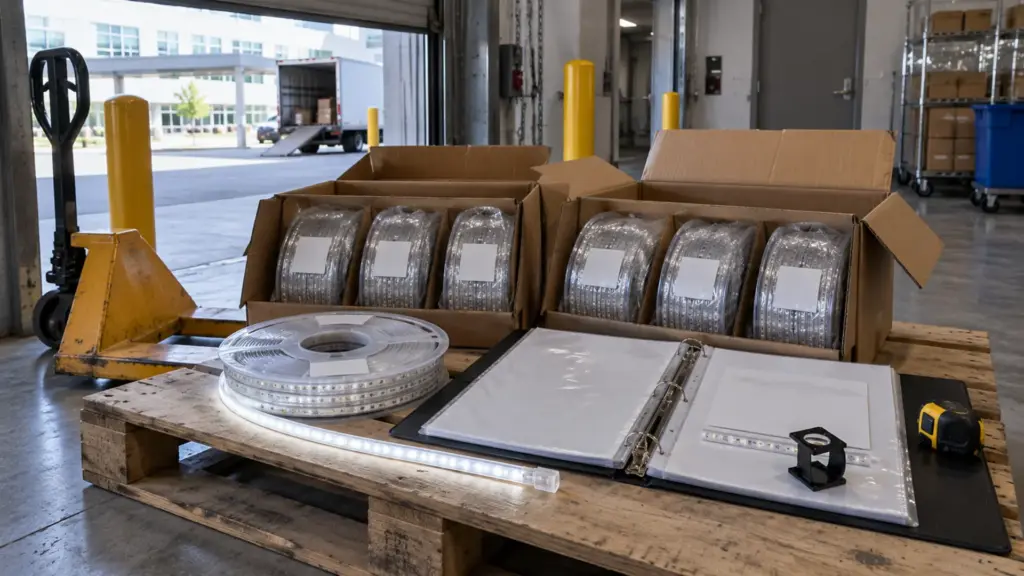
- A sample reel against the approved sample, with the package compared under magnification and the reel label photographed; the quality agreement is where that check becomes a term, and our guide to a supplier quality agreement has the clause.
A typical pair of quotes shows why the asks matter more than the name. Quote A says “Samsung 2835, CRI 90, 3000K” and attaches nothing. Quote B names a part number, attaches that part’s LM-80 at 65 mA and 85 °C, states a 3-step bin and a single lot for the order, and attaches an LM-79 for the strip. Quote A may be the better strip. Nobody can tell from the paper, which is the point. Our SMD LED strip page lists the package type and the CRI tier for each series; ask for the package part number and its LM-80 report on any strip we quote, and on anyone else’s.
When the Brand Matters, and When It Does Not
The brand earns a line on the submittal when a spec depends on something only a documented packager can back.
It matters when the spec calls for CRI 95 or an R9 figure, because the phosphor recipes that reach those numbers are published by a handful of packagers and the claim is checkable against their catalog. It matters when color consistency across floors or phases is specified in SDCM steps, because the bin structure has to exist before anyone can order inside it. It matters when a lifetime or warranty claim leans on LM-80 data, because the report has to exist for that part at that current. It matters when tunable white or dim-to-warm is specified, because the two phosphor channels have to track each other across the range and the packager’s data is where that is shown.
It does not matter on a short decorative run behind an opal cover, where the diffuser hides the dots and the job is replaced before any lumen-maintenance curve bends. It does not matter on a price-driven job where the strip assembler’s own LM-79 and a sample mockup settle the question. And it does not matter at all once the submittal is approved and the delivery shows a different name: that is a substitution, whatever the brand, and our guide to mixing and substituting strip brands covers what it triggers. The price side, where the package and the bin sit among the things that move the cost per foot, is in our guide to what drives LED strip price per foot.
The Short Version
A brand name on a strip datasheet names the packager, sometimes only the die maker, and never the strip. It proves that a datasheet, an LM-80 report and a bin structure exist for the package. It does not prove which bin was bought, what current the strip runs, what board it sits on, whether the reels share a lot, or that the reel contains the part. Ask for the packager part number, the LM-80 report for it at the strip’s operating point, the bin code on the reel label, an LM-79 on the finished strip and a sample against the approved one. The name is where the questions start.