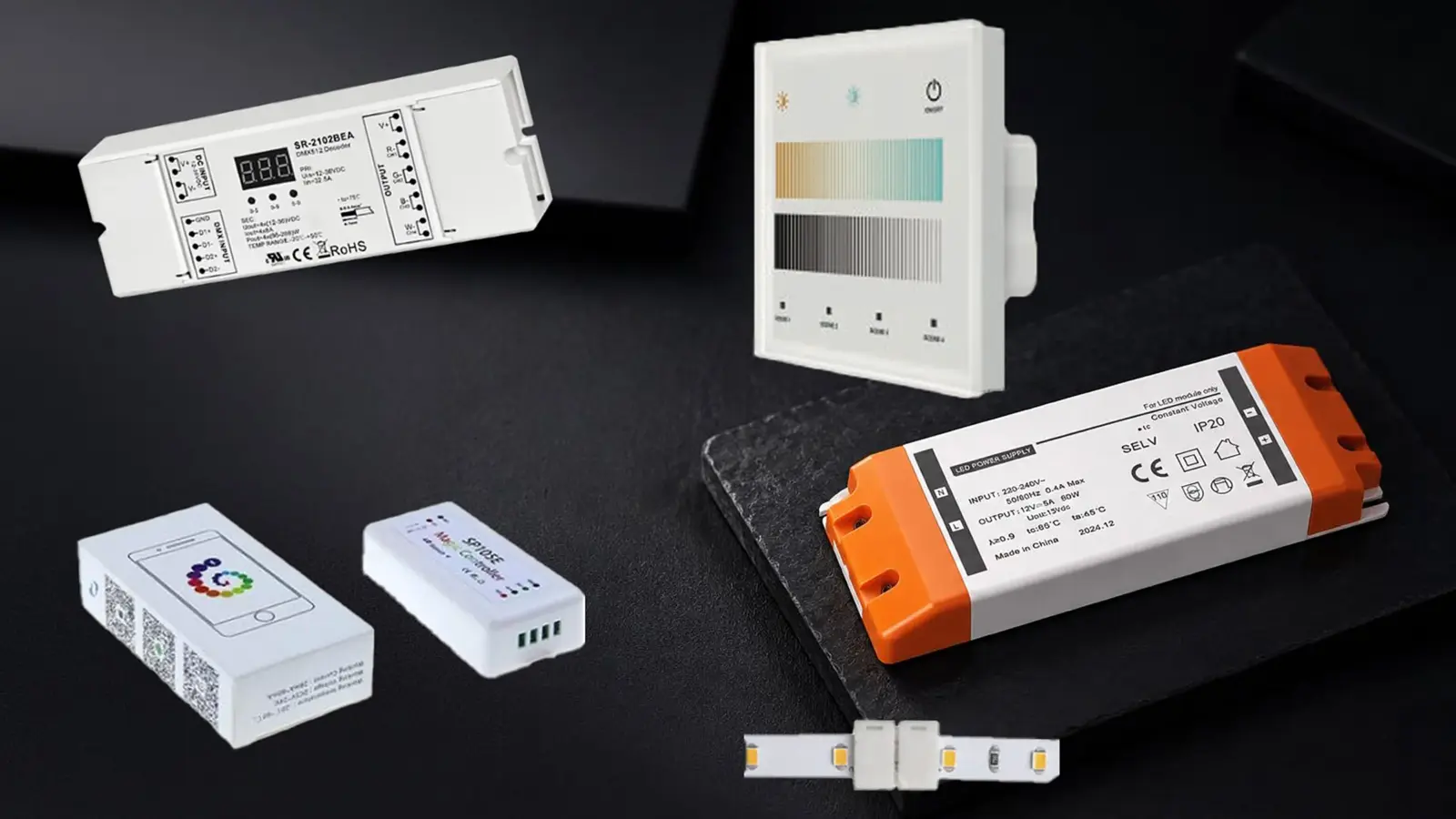

You can mix LED strip, driver and controller brands when three joints match: the electrical joint (voltage, constant voltage or current, load), the control joint (protocol, polarity, channels) and the listing joint (each part used inside its instructions). Color is a fourth check when two strip brands sit side by side.
The strip is listed, the driver is listed, and the inspector still asks for the document that shows they are meant to work together. On another job, a replacement driver from a different maker dims the strip to a flicker that the original never had. Neither is a defect. Both come from treating a lighting system as a set of interchangeable parts. This article shows which parts really are interchangeable, which are not, and what to check before a substitution goes in.
Three Joints Decide It
- 1StripVoltage, CV or CCW/ft, bin
- 2Electrical jointCheckVoltage, 80% load, Class 2
- 3DriverDimming methodInput, output
- 4Control jointCheckProtocol, channels, polarity
- 5ControllerSignal typeChannel count
- 6Listing jointCheckEach part inside its instructions
A strip system has three components and three joints between them:
- Driver to strip: the electrical joint.
- Controller to driver or strip: the control joint.
- The whole set to its listings and instructions: the compliance joint.
Brands do not matter at any joint. Specifications do. Two parts from different makers that match at every joint work together; two parts from the same maker that do not match will not. The sections below go joint by joint.
Electrical: Voltage, CV or CC, and Load
The electrical joint is the easiest to check and the most destructive to get wrong.
- Voltage. A 24V strip needs a 24V driver. According to HitLights’ guide to mixing brands, connecting a 24V supply to a 12V strip can destroy the LEDs at once. The reverse leaves a strip dim and unstable.
- Constant voltage or constant current. Most tape is constant voltage. Some long-run strips are constant current and need a matching constant-current driver. A mismatch either does nothing or overdrives the strip.
- Load. Keep each driver at or below 80 percent of its rating. Our power supply sizing guide shows the calculation.
- Class 2. If the strip’s instructions call for a Class 2 supply, the replacement must be Class 2 too, or the wiring method changes; see Class 2 vs non-Class 2.
- Connectors. Connectors from one maker on another maker’s strip must match the board width and be rated for the current. Ours are rated 5 A; our connector types guide covers the fit.
If every item matches, the brand of the driver does not matter to the strip.
Control: Protocol, Polarity and Channels
The control joint is where mixed systems usually misbehave, because “dimmable” covers several incompatible methods.
- Protocol. A 0-10V control needs a 0-10V driver; a phase dimmer needs a phase-dimmable driver set to the same phase; DALI needs DALI; DMX needs a DMX decoder. According to HitLights, assuming any dimmer works with any dimmable driver is the common mistake. Our guide to 0-10V vs TRIAC vs DALI compares them.
- Channel count. According to Simple Lighting, a controller must match the strip type: single color needs one channel, tunable white two, RGB three, RGBW four. A three-channel controller on an RGBW strip leaves the white chip unused.
- Polarity. Most constant-voltage color strips are common anode, with the positive shared and each color switched on the negative side. A controller built for the other arrangement will not drive the strip correctly.
- Standards that are not quite standard. DMX and DALI are open standards, and parts from different makers usually work together. In forum discussions among lighting technicians, the reported exceptions are makers that implement the standard slightly differently, and addressing that has to be set by hand on each device.
- Low-end behavior. Two drivers on the same protocol can dim differently at the bottom of the range. On a single zone that is a tuning issue; on two zones side by side it shows as two different brightness levels.
The fix for all of these is the same: test the exact pair. Our driver and dimmer compatibility test gives the steps.
Color: Two Brands of 3000K
Mixing strip brands on one run, or side by side, is the one combination that almost always shows. According to HitLights, the actual color temperature of two brands labeled the same can differ, and the difference is visible where they meet.

Color temperature is only half of it. Two strips at the same CCT can differ in tint, toward green or pink, and in color rendering. Our guide to color consistency and SDCM explains how bins are specified. On a repair, the safest replacement is the same model from the same bin; when that is not possible, replace the whole visible run rather than a section of it.
The Listing: What Each Label Covers
This is the joint inspectors ask about.
A listing covers a product as it was evaluated, used according to its instructions. Strip listings and driver listings are separate, and each comes with conditions. A strip’s instructions often state what kind of supply it must be used with, for example a Class 2 power supply of a given voltage. A driver’s listing states its input, output and location ratings.
That leads to three practical rules:
- Two listed products used inside both sets of instructions are generally an acceptable combination: a listed 24V strip whose instructions call for a Class 2 24V supply, powered by a listed Class 2 24V driver.
- A combination outside the instructions is the problem, not the brand. If a strip’s instructions name specific drivers or a supply type, a driver outside that list is the risk. Our guide to UL listings for LED strip explains what each standard covers, and UL vs ETL explains why either mark is acceptable.
- Some products are listed as a system. When a strip and its driver are listed together, swapping the driver takes the installation outside that system listing.
Ask for the listing documents of every part before a substitution, and check that they are real; our guide to verifying a driver’s UL or ETL certification shows how. For our own drivers, the wording on our drivers page is: “Certification coverage varies by model. Certification is held by the original manufacturing partner. Documentation and listing information are available upon request.”
Substitutions After Approval
Most mixed systems are not designed that way. They happen when a specified part is unavailable, a value-engineering round swaps a driver, or a contractor’s usual controller replaces the one on the drawings. Each of those is a substitution, and each is easier to manage before the order than after the install.
- Treat it as a new submittal line. The approved submittal described a set of parts that work together. A new driver or controller changes the set, so send its datasheet and listing with a note on which joint it touches.
- Check all three joints, not just the one that changed. A driver swap changes the electrical joint and usually the control joint as well, because the new driver’s dimming curve is different.
- Keep the strip if you can. Of the three parts, the strip is the one people see. Swapping a driver or a controller is invisible when it works; swapping part of the strip is visible forever.
- Test the new pair on a mockup or a single zone before the rest of the order is released.
Our article on or-equal substitutions and value engineering covers the review in more detail, including what cannot change without the designer’s approval.
Replacing One Part on a Service Call
Years after handover, a driver fails and the original model is no longer made. The replacement will almost certainly be a different design and often a different brand. A short checklist keeps it from creating a new problem:
- Read the old driver’s label before removing it: input, output voltage, wattage, dimming method and Class 2 marking.
- Measure the load it was carrying, or calculate it from the strip’s W/ft and length, so the replacement sits at or below 80 percent.
- Match the dimming method and phase exactly. A replacement that dims differently is the most common complaint after a service call.
- Check the location rating: dry, damp or wet, and enclosed or not.
- Compare the low end with the neighboring zones after the swap, and set the trim so they match.
- Record the new model on the panel schedule or the driver label, so the next technician knows what is there.
If the run itself failed, the readings in our LED driver troubleshooting guide tell you whether the driver or the strip is at fault before any part is ordered.
When Mixing Is Fine and When It Is Not
| Combination | Usually fine? | Condition |
|---|---|---|
| Listed strip + listed Class 2 driver of another brand | Yes | Voltage matches and the strip’s instructions allow that supply type |
| Strip + 0-10V driver + another brand’s 0-10V control | Yes | Same sink or source convention; tested low end |
| Strip + phase-dimmable driver + another brand’s phase dimmer | Often | Same phase; above the dimmer’s minimum load; tested |
| Two brands of strip on one visible run | No | Colors differ; replace the whole run |
| RGBW strip + three-channel controller | No | Channel count must match |
| Strip listed as a system with its driver + a different driver | No | Outside the system listing |
| DMX decoder of one brand + DMX console of another | Usually | Addresses set; line terminated |
FAQ
Can I use any LED driver with my LED strip?
Any driver that matches the strip’s voltage, its constant-voltage or constant-current design, its load at 80 percent, the dimming method and the supply type its instructions call for. Brand alone does not decide it.
Does using a different brand of driver void the UL listing?
Not by itself. Each listed part stays listed when used inside its instructions. The risk is a combination outside the strip’s instructions, or replacing a driver in a product listed as a system. Check the documents and ask the AHJ when in doubt.
Can you mix LED strip brands on one run?
You can connect them electrically if they match, but the colors will usually differ where they meet. On visible work, keep one model from one bin per run.
Are LED controllers universal?
No. A controller must match the protocol, the channel count and the polarity of the strip or driver. Open protocols such as DMX and DALI travel between brands better than proprietary RF systems.
What to Verify With the AHJ
- Listing documents for each part of a mixed system, and that each is used inside its instructions.
- Whether any strip on the job is listed as a system with a specific driver.
- The Class 2 status of every driver feeding strip whose instructions require it.
- Whether a substitution after approval needs a resubmittal.
- For the commissioning agent: the tested pair of each control and driver, recorded with the low-end setting.