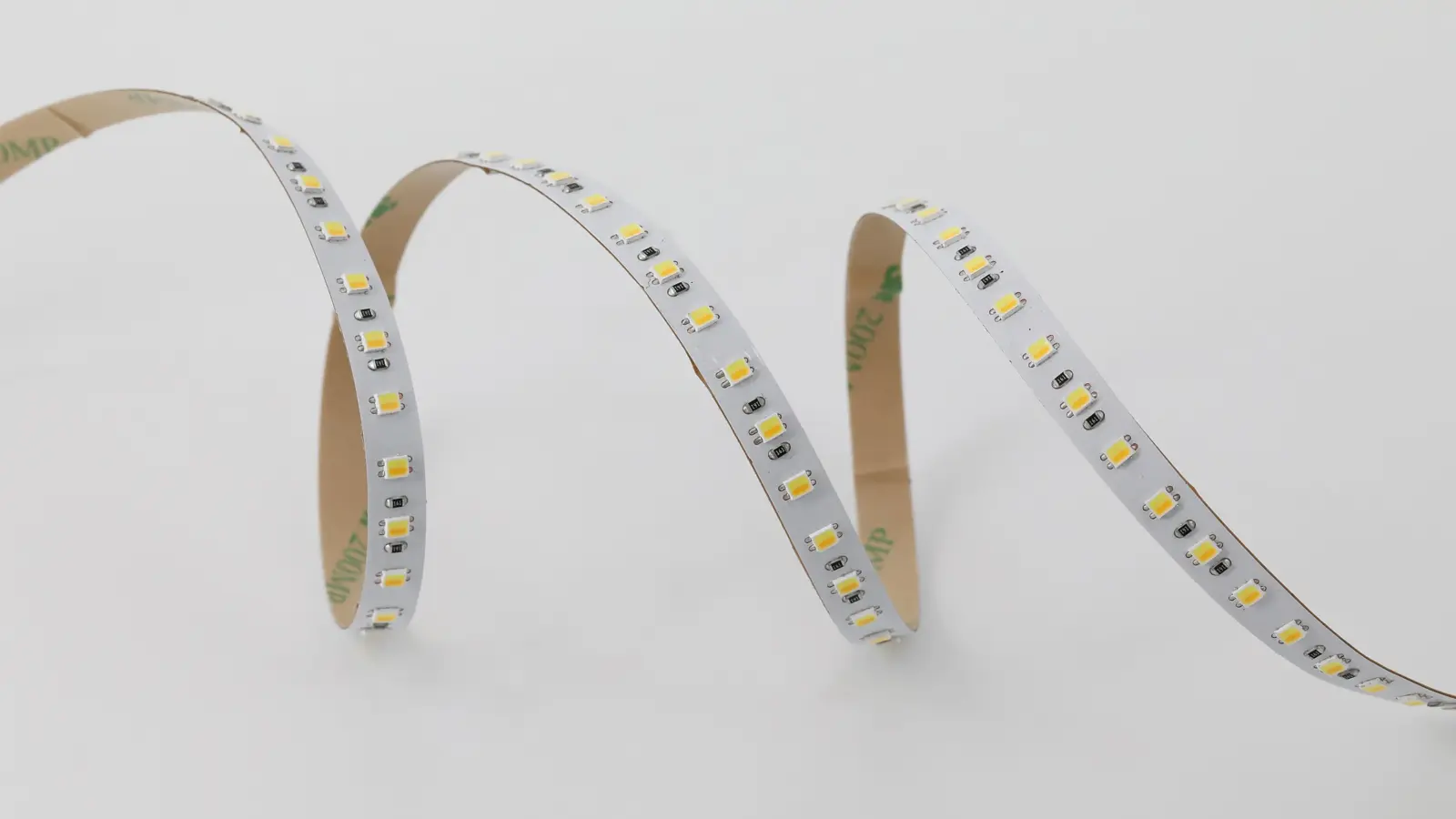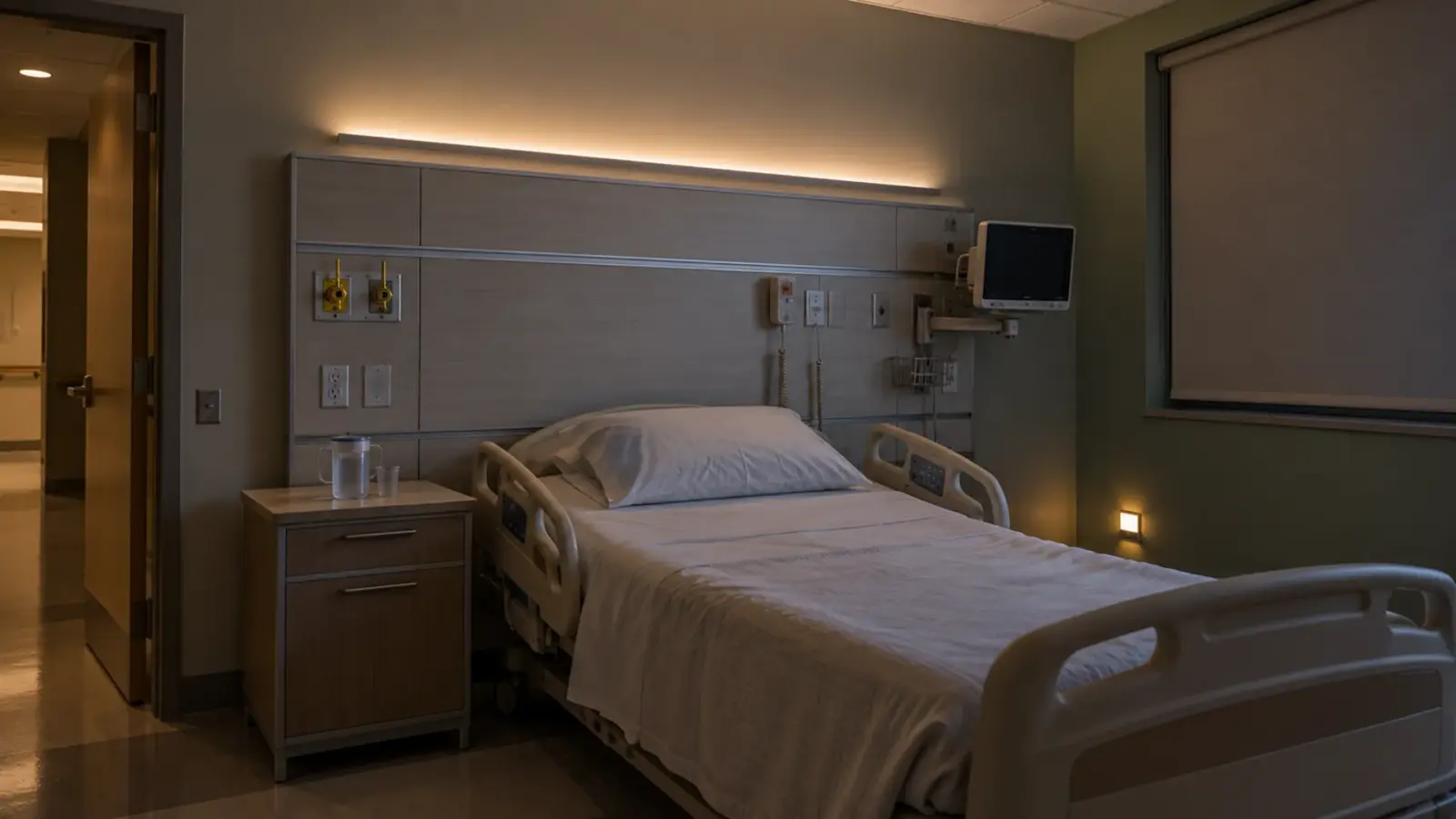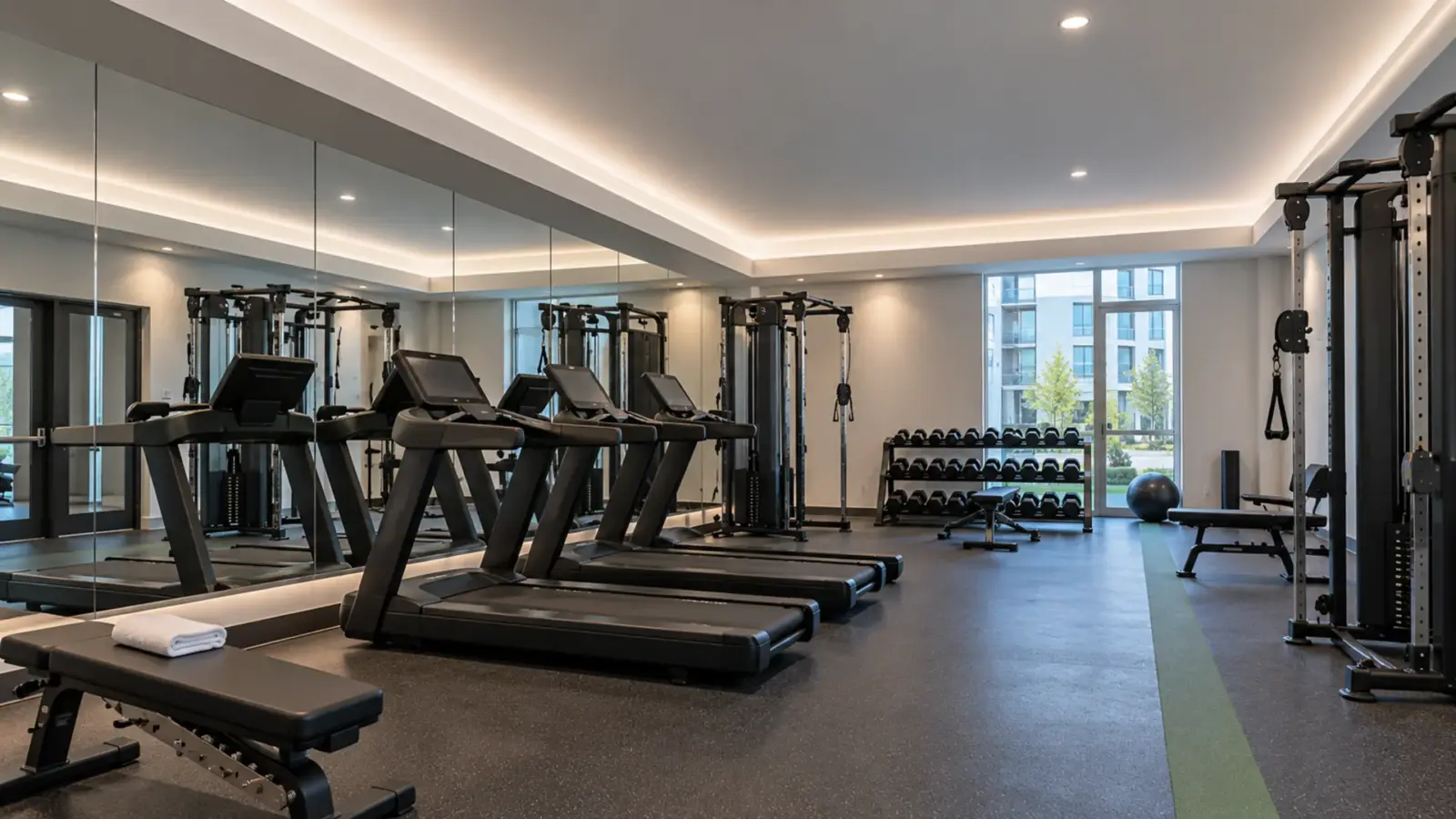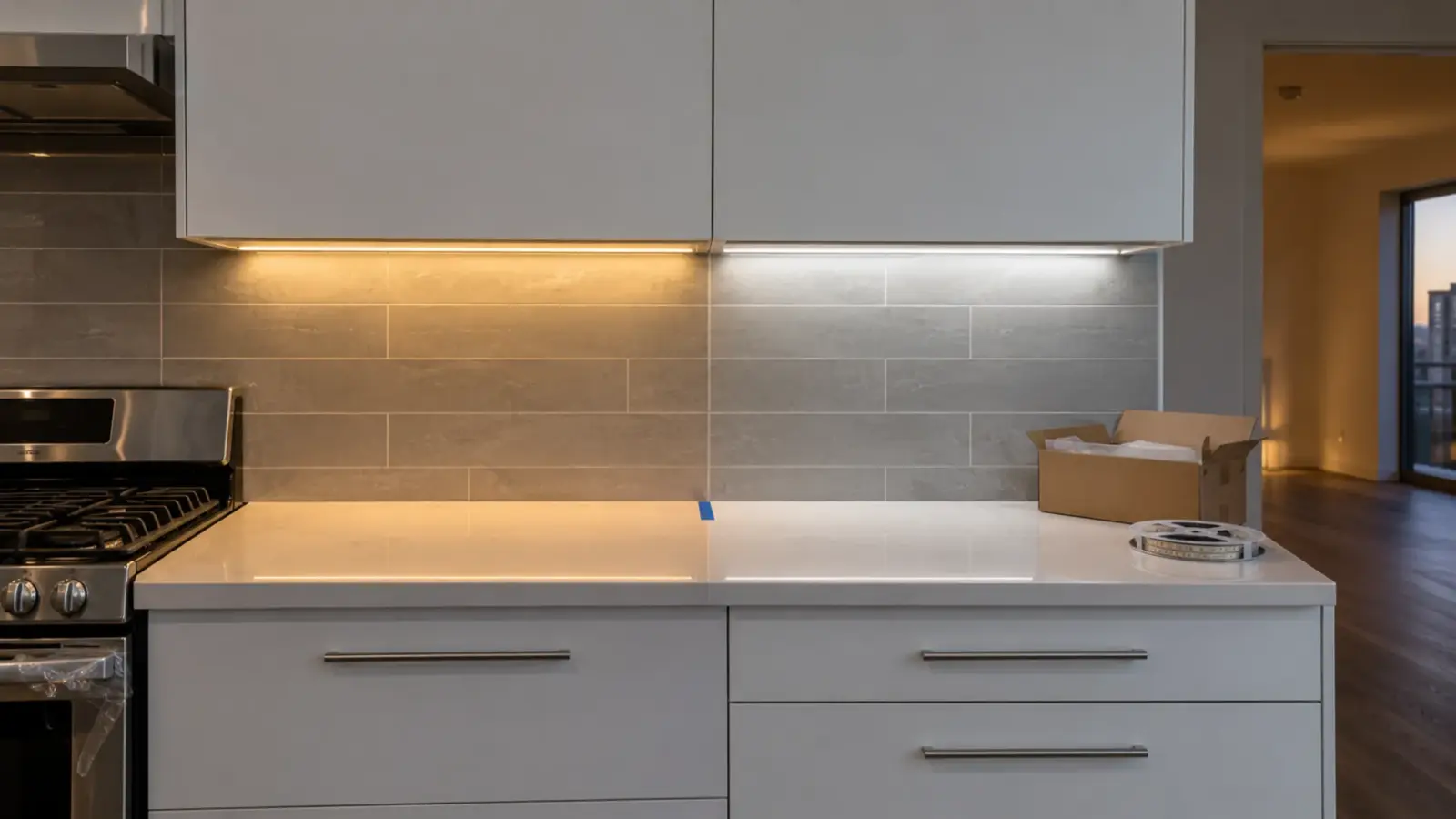
3000K LED strip belongs where people dwell, 4000K where they work, and on a mixed-use building that is a line through the floors, not one Kelvin for the whole schedule. Draw it at thresholds the eye accepts, bend it only at the unit kitchen and vanity, and order the two whites as two line items so the reels never mix.
The drawing that prompts this article: ground floor grocery, second floor dental office, floors three to six apartments, and one schedule line, “LED strip, 3500K”, for every run. It is the most common 3000K vs 4000K mistake we see.
The Wrong Fix: One Kelvin for the Whole Building
The first wrong fix is 3500K everywhere. Eight of the eleven vendor guides we scanned bring 3500K into the comparison, and on paper it is the middle answer. In the building it belongs to nobody: beside a resident’s 2700K lamps a 3500K cove reads cool and slightly green; beside the grocery tenant’s 4000K panels a 3500K shelf strip reads yellow. It also narrows the product choice. Of our families, only the CSP LED strip page lists 3500K, as an available option beside the common 2700, 3000, 4000 and 6500K points; standard COB rows are listed at 2700–6000K or 2700–6500K, two narrow COB builds start at 3000K, standard SMD rows run 2700–6500K, and our full-spectrum SMD series comes in exactly 2700K, 3000K and 4000K. A 3500K spec forces one family onto every run, or invites a substitution at the first shortage.
The second wrong fix is 4000K everywhere because “it is a commercial building”. The retail and office floors agree. The apartment floors do not: a 4000K bedroom cove reads like a workplace, and the unit lamp schedule is almost always 2700K or 3000K. The complaint arrives after move-in, with the strip behind drywall. The right fix is three steps: zone by what people do, change the Kelvin only at a threshold, and order the two whites as two products.
What 1,000 Kelvin Changes, and What It Does Not
| 3000K | 4000K | |
|---|---|---|
| Looks | Warm white, clean, a trace of amber | Neutral white, no cast |
| Flatters | Wood, warm stone, upholstery, skin, food at a table | White laminate, stainless, print, screens, produce under task light |
| Reads as | Dwelling, evening | Working, daytime |
| Where we list it | Standard COB such as UT-C384-8 (2700–6500K, Ra≥90); full-spectrum SMD UT-SFS80-8 and UT-SFS160-8 (2700K / 3000K / 4000K) | The same models and families |
| Watts per foot, output | Listed per model, not per Kelvin | Listed per model, not per Kelvin |
| Driver, cut interval, channel | Unchanged | Unchanged |
A thousand Kelvin changes the color of the light and what it flatters, not output, power, the driver or the channel. The same model row of COB LED strip at 3000K and at 4000K draws the same watts per foot, and output is listed per model, not per Kelvin, so pick output from the model row, never from the Kelvin. A 4000K run does look brighter than a 3000K run of the same model; the lumens are the same, as Signlite’s comparison also notes, and the brighter look is contrast against warmer surroundings.
CRI is its own column too: both Kelvins from the same family carry the same Ra≥90, so a counter that needs color accuracy is helped by the CRI figure, not by going cooler. And two reels at the same nominal Kelvin can still differ, because 3000K names a tolerance window; our guide to why the second reel of LED strip does not match the first covers the window and how to order inside it.
The Line: Dwelling Floors, Working Floors
Where people linger, start at 3000K; where they finish a task, start at 4000K. On a mixed-use project that rule draws a line through the building, floor by floor and tenant against shared space. A typical six-floor building:
| Zone | Strip CCT | Why |
|---|---|---|
| Ground, grocery tenant sales floor and shelf edges | 4000K | Matches the tenant’s 4000K ceiling; produce and print read true |
| Ground, restaurant tenant | 2700K, or 3000K if it trades by day | A 2700K vs 3000K call, linked below |
| Ground, shared lobby and mail room | 3000K | People wait here; a leasing office behind a door can be 4000K |
| Second floor, dental treatment rooms and staff corridor | 4000K | Clinical work; 5000K at the chair is a 4000K vs 5000K call |
| Second floor, dental waiting room | 4000K if open to the corridor, 3000K if a closed room | Follow the ceiling light it shares a sightline with |
| Floors three to six, unit bedroom and living coves | 3000K, or 2700K where the unit lamps are 2700K | Dwelling; match the lamp schedule within one step |
| Floors three to six, unit kitchen under-cabinet | 3000K, with the exceptions below | The most argued line in the building |
| Floors three to six, unit vanity | 3000K or 4000K by the vanity ceiling light | Skin against task, below |
| Floors three to six, corridors, stair hall, amenity lounge | 3000K | Residential floor; neighbors are unit doors and 3000K sconces |
| Amenity gym, laundry, trash room, back of house, parking | 4000K, 5000K in the gym and parking | Working; the gym is a 4000K vs 5000K call |
Three cells are other decisions: the restaurant is covered in our guide to 2700K or 3000K strip for hotels, restaurants and apartments; the gym and the dental chair in where 5000K strip beats 4000K and where it backfires. The rest of the table is this article’s line, and two rows on it are argued on every project.

Unit Kitchens and Vanities: Where the Line Bends
The apartment kitchen is where 3000K vs 4000K is argued the longest, because both sides have a point: the counter is a task surface, and the kitchen opens to a living room at 2700K or 3000K. Three rules settle it. First, match the fixture the unit standard already specifies for the kitchen ceiling, within one step: a 3000K lamp schedule means 3000K strip; where the general contractor is installing 4000K flat panels in the kitchens, as some student-housing and senior-living standards do, the strip is 4000K and the living-room cove stays at 3000K with the change at the soffit step between them. Second, read the counter: white quartz or white laminate shows 3000K as a touch yellow and is the one finish where 4000K under-cabinet strip earns its place under a 3000K ceiling; wood, warm stone and dark counters show 4000K as grey. Third, the kitchen is used at night, dimmed, covered below. Our pick for most multifamily kitchens is 3000K at Ra≥90 or better; the full-spectrum series, UT-SFS80-8 and UT-SFS160-8 at 2700K, 3000K or 4000K with a fidelity of Rf 94–95, is what we quote when the counter and the food on it have to read true at either Kelvin.
The vanity mirror is the second bend. A 3000K backlit mirror flatters skin and suits a hospitality-grade unit or a condo; a 4000K mirror suits senior living and student housing, where reading a label matters and the bathroom ceiling light is usually 4000K already. The rule is the kitchen rule: mirror strip and vanity ceiling light within one step of each other. A 4000K mirror under 2700K downlights is the pairing residents photograph for the property manager. Where one bathroom has to do both, a tunable mirror strip on a wall control is the honest answer; our guide to tunable white strip in schools and healthcare covers the senior-living case.
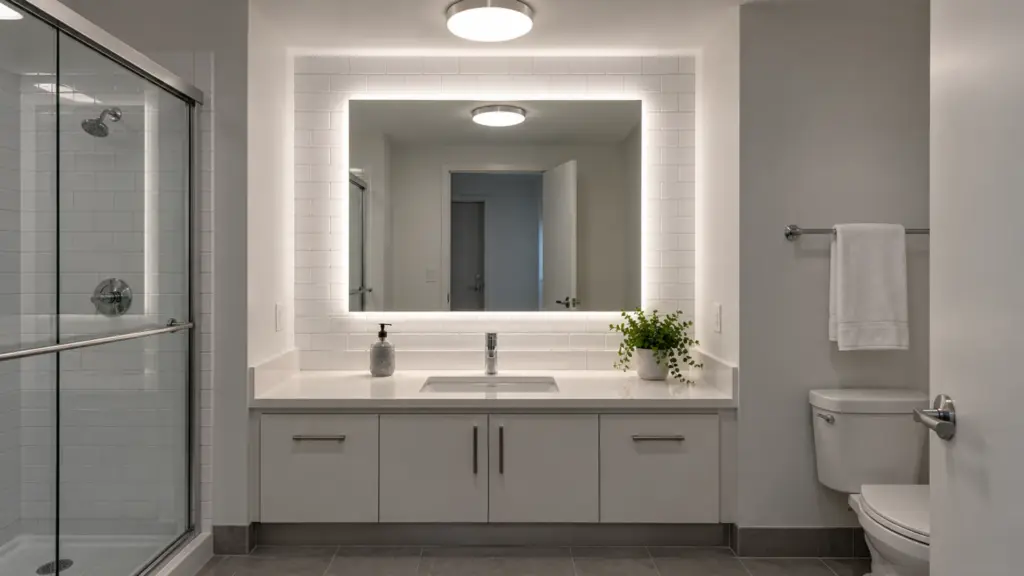
For any single room not on the table, the one-step rule and the three gates in our guide to picking LED strip color temperature by sightline, not by room give the answer.
Shared Spaces: Lobby, Elevator Lobbies, Stair Halls
The line has to change somewhere. Change the Kelvin at a threshold: a door, a change of ceiling height, a change of floor finish, the elevator opening. Never change it along one continuous surface, and never in a view that holds both whites side by side at the same distance.
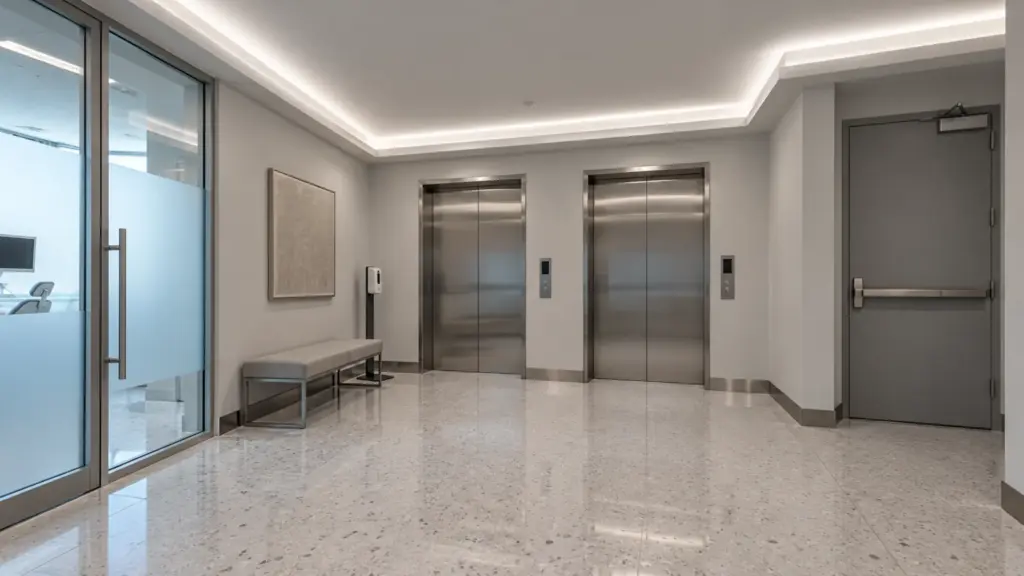
The ground-floor lobby is dwelling space even though office visitors cross it; people wait there, so it takes 3000K. A leasing office is a 4000K zone only behind its own door; an open leasing counter stays at 3000K and the staff get a 4000K task lamp.
The elevator lobby on each floor takes the Kelvin of the floor it serves: 4000K on the dental floor, 3000K on the residential floors. The cab is its own light and acts as the threshold, so a rider never sees the two coves at once. This fails only at a glass-walled elevator or an open stair that shows two floors in one view; there, the cove on the lower floor stops short of the opening.
The stair hall changes at the fire-door landing between the office floor and the first residential floor: door closed, each side sees one white. A residential corridor stays at 3000K from end to end; one that runs 3000K past the units and 4000K past the laundry room is the continuous-surface mistake, and the laundry room gets its own 4000K fixture behind its door.
At 10% Output
Nine of the eleven guides we scanned say “add a dimmer”; none says what the strip does when dimmed, and that changes the 3000K vs 4000K call for any space lit at night.
A fixed-CCT LED strip keeps its Kelvin as it dims: a 4000K strip at 10% is still 4000K. An incandescent lamp warmed as it dimmed, and that is what a resident’s eye expects at 2 a.m. in a corridor: low light that is also warm. A 4000K cove at 10% reads grey, and residents call it cold even where the daytime level was approved; a 3000K cove at 10% is acceptable; a 2700K cove at 10% is what people mean by cozy.
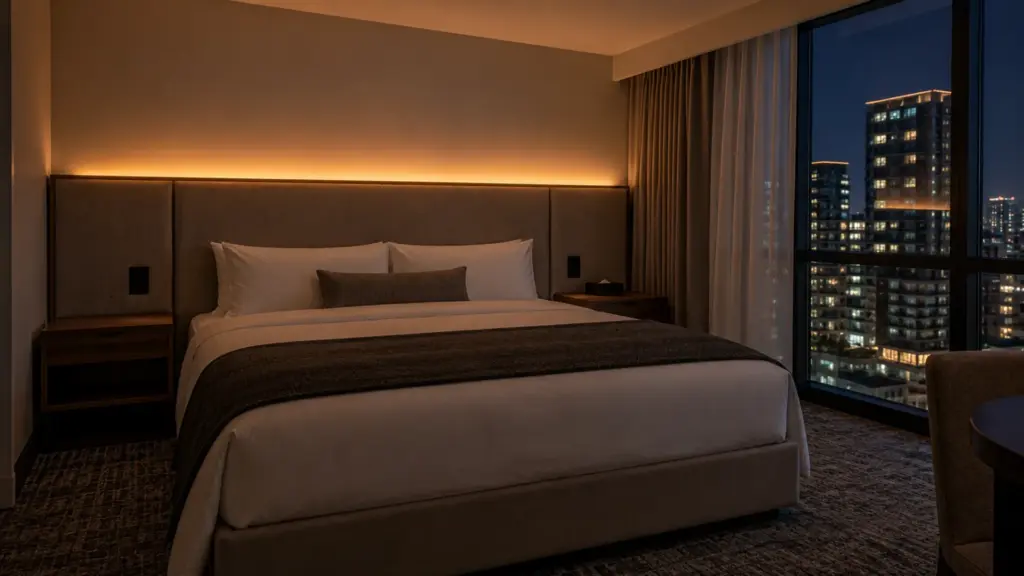
So any residential circulation space that dims at night takes 3000K at the warmest, never 4000K. And the spaces that must be 4000K by day and dimmed at night, the dental waiting room, the senior-living corridor, the amenity lounge that hosts a morning class and an evening gathering, are a product decision, not a Kelvin decision. Our tunable white LED strip runs 2700–6500K from one strip on a tunable controller, in SMD as UT-T168-10 and in dot-free COB as UT-T640-10; UT-T240-10-OF steps through preset whites from a wall switch without a separate controller; and the dim-to-warm models, UT-T672-10-DTW in COB and UT-T120-8-DTW in SMD, dim from 3000K toward 1800K as the level drops, which gives a 3000K corridor the incandescent behavior residents expect at night. The control side is in our guides to DALI DT8 tunable white strip and dim-to-warm LED strip; tunable strip needs a CCT controller and dim-to-warm strip a single-channel dimmer, so each is a separate schedule line.
Ordering Two Whites on One Project
The schedule can be right and the building still wrong when the two whites are ordered as one product. A single line reading “UT-C384-8, 3000K/4000K per plan” is filled as one Kelvin; the plan note never reaches the person packing reels. The ordering side has six parts.
- Two line items. One per Kelvin, each with its own model designation, quantity and zone list; tunable or dim-to-warm strip is a third line with its controller.
- Quantities by zone, from the cut schedule. Count the 3000K feet and the 4000K feet room by room; our guide to ordering strip by room with a cut schedule gives the format a factory can fill.
- One lot per Kelvin. Ask that all 3000K strip ship from one production lot and all 4000K from one, so no two reels in one sightline come from different bins.
- Reel labels and cartons. Ask for the Kelvin and the lot on every reel label, and keep the two Kelvins in separate cartons on site, marked at the carton; a 3000K reel on the dental floor is found at the walkthrough, above a closed ceiling. Our guide to staging LED strip on a jobsite covers storage.
- One submittal sheet per Kelvin. Two entries, each with its zone list, so the reviewer approves the line and not only the family.
- The driver does not change; the controller might. Both Kelvins draw the same watts per foot, so the driver schedule is unchanged; tunable runs need a CCT controller and dim-to-warm runs a single-channel dimmer.
Whether floors three to six can still move from 4000K to 3000K after the order depends on the stage: before release, yes, at a recalculated order; after release, a Kelvin swap strands built reels, as our guide to what a late CCT, length or finish change costs after release shows. The cheap time to settle the line is the submittal.
Mockup: Two Runs, One Wall
Before the order, mock both whites where they will live: a 3 ft (1 m) run of each Kelvin, in the channel and diffuser specified, on the actual finish, with the room’s other fixtures on. Check the three things a table cannot settle: the strip against the ceiling fixture it shares a sightline with, against the counter or wall finish, and at 10% with the room otherwise dark. Photograph each at the same exposure; phone cameras exaggerate the difference.
The mockup is also where the zone schedule gets signed: walk the owner’s representative through the table with both samples in hand and get it initialed before the submittal closes. Our guide to LED lighting mockup approval lists what else to check before signing.
FAQ
Is 4000K LED strip brighter than 3000K?
No. On the same model row both carry the same watts per foot and the same listed output; a 4000K run looks brighter in a warm room because it contrasts with its surroundings. Choose output from the lm/ft column and the Kelvin from the zone.
Can 3000K and 4000K strip run on the same driver?
Yes, as separate runs. The Kelvin does not change voltage or watts per foot, so one driver can feed a 3000K run in one room and a 4000K run in the next if the load allows. Never splice the two into one continuous run.
Is 3500K a good compromise between 3000K and 4000K?
Rarely. It reads cool beside 2700K lamps and yellow beside 4000K panels, and the CSP family is the only one of ours that lists it. Specify 3500K only where every other fixture in the sightline is already 3500K.
Should apartment under-cabinet strip be 3000K or 4000K?
3000K in most multifamily kitchens, matched within one step to the unit’s ceiling fixture. Go to 4000K only when the kitchen ceiling light is 4000K or the counters are white and the owner wants the task look, changing back to 3000K at the soffit step.
Decision Rule
Zone the building by what people do: 3000K where they dwell, 4000K where they work. Change the Kelvin only at a threshold, never along one surface, and give any space lit at night a warm point or dim-to-warm strip rather than 4000K. Order the two whites as two line items, one lot each, labeled on reel and carton, and get the zone schedule signed at the mockup.
Unitop Lighting supplies COB, SMD and tunable white strip for multifamily, hospitality and commercial projects across the US. Send the floor plans with the zone list and the tenant lighting schedules, and we return the strip package split by Kelvin, with model, lot and controller per zone, before anything is quoted: request a quote.