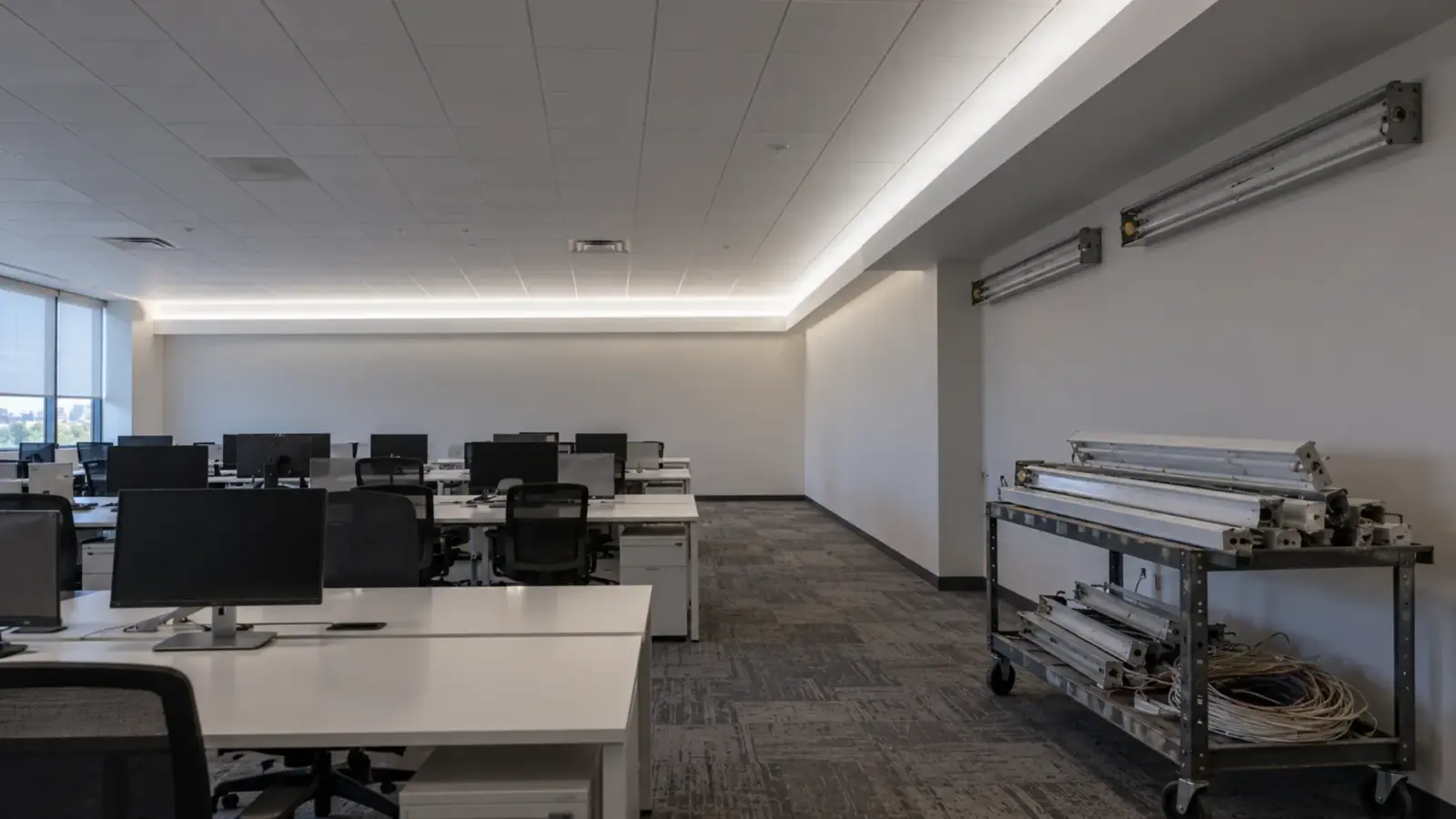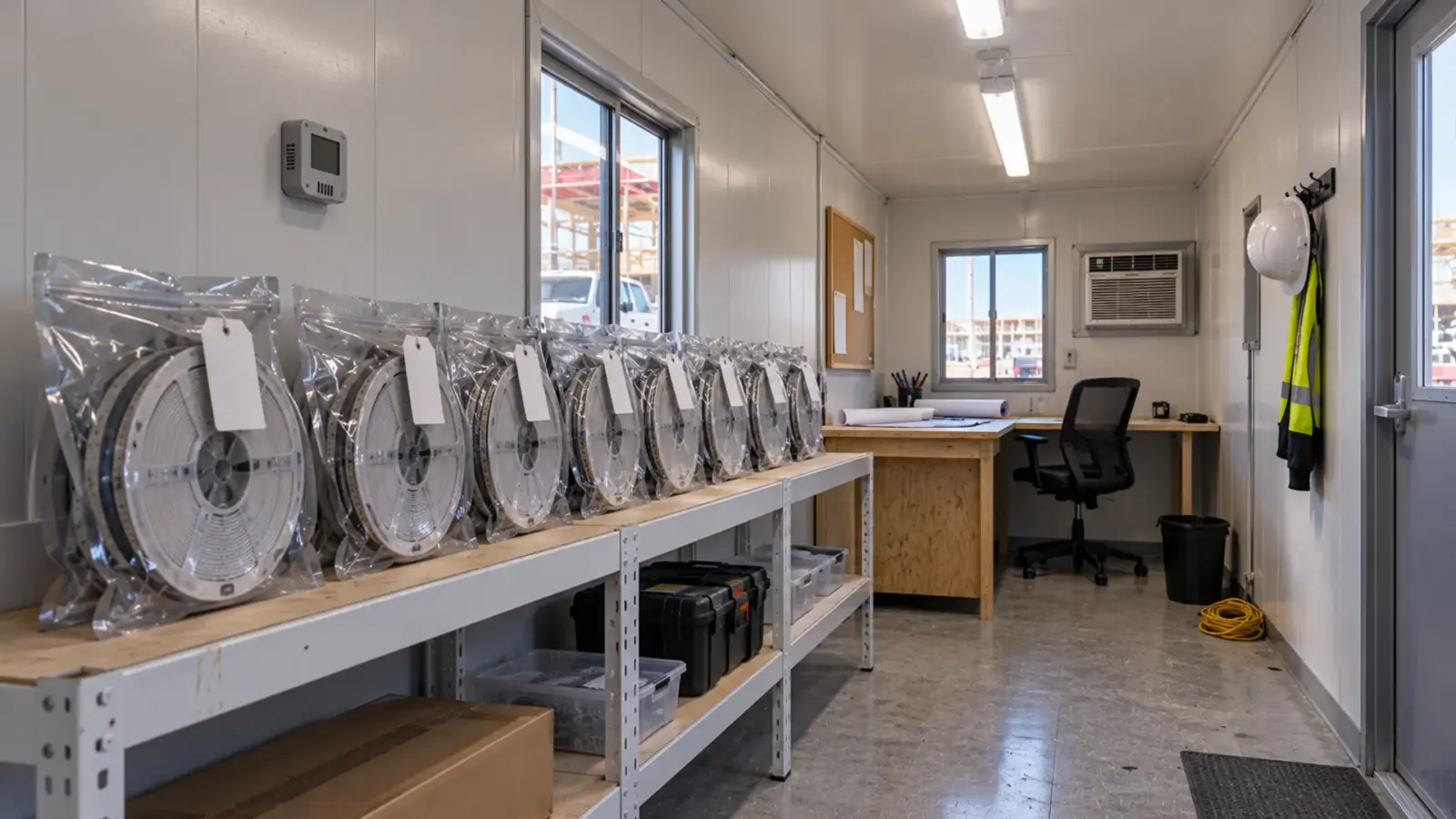
A pallet of strip sits in a jobsite trailer for six weeks before the cove goes in. Keep it cool and dry in its original reels and bags, label each reel by area and lot, never power a reel on the roll, and ask the supplier for the storage limits of the exact model.
Where Strip Waits, and for How Long
Strip waits twice. It sits on the dock for a day while someone counts cartons, and it sits on site for weeks or months until the area is ready. Our receiving inspection guide covers the dock, says to store it by area and warns against trailers that bake in the sun. This guide covers the second wait, where the reels spend most of their time off the shelf. The common places for it are the dock, a hallway on the floor it serves and the job trailer, and in our experience each fails differently: the dock is open to traffic and weather, the hallway collects drywall dust and foot traffic, and an uninsulated trailer cooks. Pick the place before the pallet arrives, not after it has been moved twice. In our reading, a hold of days needs little, a hold of weeks needs a plan, and a hold of months needs a different place from the trailer, preferably a conditioned room on the floor the strip serves.
Our product pages do not list storage figures for individual models. For this class of strip we use typical values, rounded to the cautious side: storage between 32°F and 104°F (0 to 40 °C), relative humidity up to 70 percent without condensation, and the strip kept in its sealed bag.* Other makers’ datasheets and references below show how wide the range can run. For the model on your job, confirm its storage range at quote.
*Typical value for this class of strip, rounded down. Confirm the model datasheet figure with your quote.
Heat: The Trailer Is Not a Climate
In our experience a job trailer or a steel container is a common place to put a pallet, and an uninsulated one is not a climate. The Container Handbook says that “daily overheating on sunny summer days amounts on average to 20°C even in temperate latitudes,” and that cargo surfaces in the upper part of a container may see more than 50°C. Its four radiation classes average between 2 and 17°C of overheating, so 20°C is the sunny-summer figure, not an every-day one. American Trailer Rentals measured the interior of a beige container at 122.9°F on a 92°F day in Florida, about 31°F above the air. Those are steel shipping containers, not every site trailer. An insulated, air-conditioned office trailer is a different case, as our cover photo shows; an uninsulated metal box in the sun is the case to worry about.
Set that against two storage limits: our typical 104°F (40 °C) from above, and one maker’s datasheet, HDL’s LSP565, which gives 0 °C to 60 °C, or 32°F to 140°F, and an operating range of -20 °C to 45 °C. The arithmetic is a budget:
| Quantity | Value |
|---|---|
| Our typical storage limit* | 104°F (40 °C) |
| One maker’s storage maximum (HDL) | 140°F (60 °C) |
| Steel container rise, average on sunny summer days | 36°F (20 °C) |
| Steel container rise, Florida measurement | 31°F (122.9 minus 92) |
| Ambient at which the interior reaches 104°F | 68°F (104 minus 36) or 73°F (104 minus 31) |
| Ambient at which the interior reaches 140°F | 104°F (140 minus 36) or 109°F (140 minus 31) |
*Typical value for this class of strip, rounded down. Confirm the model datasheet figure with your quote.
A limit is a maximum, not a target: 3M’s tape range tops out at 80°F, and an archived copy of HitLights’ storage article says storage is ideally below 77°F (25°C). Try three summer days with the same arithmetic, adding the two rises to the ambient.
| Hottest day of the hold | Steel container with +31°F | With +36°F | Against 104°F (ours) | Against 140°F (HDL) |
|---|---|---|---|---|
| 88°F | 119°F | 124°F | Over | Under |
| 98°F | 129°F | 134°F | Over | Under, little margin |
| 108°F | 139°F | 144°F | Over | At or over |
On our typical limit an uninsulated steel box in summer sun is outside the range on any day above about 70°F, and it is only on a maker’s 140°F maximum that a 98°F day looks safe. These are averages applied to a steel container; American Trailer Rentals found the surface of a red container nine degrees above a beige one’s, so in our reading a darker box will run hotter.
The rule that follows is ours: for any hold longer than a few days in summer, use a conditioned room, a site office or a supplier’s warehouse, and use the trailer only for days. In our view that costs less than a replaced reel.
Moisture: Slab, Sweat and Sealed Bags
The HDL datasheet asks for strip to be stored “in a dry and sealed environment,” says the storage period “should not be too long,” and says to “open the seal before use.” Its use note limits non-waterproof strip in use to indoor installations at no more than 70 percent relative humidity, which is a use condition and not a storage figure. In our practice, keep strip in its sealed bag until the day it is mounted, off the slab on a shelf or a pallet, and away from a wall that sweats. A bag that shows moisture inside, or a reel whose pads look dull or spotted, is in our practice a reason to light that reel on the floor before anything else is done with it.
In our view, opening a bag in a damp room early, to count or check, undoes the packaging. Open one reel for the bench test on the day, and reseal what is left. In our practice, keep the bags off a floor that collects drywall dust, because dust on strip pads is a problem for the connector and the cut end. Condensation after a cold night is a separate problem; a cold-weather install guide covers it.
Reel Handling: Original Reels, No Power on the Roll
Keep each strip on its original reel and in its original bag until it is mounted. HitLights’ storage article, read in an archived copy, recommends reusing the original reel, coiling loosely in a natural spiral if you must coil, and a minimum bend radius of 2 inches. We found no stacking limit for cartons in any source, so in our practice, stand reels upright on their edges with space between them, do not stack beyond what the carton’s own marking allows, and keep them where a forklift tine cannot reach.
In our practice, handle a reel by its flanges and its bag, not by its leads or its cut end, and put it back in the bag after any check. Do not power a reel on the roll. Wired4Signs says to “never power on any strip while it is still coiled on its roll,” because doing so “will kill the strip in seconds.” Our installation guide points the same way in its bench test: uncoil the strip, because coiled strip at full output holds its own heat. Our tool checklist covers lighting each reel on the floor before it goes up.
Neon reels are long. A 164 ft (50 m) reel is a supply length, as our reel guide explains; stage it the same way, in its original packaging.
The Adhesive Has a Shelf Life Too
The tape on the back of the strip is a product with its own date. 3M’s datasheet for a typical acrylic transfer tape, 9453LE with 300LSE adhesive, says to store it at 60°F to 80°F and 40 to 60 percent relative humidity in the original packaging, out of direct sunlight, and to use it within 24 months of manufacture. Its ideal application range is 70°F to 100°F, and initial application below 50°F is not recommended.
Our pages do not name the adhesive on each strip, so that datasheet is an example, not our spec. The point holds in our reading: tape that sat hot for six weeks and then goes onto a cold wall is asked to do more than it was stored for. 3M’s sheet adds that bond strength builds as a function of time and temperature, and we suggest a test piece pressed on the real surface at install temperature, which tells you more than the reel’s age does. Use clips or a channel where the install allows, and ask the supplier how long the tape on your model is good for.
Labels: Reel, Area, Lot
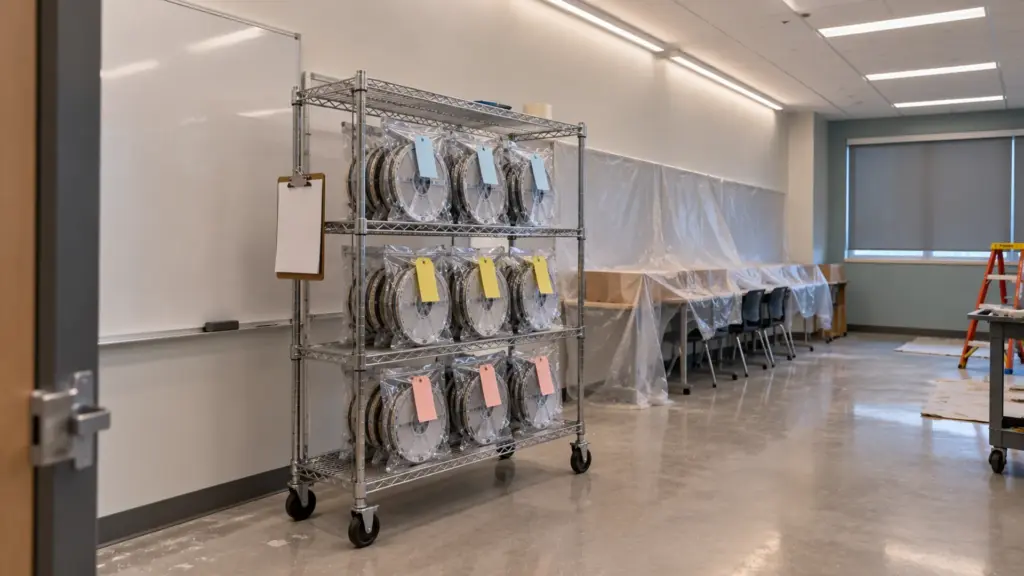
In our practice, label every reel when it is put into staging, not when it is pulled. The label carries the area it is for, the run or room it will be cut for, the model and the lot. Our receiving guide keeps one approved sample as the reference, and a label with the area on it lets a foreman pull the right reel for the right floor without opening three bags.
Keep a staging log: the date the reel went in, where it is and the dates it came out. If a reel fails after install, the log shows how long it waited and where.
| Label field | Example |
|---|---|
| Area | Floor 7 east corridor |
| Run | Cove C, long wall |
| Model | The exact model number from the submittal |
| Lot | The lot or batch code on the reel label |
| In / out | Date in, date pulled |
Spare reels belong in the log too. Keep an unopened spare sealed in the same lot as the run it backs up, because a spare from another lot may not match the color of the run it replaces.
A Staging Plan for Six Weeks
Compare the places a pallet can wait. The columns are our reading, and the trailer row applies to an uninsulated trailer.
| Place | Heat | Moisture | Handling | Use |
|---|---|---|---|---|
| Uninsulated trailer or container | Highest; steel containers measured 31 to 36°F above the air in the sun | Condensation and a damp slab | Open to traffic | Short holds in mild weather |
| Site office or conditioned room | Near room temperature | Low | Controlled | Preferred for a long hold |
| Finished room on the floor it serves | Near room temperature | Low | The crew is nearby | Good for the week before install |
| Supplier or contractor warehouse | Depends on the building | Depends | Controlled, off site | Releases by floor |
For a six-week hold our pick is the conditioned room or the supplier’s warehouse in the table; the trailer is for a few days. Shorten the hold as well as the heat: our release timing guide covers releasing strip by floor, so a reel arrives when the area is ready and does not wait six weeks in the first place.
Before the Reels Leave Staging
- The strip has spent the hold in its original reel and sealed bag.
- The staging place stayed inside the storage range for the exact model, and the log shows it.
- No reel was powered on the roll.
- Each reel is labeled by area, run and lot.
- The tape’s age is within the maker’s limit, or clips or a channel carry the strip.
- One reel from each lot is lit on the floor before it goes up.
The strips discussed here are on our COB LED strip and SMD LED strip pages.