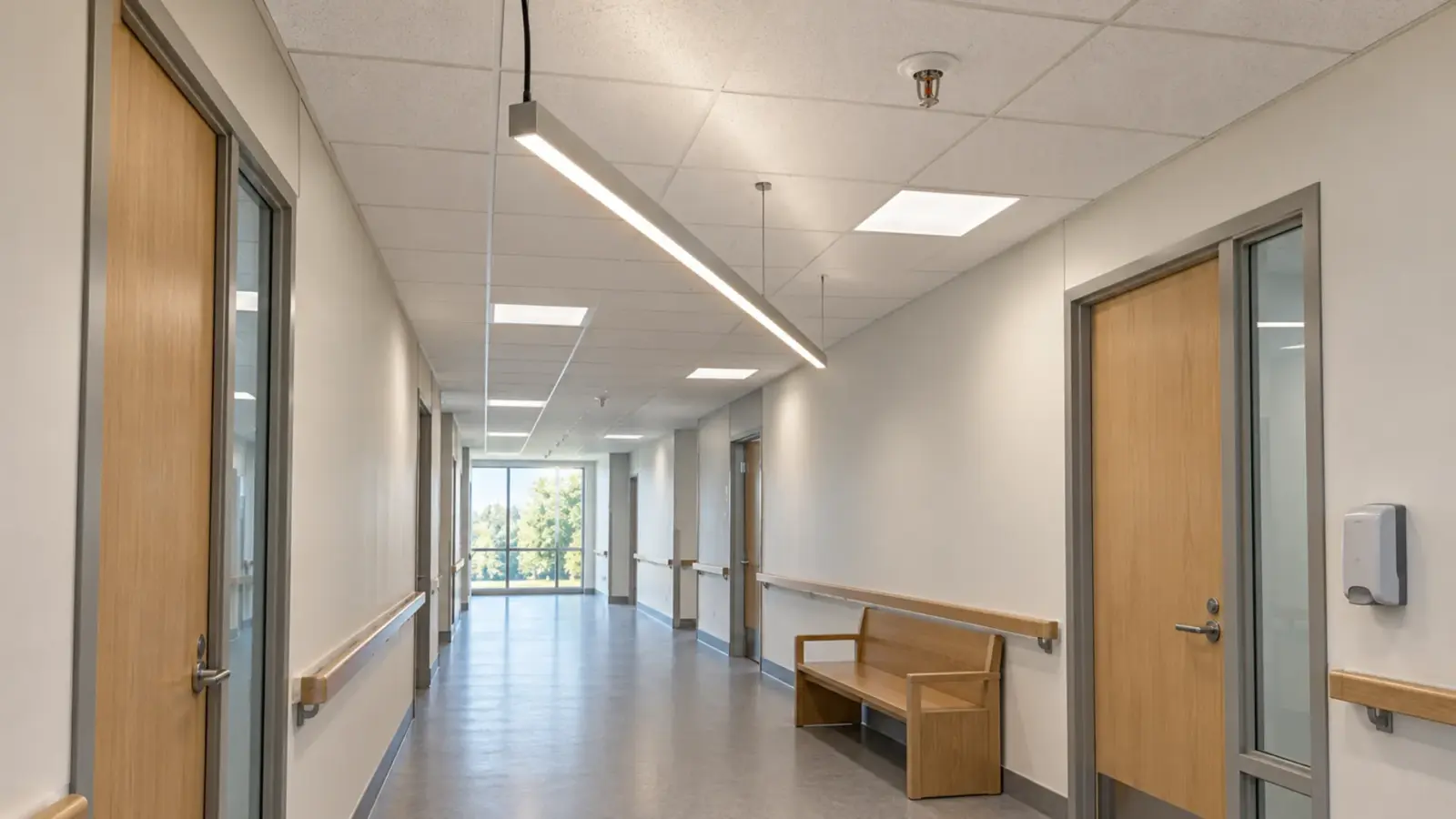
On a typical hotel corridor job, the drawings hang a linear LED channel from the ceiling and the sprinkler plan puts a head every 10 ft along the same line. The sprinkler contractor measures the bottom of the channel against the head’s deflector, and that one measurement decides whether the channel moves or a second head goes in.
LED strip has no fixed clearance from a sprinkler head. NFPA 13 asks whether anything at or below the deflector blocks the spray pattern, so a cove above the ceiling plane is usually not an obstruction and a hung channel can be. Smoke detectors follow the detector maker’s instructions and the AHJ, and we found no NFPA 72 distance for lighting.
Whose Rule This Is: Not the NEC
We found no NEC section that sets a clearance between a luminaire, a strip or a channel and a sprinkler head, and our NEC guide stays with wiring. Sprinkler spacing and obstruction rules sit in NFPA 13. Detector placement sits in NFPA 72.
Both are design standards for other trades. The sprinkler designer usually applies NFPA 13 to the reflected ceiling plan, and the AHJ, often the fire marshal, inspects the result. The electrician’s part is to hand over accurate numbers early.
Section numbers shift between editions. QRFS, a sprinkler supplier’s blog, quotes the 2019 edition for the definitions and the obstruction table and the 2022 edition for the three-times rule, and the two use different numbers for the same ideas. This article names each rule by what it does and says which edition a source quotes. We read these rules through trade articles, not the standards, so treat the figures as an illustration and let the sprinkler designer apply the edition the jurisdiction has adopted.
Start With the Deflector Level: Vertical First
As QRFS quotes the 2019 edition, a continuous obstruction sits at or below the deflector level and “affects the discharge pattern of two or more adjacent sprinklers.” A noncontinuous obstruction affects a single sprinkler. Both definitions start at the deflector, so the first question is vertical: is any part of the strip, channel, cove lip or hanger at or below the deflector? If everything sits above it, these tests do not start.
The 18 in. line matters next. QRFS, quoting NFPA 13, says the first test applies when an obstruction is no more than 18 in. below the deflector and prevents the pattern from developing, and a second covers obstructions farther down that interrupt discharge in a horizontal plane. HFM’s article by NFPA senior engineer Brian O’Connor lists “surface-mounted light fixtures” among the common obstructions and says that below 18 in. they generally matter only if wider than 4 ft.
Here is how five common strip layouts sit against a pendent head’s deflector. The channel sizes are from our LED channels and diffusers range.
| Layout | Lowest point against the deflector | What the sprinkler designer does with it |
|---|---|---|
| Cove ledge above the dropped ceiling, strip aimed up | Above the deflector | Outside the tests; confirm if a head sits inside the cove void |
| Surface channel tight to the ceiling, such as UT-CH3020 (30×20 mm, 0.79 in tall) | Bottom 0.79 in below the ceiling, above a deflector that drops 1½ in (an assumed figure, one commenter’s guess in a Meyer Fire thread; the cut sheet gives the real one) | Usually nothing; the cut sheet of the head on the job decides |
| Coffer or bulkhead lip hanging 6 to 12 in. below the plane | Below the deflector | Solid and continuous: beam table, offset or extra heads |
| Hung linear channel | Below the deflector | The same, along the whole run |
| Strip under a shelf or millwork edge | The millwork is the obstruction | The strip adds nothing to it |

The cove row is the common one, and it is the easiest to keep clear. A cove ledge sits above the dropped ceiling by design, so the strip, the lip and the driver feed all live above the deflector. Trouble starts when a designer lowers the lip to hide the strip from a standing eye, or turns a cove into a hung coffer edge. Each inch the lowest point drops moves a row of the table further down. On a hospital or hotel job, check the lip height on the section drawing, not only on the plan, because the plan shows where a run goes and the section shows how low it hangs.
Which Test the Sprinkler Designer Runs
Three tests do most of the work.
The three-times rule. The 2022 text, as QRFS reports it, keeps a sprinkler at least three times an object’s largest dimension away, capped at 24 in. HFM gives the arithmetic: a 4 by 7 in. fan hub needs the sprinkler 21 in. away. For a long channel the largest dimension is its length, so the cap decides and 24 in. is the most it could ask. The same source reports that in light and ordinary hazard occupancies only structural members count for this rule, and that the appendix intends to exempt nonstructural elements. In a different context, HFM calls light hazard the occupancy type of most patient care areas; the sprinkler designer usually sets the class for each room.
The exemption covers only the three-times rule. The 2022 commentary, as QRFS quotes it, says the beam rule and the wide-obstruction rule “still apply and must always be met.”
The beam table. For a solid, continuous obstruction, the 2019 table, as QRFS prints it, sets the highest the deflector can sit above the obstruction’s bottom (B) for each horizontal distance from the deflector’s center to the obstruction’s side (A). A few of its rows: under 1 ft, 0 in.; 1 ft to under 1 ft 6 in., 2½ in.; 1 ft 6 in. to under 2 ft, 3½ in.; 2 ft 6 in. to under 3 ft, 7½ in.; 3 ft to under 3 ft 6 in., 9½ in. The closer the head, the lower it must sit relative to the bottom of the obstruction.
The both-sides and soffit options. QRFS reports that an obstruction under 4 ft wide may have sprinklers on opposite sides, each no more than half the allowed spacing from its centerline, and that a soffit or similar obstruction against a wall no more than 30 in. wide may follow the table. Over 4 ft wide, the 2022 text, as QRFS reports it, puts a sprinkler underneath.
Here is a worked case with assumed numbers: a UT-CH3020 channel hung on cables down a corridor (an assumed layout; hanging hardware is quoted separately), a pendent head with its deflector 3 in. below the ceiling, and the table above.
| Channel bottom below ceiling | Deflector above channel bottom (B) | Table row that fits | Head at least this far from the channel’s side (A) |
|---|---|---|---|
| 3 in. | 0 in. | under 1 ft allows 0 in. | no offset, deflector level with the bottom |
| 6 in. | 3 in. | 1 ft 6 in. allows 3½ in. | 1 ft 6 in. |
| 9 in. | 6 in. | 2 ft 6 in. allows 7½ in. | 2 ft 6 in. |
| 12 in. | 9 in. | 3 ft allows 9½ in. | 3 ft |
A channel hung on the same centerline as the heads leaves A near zero, and the table then asks for a deflector level with the channel bottom. That is why the usual fixes are to raise the channel, move it off the head line, or add heads on both sides. The case is an illustration, not a design: the sprinkler designer uses the adopted edition and the real head.
A Meyer Fire Protection forum thread shows the same logic on a smaller object. A 7 by 14 in. drum light sat near a concealed head in a senior living unit, the contractor wanted a second head 3 to 4 ft away, and the commenters argued over which rule applied.
Smoke Detectors and the Cove
Detectors matter in two ways. First, a detector is itself a noncontinuous obstruction. QRFS says it can block a nearby head, and its hospital example treats detectors within 18 in. as “quite possibly” obstructions that need exact measurements, so a detector and a hung channel near the same head go on the sprinkler designer’s list together.
Second, a cove can sit close to a detector. We found no NFPA 72 distance between lighting and a smoke detector, and the sources that came up were vendor and forum guidance that did not agree; some detector makers give their own distance from fluorescent fixtures, and the figures differ. The installation sheet of the detector model on the job and the fire alarm designer’s layout govern. A bulkhead or coffer lip near a detector changes the ceiling geometry the detector layout is drawn on, so put both on the same reflected ceiling plan and let the fire alarm contractor sign the location.
Five Numbers for the Sprinkler Contractor
Send these before the sprinkler shop drawings are final, because a head that moves after the pipe is hung moves the pipe with it.
- The elevation of the lowest point of every strip, channel, cove lip and hanger below the finished ceiling.
- The width and the run length of each one, since under and over 4 ft wide are different cases and a continuous run affects every head beside it.
- The room type of each space, so the designer can set the hazard class.
- The line of each run on the reflected ceiling plan against the head grid.
- The ceiling type: grid, drywall or open. The deflector drop depends on the head, and its cut sheet gives the number.
Our office guide shows how to draw the break around a head, and our ceiling cloud guide covers moving the strip or the cloud. A mockup settles the rest; our mockup approval guide lists what to check, and the sprinkler head belongs on that list.
FAQ
Does LED strip count as a sprinkler obstruction?
Only if part of the strip, its channel or its hanger sits at or below the deflector level and blocks the spray. A strip above that level is outside the tests, and a hung channel is not. The sprinkler designer decides.
How far should a cove be from a sprinkler head?
NFPA 13 gives no single distance for strip. A cove whose lowest point is above the deflector has none to meet under these tests. A lip or channel below the deflector follows the beam table, where the offset grows with the height of the obstruction’s bottom below the deflector.
Does the NEC set a clearance between lighting and sprinklers?
We found no NEC section that does. Sprinkler obstruction rules sit in NFPA 13, applied by the sprinkler designer and the AHJ.
Can the electrician or ceiling crew move a sprinkler head?
Head locations come from the sprinkler contractor’s drawings, so a move goes through that contractor and the plan review. Raise or relocate the strip first.
What to Settle Before Ceiling Close-In
- The lowest point of every strip, lip and hanger against the deflector level of the heads on the job.
- The hazard class of each room, as the sprinkler designer sets it, and the NFPA 13 edition the jurisdiction has adopted.
- Whether any run hangs below the deflector, and the offset or extra heads the designer asks for.
- The detector locations and instruction sheets, on the same plan as the cove.
- A written answer from the sprinkler contractor, kept with the punch list items.