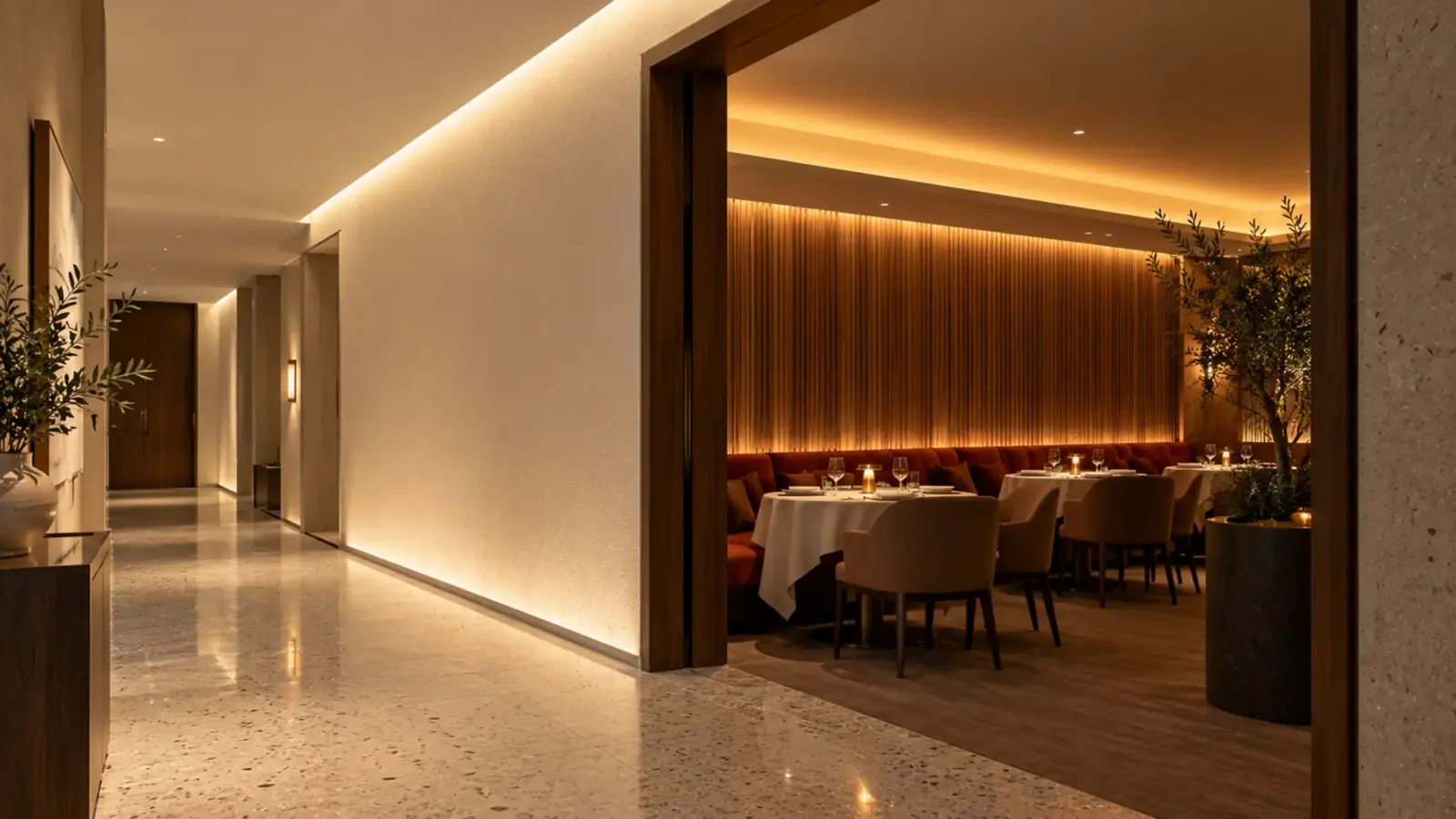
A hotel corridor lit at 3000K opens into a restaurant lit at 2700K. At the threshold the difference is plain: the corridor looks clean, the dining room amber and low. Inside either room nobody notices. That is most of the 2700K vs 3000K question: pick by what the space is for, then decide where the two whites meet.
The short answer for warm white LED strip on hospitality and multifamily projects:
- 2700K for rooms people settle into after dark: guest rooms, dining rooms, bars, lounges, apartment bedrooms and living rooms.
- 3000K for spaces that work as well as host: lobbies, corridors, reception, vanities, apartment kitchens and amenity areas used by day.
- Dim-to-warm where one room has to do both, shifting from 3000K at full to a candle-like warm white when dimmed.
What 300 Kelvin Changes, and Where You See It
Both are warm white. 2700K carries more orange and reads like an incandescent lamp; 3000K reads cleaner, with less yellow, and keeps whites looking white. LEDVANCE describes 2700K as the warmer, more relaxing choice and 3000K as slightly crisper.
The gap shows in three situations:
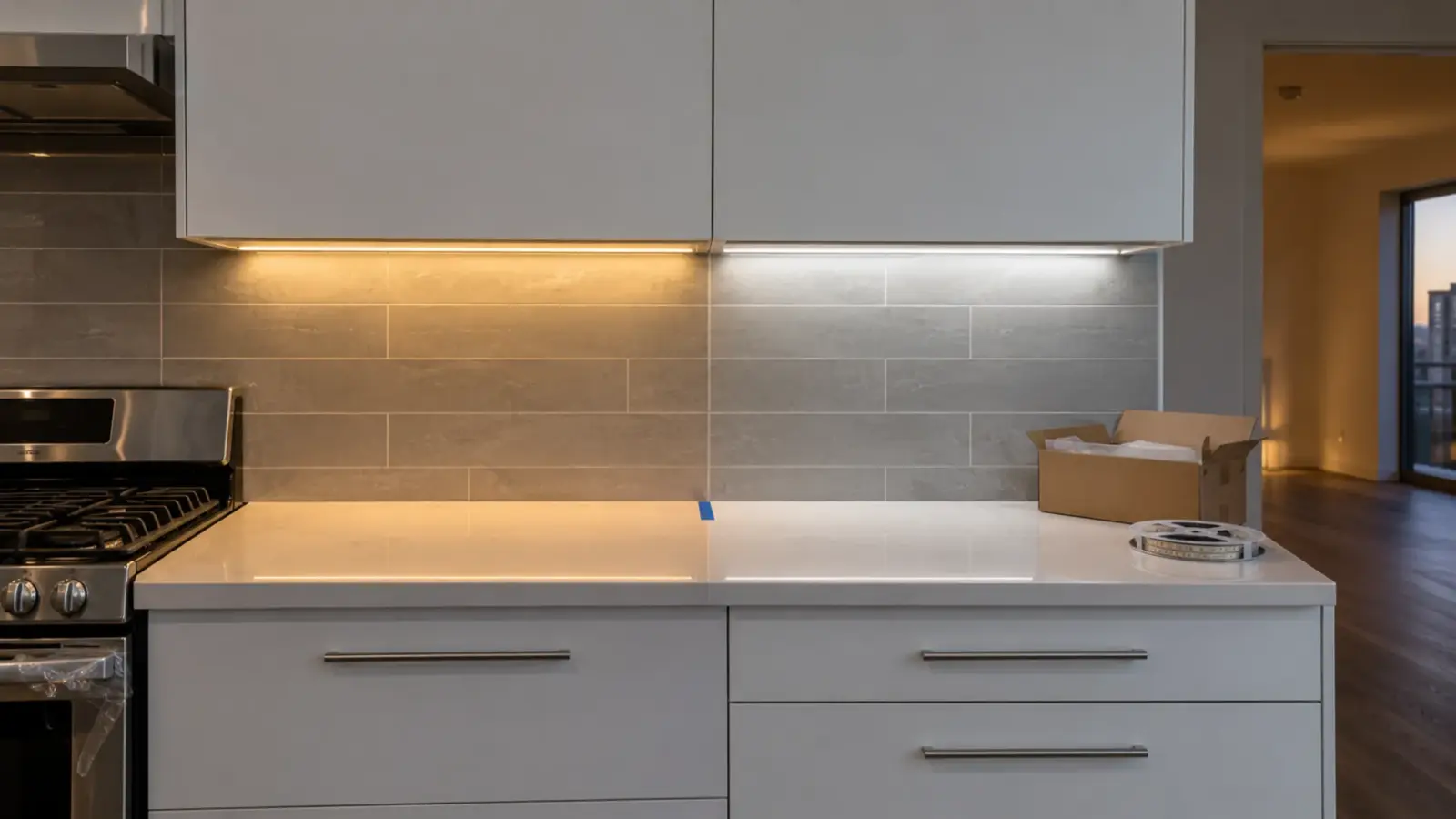
- Side by side. Waveform Lighting notes the difference is most noticeable when the two are installed next to each other; across separate rooms it is much less obvious.
- On white surfaces. A white plaster ceiling or a white quartz counter shows the yellow of 2700K more than walnut or brass does.
- Dimmed. As light levels fall, 2700K starts to look amber and dark; 3000K holds a cleaner white for longer.
Hotels: Rooms Warm, Public Space Cleaner
Hotel guides split the property roughly the same way. According to SBC Lighting’s hotel guide, guest rooms, suites and lounges use 2700K for a residential feel, while lobbies, reception areas, meeting rooms and corridors often use 3000K.
| Hotel space | Strip application | CCT we would draw | Why |
|---|---|---|---|
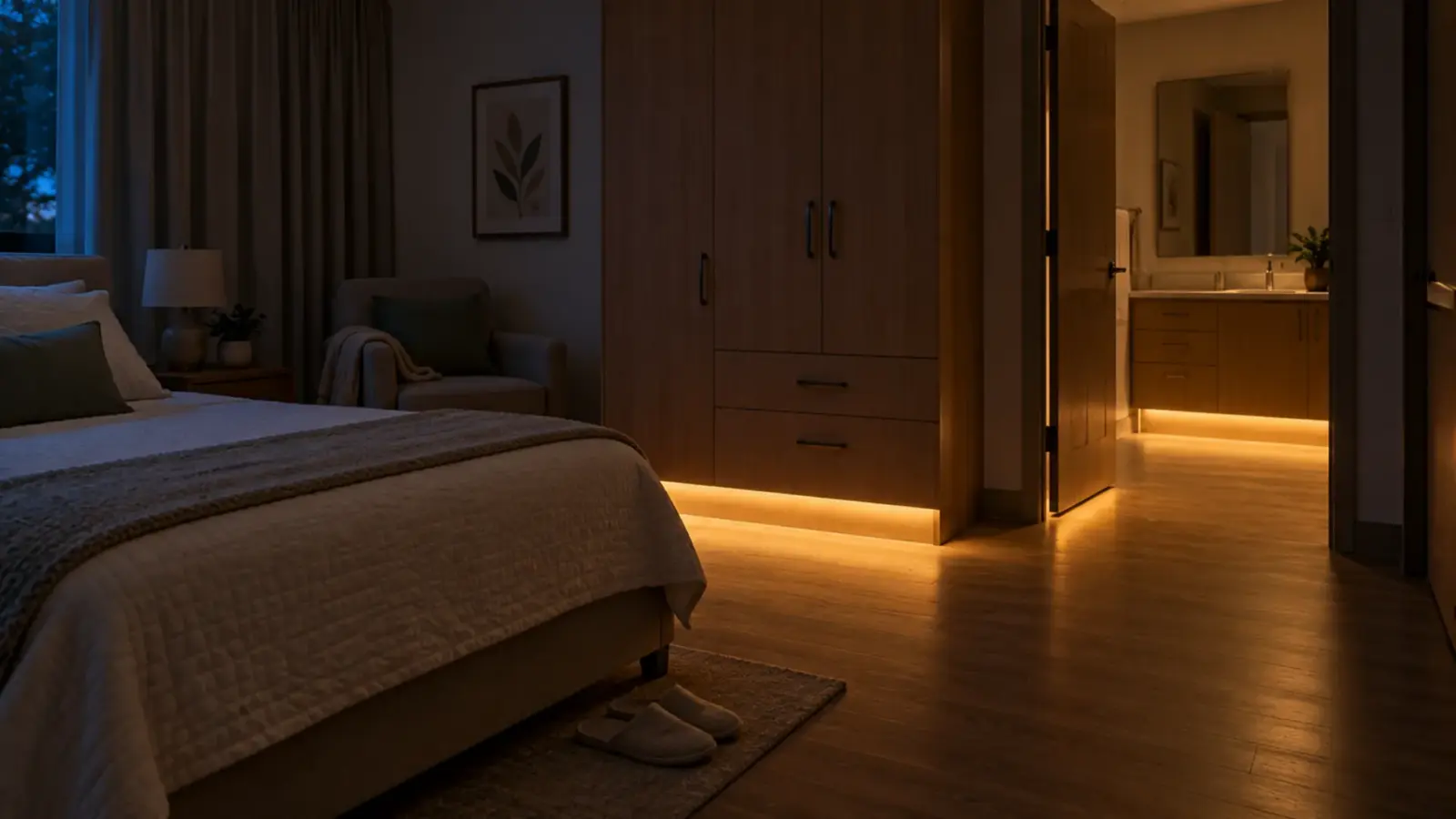
| Guest room | Headboard, ceiling cove, under-bed | 2700K | Evening use, residential feel |
| Guest bathroom | Mirror and vanity backlight | 3000K | Grooming needs cleaner white |
| Closet and minibar | Shelf and door-switched strip | 3000K | Seeing color of clothes and labels |
| Corridors | Cove or wall slot | 3000K | Circulation, cleaner photos, long runs read evenly |
| Lobby and reception | Feature walls, desk front | 3000K, or 2700K in a lounge zone | Works day and night |
| Restaurant and bar | See the next section | 2700K | Evening dining |
Corridors deserve a second look. They are long, they are photographed for every listing, and the strip is the main light, so any unevenness or tint shows. 3000K keeps the walls and doors reading as their real colors; 2700K over a long corridor can look dim and dated, especially where the carpet and walls are already warm.
On a renovation, match what stays. If the corridor sconces are 2700K, a 3000K corridor cove will look cold beside them; the transitions section below covers where to change.
Restaurants and Bars: 2700K Unless the Room Works by Day
Dining rooms and bars that do most of their business after dark almost always read better at 2700K: food, wood and faces look warmer, and the room feels lower and more intimate. Guocio’s restaurant guide, a vendor’s view, puts fine dining at the warm end and quick-service at a wider and cooler range.
| Restaurant space | Strip application | CCT |
|---|---|---|
| Fine dining room | Ceiling coves, banquette backs | 2700K |
| Bar back shelf | Shelf-edge and bottle lighting | 2700K, high CRI |
| Host stand and entry | Desk front, signage halo | 2700K or 3000K to match the entry |
| All-day cafe | Coves, counter front | 3000K |
| Patio and terrace | Under-rail, canopy edge (outdoor rated) | 2700K |
| Open kitchen and pass | Task strip | 3000K or cooler, to see the food |
Many restaurants work two services in one room. A cafe that is bright at breakfast and dim at dinner either picks 3000K and lets it read slightly cool after dark, or uses dim-to-warm so the color follows the dimmer; the section below covers that option.
The bar back shelf is the one place where CRI matters as much as CCT; labels, liquids and glass need a strip with good red rendering. Our high-CRI guide covers the tiers.
Apartment and Condo Projects: Units vs Common Areas
On multifamily work, the developer usually sets one standard for units and another for common areas, and the strip follows it.
| Multifamily space | Strip application | CCT |
|---|---|---|
| Unit bedroom | Headboard niche, ceiling cove | 2700K |
| Unit living room | Cove, media wall | 2700K or 3000K |
| Unit kitchen | Under-cabinet task, toe kick | 3000K task, 2700K accent |
| Unit bathroom | Mirror and vanity backlight | 3000K |
| Corridors and elevator lobbies | Cove or slot | 3000K |
| Amenity lounge | Coves, bar back | 2700K or 3000K |
| Leasing office | Linear slot, desk front | Cooler than this page: see our 4000K vs 5000K guide |
The kitchen is where most unit specs get it wrong: 2700K under the cabinets makes a white counter look yellow and food harder to read. 3000K at the counter, with 2700K kept for the toe kick or a display shelf, keeps the task honest and the room warm.
Transitions: Where Two Whites Meet
Most projects use both. The rule that keeps it from looking like a mistake is simple: one CCT per sightline.
- Change at a threshold: a door, a change of floor finish, a step in the ceiling, an opening between rooms.
- Never on one continuous surface: a cove that runs from the corridor into the restaurant should change at the break in the cove, not in the middle of a run.
- Match the surface type: two coves of different CCT seen in one view look like a fault; a 3000K corridor cove next to 2700K sconces inside a room reads as two lighting layers.
- Check photos: a corridor shot through into a restaurant will show the difference more than the eye does.
- 1Corridor cove3000KClean, works by day
- 2ThresholdDoor, step or cornerChange the white here
- 3Restaurant cove2700KWarm, evening
- 4Not mid-runOne continuous coveTwo whites look like a fault
The same rule applies to strip from different reels: a seam inside a continuous run looks like an error even at the same nominal CCT. Our guide to why a second reel may not match covers that side.
Dim-to-Warm as the Third Answer
When one room has to be 3000K for lunch and 2700K or warmer for dinner, dim-to-warm strip avoids choosing. Our UT-T672-10-DTW (COB) and UT-T120-8-DTW (SMD) start at 3000K at full output and warm toward 1800K as they dim, on two wires and an ordinary dimming system. The color follows the dimmer, so there is nothing extra for the staff to set.
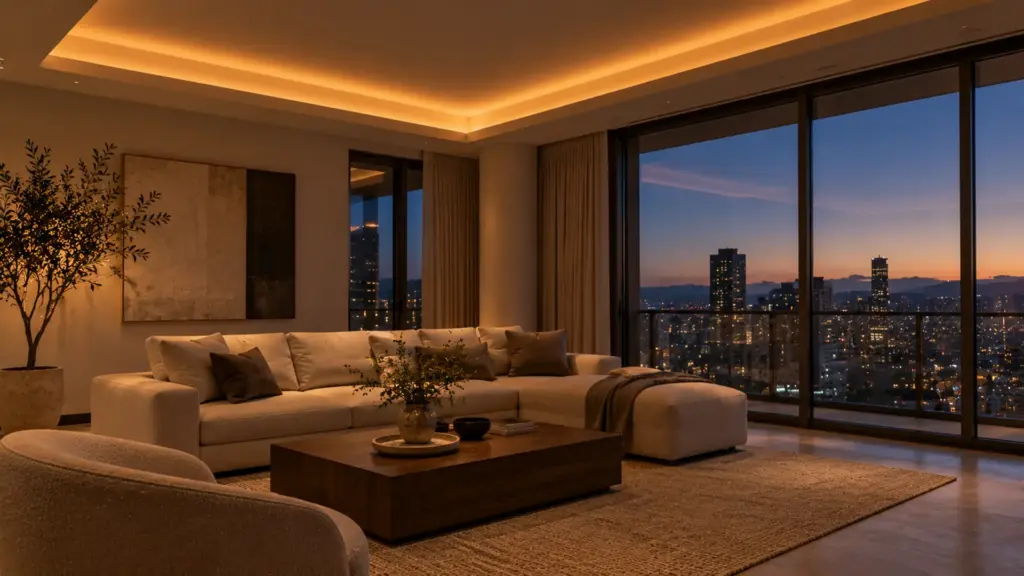
Tunable white goes further, with a separate control for color temperature across 2700–6500K, at the cost of a second channel and a tunable controller. Our dim-to-warm vs tunable white guide explains when each fits.
CRI and Finishes at Warm Color Temperatures
At 2700K and 3000K, rendering matters more than at cooler whites, because warm-white LEDs can flatten reds and make wood, leather and food look muddy. Our standard COB and SMD strip is Ra≥90; the full-spectrum UT-SFS series is Ra≥95 with R1–R15 ≥90, in 2700K, 3000K and 4000K only. For bar back shelves, food display and timber feature walls, it is worth the step up.
Finishes change the choice too. Warm timber, brass and terracotta tolerate 2700K and look richer under it. White stone, gray tile and white lacquer show the yellow, which is one reason many vanity and kitchen details end up at 3000K. Our color temperature by sightline guide takes the finish question further.
Renovations: Matching What Stays
Renovation projects rarely start from a blank page. Before choosing a CCT for new strip, find out what stays: sconces, pendants, downlights, display lighting. Older halogen and incandescent sources read close to 2700K; earlier LED retrofits are often 3000K or a mix. A new 3000K cove beside retained 2700K sconces looks like a mistake even though both are “warm white”.
Light a sample of each candidate next to the fixtures that stay, at night, at the level the room will run. If the existing lighting is mixed, decide which white the space should have and plan the replacement of the odd fixtures with the strip, rather than matching the worst of them.
Outdoor and Spa Areas on the Same Project
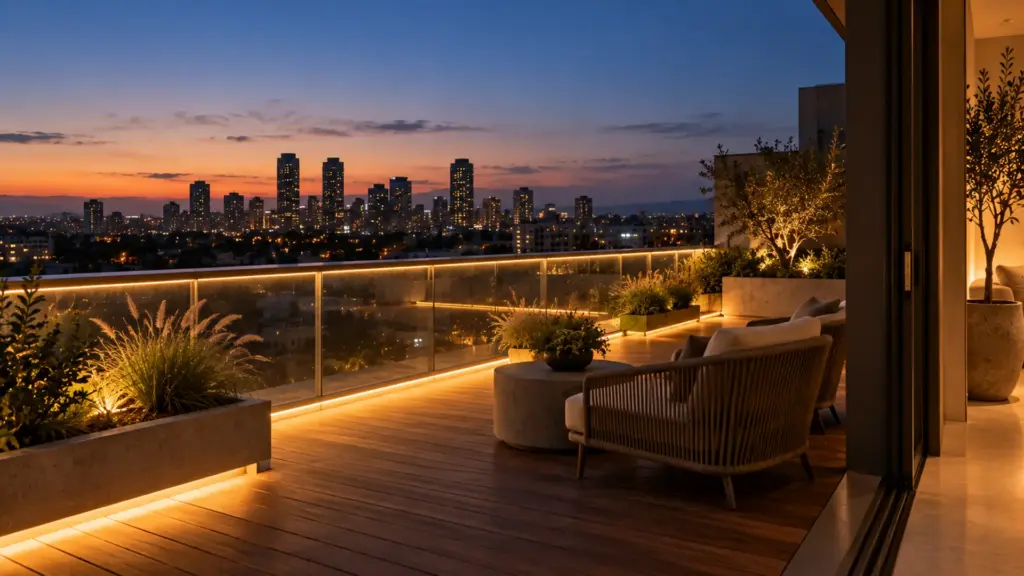
Hotel and multifamily projects carry the same question outside: patios, pool decks, entry canopies, balconies. Outdoor strip comes in the same whites; our outdoor IP65 to IP68 strip lists 2700–6500K. Match the interior CCT of the space the outdoor area belongs to: a restaurant terrace at 2700K like the dining room, an entry canopy at 3000K like the lobby.
Spa steam rooms and saunas are a special case. Our UT-O320-8-SA high-temperature silicone strip is rated to +221°F (+105°C) and comes only in 2700–3000K, which suits the relaxed, warm look these rooms want anyway.
Mockup Before the Order
The two whites are close enough that a decision made from a catalog is a guess. A short mockup settles it:
- Light a meter of each CCT in the actual detail, behind the actual cove lip or cover.
- Look at night, at the dim level the space will run during service or in the evening.
- Put the real finishes next to it: the stone sample, the fabric, the timber, a plate of food for a restaurant.
- Photograph both from the main viewing position; the camera shows the difference the client will see in marketing photos.
- Record the chosen CCT and the sample’s lot on the schedule, so the order matches the mockup.
Product Families at Both Color Temperatures
| Family | 2700K | 3000K | Note |
|---|---|---|---|
| COB, 12V/24V | Yes | Yes | Most series 2700–6000K or 2700–6500K |
| SMD 2835 and 5050 | Yes | Yes | 2700–6500K |
| Full-spectrum SMD (UT-SFS) | Yes | Yes | 2700K, 3000K and 4000K only |
| CSP | Yes | Yes | 2700–6500K on most families |
| Wall washer bars (UT-WB27) | Yes | Yes | 2700K, 3000K, 4000K, 6500K |
| 120V COB (UT-H120-296-COB, -288-COB) | No | Yes | 3000K, 4000K, 6000K |
| High-temperature outdoor (UT-O320-8-SA) | Yes | Yes | 2700–3000K only |
| Dim-to-warm | 3000K → 1800K | Shifts with dimming |
If a specification calls for 3500K, confirm the model at quote; it is not a standard option in our tables. Our COB LED strip table lists the CCT range for each series.
Spec Notes for This Job
- Write the CCT next to every strip tag on the schedule, not “warm white”.
- Draw the CCT boundary on the plan at a threshold, and check every sightline across it.
- Put 3000K where people groom, cook or work; 2700K where they settle in for the evening.
- Use dim-to-warm where one room serves both lunch and dinner, or work and evening.
- Order every reel for one sightline from one production lot.
- Keep outdoor areas at the CCT of the interior space they belong to.
- On renovations, light the new strip beside the fixtures that stay before the order is placed.
- Specify Color Rendering Index, 0–100: how truthfully the light shows colors next to a reference source. Ra≥90 is the usual bar for interiors. with the CCT: Ra≥90 as the floor, the full-spectrum tier where food, timber or art is lit.
If the project is at the schedule stage, send the drawings and the finish board. We will check each space against the strip families that exist at the CCT you want, including dim-to-warm where a room has to do both, and send samples at both whites so the choice is made in the room: request a quote.