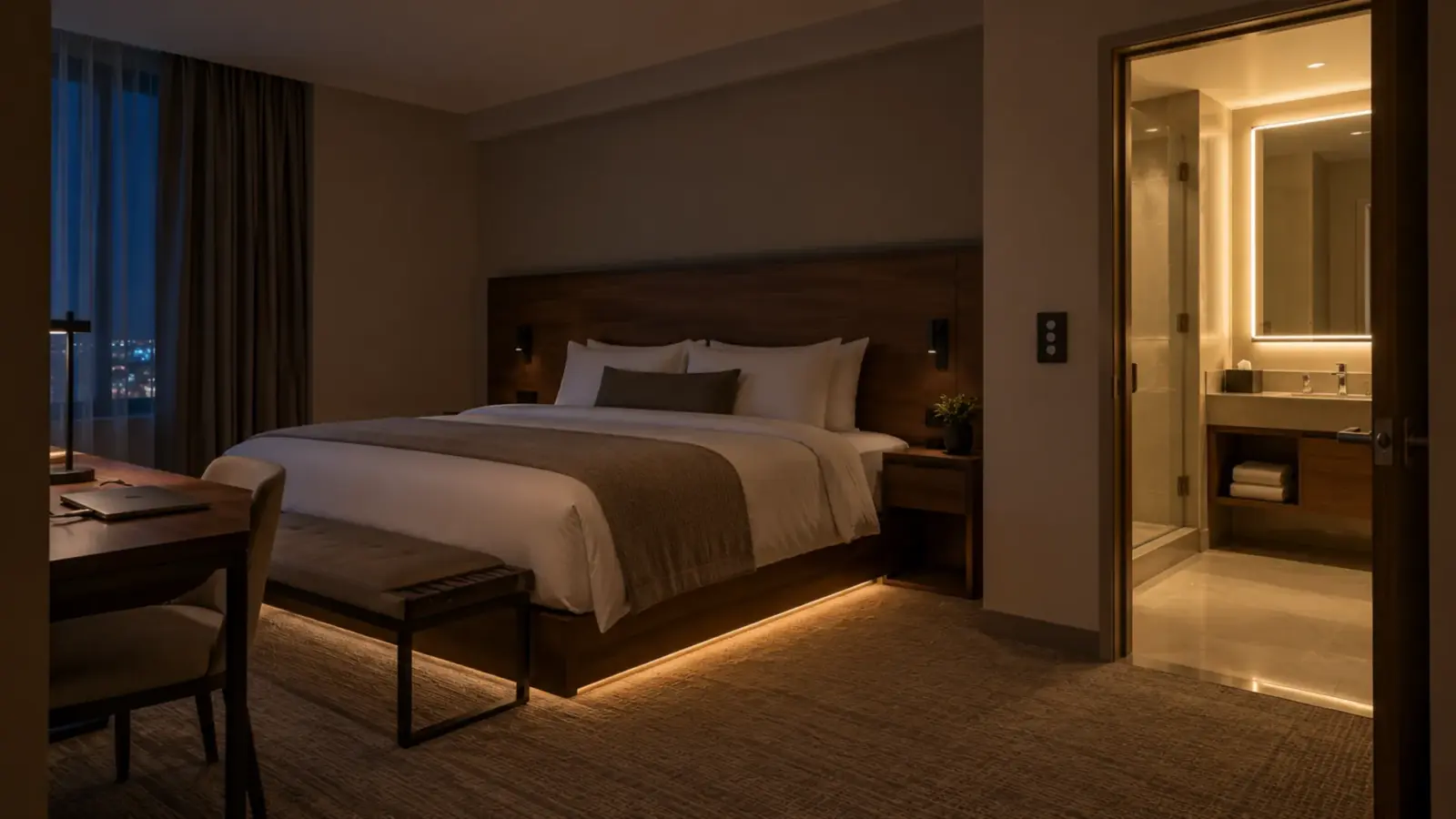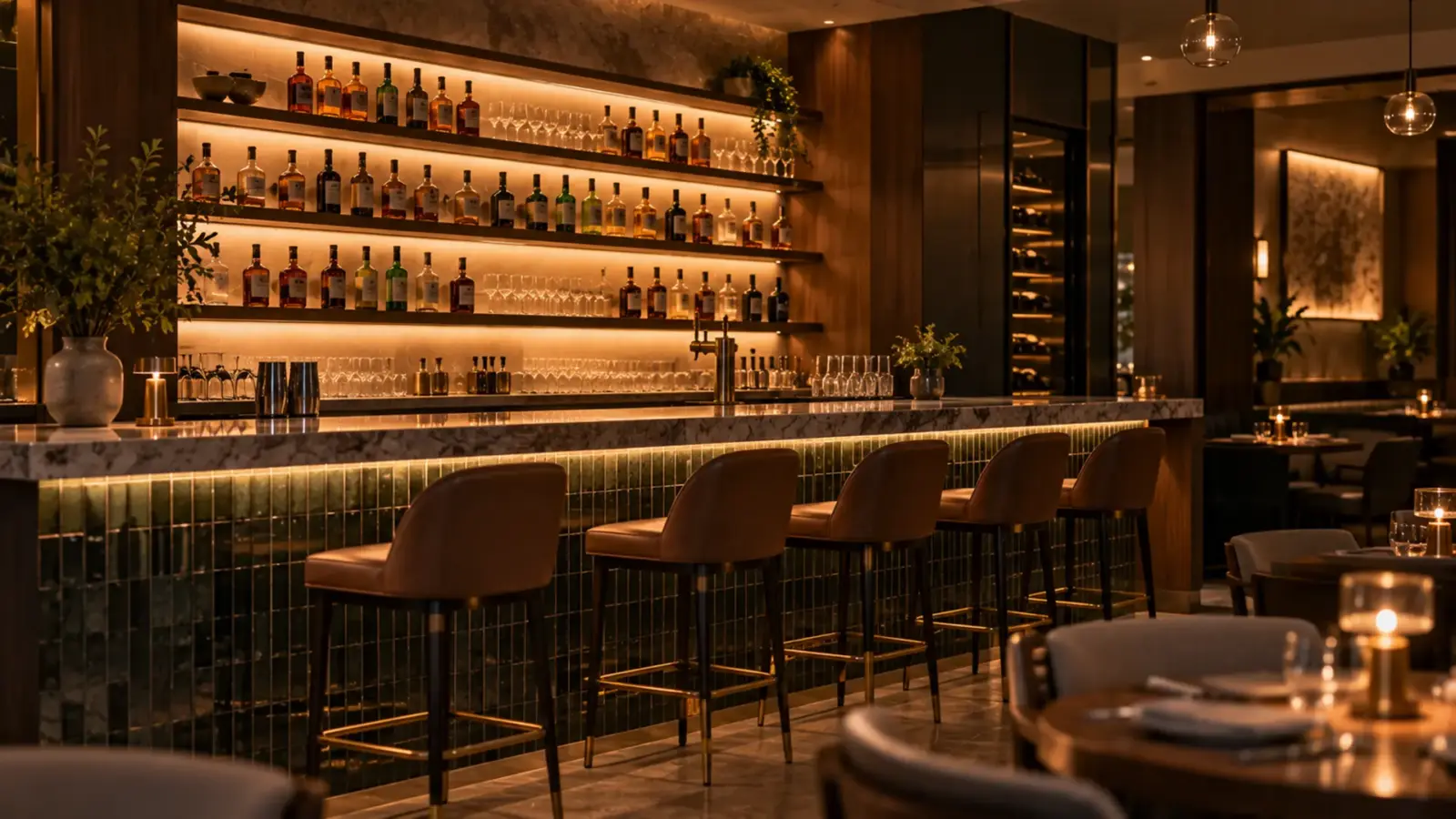
Restaurant and bar LED strip works when each zone gets its own product, color temperature and protection: warm 2700K strip for guests, cooler task light behind the bar, sealed strip wherever drinks and mops reach, and dimming that follows the service. One strip and one setting for the whole room is how a bar ends up glaring at its guests.
At 9 p.m. the dining room is at 20%, and the back bar is the brightest thing in the room, as it should be. The strip under the bar top, meant to make the counter float, is lighting the guests’ shoes and the mop bucket. The difference between those two details is not the product. It is where each zone’s light is aimed, how warm it is, and how wet it gets.
The Zone Table
| Zone | Product from our range | CCT | Protection | Control |
|---|---|---|---|---|
| Back-bar shelves | Dot-free COB UT-C480-8; full-spectrum UT-S2835-480-FS where labels matter | 2700K–3000K | Indoor, wipe-down | Dimmed with the room |
| Bar die and front underside | IP65 COB UT-O480-8-65 | 2700K | IP65, sealed ends | Dimmed with the room |
| Service well and pass | IP65 strip in a channel | 4000K | IP65, washdown nearby | Separate switch, full output |
| Booths, banquettes and coves | Narrow COB UT-C400-3 in millwork | 2700K | Indoor | Dimmed, evening scene |
| Signage and feature lines | Neon flex UT-N1010-TB | White or color | IP67 | On a timer or scene |
| Patio and entry | IP67 COB UT-O480-10-67 | 2700K–3000K | IP67, outdoor driver | Photocell or timer |
The table is a starting point. The sections below explain the choices zone by zone, including the mistakes each zone tends to attract.
Back Bar Shelves
The back bar is the display. Bottles, glassware and labels need even light from the front edge or from under each shelf, with no dots reflecting in the glass.
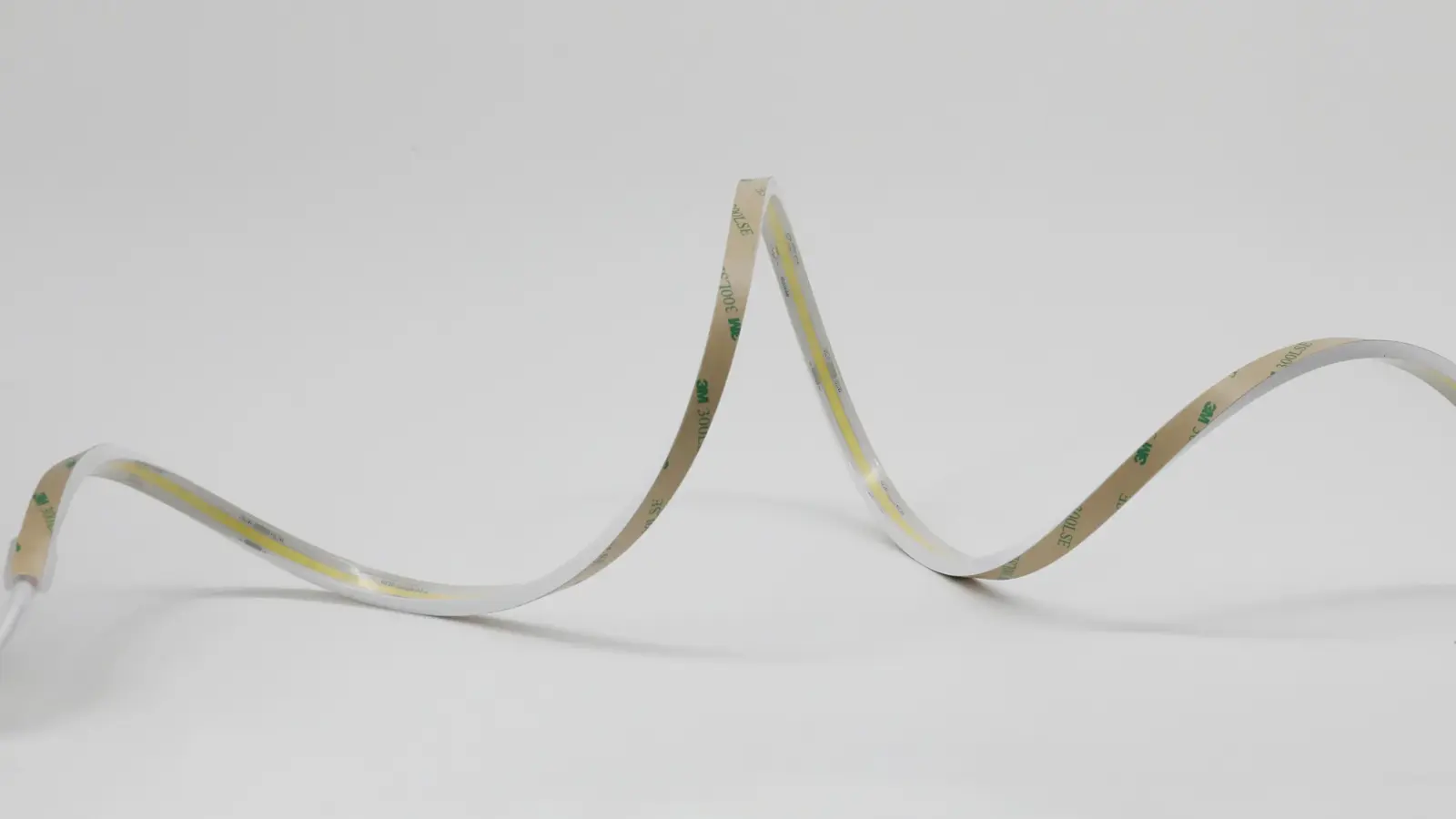
- Use dot-free strip. Glass bottles mirror every LED. COB strip such as UT-C480-8 at 3.2 W/ft (10.5 W/m) reads as one line in the reflection.
- Use high Color Rendering Index, 0–100: how truthfully the light shows colors next to a reference source. Ra≥90 is the usual bar for interiors. where the bottles sell the drink. Amber spirits and colored labels look flat under low-CRI light. Our UT-S2835-480-FS is Ra≥98; Flexfire recommends CRI 90 or higher for food and drink settings.
- Hide the strip behind a lip. A shelf edge or a small fascia keeps the strip out of the bartender’s eyes and the guests’.
According to Super Bright LEDs, strip on the back-bar shelves draws guests’ attention to the selection; aspectLED describes low-profile strip and linear bars for the same job. Keep the shelves on the same dimming as the room, so the back bar stays the brightest element at every hour.
Bar Die and Footrail
The bar die is the front face of the bar on the guest side. Strip under the bar-top overhang can make the top look like it floats, or it can glare into the room.
- Aim down the die face, not out into the room. A strip set well back under the overhang washes the die and leaves the floor dark.
- Check from a seated guest’s eye level, at the tables nearest the bar. If the strip is visible from there, it will be visible all night.
- Seal it. Drinks, ice and mops reach this zone. A silicone-coated IP65 strip such as UT-O480-8-65 and sealed end caps survive spills; a bare strip with an open cut end does not.
According to Toast’s bar lighting guide, warmer light suits the guest-side overhang. Keep it at 2700K to match the room.
Service Well and Pass
Behind the bar, the bartender needs to see ice, garnish, measures and the till. That is task light, and it can be cooler than the room.
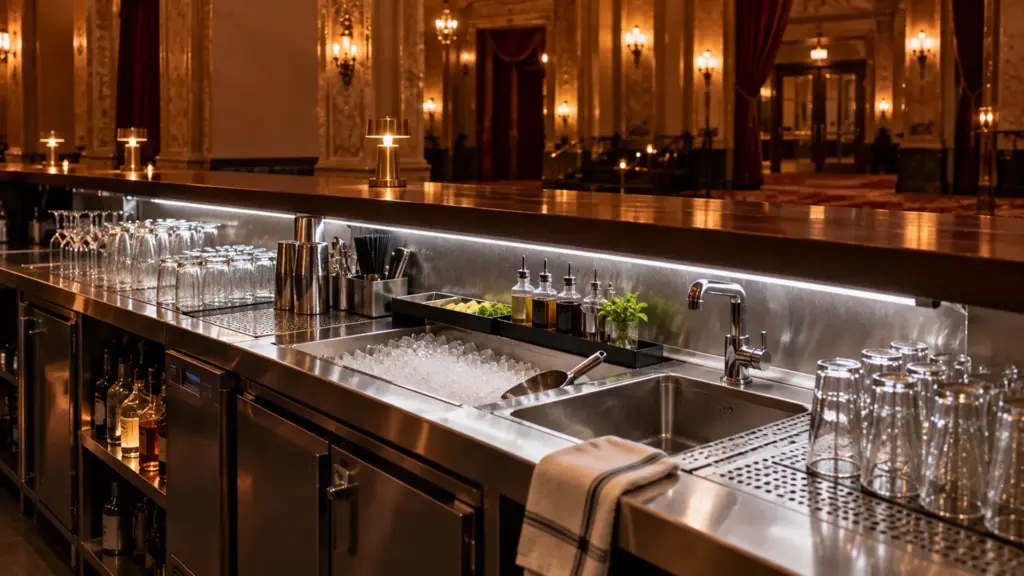
Toast suggests cooler light, around 4000K, under the server-side counter, aimed toward the back so it does not spill into the guests’ view. Use IP65 strip in a channel with a frosted cover here, because the well is washed down every night and the strip sits close to water. Put it on its own switch at full output: staff need the same light whether the room is at 20% or 100%.
The kitchen pass follows the same rules, with heat lamps nearby. Keep the strip away from the lamp’s heat and choose a construction rated for the temperature at that point.
Booths, Banquettes and Coves
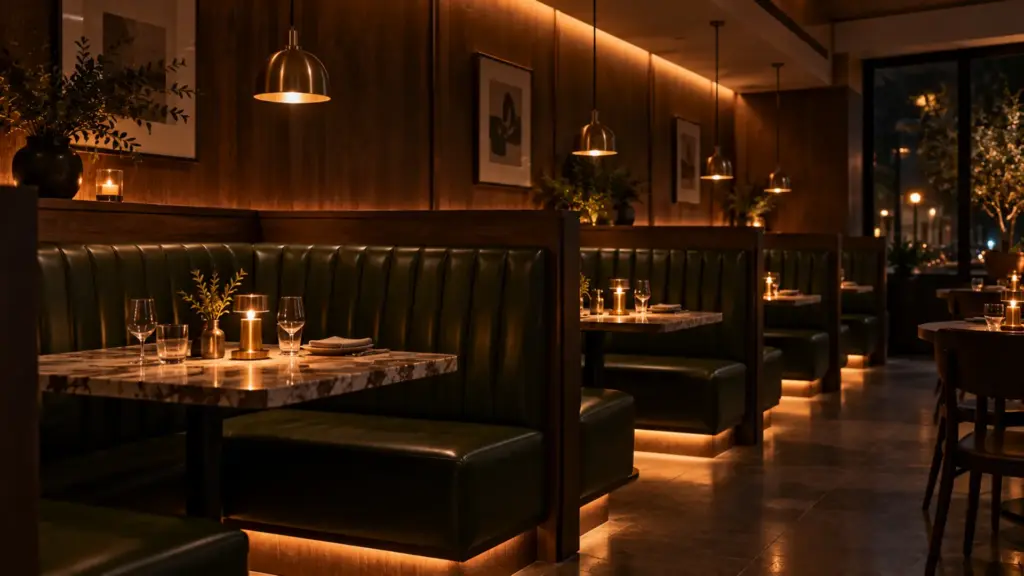
Booth and banquette lighting is where strip sets the mood. Narrow strip fits in millwork details that a fixture cannot: under the seat, behind the backrest, in a reveal above the panel.
- Use narrow, dot-free strip. UT-C400-3 is a 2.7/3 mm COB strip at 2.1 W/ft (7 W/m), small enough for a millwork reveal.
- Keep it warm and low. 2700K and dimmed for evening service. Our article on 2700K vs 3000K covers which one suits which surface.
- Mind the upholstery. Strip under a bench lights legs and bags. Behind the backrest, it lights the wall and the guests’ hair from behind, which is usually what the designer wants.
Ceiling coves follow the cove rules: hide the strip behind the lip, dim with the room, and choose the cover by depth. Our diffuser guide helps when the cove is shallow.
Signage and Feature Lines
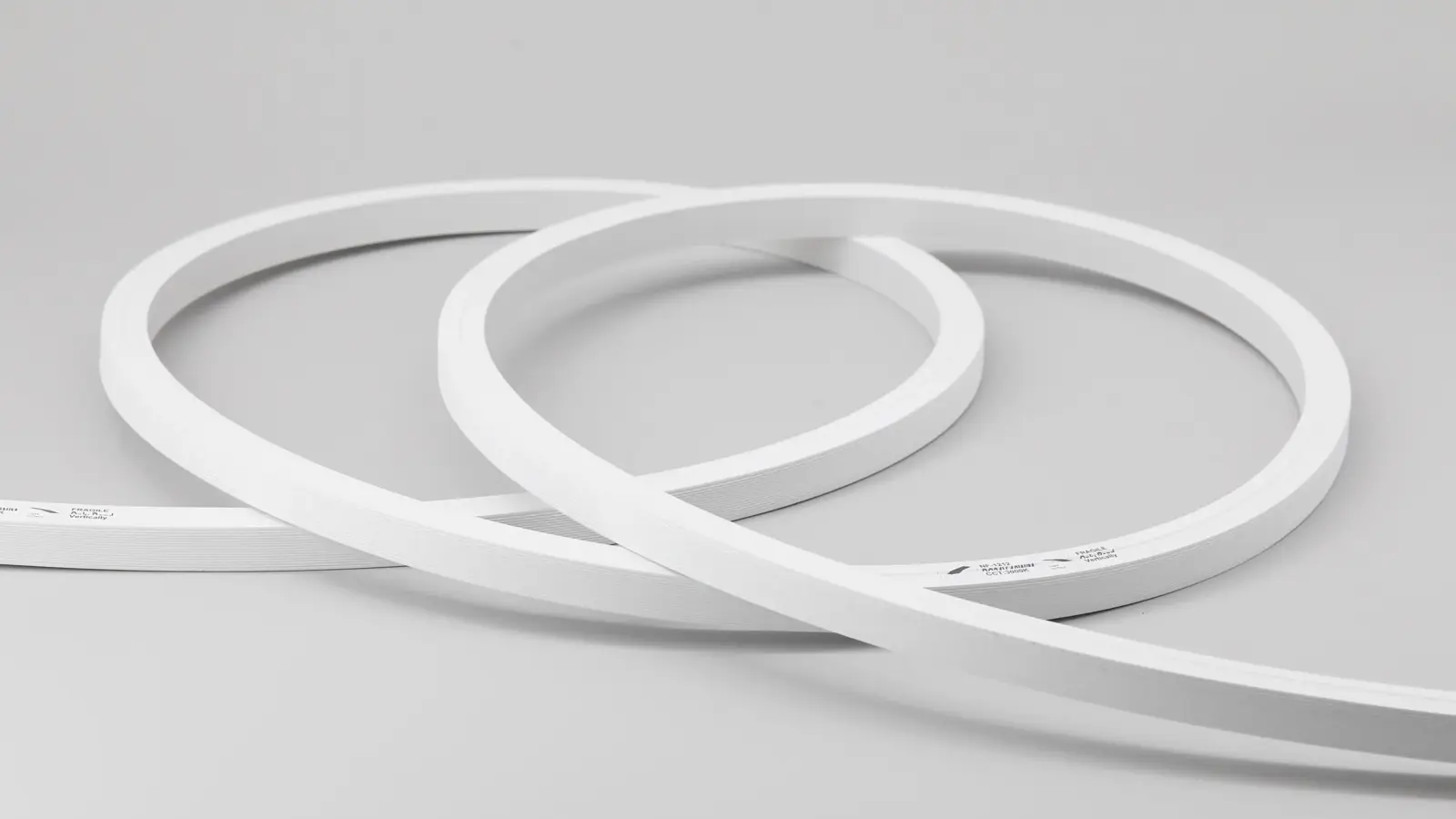
Neon flex carries signs, outlines and feature lines on walls, ceilings and bar fronts. Our UT-N1010-TB is a 10 × 10 mm top-bend neon at 3.0 W/ft (10 W/m), Dust-tight, and protected against temporary immersion in water. The usual rating for wet or outdoor runs that are not submerged all the time., in mono white or CCT; larger profiles carry RGB and RGBW for color.
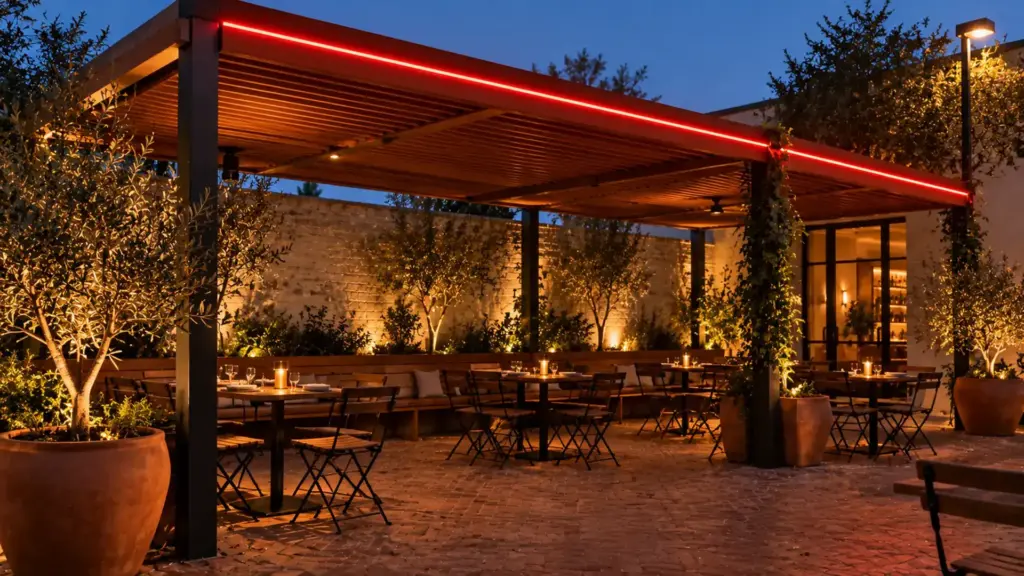
Two rules keep a neon feature from fighting the rest of the room. Put it on its own control, so it can stay on after the room dims or switch off for private events. And keep its color and brightness subordinate to the back bar unless the sign is the point. Our LED neon flex page lists bend directions and profiles.
Patio and Entry
Outdoor dining extends the room. Strip under a bench, along a planter edge or under a canopy fascia carries the interior’s warmth outside.
Use IP67 or IP68 construction outdoors, such as UT-O480-10-67, with connectors and drivers rated for the location, and keep the color temperature within one step of the interior so the patio and the dining room read as one place. Our facade and outdoor applications page covers exterior strip in more detail, and the outdoor and waterproof LED strip page lists each construction.
Dimming by Service Period
A restaurant changes character over the day. The lighting has to follow it.
- Lunch: room and coves higher, back bar at a moderate level.
- Dinner: room and coves down, back bar up relative to the room, booths at their evening level.
- Late bar: room low, back bar and feature lines carrying the space.
- Cleaning: service and kitchen zones at full, guest zones off.
Group the strip into zones that match those scenes, and use 0-10V control such as UT-D96-24-010 or TRIAC dimming such as UT-D60-24-TRC, matched to the dimmer. For an evening that gets warmer as it gets darker, dim-to-warm strip such as UT-T672-10-DTW shifts from 3000K toward 1800K as it dims; our dim-to-warm guide explains when it beats plain dimming. According to Ellumiglow, very warm color around 2200K is an accent look rather than a task light, so keep warm-dim to guest zones.
Glare From the Guests’ Side
Most complaints about bar lighting come from where the guests sit, not where the designer stood. Strip that is invisible from the bar entrance can be in plain view from a low booth, a high-top or a seat at the end of the bar.
Walk the room on the drawings before the strip is placed:
- Seated eye level at the tables nearest the bar. Anything the strip lights that faces this position, or any strip visible from it, will glare all evening.
- Bar stools. Guests at the bar look down at the bar top and across at the back bar. Strip under the bar top’s front edge is easy to see from a stool when it sits too close to the edge.
- Mirrors and glass. Back-bar mirrors, glass shelves and polished stone reflect strip from angles no section drawing shows.
The fix is almost always the setback and the lip, not a dimmer: move the strip further behind the edge, add a small baffle, or turn it to face the surface it is meant to light.
Spills, Cleaning and Heat
A bar is a wet, sticky, hot workplace. Plan the strip for the worst night, not the opening night.
- Spills reach the bar die, the footrail, the service well and anything under a counter. Use silicone-coated strip with sealed end caps there.
- Cleaning happens every night with hot water and strong cleaners. Joints and cut ends near the well need to survive a wipe-down, and the driver must not sit where the cleaning water goes.
- Heat comes from glass washers, ice machines that exhaust warm air, heat lamps and coffee equipment. Keep strip and drivers away from those exhausts.
Mockup in the Real Room
A bench mockup cannot show glare from a booth or the color of a whiskey bottle under the strip. Once the millwork is in place, light one bay of the back bar and one section of the bar die with the specified strip, at the evening dimming level, and look at it from the seats. Approve the setback, the CCT and the output there, and then release the order for the whole bar.
Drivers in Millwork
Bars are millwork projects, and millwork hides drivers badly. Plan driver locations with the millwork shop:
- An accessible cabinet or a service panel behind the bar, ventilated and away from ice wells and dishwashers.
- Short low-voltage runs to each zone, with feed points shown on the shop drawings.
- One label per driver naming its zone, matching the scene schedule.
A driver that can be reached from behind the bar with the restaurant open is worth more than a tidy one that needs the bar die removed.
Spec Notes for This Job
- Back bar: dot-free, high-CRI strip behind a lip, 2700K–3000K, dimmed with the room.
- Bar die: IP65 strip aimed down the face, checked from a seated guest’s eye level.
- Service well: 4000K IP65 task strip on its own switch.
- Booths and coves: narrow warm strip, evening dimming.
- Neon and signage on their own control; patio in IP67 with outdoor-rated drivers.
- Zones grouped by service period; drivers reachable from behind the bar.
We supply strip, neon flex, drivers and samples for restaurant and bar projects across the US. Send the millwork drawings and the lighting zones, and we will match the strip, the controls and the drivers zone by zone: request a quote.