Our high-temperature silicone strip is rated to +221 °F (105 °C); the air over a cook line can pass 100 °F on summer nights. LED strip survives a commercial kitchen when it is matched zone by zone: sealed silicone where there is grease and water, the high-temperature build near heat, nothing inside the hood, a level the inspector measures.
A Typical Job: The Hotel Kitchen Renovation
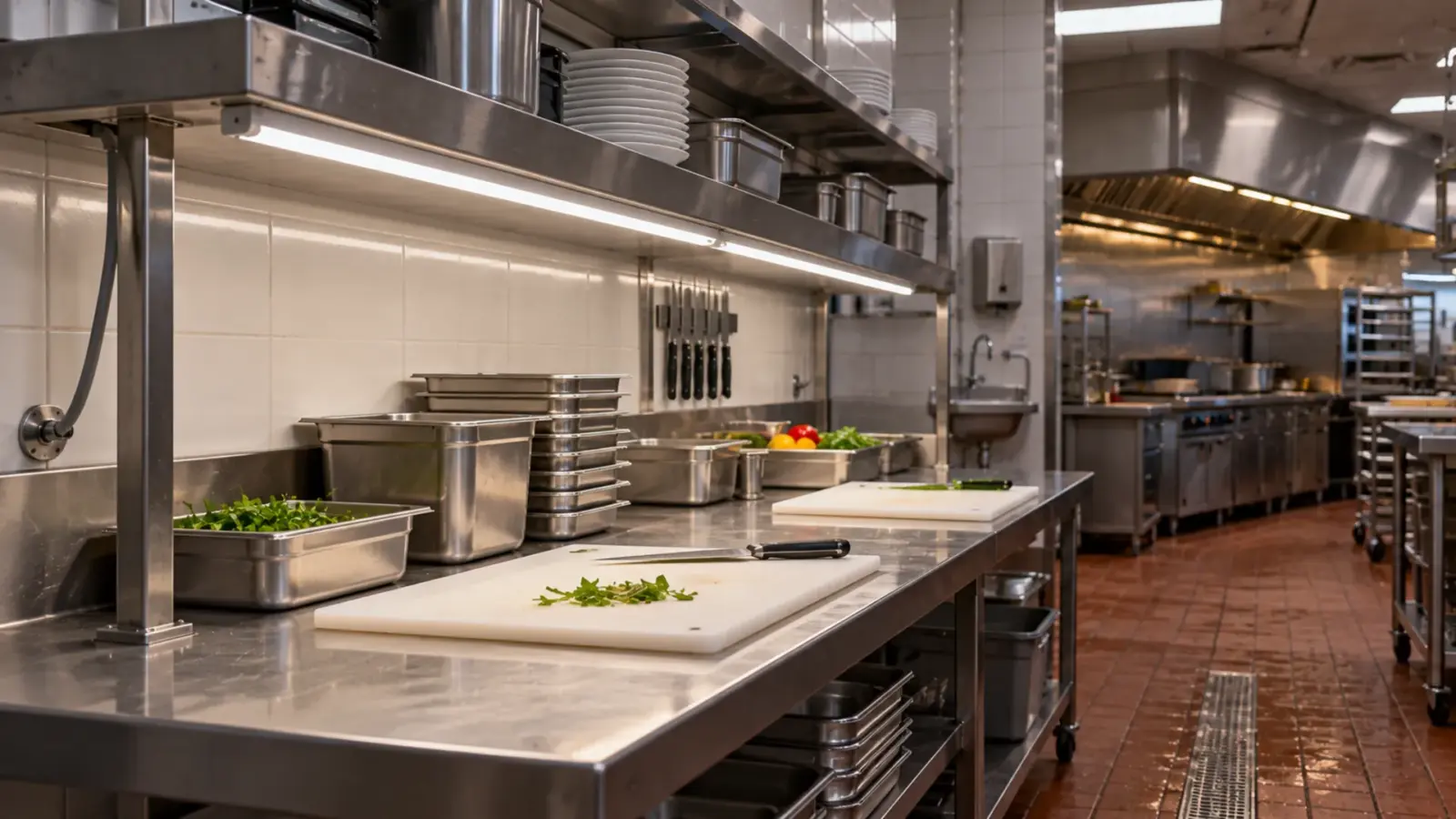
A typical job: a hotel renovates its banquet kitchen and the general contractor asks for strip under the stainless shelving over the prep line, in the dish room, and along the walk-in shelves, because the ceiling fixtures leave the counters in shadow and the chef wants to see the cutting boards. The electrical contractor has a reel of standard 24V COB and a Class 2 driver on the truck.
That reel is the wrong product for three of the four places, and the fourth will fail the inspection. Standard COB is IP20, open to grease and steam. The Class 2 driver is IP20 and belongs in a dry room. The health inspector will measure the prep surface and ask what happens if the light breaks over the salad station. Each point is a rule, and the rules below follow the zones of the kitchen.
What the Food Code Asks of the Light
The FDA Food Code is adopted state by state, so the text an inspector enforces is the state rule. Minnesota’s adoption, rule 4626.1470, carries the model code’s three light levels and is a fair guide to what most states require; check the edition your state adopted.
| Food Code tier (MN 4626.1470, from FDA 6-303.11) | Where | Where it is measured |
|---|---|---|
| 10 fc (108 lux) | Walk-in refrigeration units, dry food storage, any room during cleaning | 30 in (75 cm) above the floor |
| 20 fc (215 lux) | Self-service surfaces such as buffets; inside reach-in and under-counter refrigerators; handwashing, warewashing, utensil storage, toilet rooms | At the surface, or 30 in above the floor for the wash and storage areas |
| 50 fc (540 lux) | Any surface where an employee works with food, or with knives, slicers, grinders or saws | At the work surface |
Two things follow for strip. The 50 fc tier is measured on the prep surface, and a strip under a shelf 15 in above that surface is the most efficient way to add light exactly where the meter reads; it supplements the ceiling, it does not replace it. And the 10 fc tier for the walk-in is measured 30 in off the floor, between shelves, where ceiling fixtures are blocked by the stock; a sealed strip along the shelf edges lights that plane directly.
Shielding and Shatter Resistance
The rule the inspector quotes first is the bulb rule. Minnesota 4626.1375, the adoption of Food Code 6-202.11, requires light bulbs to be shielded, coated or otherwise shatter-resistant wherever there is exposed food, clean equipment, utensils or linens, or unwrapped single-service articles. The only exception is storage of food in unopened packages, and only when “the integrity of the packages cannot be affected by broken glass falling onto them” and the packages “are capable of being cleaned of debris from broken bulbs before the packages are opened”.
A silicone-jacketed strip has no glass to break, and a polycarbonate channel cover has none either; that is the argument for strip over the prep line, and it is a strong one. It is still the health authority’s call. Describe the construction on the submittal (silicone sleeve, PC cover, no glass), bring a sample to the pre-opening inspection, and do not write “complies with 6-202.11” on a drawing; write what the product is and let the inspector apply the rule. NSF listings belong to food equipment and to fixtures tested as such; our strip carries no NSF listing and the article does not pretend otherwise.
Heat: Where Strip Lives and Where It Dies
Heat shortens LED life faster than anything else in a kitchen. The US Department of Energy’s fact sheet on thermal management of white LEDs reports a Lighting Research Center test in which one LED ran at a junction temperature 11 °C (about 20 °F) higher than an identical one, and its estimated L70 life fell from about 37,000 to 16,000 hours; Flexfire’s thermal management article, which cites the same test, says it “reduced functional life by more than 50%” and adds the warning that applies to every enclosed shelf: “Poor ventilation can cause heat to build up, even if the surrounding temperature seems safe.”
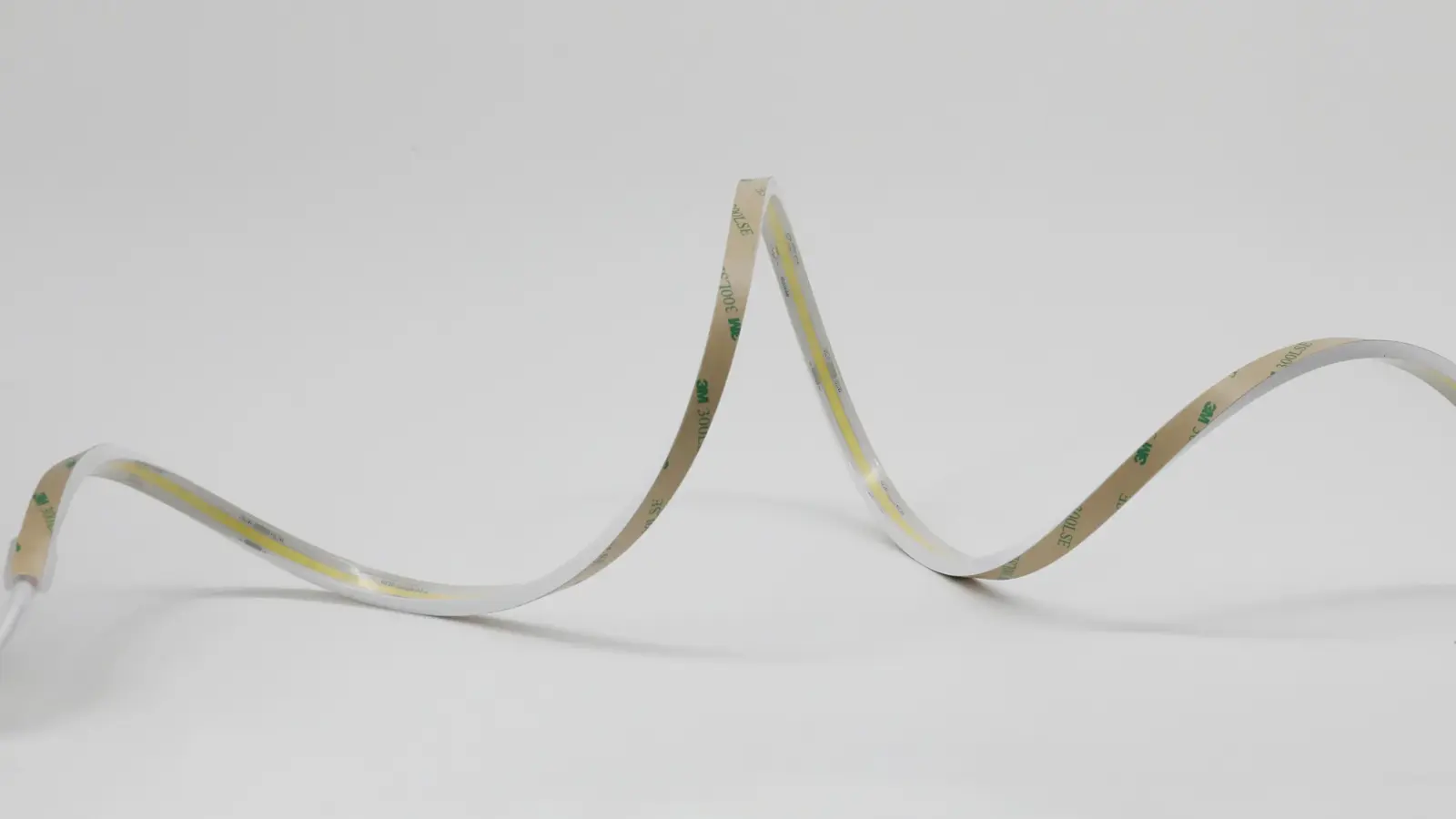
Three heat zones. The hood and the cook line under it belong to the hood manufacturer’s listing and NFPA 96; strip has no place inside or on a hood, and our rule is no strip in the first 2 ft (0.6 m) beside it, which is too hot and too greasy. The warm band around the line, the pass and the plating counter near the heat lamps, is where ambient air can sit above 100 °F on busy nights; here the build is the high-temperature silicone series, UT-O320-8-SA at 2.4 W/ft or UT-O640-10-SA at 4.3 W/ft, rated to +221 °F (+105 °C) and sold in 2700 to 3000K, the same series our sauna guide covers. Everything else, prep, dish, storage and walk-ins, is room temperature or colder, and the standard sealed builds apply.
Two habits protect the strip anywhere: mount it in an aluminum channel so the metal carries heat away, and leave the channel vented, because a strip sealed into a closed shelf cavity over a steam table cooks in its own heat.
Grease: The Film That Insulates
Airborne grease settles on every horizontal surface in a kitchen, and the underside of a shelf is a horizontal surface. On a bare strip the film does two things: it can dim the light within weeks, and it insulates the LEDs so they run hotter. On a diffuser cover it only dims, and it wipes off.
So the rule is a smooth, sealed, wipeable outer surface with no exposed PCB: a silicone-coated or sleeved strip, a polycarbonate cover, and end caps, with nothing that traps grease at the edges. The silicone tolerates the degreasers kitchens use; confirm the facility’s chemical list before the cover material is chosen, because some quaternary sanitizers can cloud some plastics. Plan a wipe-down of the covers on the hood-filter schedule, and tell the kitchen manager that a strip that reads dim usually needs cleaning, not replacement.
Water: Splash, Hose and Standing Water
A kitchen is a wet location in three different ways, and the IP code answers each one differently, as our wet location guide sets out. Splash and steam at the prep line and the pass take IP65, the silicone top-coat UT-O320-8-65 at 2.4 W/ft. The dish room and the pot-wash area are hosed down nightly and water stands on the floor and in the low shelves; that is IP67, the extrusion-sleeve UT-O320-8-67 at 3.0 W/ft, or IP68 where the strip can sit in water, the full-tube UT-O120-12-68. Our CSP sealed builds pass roughly 3 m submersion testing in the IP67 and IP68 versions.
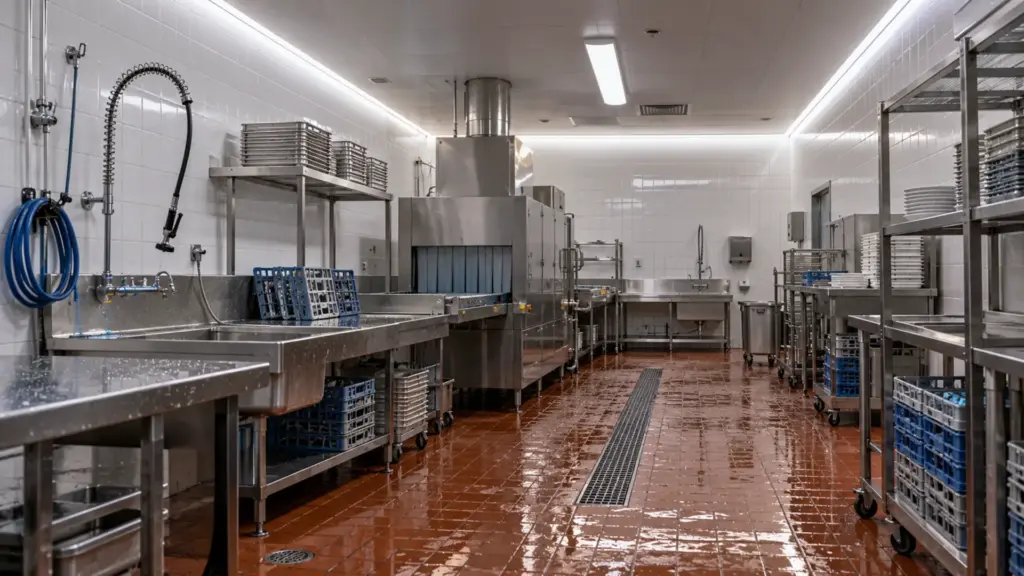
The water rule most installs break is at the ends and the driver. Every cut end is re-sealed with a matching silicone end cap and adhesive, as our cut end sealing guide shows, or the rating is gone at the first hose pass. Connectors match the strip’s rating. And the driver never lives in the dish room: a Class 2 IP20 driver goes in a dry electrical room or above a dry ceiling, or the wet zone gets a potted IP67 driver such as the UT-D100-24-67 in a gasketed box. The IP code says nothing about the wet location marking the inspector looks for; we confirm the marking for the model you specify at quote.
Cold: Walk-Ins and Reach-Ins
Walk-in coolers run near freezing and freezers well below it; the Food Code wants 10 fc at 30 in off the floor in the cooler, and 20 fc inside reach-ins. Cold is kind to LED life, but the door is not: every opening brings warm, humid air that condenses on the coldest surfaces, and a strip and its connectors are among them. The build is the same sealed silicone as the dish room, with the ends capped and the leads brought out through a sealed gland, and the driver outside the box in a dry space.
Our CSP construction has type testing on file for exactly this swing: thermal shock from -40 °F to 212 °F for 500 cycles, 1,000 hours of temperature cycling across the same range, and 1,000 hours at 185 °F (85 °C) and 85% relative humidity with zero measured lumen loss. The CSP LED strip page lists the sealed IP67 and IP68 builds and a continuous operating range of -4 °F to 185 °F; the range of a standard COB or SMD model is confirmed on its datasheet at quote. Inside the walk-in, mount the strip under the front edge of each shelf so it lights the shelf below and the aisle, not the ceiling.
Six Zones, Six Builds
| Zone | Food Code tier | Exposure | Strip build | Where it goes |
|---|---|---|---|---|
| Hood and cook line | 50 fc at the work surface (from the ceiling) | Heat, grease, flame | None | No strip inside the hood, and our rule is none within 2 ft of it |
| Pass and plating counter | 50 fc | Heat from lamps, grease | High-temp silicone UT-O320-8-SA, Ra≥90 | Under the pass shelf, aimed at the plates |
| Prep line | 50 fc at the cutting surface | Splash, steam, grease | IP65 UT-O320-8-65 in an aluminum channel with a PC cover | Under the stainless shelf, front edge, aimed down |
| Dish room and pot wash | 20 fc at 30 in | Hose-down, standing water | IP67 UT-O320-8-67 or IP68 UT-O120-12-68, potted driver outside the room | Under shelves and along the wall-ceiling edge |
| Dry storage | 10 fc at 30 in | Dust, low traffic | Standard sealed strip, or 120V IP65 UT-H120-120 for long perimeters without a driver | Along the shelf edges or the wall-ceiling edge |
| Walk-in cooler and freezer | 10 fc at 30 in | Cold, condensation at the door | Sealed CSP or silicone COB, ends capped, driver outside | Under the front edge of each shelf |
Two notes on the table. The 120V line in dry storage is for the long, driverless perimeter: a direct-AC strip such as UT-H120-120 runs 98 ft (30 m) from a single feed at IP65 and Ra≥80, is wired with line-voltage methods rather than Class 2 rules, and keeps the driver question out of a room that has no electrical closet; our 120V vs 24V guide covers the trade. And the high-CRI question belongs to the pass and the open kitchen, where guests see the food; Ra≥90 is the floor there and the Ra≥98 full-spectrum SMD is the upgrade, while the dish room is lit for the meter, not the eye. Our hotel and restaurant guide places the kitchen in the whole property’s plan.
Rules of Thumb
- No strip inside or beside the hood; the hood listing and NFPA 96 govern there.
- Heat band near the line and the lamps: the +221 °F high-temperature series, in a channel with air.
- Grease: sealed silicone or a PC cover, wiped on the hood-filter schedule.
- Water: IP65 for splash, IP67 for hose-down, IP68 where it stands; every cut end capped; driver dry and outside the wet room.
- Cold: sealed build, leads through a gland, driver outside the box.
- Light levels: 50 fc on the prep surface, 20 fc in the wash areas, 10 fc at 30 in in storage and walk-ins, per the adopted Food Code.
- Shatter resistance: describe the construction, bring the sample, let the health authority rule.
The sealed and high-temperature builds named here are on our outdoor and waterproof LED strip page and the 120V line on its own page; send the kitchen plan with its zones marked and we will match a build and a driver location to each one at quote.