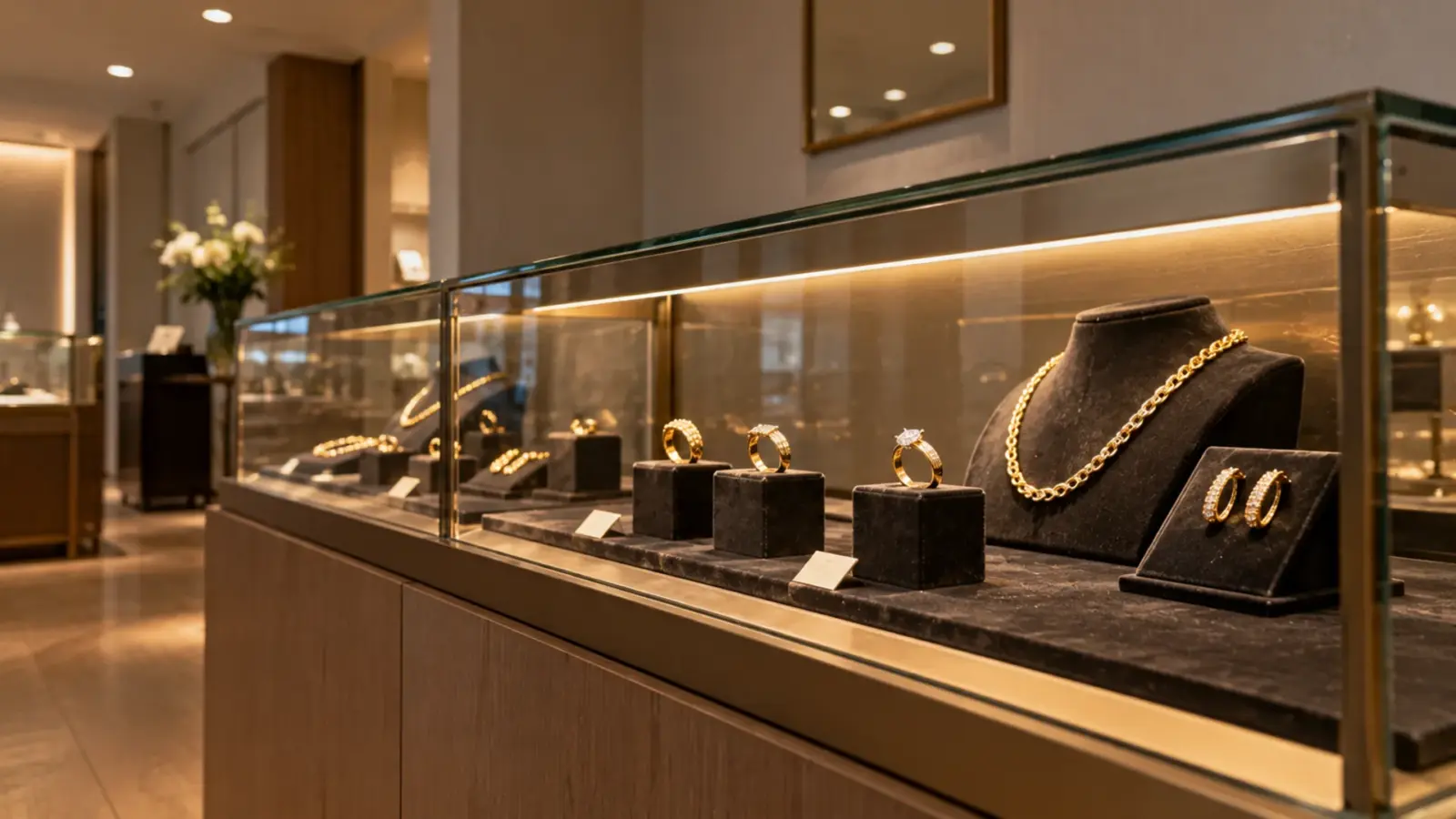
Light jewelry with dot-free strip at Ra 90 or higher: about 3000K for yellow gold, 4000K to 5000K for diamonds and white metals. Set the strip behind the case lip, aimed at the goods and away from the glass, and keep the watts low, because a closed case holds heat.
- Choose color temperature by the metal and the stone, not by the store.
- Ask for the CRI value and, where reds matter, the R9 value.
- Keep the heat load of the strip in the case to single-digit watts per section.
- Use tunable white when one case holds both gold and diamonds.
Decision 1: Color Temperature by Metal and Stone
Jewelry looks right under light that suits the metal around the stone. According to degreefurniture’s guides, warmer light suits yellow gold and cooler light suits silver, white gold and diamonds, and one of them splits the range as 4000K to 6200K for diamond and 2000K to 3500K for gold. Another recommends a neutral 3000K to 4000K as a safe middle that avoids distorting gem color. These are vendor figures; they agree on the direction and differ on the numbers.
| Goods | Starting point | Why |
|---|---|---|
| Yellow gold | 2700K to 3000K | Warm light keeps the metal rich, not brassy |
| White gold, silver, platinum | 4000K to 5000K | Neutral to cool light keeps the metal clean |
| Diamonds | 4000K to 5000K | Cool light shows the sparkle and the color grade |
| Colored stones, pearls | 3000K to 4000K | Balanced light avoids shifting the hue |
| Mixed case | Tunable white | One strip, set per section |
The values our strips list are 2700K to 6000K or 6500K on COB, so every row above is available. A show window or a long run of cases deserves the same discipline: choose the value once, order all the strip for it from one production run, and keep the cases that share a sight line on the same bin so that gold in one case and gold in the next look like the same gold. Use one color temperature per case and per sight line; two neighboring cases at different values look like a mistake from across the shop. Our color temperature guide and the 4000K vs 5000K comparison explain the trade-offs.
Decision 2: CRI, R9 and the Reds
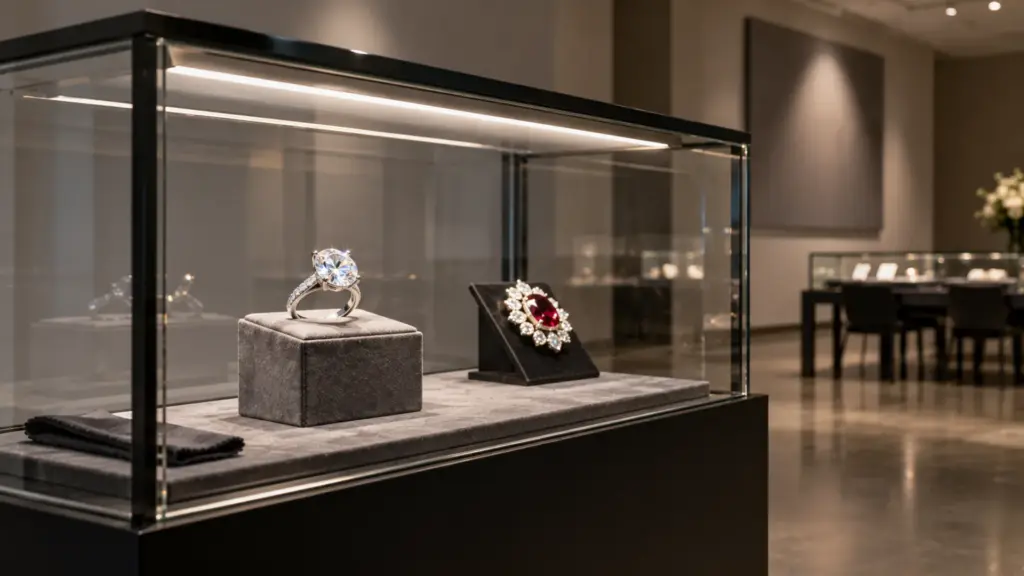
CRI is the single biggest factor in how stones look, and the sources agree on it. According to one vendor guide, standard 80 CRI strip makes gold look brassy and diamonds look flat, and CRI above 90 is the usual recommendation for retail displays. Our standard COB models list Ra≥90 and our SCOB model UT-SC320CRI97-15 lists Ra≥97.
Ra is an average of eight pastel samples and does not weigh deep red. For rubies, garnets and red coral, ask for R9. It is not published on our spec table, so we confirm it at quote. Our guide to CRI 90, 95 or 98 sets out what each level costs in output and when the extra points show.
The higher-CRI strip draws more power per foot. UT-SC320CRI97-15 is 4.6 W/ft against 2.4 W/ft for UT-C320-8, which matters in the next section.
Decision 3: Heat in a Closed Case
LEDs run cool compared with halogen, and a closed glass case still collects the heat. According to the vendor guides, fixtures in enclosed spaces need to be properly rated and the case should not build up hazardous heat. The practical way to size it is watts per section.
| Strip | W/ft on our spec sheet | Load for a 3 ft section |
|---|---|---|
| UT-C400-3, 3 mm PCB | 2.1 | 6.3 W |
| UT-C320-8, 8 mm PCB | 2.4 | 7.2 W |
| UT-CSP-512-CCT, tunable white | 2.44 | 7.3 W |
| UT-SC320CRI97-15, Ra≥97 | 4.6 | 13.8 W |
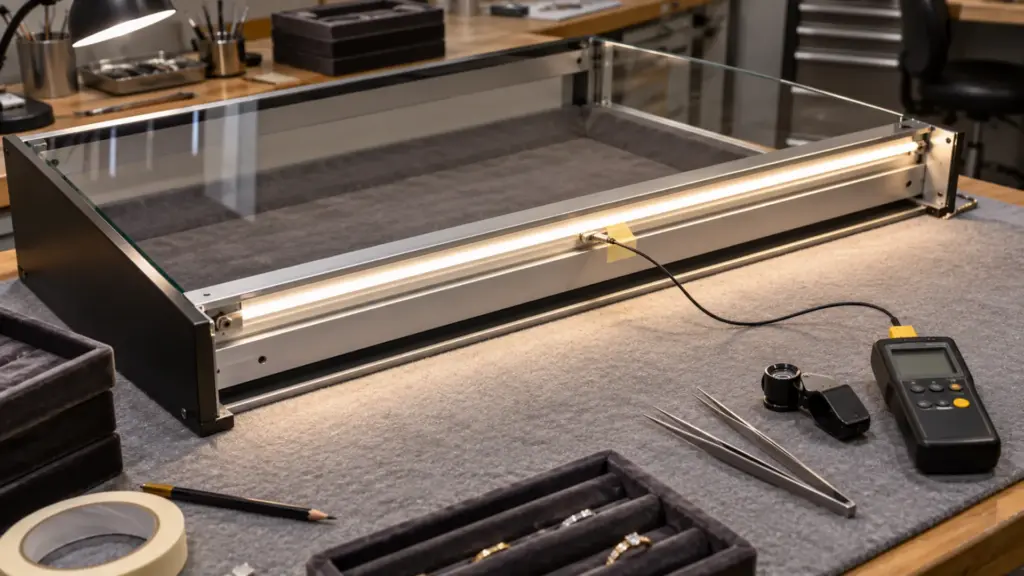
The Ra≥97 strip puts about twice the heat into the same section as the standard one. That is a fair price for color, and it decides the detail: mount the strip on an aluminum channel, leave a path for air at the top and back of the case, and dim the strip rather than run it at full output. Our thermal management guide works through why a high-watt strip needs aluminum behind it, and the compact UT-CH1207 channel (12 × 7 mm, 8 mm strip) fits a case lip where room is tight.
Where the case is sealed and the load is more than a few watts, ask whether a lower-wattage strip with a tighter pitch gives the same light with less heat. The lumens per foot guide shows how to compare them.
Placement: Where the Strip Sits Relative to the Glass
The strip belongs where it lights the goods and does not show in the glass. Three positions work in a jewelry case:
- Behind the top front lip, set back and aimed down and slightly forward. This is the default and gives a soft gradient down the front of the goods.
- On the inner side posts, aimed across, which avoids the shadow under a chain and lights the sides of a ring.
- Under a glass shelf, aimed up, for goods that sit on the shelf above; use a diffused line and mind the glass edge.
Standard SMD strip puts its points on the glass; dot-free COB strip reads as a single line, as in our retail displays guide. A vendor guide in our sources also warns that standard strip hot-spots behind a backlit panel, which is a depth problem covered in our backlit panel guide.
Glass, Mirrors and Reflections
A jewelry case is mostly glass and sometimes mirror, and every reflective surface repeats the strip. A mirrored back panel doubles the goods and the light, which looks rich when the line is hidden and harsh when it shows. Check three reflections in the mock-up: the strip in the front glass, the strip in the back mirror and the strip in the polished metal of the goods themselves. A line set back behind the lip and aimed down shows in none of them. A line set on a side post and aimed straight at the viewer shows in all three.
Short Cases and Cut Intervals
Many jewelry sections are 2 to 3 ft long, and the cut interval decides how much of that is lit. UT-C400-3 cuts every 0.39 or 0.79 in, so a 30 in section lights to within 0.4 in or less. UT-C320-8 cuts every 0.98 or 1.97 in, which can leave a stub of up to 1.97 in at the end of a 30 in section. The side-view UT-C320-6-SV cuts every 0.25 in and suits a side post where light must reach the end. CSP mini-cut strip goes down to 0.39 in on UT-CSP-300-MC12 on a 12V supply. Check the interval on the model you quote against the shortest section on the plan.
A Worked Case: Six Feet of Showcase
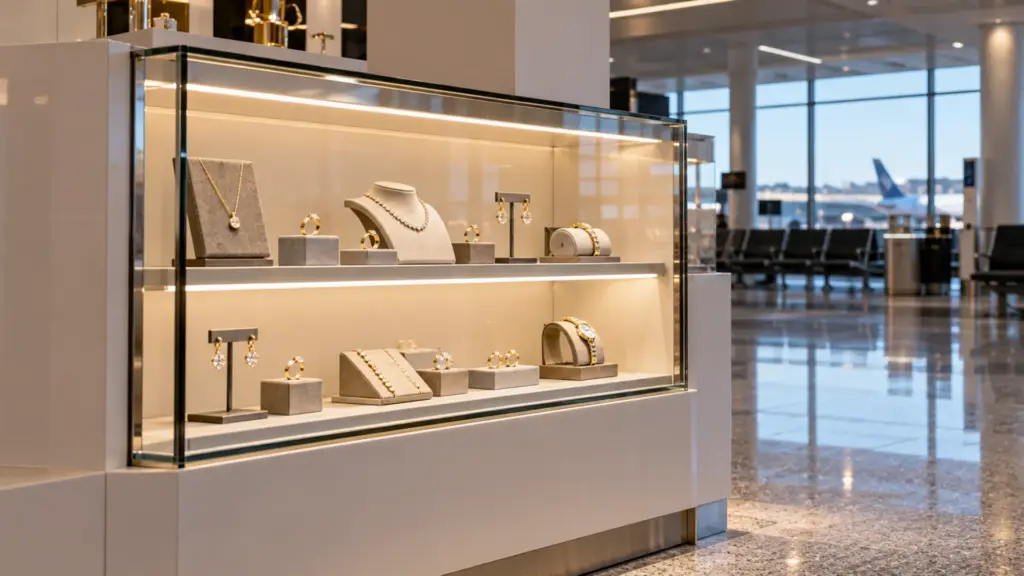
Take a 6 ft counter case with three 2 ft sections: one for yellow gold, one for diamonds and one for colored stones. A strip at the top front lip and one on each side post gives six runs of about 2 ft.
| Section | Strip | CCT | Strip length | Load |
|---|---|---|---|---|
| Yellow gold | UT-C400-3, 2.1 W/ft | 3000K | 2 ft lip + 2 × 1 ft posts = 4 ft | 8.4 W |
| Diamonds | UT-SC320CRI97-15, 4.6 W/ft | 5000K | 4 ft | 18.4 W |
| Colored stones | UT-C320-8, 2.4 W/ft | 4000K | 4 ft | 9.6 W |
| Case total | 12 ft | 36.4 W |
About 36 W of strip in a 6 ft closed case is a heat load to plan for, and the diamond section is half of it. Moving the diamond section to UT-C320-8 at 5000K would cut the case to about 27.6 W (4 ft × 2.4 = 9.6 W for that section, plus the other two sections), at Ra 90 instead of Ra 97. That is the trade: color accuracy against heat, and the jeweler decides. Each run is under 16 ft, so voltage drop is not a limit, and the driver size is set by the total and by the case’s driver space.
Mixed Cases: Tunable White and Dimming
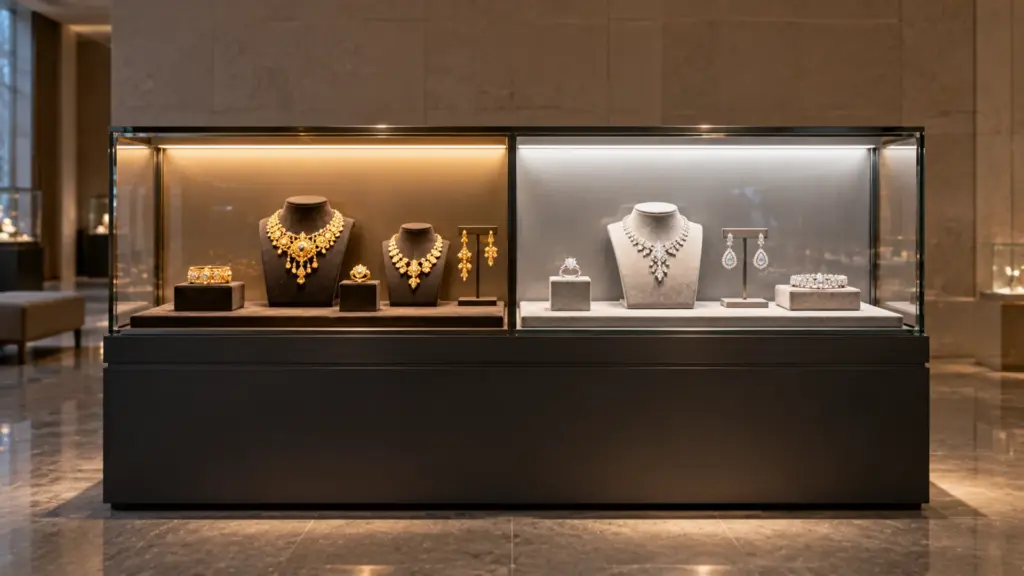
A jeweler rarely sells one metal. A tunable strip lets one case run 3000K over gold and 5000K over diamonds, or move with the day: warmer on a quiet afternoon, cooler on a bright Saturday. Tunable white strip uses two channels, and UT-CSP-512-CCT mixes 2700K and 6500K. Where the shop wants a warm glow as the light is dimmed, dim-to-warm is the simpler choice.
Test the lowest level in the actual case. A strip that is steady at full output can flicker at 5% on a small driver, and a jewelry case is the kind of display that is looked at closely.
Mistakes That Show Up on the Counter
Jewelry cases fail in a few repeatable ways, and the customer sees them before the owner does.
- One CCT for the whole case. Gold and diamonds want different light; a compromise at 3500K-style neutral flattens both. Use two sections or tunable white.
- Strip on the front lip at eye level. The line appears in the glass; set it back and aim it down.
- A hot driver inside the case. Put the driver outside, in the base or the counter, with an air path.
- No test with the real goods. A sample of gold, a sample of stones and a mirror behind them will show problems a drawing cannot.
- Ra 80 strip because it was cheaper. The price saved is small on a case; the brassy gold is what the customer remembers.
FAQ
What color temperature is best for jewelry display lighting?
It depends on the metal. Warm 2700K to 3000K suits yellow gold, and 4000K to 5000K suits diamonds, silver and white gold. Mixed cases use tunable white.
What CRI should jewelry display lighting have?
Ra 90 or higher as a floor, and higher where color grading matters. Ask for the R9 value where red stones are sold. Our SCOB model lists Ra≥97.
Do LED strips damage or heat jewelry?
LED strip emits very little ultraviolet, and heat is the case problem rather than the light. Keep the wattage low, mount on aluminum and dim where you can. Check the case for hot surfaces if the strip is sealed in with the goods.
Is LED strip better than spot lighting in a jewelry case?
Strip gives even light across the whole case, and spots give sparkle on single pieces. Many cases use both: strip for the base light and a small spot for a feature piece.
Before You Order
Run the mock-up with the actual goods: a gold ring, a diamond solitaire, a colored stone and a silver chain, on the actual backing, with the actual glass. Look at it from the customer’s height and from across the counter, at full output and at the dimmed level the shop will use. Photograph the result under the shop’s other lights, and write the approved CCT, CRI and strip model into the order.
Settle five things on the case drawing: the metal and stone in each section, the CCT for each, the CRI and R9 required, the watts per section and the cut interval against the shortest run. Send the drawings and we match COB strip and channels to the cases and check the loads before anything is quoted: request a quote.