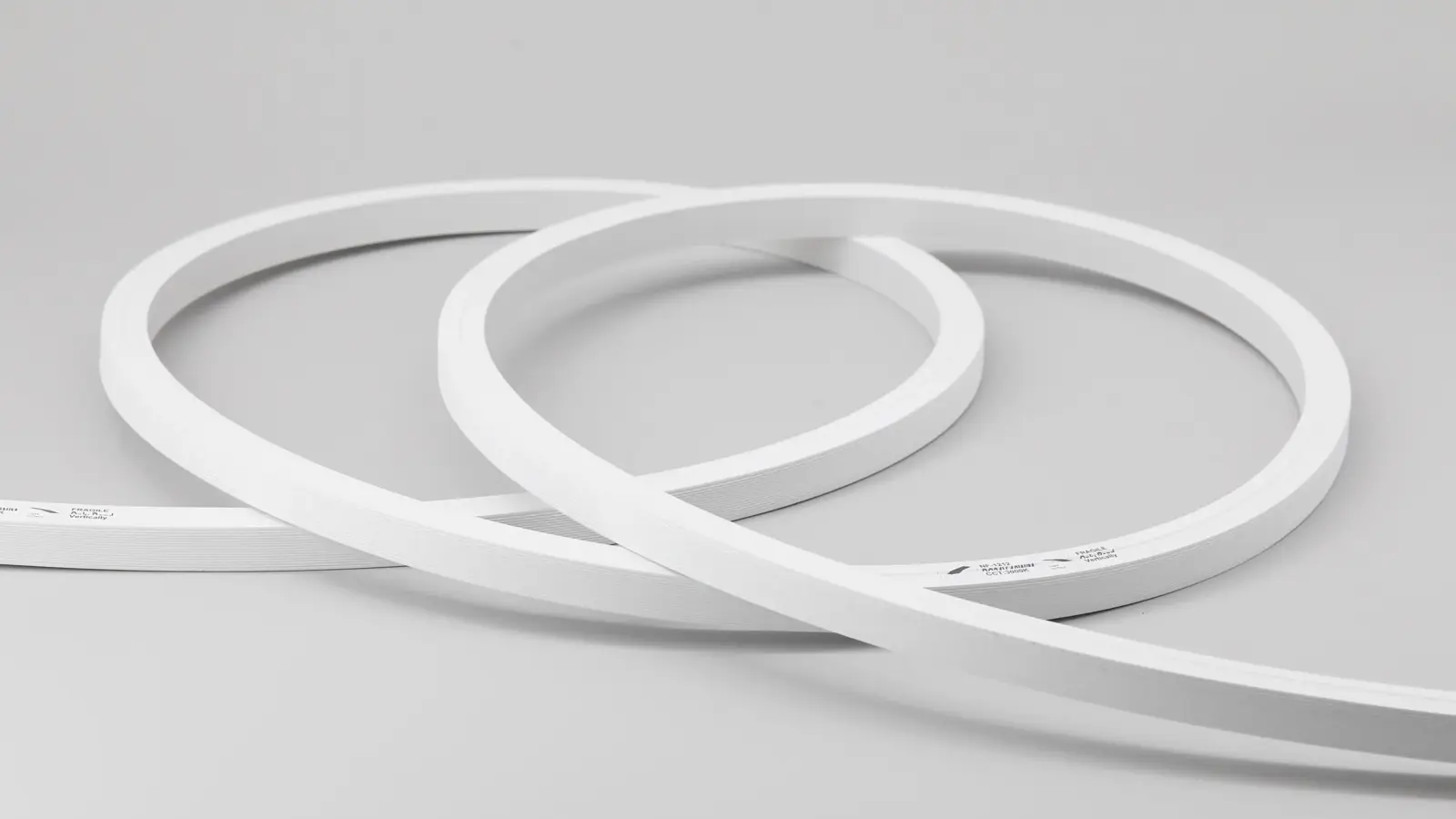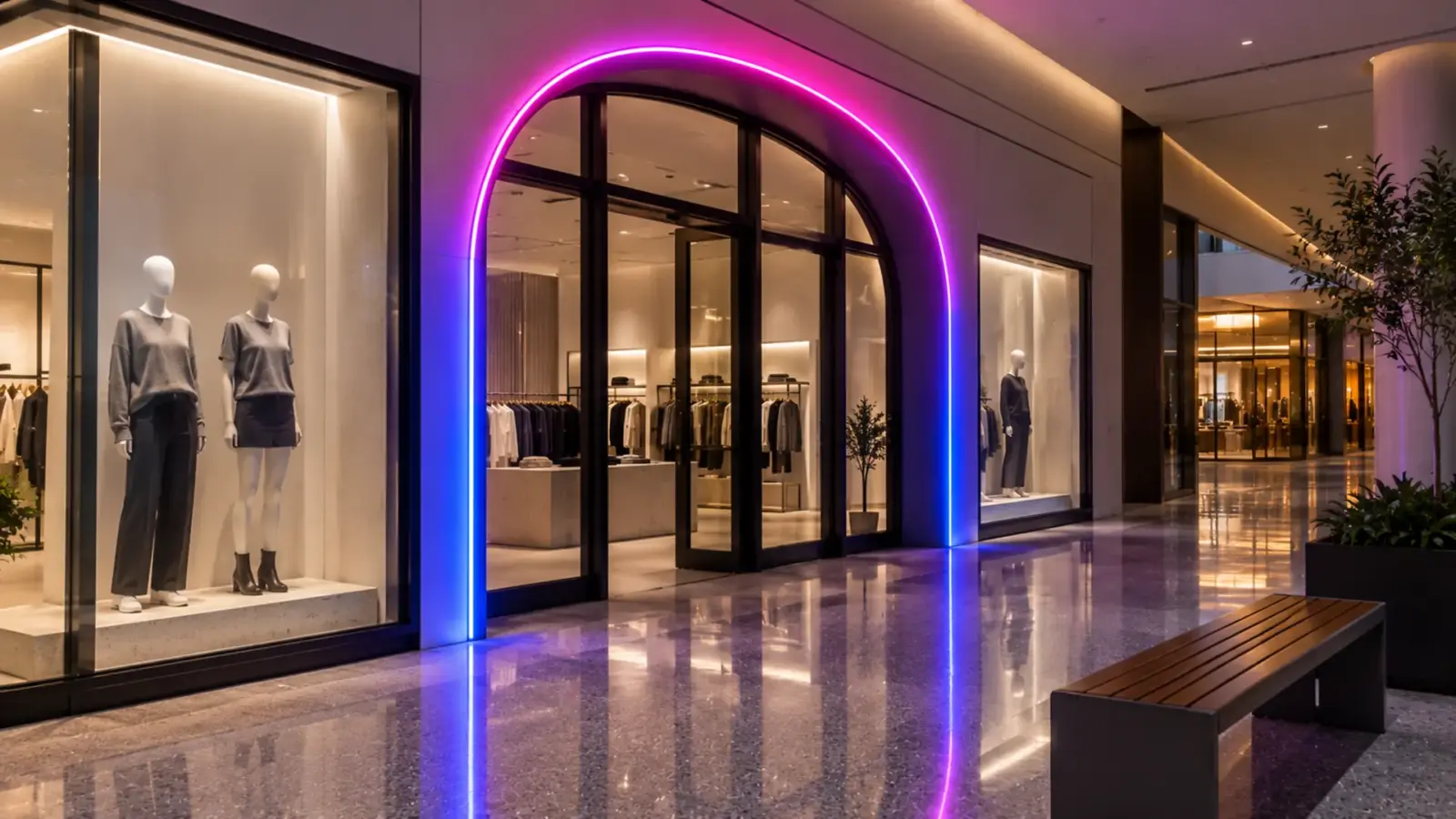
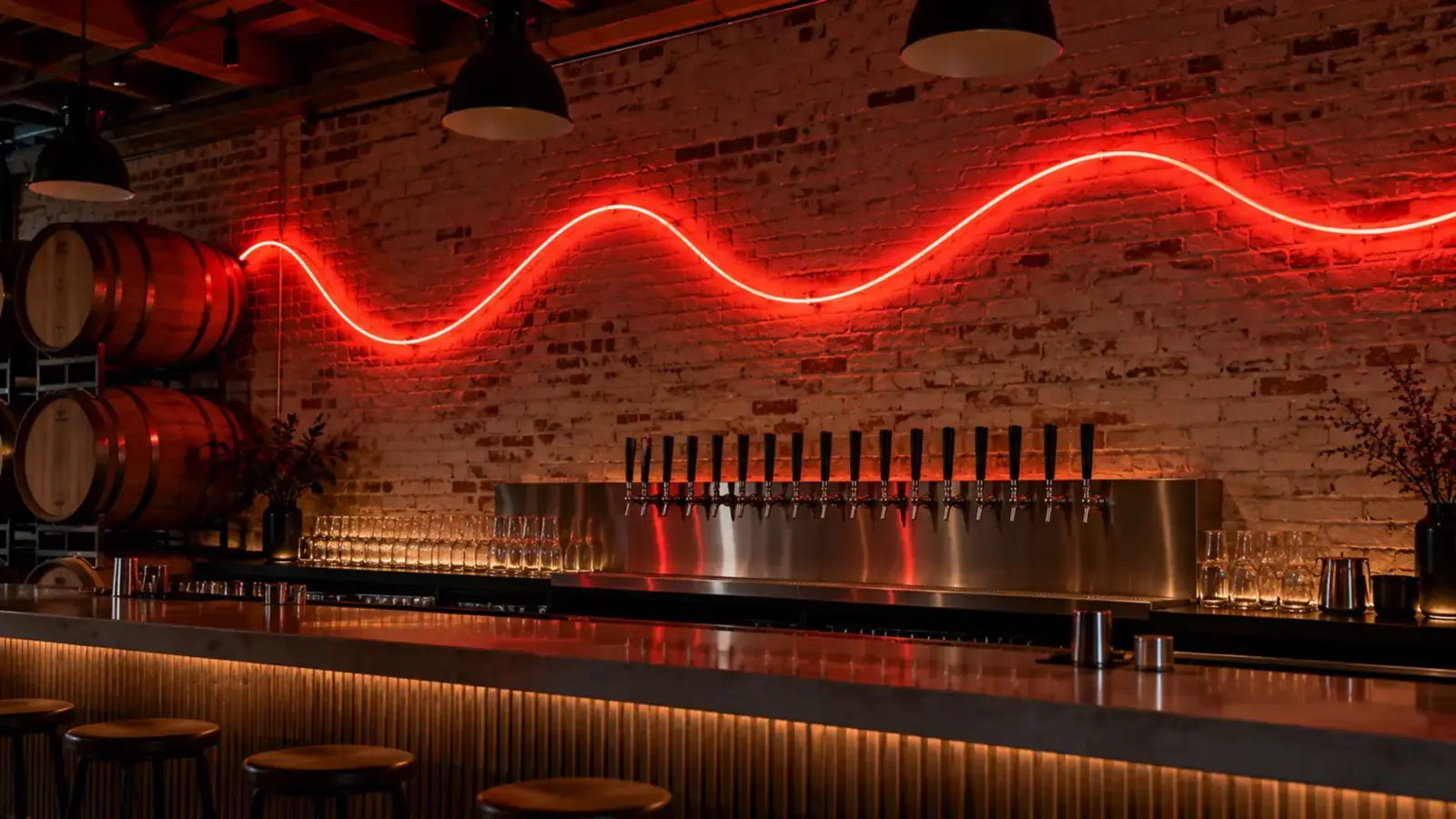
For a new sign or outline, LED neon flex is the default. It runs on 24V instead of the thousands of volts glass neon needs, bends by hand on site, survives knocks and weather, and goes in with ordinary low-voltage work. Glass still wins when the client is paying for the glass itself.
That verdict holds on the three things a contractor quotes on: what it costs to build and keep running, how long it lasts and what fails, and how it gets through inspection. The rest of this page takes them in turn.
Side by Side
| LED neon flex | Glass neon | |
|---|---|---|
| Operating voltage | 24V DC from a driver | 3,000–15,000V from a neon transformer |
| How it is made | Cut to length from a reel on site | Tubes bent by hand to a full-size pattern |
| Power, typical | 2.4–6.1 W/ft on our profiles | About 15–20 W/ft, according to sign-industry figures |
| Rated life | 50,000 hours (our profiles) | Commonly cited around 10,000 hours |
| Breakage | Silicone body, flexible | Glass; a crack can put out the whole tube |
| Outdoor rating | IP67 on our standard profiles | Depends on housings and transformer |
| Depth on the wall | Shallow, about 1 in for a typical LED sign | 3–5 in with tube supports, according to Radikal Neon |
| Dimming and color change | Dimmable; RGB, RGBW and addressable versions | Fixed color per tube |
| Who installs | Electrical contractor | Neon bender and sign installer |
Cost: What You Pay For, Up Front and Later
We do not quote prices here, but the cost structure explains why the two compare the way they do.
| Cost item | LED neon flex | Glass neon |
|---|---|---|
| Fabrication | Profile cut on the marks, end caps fitted | Each tube bent, processed, filled and tested by a specialist |
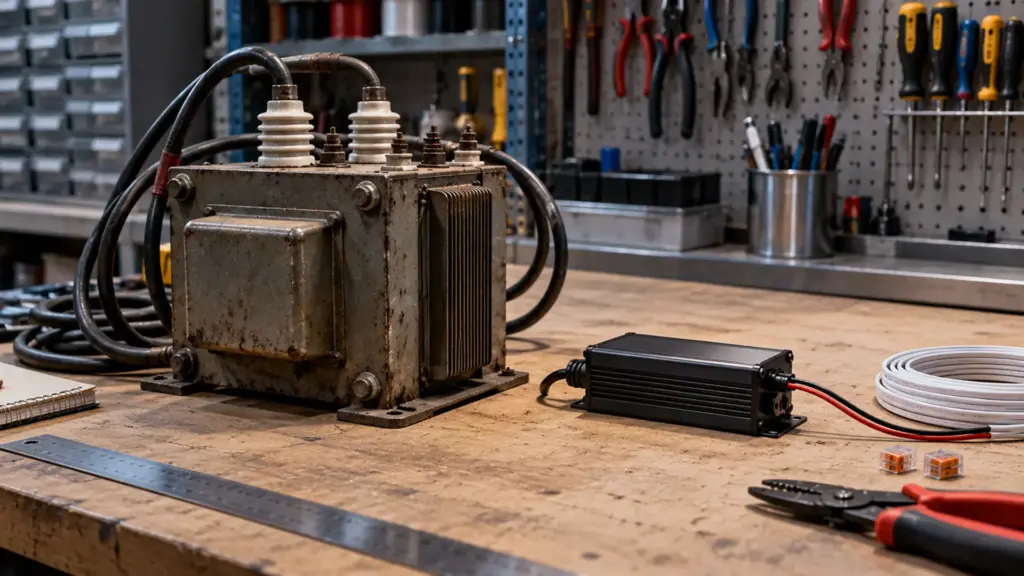
| Power supply | Low-voltage driver | High-voltage transformer |
| Mounting | Clips or aluminum channel | Tube supports and standoffs |
| Wiring | Low-voltage feed, often Class 2 | High-voltage cable with its own clearances |
| Changes on site | Cut, re-cap, re-feed | New tube from the bender |
| Repair | Replace a section | Remake the broken tube |
The glass side carries skilled labor at every step, and any change made after fabrication goes back to the bench. On the LED side most of the work is ordinary installation, and a damaged section is cut out and replaced. That is the main reason LED flex usually costs less to build and less to keep; a specific project’s numbers depend on size, color and how many changes come later.
Running Energy: A 40 ft Sign Worked Through
Take a 40 ft outline lit 12 hours a day, every day: 4,380 hours a year.
| Power at the source | With driver or transformer losses | Energy per year | |
|---|---|---|---|
| LED flex, UT-N1010-TB at 3.0 W/ft | 120 W | 132–156 W (10–30% overhead) | about 580–680 kWh |
| Glass neon at 15–20 W/ft | 600–800 W | Not separated in the source figure | about 2,630–3,500 kWh |
Our arithmetic. The LED overhead range is Custom Neon’s estimate for drivers and controllers; the glass figures are the sign-industry numbers PC Tech Magazine reports. Other sources give glass ranges both lower and much higher, so treat the glass row as an order of magnitude. Multiply by your own electricity rate to compare cost; even at the low end, the glass sign uses several times the energy.
A larger LED profile draws more: UT-N1616-TB is 4.3 W/ft and UT-N3017-TB 6.1 W/ft. The ratio to glass stays large.
Lifespan and What Fails First
Our neon profiles are rated for 50,000 hours. Glass neon is commonly cited around 10,000 hours, though PC Tech Magazine notes a glass tube left undisturbed can run for decades; its life depends on the electrode seals, the transformer and slow loss of gas.
What fails is more useful than the hours:
- Glass: a crack or broken electrode seal puts the whole tube out; transformers fail and are replaced by a sign technician; tubes dim as gas is lost and need reprocessing.
- LED flex: the weak points are the joints and the cut ends, where water can get in if a cap is badly sealed, and the driver. Both are ordinary repairs. Our installation guide covers sealing the ends so they do not fail.
Code and Listing
Signs and outline lighting have their own article in the NEC, Article 600, and the code expects signs to be listed and marked. Electric signs are evaluated to UL 48; neon transformers and power supplies are covered by their own standard, UL 2161. A finished sign’s listing belongs to the sign maker who builds and labels it, whichever light source is inside.
- 1Light sourceLED flex + 24V driverOr tubes + transformer
- 2Sign makerBuilds and labelsHolds the sign listing
- 3Listed signUL 48The finished sign
- 4InstallationNEC Article 600Signs and outline lighting
- 5RetrofitOwn listing routeConfirm before converting
For a contractor, the differences that matter on site:
- Voltage. Glass neon brings high-voltage wiring, clearances and a transformer to the job. LED flex runs on low voltage from a driver, which often allows Class 2 wiring methods; the supply’s marking decides that, as our NEC guide explains.
- Who signs off. A sign is usually inspected as a sign, so check with the AHJ which listing they expect to see on the finished piece.
- Retrofits. Replacing glass tubes with LED flex in an existing sign changes the sign’s construction. LED retrofit kits for signs have their own listing route; confirm with the sign’s listing holder or the AHJ before converting a listed sign.
For the strip itself, our UL listing guide explains which standards apply to LED strip and flex.
Installation: Who Can Do It
Glass neon is a trade of its own: the tubes are bent and processed by a neon bender, and installing and servicing the high-voltage side needs someone who works with it. LED neon flex is cut, capped, mounted and wired by an electrical contractor. Our neon page puts it in one line: any electrical contractor can install it, with no neon-bending trade required.
That changes the schedule as much as the cost. A design change on site is an afternoon with LED flex and a new tube order with glass.
Look and Brightness
Glass neon glows all the way around the tube, and gas-filled tubes have color qualities that are hard to copy exactly. Most LED neon flex emits from one face, which is what you want on a wall and less convincing in free air. Round 360° profiles such as UT-ND18-360 and UT-ND25-360 come closest to the tube look for suspended or freestanding work.

LED flex adds what glass cannot do: dimming, tunable white, RGB and RGBW color, and addressable versions that animate along the line. Our neon selection guide covers profiles and bend directions.
Color: Gas, Coatings and LEDs
Glass neon gets its color from the gas in the tube and from coatings on the inside of the glass: neon gas glows red-orange, other gases and coated tubes give the rest of the palette. That is the source of the depth people recognize in a glass sign, and each tube is one color for its life.
LED neon flex gets its color from the LEDs and the jacket over them. Our profiles come in single colors, tunable white, RGB and RGBW, and SPI addressable versions, so one sign can change color or animate along the line. A mockup lit next to a glass reference is the honest way to judge a color match when a client brings one.
Shipping, Handling and Spares
Glass tubes are crated, handled with care and replaced by the bender who made them; a spare is a second tube made to the same pattern. LED flex ships on reels or cut to the pattern, and a spare is a length of the same profile from the same lot, with end caps. On a phased job or a multi-site rollout, keeping spares of LED flex is a box on a shelf.
Durability Outdoors
Our standard neon profiles are rated Dust-tight, and protected against temporary immersion in water. The usual rating for wet or outdoor runs that are not submerged all the time., and UT-N1616-68 is IP68 with an IK10 impact rating. Glass tubes outdoors rely on their housings and on careful mounting, and they do not take impact. For storefronts, canopies and anything within reach, LED flex is the safer choice; the ends and the joints still need sealing to keep the rating.
FAQ
Is LED neon flex cheaper to run than glass neon?
Yes, by a wide margin. Our profiles draw 2.4 to 6.1 W/ft, while sign-industry figures put glass neon around 15 to 20 W/ft. For a 40 ft sign lit 12 hours a day, that is roughly 580 to 680 kWh a year for LED flex against 2,600 kWh or more for glass.
How long does a glass neon sign last?
Glass neon is commonly cited at around 10,000 hours, though an undisturbed tube can run much longer. Its life depends on the electrode seals, the transformer and gas loss. Our LED neon profiles are rated for 50,000 hours.
Do LED neon signs need a transformer?
They need a low-voltage driver, not a neon transformer. Our LED neon flex runs on 24V DC from a driver sized to the load, often a potted outdoor unit such as UT-D100-24-67 for exterior signs.
Can LED neon flex replace glass tubes in an existing sign?
Physically, yes: the flex follows the same pattern on clips or channel, and a 24V driver replaces the transformer. Because it changes a listed sign’s construction, confirm the retrofit with the sign’s listing holder or the AHJ first.
When Glass Still Makes Sense
Glass neon is still the right answer for heritage signs that are being restored rather than replaced, for art pieces and interiors where the hand-bent tube is the point, and for colors and glows a client has seen in glass and will not accept a substitute for. In those cases the cost, the high voltage and the maintenance are part of what is being bought.
For everything else, from storefronts and canopies to wayfinding and architectural outlines, we supply LED neon flex cut to the pattern, with end caps, feeds and drivers matched to each run. Send the artwork or the elevation with the run lengths and request a quote; the profiles are on our LED neon flex page.