A 64 ft cove of UT-C320-8 COB at 24V needs four feed points, one every 16 ft. The 48V strip in the same 8 mm width, UT-C480-8-48V, draws the same 2.4 W/ft and runs the whole 64 ft from one feed. At the same light output, the voltage changes the current, and the current decides the rest.
That is the comparison this page makes: 12V, 24V and 48V LED strip at the same watts per foot, so the light on the ceiling is the same and only the electrical side changes. The short verdict:
- 24V is the default for commercial work: the widest range of strip, drivers and controls.
- 48V pays on long, unbroken runs where every extra feed means another driver location or another wire pulled through a finished ceiling.
- 12V earns its place on short pieces where a finer cut step matters, and on 12V systems.
Same Light, Three Voltages: Only the Current Changes
Brightness comes from the LEDs and the power they get, not from the supply voltage. Two strips at 2.4 W/ft with the same LEDs give about the same light whether they are wired for 12V, 24V or 48V. What changes is the current needed to deliver those watts: current equals watts divided by volts, so it halves each time the voltage doubles.
| Same 2.4 W/ft, 64 ft run (154 W) | 12V | 24V | 48V |
|---|---|---|---|
| Current per foot | 0.20 A | 0.10 A | 0.05 A |
| Current for the whole run | 12.8 A | 6.4 A | 3.2 A |
| Our strip at this output | UT-C320-8 (12V) | UT-C320-8 (24V) | UT-C480-8-48V |
| Rated run per feed | 16 ft (5 m) | 16 ft (5 m) | 65 ft (20 m) single feed |
| Feed points for 64 ft | 4 | 4 | 1 |
Current per foot and per run are our arithmetic (W/ft × length ÷ voltage); run limits are from the COB LED strip spec table.
The SMD range shows the same pattern. UT-S2835-120 at 12V or 24V draws 4.4 W/ft and is rated 16 ft (5 m) per feed. UT-S2835-160-48V draws the same 4.4 W/ft and is rated 49 ft (15 m) from a single feed. Both are 10 mm, Ra≥90, 2700–6500K, listed on our SMD LED strip page.
Lower current means less voltage lost in the copper of the strip itself, which is why the 48V versions carry further before the far end dims. Our voltage drop guide walks through why the drop happens after the driver.
Gate 1: Run Length per Feed
Start with the longest continuous run on the drawing and the places where a feed can reach it. That single number settles most voltage decisions.
On our spec tables, standard 12V and 24V strip is rated 16 ft (5 m) per feed. Some 24V COB series go further: UT-C384-8 reaches 32 ft (10 m). The 48V series reach 65 ft (20 m, UT-C480-8-48V) and 49 ft (15 m, UT-S2835-160-48V) from one feed. These are per-model figures, rounded down, and a different model will have a different number. Read the row for the model on your schedule; do not carry one strip’s limit to another.
What the feed count means on site:
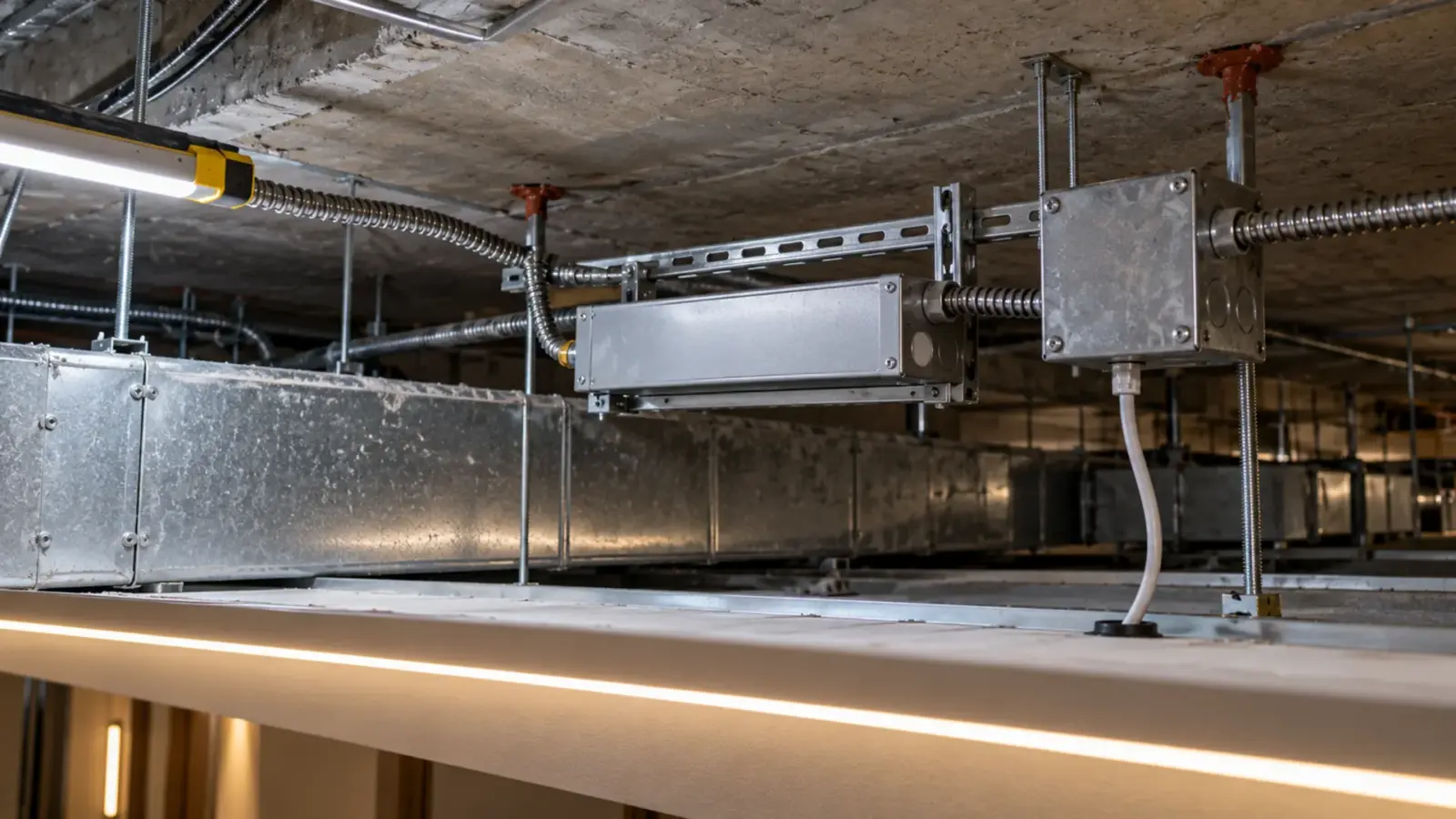
- Each feed is a wire pulled from the driver location to a point on the run, and each one needs a path through the ceiling or millwork.
- Each feed point is a joint that can fail and needs access later.
- Short runs gain nothing from 48V. A 12 ft under-cabinet run is one feed at any voltage.
A typical job: a 64 ft perimeter cove in a hotel ballroom pre-function area, with the driver closet at one end. At 24V the cove needs four feed points spaced along the run, so three of the four home runs travel 16, 32 and 48 ft inside the cove before they reach their section. At 48V the one feed lands at the closet end.
Constant Current: The Fourth Answer
Constant-current strip keeps 24V and regulates the current along the run instead. UT-C480-8-CC (2.3 W/ft) and UT-S2835-140-CC (3.7 W/ft) are rated 65 ft (20 m) on one feed. If the controls, drivers or the rest of the job are standardized on 24V, constant current gives most of the reach of 48V without a second supply voltage on site. The trade is a smaller choice of models.
Gate 2: Cut Pitch and the Length of the Detail
The cut step decides how close the lit length can get to the length of the detail, and that matters most on short pieces.
| Strip | 12V cut step | 24V cut step | 48V cut step |
|---|---|---|---|
| UT-C320-8 / UT-C480-8-48V (COB, 8 mm) | 0.98 in (25 mm) | 1.97 in (50 mm) | 1.97 in (50 mm) |
| UT-S2835-120 / UT-S2835-160-48V (SMD, 10 mm) | 0.98 in (25 mm) | 1.97 in (50 mm) | 1.97 in (50 mm) |
On a 30 in cabinet or a 22 in shelf, a 0.98 in step leaves at most about 1 in unlit; a 1.97 in step can leave up to about 2 in. Inside a channel with an opal cover that gap shows as a short dark end. On a 60 ft cove nobody sees 2 in.
One finding from our own tables: our 48V strips cut at the same 1.97 in step as the 24V versions. Published guides often say 48V forces much longer cut steps; on these models it does not. Check the cut column for the exact model before assuming either way.
Where the finest step matters most, some 12V strips go further still: UT-C320-6-SF, a 6.6 mm solder-free COB, cuts every 0.49 in (12.5 mm), at 10 ft (3 m) per feed.
Gate 3: Drivers, Dimmers and Controls
A voltage is only usable if the rest of the system exists at that voltage.
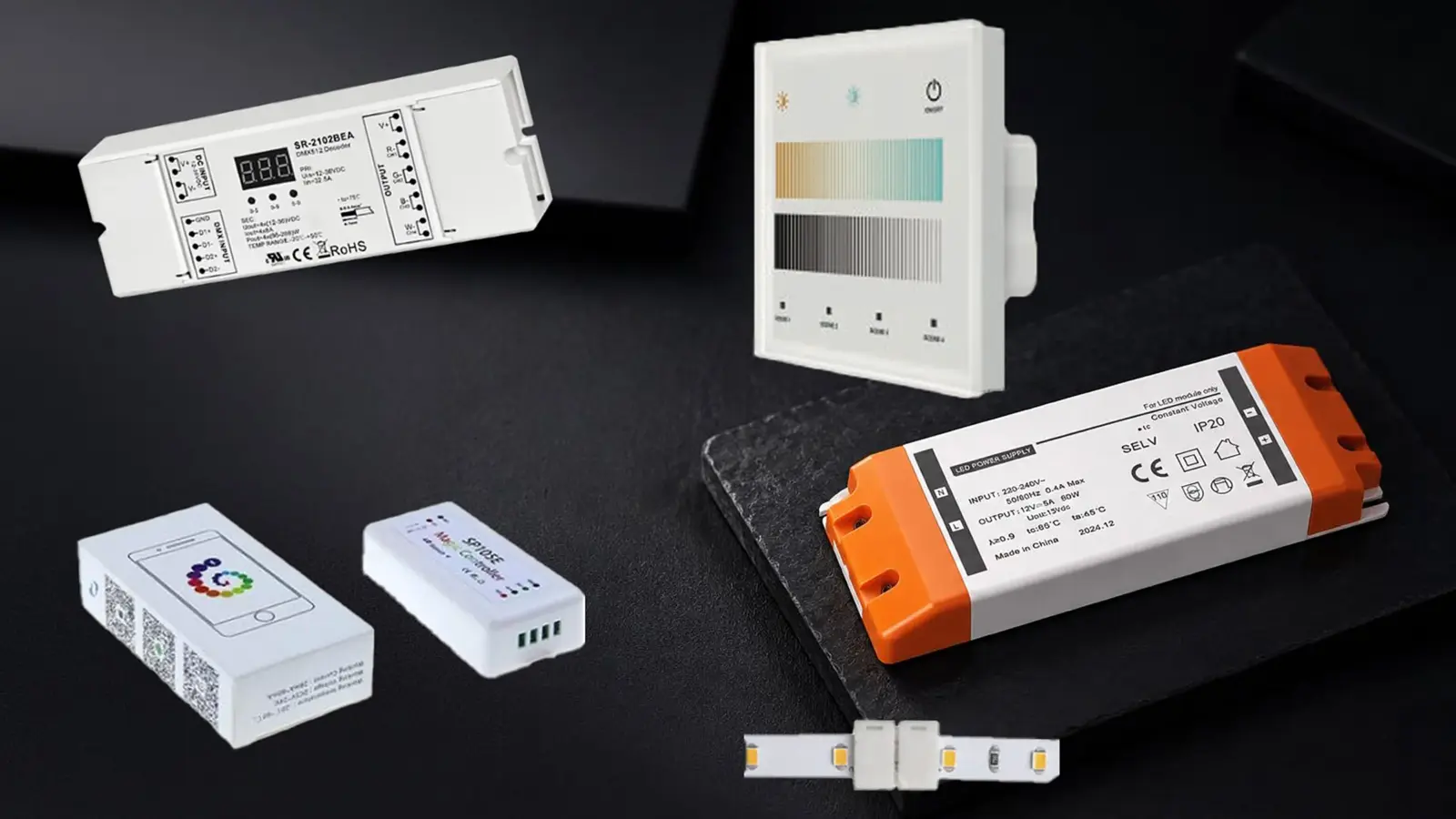
- 24V has the full range. Our drivers, controllers and connectors table lists Class 2 24V supplies at 40 W and 60 W (UT-D40-24-C2, UT-D60-24-C2), a 0-10V Class 2 version (UT-D60-24-C2-010), TRIAC (UT-D60-24-TRC) and potted IP67 units.
- 12V shares much of it. UT-D60-1224-67 outputs 12V or 24V; the 0-10V decoder UT-C010-350 and the DALI DT8 controller UT-CDALI-DT8 take 12–24V DC.
- 48V is narrower. Our table has no 48V output driver, and the decoders above are rated 12–24V input, so 48V supplies and dimming are matched to the strip at quote. Allow for that on a schedule that names one driver family for the whole job.
- Color and tunable strip is mostly 24V. Tunable white, RGB and RGBW in our range are 12V or 24V. The 48V models are single-color white, COB and 2835.
A 48V strip on a 24V supply lights dimly or not at all; a 24V strip on a 48V supply is overdriven and fails. Mark the voltage on the drawing next to each run and on the driver schedule, so a substitution cannot cross voltages.
Gate 4: Location, Class 2 and the Inspector
Higher voltage does not change the rule that the supply decides the circuit class: a Class 2 supply is marked on its label, and the cable and wiring method follow from that. What 48V changes is how much one long feed carries.
The 64 ft run above draws about 154 W at any voltage. One Class 2 circuit cannot carry that much, so at 48V the single feed either comes from a supply that is not Class 2, with the wiring method that goes with it, or the run is split across two Class 2 circuits. At 24V the four 38 W sections each sit on their own Class 2 supply at about 64% load. Our power supply sizing guide covers the loading rule.
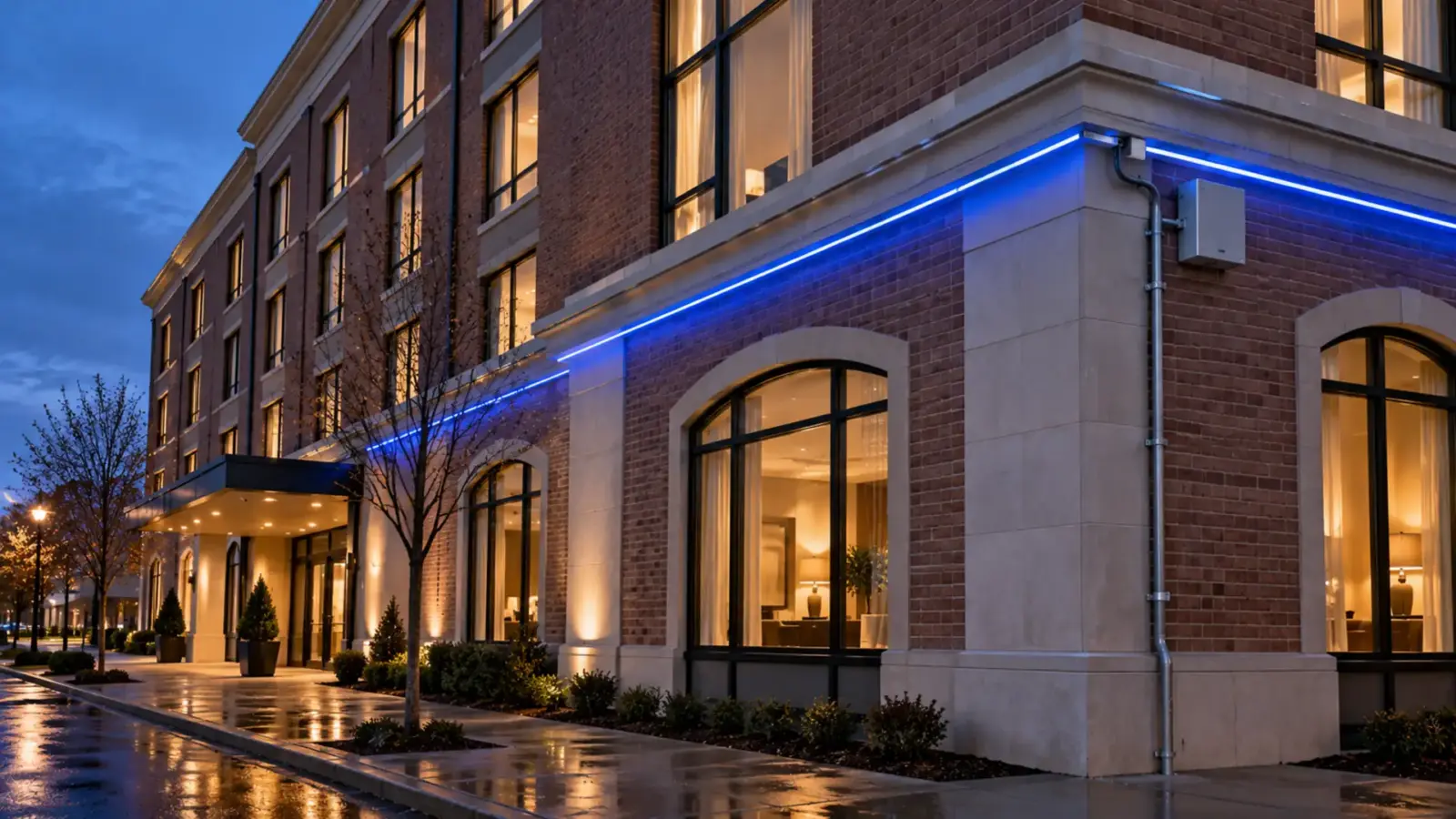
Outdoors and in wet areas, ask before the drawing is final. Class 2 limits are stricter where wet contact is likely, and 48V sits closer to those limits than 24V. Settle 48V in a wet location with the supply’s listing and the AHJ. Our NEC guide explains which edition applies where.
A Second Example: A 98 ft Corridor Slot
A brighter strip changes which limit binds first. Take a 98 ft ceiling slot down a school corridor in UT-S2835-120 at 4.4 W/ft, about 431 W in total.
| 98 ft at 4.4 W/ft (431 W) | 24V, UT-S2835-120 | 48V, UT-S2835-160-48V |
|---|---|---|
| Rated run per feed | 16 ft (5 m) | 49 ft (15 m) single feed |
| Sections on the run | 7 (six of 16 ft, one of 2 ft) | 2 of 49 ft |
| Load per full section | 70 W, 2.9 A | 216 W, 4.5 A |
| Fits one 60 W Class 2 supply at 80% | No: 48 W per supply means sections of about 10 ft | No |
At this output the Class 2 power budget, not the voltage, sets the number of supplies. At 24V the run either splits into sections of about 10 ft, each on its own 60 W Class 2 supply, or the 16 ft sections go on larger non-Class 2 drivers such as the UT-D150-24-L. At 48V the two 49 ft sections each need a supply above any Class 2 rating, so the wiring method for the feeders changes with it.
Neither answer is wrong; they cost different things. More, smaller supplies keep every circuit Class 2 and spread the driver locations along the corridor. Fewer, larger supplies mean fewer feeds and fewer driver locations, with feeders run as a non-Class 2 circuit. Decide this on the drawing, with the electrical engineer, before the slot is framed.
Wire From the Driver to the Strip
The drop in the feed wire follows the same arithmetic. Take one 38 W section (16 ft at 2.4 W/ft) fed through 30 ft of 18 AWG two-conductor cable, 60 ft of copper out and back:
| Voltage | Current | Volts lost in the cable | Share of supply voltage |
|---|---|---|---|
| 12V | 3.2 A | 1.23 V | 10.2% |
| 24V | 1.6 A | 0.61 V | 2.6% |
| 48V | 0.8 A | 0.31 V | 0.6% |
Our arithmetic: 18 AWG copper at 6.385 Ω per 1,000 ft, the same table our feed-wire voltage drop calculator uses for any gauge and length. At 12V the same cable loses a tenth of the voltage before the strip starts, so the 12V job needs heavier cable or shorter home runs. Halving the voltage doubles the current and doubles the volts lost; because the supply voltage is also halved, the percentage lost is four times larger.
For comparison, Hitlights reports measuring a 2.68 V drop (11.2%) along a 20 m run of its 24V strip, and notes that the same drop on 12V would be about 22%.
Which Voltage by Application
| Application | Usual pick | Why |
|---|---|---|
| Under-cabinet and shelf runs under 10 ft | 12V or 24V | One feed either way; 12V cuts finer |
| Coves up to about 16 ft per section | 24V | Widest choice of strip, drivers, dimming |
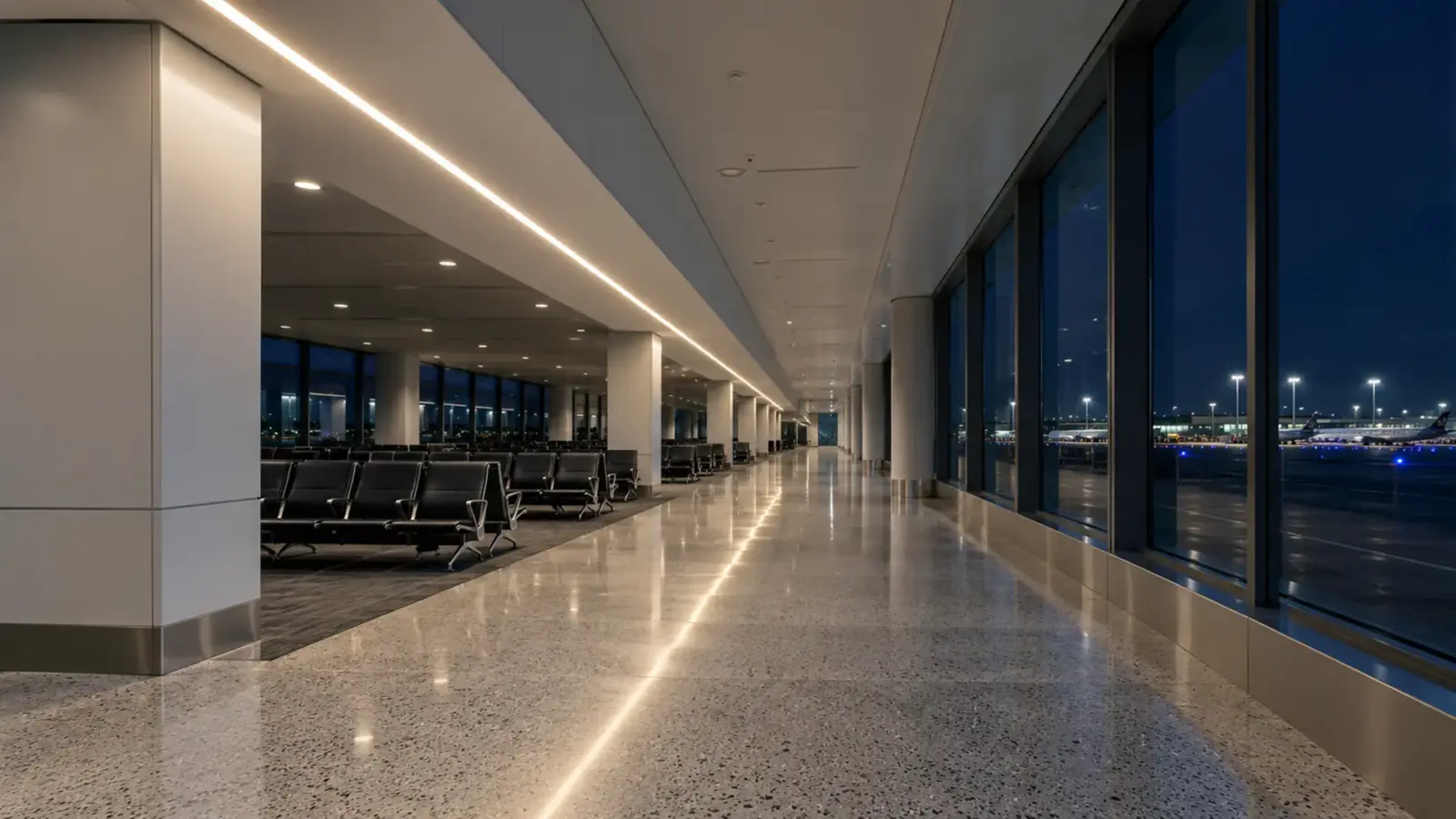
| Long perimeter coves, corridors, slots over 32 ft | 48V or 24V constant current | One feed instead of several |
| Facades, soffits, canopies | 24V; 48V or constant current where feeds are hard to reach | Check wet-location rules first |
| Tunable white, RGB, RGBW | 24V | Our color and tunable ranges are 12V/24V |
| Line-voltage runs with no room for drivers | 120V strip | See our 120V vs 24V guide |
Mistakes That Cost a Second Visit
- Choosing 12V for a long cove because the first sample was 12V. The run then needs heavier feeders and more feed points than the 24V version of the same strip.
- Mixing voltages on one controller. A decoder that takes 12–24V input cannot run a 48V section; that run needs its own dimming path.
- Feeding a 48V run from one supply without checking the Class 2 load. A long run can exceed one Class 2 circuit; split it or change the wiring method before rough-in.
- Assuming 48V means long cut steps. On our 48V models the step is the same 1.97 in as 24V; on other makers’ strips it may not be.
- Ordering by voltage alone. Brightness is set by W/ft and the LEDs; compare lumens per foot at the same CCT, as our lumens per foot guide shows.
FAQ
Is 24V LED strip brighter than 12V?
No. A 24V strip and a 12V strip at the same watts per foot with the same LEDs give about the same light. The 24V version draws half the current, so it loses less voltage along the run and in the feed wire, which keeps the far end closer to full brightness.
Can I run 48V LED strip from a 24V driver?
No. A 48V strip on a 24V supply lights dimly or not at all, and a 24V strip on a 48V supply is overdriven and fails quickly. Match the supply output to the strip’s rated voltage, and keep the two voltages on separate, labeled drivers.
Is 48V LED strip Class 2?
The strip does not set the class; the supply does. A 48V supply can be a listed Class 2 unit, but one Class 2 circuit carries limited power, and a long single-feed 48V run can need more than that. Check the load against the supply’s marking, and confirm 48V in wet locations with the AHJ.
Does 48V LED strip cost more to install?
The strip is one part. 48V can remove feed points, drivers and home runs on long runs, while it can narrow the choice of drivers and dimmers. On short runs it saves nothing, because the feed count does not change.
Decision Rule
Pick 24V by default. Move to 48V, or to 24V constant current, when a single run is long and unbroken, feeds are hard to reach, and the job’s dimming does not need color or tunable white. Keep 12V for short pieces where a 0.98 in cut step shows, and for 12V systems.
If you are choosing now, send the reflected ceiling plan with the run lengths and the driver locations. We will check each run against the per-feed limit of the model, count the feeds at 24V and 48V, and match the supplies and dimming before anything is quoted: request a quote.