

LED strip feed-wire voltage drop calculator
The cable from the driver to the strip loses voltage before the strip even starts. Enter the run and the cable, and see how much, whether it passes your limit and the smallest gauge that does.
Feed wire from driver to strip
Two-conductor copper cable, one home run. The result counts the cable only; add the strip's own drop from its spec table.
What the number counts, and what it leaves out
-
01
The formula
Volts lost = current × resistance per 1,000 ft × 2 × one-way length ÷ 1,000. Current is the load divided by the strip voltage. The 2 is the conductor out and the conductor back.
-
02
What it leaves out
The strip's own copper, the joints and connectors, and the driver's regulation. The run limit per feed comes from each model's spec table, not from this page, and that limit still applies.
-
03
Where the values come from
Solid copper resistance at 68°F (20°C). The 167°F (75°C) option scales by the copper temperature coefficient, which lands within a few percent of the NEC Chapter 9 Table 8 column for the gauges it lists.
Copper resistance used by the calculator
Ohms per 1,000 ft of one conductor. Stranded cable reads a few percent higher than solid; the difference is inside the rounding of a field measurement.
| AWG | Ω per 1,000 ft at 68°F | Ω per 1,000 ft at 167°F | Where it belongs |
|---|---|---|---|
| 26 | 40.81 | 49.62 | Strip leads, inches only |
| 24 | 25.67 | 31.21 | Strip leads and pigtails |
| 22 | 16.14 | 19.63 | Jumpers under a few feet |
| 20 | 10.15 | 12.34 | Short jumpers at low current |
| 18 | 6.39 | 7.76 | Home runs under 10 ft at 24V |
| 16 | 4.02 | 4.88 | Home runs to about 25 ft at 4 A, 24V |
| 14 | 2.53 | 3.07 | The common 24V home run |
| 12 | 1.59 | 1.93 | Long home runs, or 12V systems |
| 10 | 1.00 | 1.21 | Long 12V runs; consider moving the driver |
| 8 | 0.63 | 0.76 | Rare for low-voltage lighting |
The guides behind the numbers

Why Does the Far End of an LED Strip Go Dim?

How to Size an LED Strip Power Supply, From Watts to Class 2 Limits

12V, 24V or 48V LED Strip? Compare Them at the Same Light Output
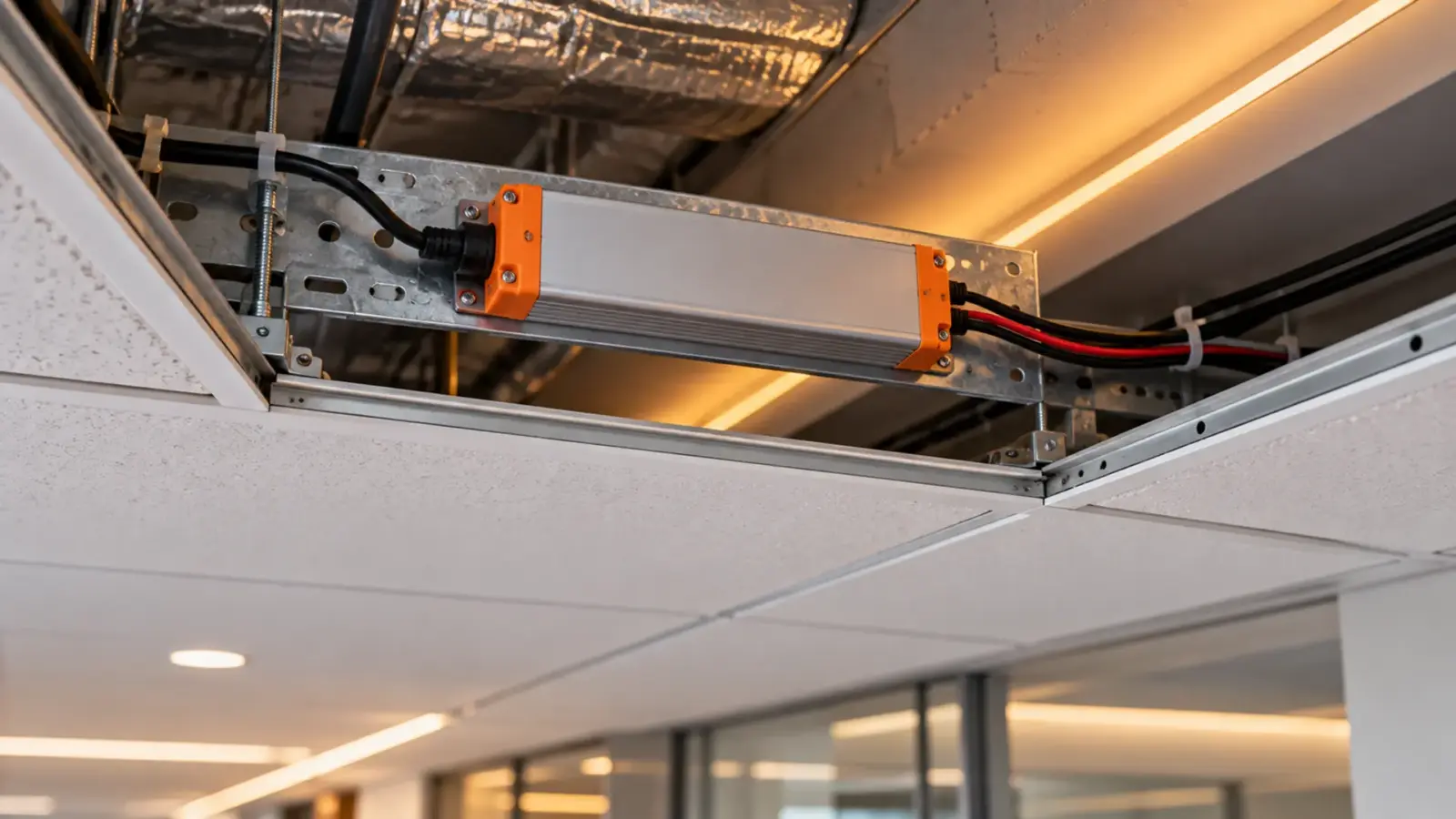
What Does the Inspector Check on a Class 2 LED Driver?

When Constant-Current LED Strip Beats 24V Constant Voltage

A Remote LED Driver Is Limited by Its Cable, Not Its Rating
Reading the result
Does the calculator include the voltage drop inside the strip?
No. It counts the cable between the driver and the first feed point only. The strip's own copper loses voltage along the run as well, and that part is set by the model: each spec table lists a run limit per feed that already allows for it. Keep the strip within its limit and use this page for the cable.
Why is the cable length doubled?
Current flows out on one conductor and back on the other, so a 25 ft home run is 50 ft of copper. Enter the one-way distance from the driver to the strip and the calculator doubles it.
Which temperature should I pick?
Use 68°F for a cable in open air or a cool plenum, and 167°F when the cable runs warm, such as bundled in a driver enclosure or an attic in summer. Warm copper resists more, so the hot column is the safe side for sizing.
What percentage drop is acceptable?
There is no code figure for low-voltage DC lighting cable. Common practice is to keep the cable under about 3 percent and the whole path, cable plus strip, under about 5 percent, because the eye notices the far end before the numbers look large. At 12V the same watts draw twice the current, so a 3 percent cable at 24V becomes about 12 percent at 12V.
Can I use this for 120V AC strip?
No. At 120V the current for the same load is a fraction of the low-voltage case, and the branch circuit is sized to the NEC rather than to a percentage at the strip. The calculator is for 12V, 24V and 48V DC feeds from a driver.
Send the layout and we size the feed
Reflected ceiling plan, run lengths and driver locations are enough. An engineer replies with the feed points, cable sizes and driver schedule, in writing.
- 1 reel minimum
- Drawings welcome
- US-based support