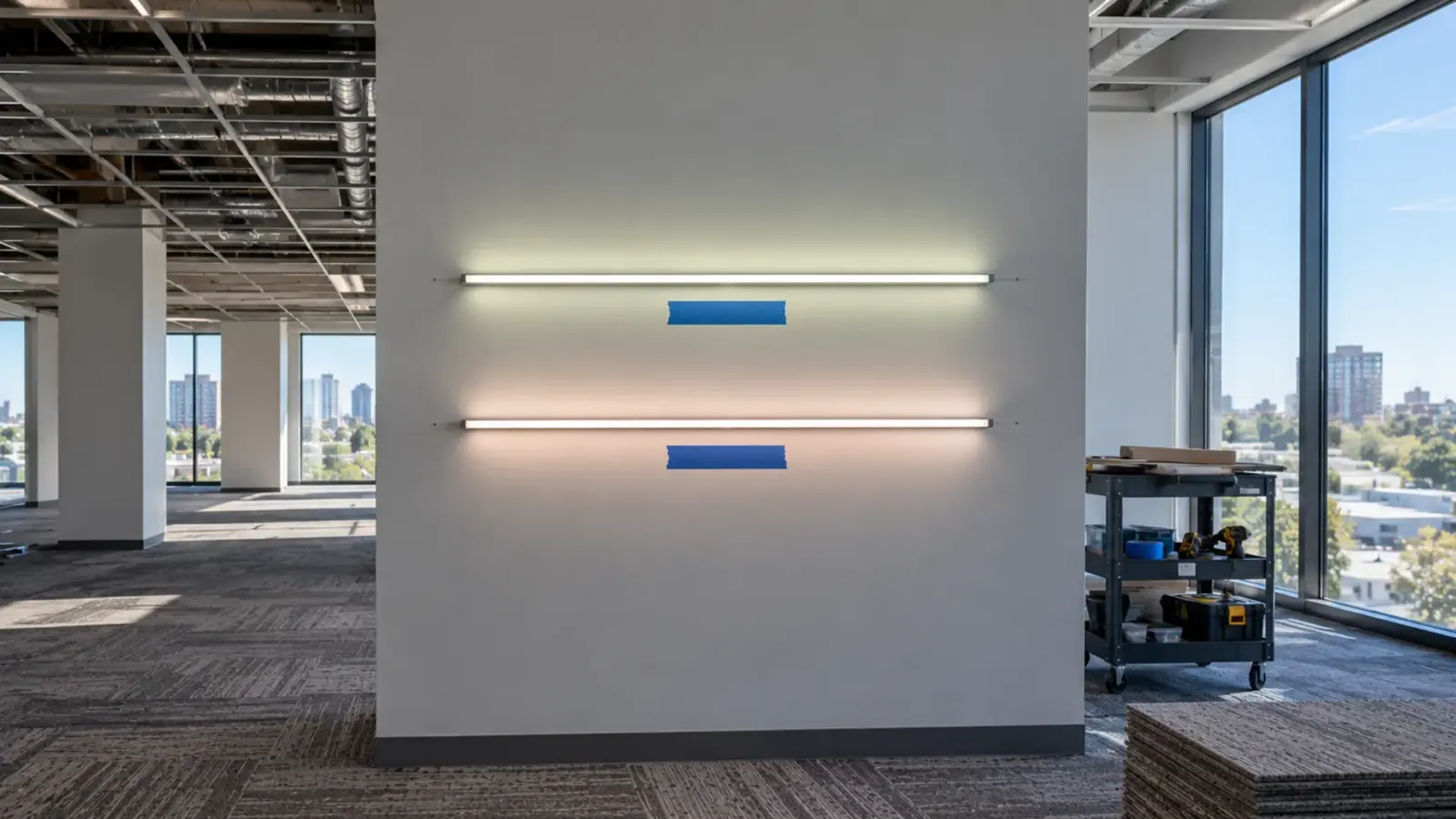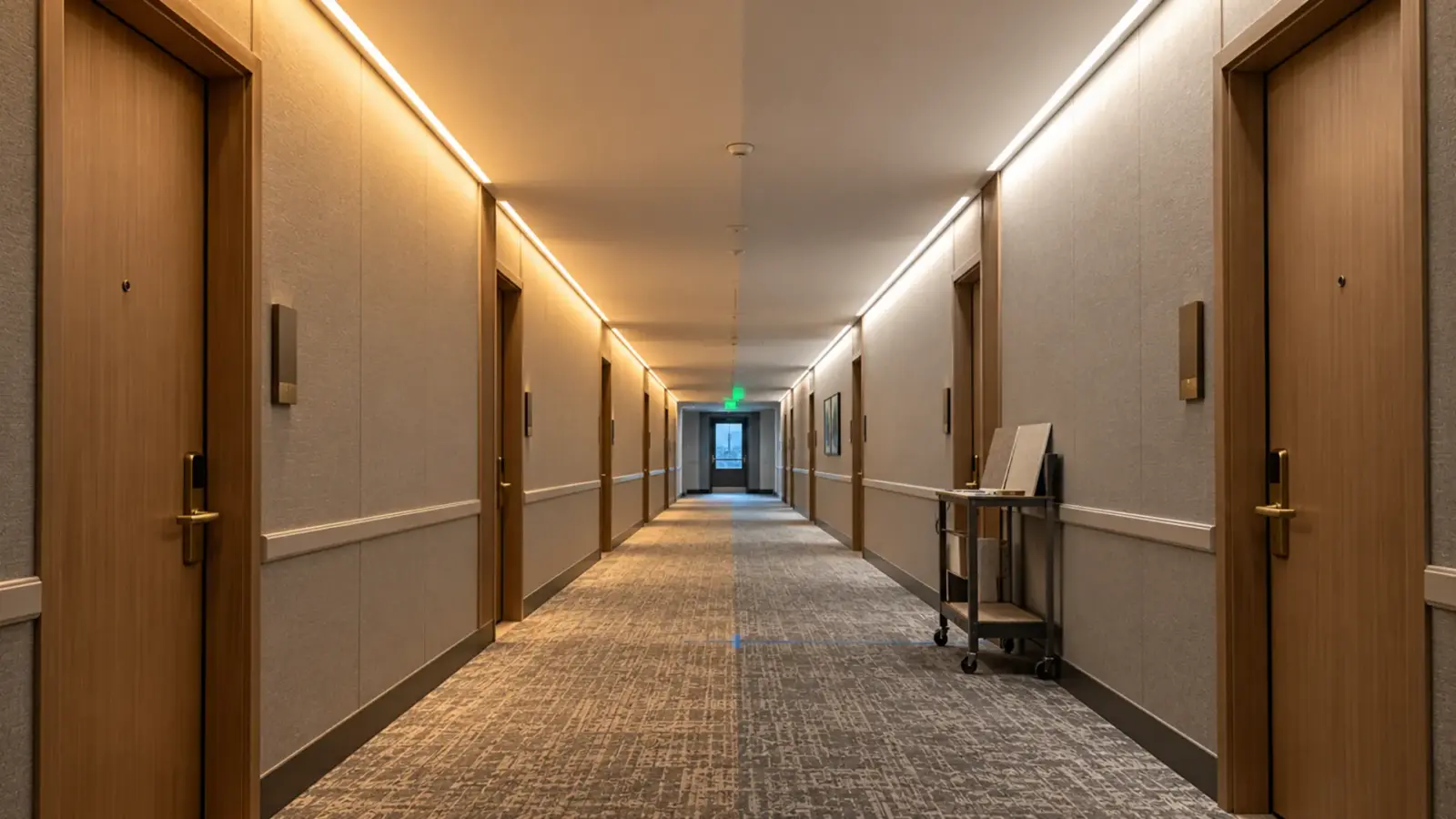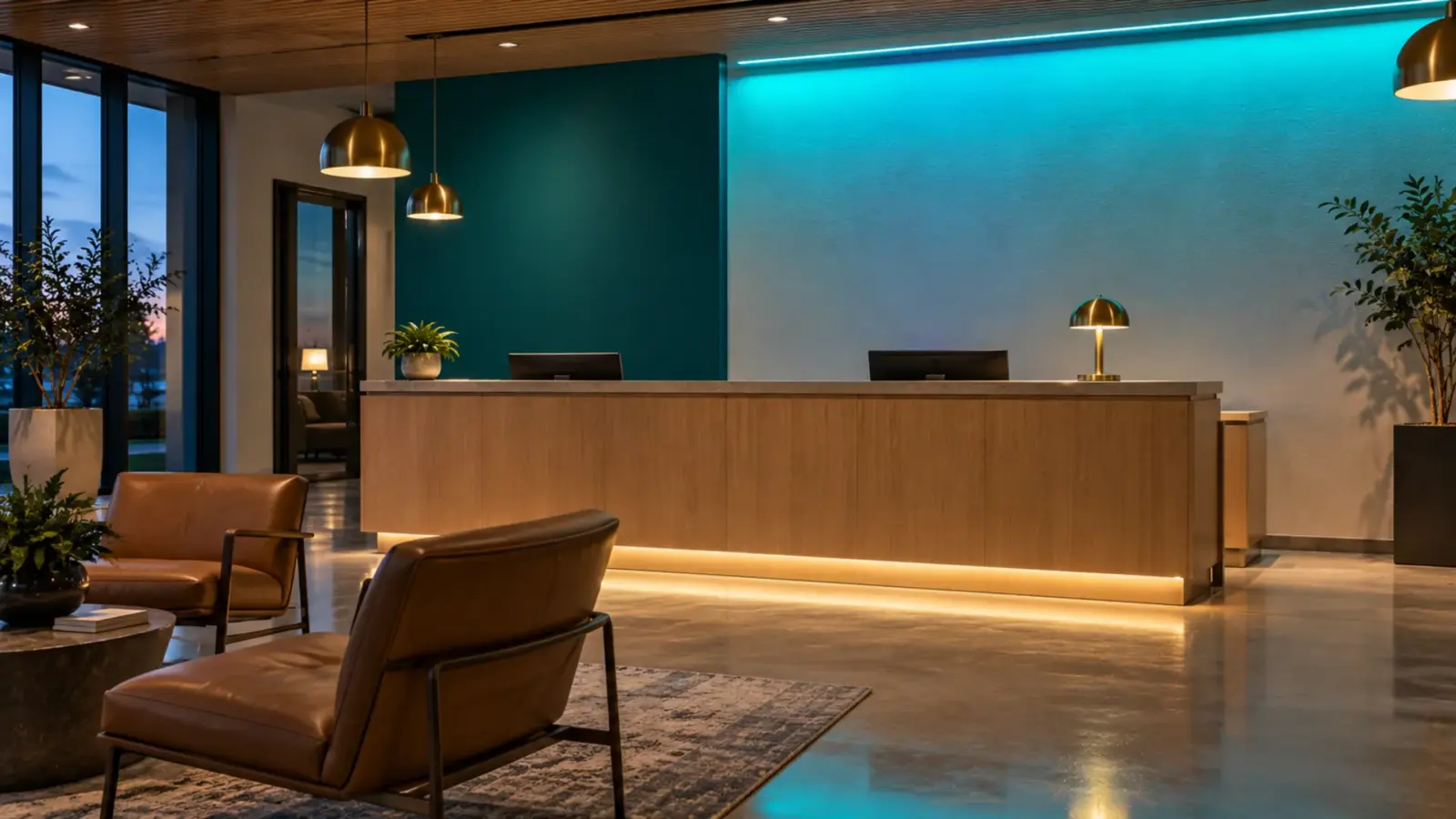
You have ten weeks between the last bell and teacher in-service, a campus lighting standard, and an energy code that wants every classroom zone on a sensor. School LED strip lighting fits that job where it is a dimmable zone out of reach: library shelves, corridor coves, lecture hall ceilings and student union walls, ordered before the school year ends.
Strip is a supporting layer in schools. Troffers and linear pendants light the desks; strip handles the lines a fixture cannot: a cove that lifts a corridor ceiling, a shelf edge in a library, a ceiling recess in a lecture hall. The sections below go space by space, then through the four things that decide a school job: the campus standard, the controls code, abuse, and the calendar.
Where Strip Works in a School
| Space | Strip detail | CCT | Example model | Watch for |
|---|---|---|---|---|
| Corridor | Cove or slot along both walls, above reach | 4000K | UT-C384-8 | Reach, sensors, uniformity |
| Library | Shelf canopy, reading-room cove, desk carrel | 4000K | UT-S2835-128-HE | Glare on screens, shelf cut lengths |
| Classroom | Perimeter cove or whiteboard wash as its own zone | 4000K to 5000K | UT-C384-8 | Control zone and code |
| Lecture hall | Ceiling recess, step riser (see code) | 3000K to 4000K | UT-C384-8 | Scene dimming for projection |
| Student union, athletics lobby | Cove or feature wall in school colors | RGBW | RGBW strip on DMX | Control handover to staff |
| Gym, shop, labs | Not a strip location | None | None | Impact-rated or sealed fixtures |
Read the Campus Standard First
Universities and many districts publish their own lighting design standards, usually as Division 26 sections, and they bind the job before any product sheet does. Three examples show how specific they get:
- Western Washington University asks for the front third of a classroom on its own control zone, the rear two-thirds switchable to at least two levels, all on 0-10V dimming.
- The University of Maryland, according to its design criteria, sets hallways at a minimum of 8 footcandles at the floor with a maximum-to-minimum ratio of 5.
- The University of British Columbia, according to its 2025 guidelines, asks for daylight harvesting in classrooms, corridors and public spaces.
A strip run has to fit that standard like any fixture. Before the layout, pull five things out of it:
- Dimming protocol. 0-10V, DALI or a named control platform; the strip driver has to speak it.
- Zoning rules. Which zones a classroom, corridor or library must have, and which ones strip may join.
- CCT and CRI. Many campuses fix one CCT across a building; strip has to match the fixtures beside it.
- Approved products and spares. Some campuses list approved drivers or require spare stock at handover.
- Uniformity and levels. Ratios like Maryland’s 5 to 1 apply to the whole space, strip included.
Read the standard before the submittal, not after the rejection.
Classrooms: Strip Is a Control Zone
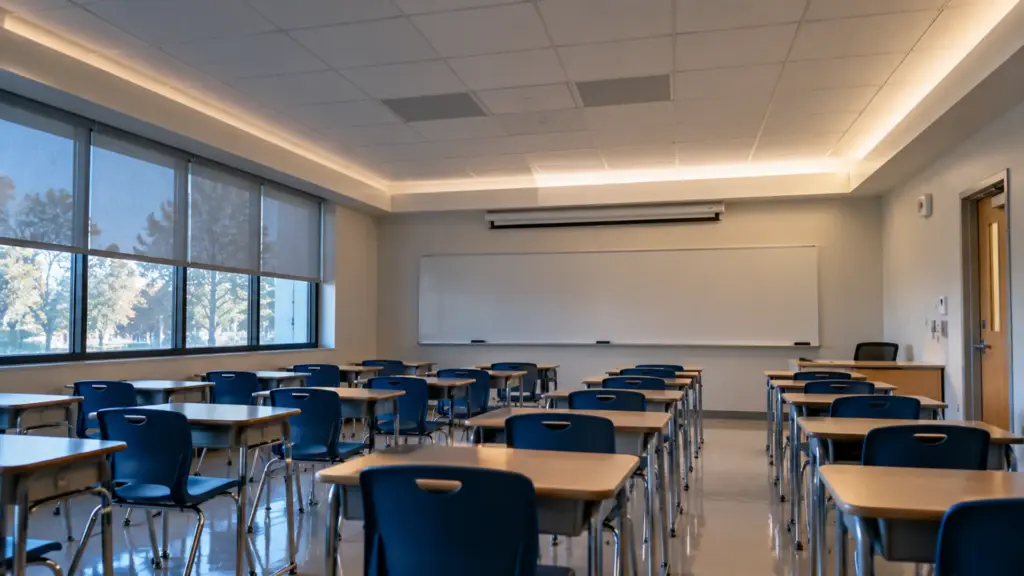
In a classroom, strip is a control zone before it is a light. Energy codes require classroom lighting to switch off automatically and to dim in steps. According to Lutron’s code summaries, ASHRAE 90.1 calls for automatic shutoff within 30 minutes of vacancy and an occupant-selectable level between 30% and 70% of full power plus off; Title 24 (2022) shuts lighting off after 20 minutes of vacancy or less and requires automatic multi-level daylight control. The adopted edition decides the exact rule.
A perimeter cove or a whiteboard wash on strip must join that scheme. Put it on a dimming driver that matches the room controls, such as the 0-10V Class 2 driver UT-D60-24-C2-010 or the 96 W UT-D96-24-010, wire its control input to the room’s zone, and include its watts in the lighting power total. Our lighting power density guide shows how strip counts, and the 0-10V, TRIAC and DALI comparison covers matching the driver to the controls. The drivers and controllers page lists the dimming drivers and the UT-CTP-010 wall panel.
Corridors and Stairs: Above Reach
A school corridor tests every detail a student can reach. Vandal-resistant fixtures carry impact ratings: one maker lists IK10 for a wraparound fixture made for schools and stairwells. LED channels and covers are not rated that way, so strip in a school corridor goes where hands do not: a cove at the ceiling edge, a slot in the ceiling, or the top of a wall above about 8 ft. Below that, use a rated fixture.
Corridor coves also have to read evenly from end to end. A 120 ft corridor shows every dim end, so pick a run length the strip carries without a visible drop, such as UT-C384-8 at 32 ft (10 m), and feed each run from its own point. Put corridor strip on the corridor sensor zone; a cove that stays on at night when the troffers switch off defeats the controls the inspector checks.
Libraries: Shelves and Screens
Libraries are where strip does the most work in a school. A strip under a shelf canopy lights the spines of the books below it, which ceiling light cannot reach in a tall stack. A high-efficacy SMD strip such as UT-S2835-128-HE, rated at 190 lm/W for the whole strip at 2.9 W/ft, keeps a long run of shelving inside the power budget. Our SMD LED strip range lists it.
Two details decide the result. Shelves come in many widths, and the cut interval decides the gap at each end. A 36 in bay takes 14 segments of UT-S2835-128-HE at 2.46 in, which is 34.4 in of strip and a 1.6 in dark gap; a 30 in bay takes 12 segments, 29.5 in, and almost no gap. Measure the shelf schedule against the cut interval before ordering, or use free-cut strip where the bays vary. And reading rooms are full of screens: keep any visible line out of the reflected view from a seated reader, with the strip set back behind the canopy lip and an opal cover.
K-12 and University Jobs Differ
The product is the same; the job is not. K-12 work is usually a district project: public bid, a district standard that may be a page long, and a hard summer window because the building is empty only then. The school’s maintenance staff is small, so the fewer part numbers the better.
University work runs on a campus standard that is often long and specific, in buildings that rarely empty completely, because summer sessions, research and conferences keep them occupied. Work moves floor by floor or wing by wing. The campus facilities shop maintains the lighting for decades, so it wants the same strip, driver and channel in every building and spare stock it can find. Ask for the campus’s approved product list before the layout, and keep the part count small either way.
Lecture Halls, Gyms and Student Unions
Lecture halls run on scenes: full light for exams, lower light for notes, near dark for projection. A ceiling recess with strip dims smoothly into the projection scene where downlights would leave hot spots on the seats. Put it on the same scene controller as the downlights, so one button at the lectern sets both. Step and aisle lighting in a lecture hall is an egress question, which the adopted building code and the AHJ settle, not a design choice.
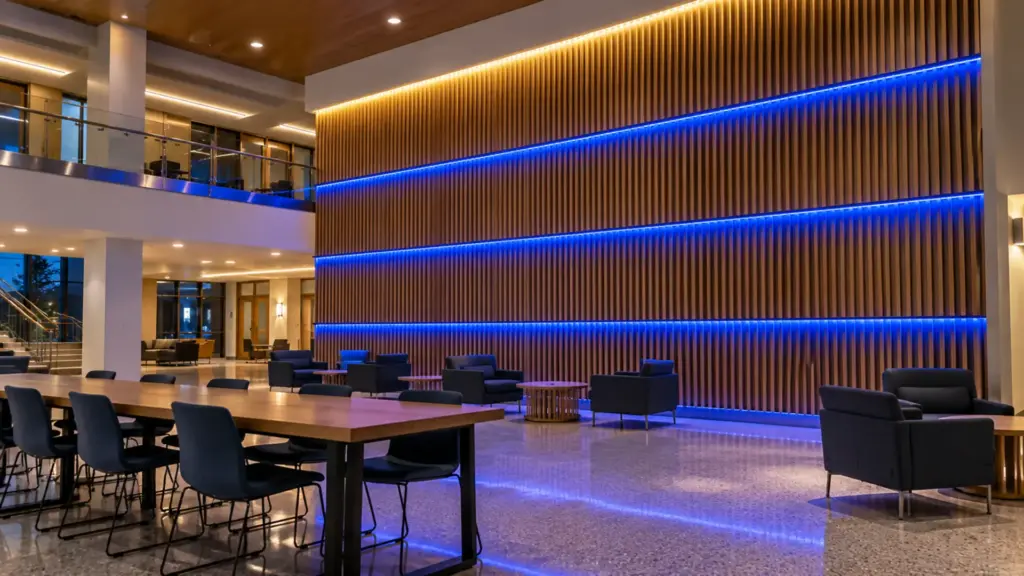
Gyms, shops and labs are not strip locations; they need impact-rated or sealed fixtures. The student union and the athletics lobby are the exception at the other end: a feature wall or cove in school colors on RGBW strip, controlled by a DMX decoder such as UT-CDMX-480. Plan the control handover there: someone on staff has to recall the game-day scene in three years. Our RGB and RGBW LED strip page lists the color range.
The Summer Window
K-12 lighting work usually happens between the last day of school and teacher in-service, and university work between commencement and fall move-in. Everything that can wait for the window waits for it, so the window is crowded: demolition, ceilings, mechanical, paint, and every trade’s deliveries.
- 1WintersurveyCampus standard, layout
- 2SpringsubmittalsCut lengths, drivers, controls approved
- 3Order datelead time backMaterial lands before the window
- 4Summer windowinstallInstall and test by wing
- 5Before in-serviceclose outPunch, labels, spares
A summer strip job runs on a calendar that starts months earlier:
- Winter: survey, campus standard review, layout.
- Spring: submittals approved, including cut lengths, drivers and controls.
- Order date: our standard CCT and CRI combinations ship in 1–2 weeks, and custom builds add roughly two to three weeks, with the ship date confirmed in writing at quote. Order so the material lands before the window opens.
- Window: install by building or wing, test each zone with the controls contractor.
- Before in-service: punch list, labels, spare strip handed to the district.
Facility managers who get summer work done sequence it in May and have materials on site before the trades arrive, as one school electrical supplier puts it. On multi-building districts, phased deliveries by building keep the storage problem off the site; our project supply service schedules shipments that way.
A Corridor Retrofit, Worked
A typical case, not a specific project: a middle school with four corridors of 120 ft each, coves on both walls, 960 ft of strip. With UT-C384-8 at 3.0 W/ft, the corridors load about 2,880 W. The strip is rated for 32 ft (10 m) runs with no voltage drop, so each wall splits into four runs of 30 ft, 32 runs in all.
The driver count follows the wiring choice. A 60 W Class 2 driver at 80% carries 48 W, about 16 ft, so the job needs about 60 Class 2 drivers. A 96 W 0-10V driver such as UT-D96-24-010 at 80% carries about 77 W, one 24 ft run, so 40 drivers with the output wired as power wiring instead of Class 2. Either way, every corridor run joins the corridor sensor zone, and the whole job comes from one production lot so the four corridors match.
Public Bids and Substitutions
Public school work is bid, and bids invite substitutions. A strip spec that names a part number and nothing else invites an “or equal” that matches the wattage and nothing else. Write the performance into the spec: CRI, color consistency in SDCM, cut interval, run length per feed, rated life, dimming protocol, and the channel and cover. Then the submittal review compares what matters. Our submittal package guide lists what a complete strip submittal contains, and the value-engineering guide covers which substitutions hold up.
Before the Bid Goes Out
- Campus or district lighting standard read and followed: dimming protocol, zones, uniformity.
- Strip only above reach in corridors, stairs and gyms.
- Every classroom strip run on a dimming driver in the room’s control zone, counted in the power total.
- Shelf and cove lengths checked against the cut interval.
- Order date set back from the summer window by the lead time, with phased deliveries by building.
- Performance written into the spec, so “or equal” means equal.
Unitop Lighting supplies strip, drivers and controls for K-12 and campus projects across the US. Send the reflected ceiling plans, the campus standard and the summer schedule with your quote request, and we will match runs, drivers and controls to the standard and confirm ship dates against the window. Request a quote.