A cove drawn to California’s Title 24 gets re-bid for an office in another state, and the drawings say “controls per code.” The code there is the IECC or ASHRAE 90.1, the strip circuit has to meet it, and the driver on the drawing may not be able to.
LED strip is lit by its driver, so the energy code reaches it through the circuit. Outside California the IECC and ASHRAE 90.1 ask the same kinds of things of a cove or channel that provides general light: automatic off or a time switch, a way to reduce the light, daylight dimming near windows and a functional test. The driver has to be dimmable and on a controlled circuit.
Which Code Applies: Edition and State
States adopt the IECC, ASHRAE 90.1 or both, and amend them. DOE’s Building Energy Codes Program keeps a profile for each state. Its Florida page, read for this article, lists the commercial code as the 2021 IECC and ASHRAE 90.1-2019, effective 12/31/2023, mandatory statewide, with state amendments. Other states, and cities such as Chicago, have their own code documents, so look up the edition and the amendments before reading any section number below. The Illinois training deck cited here lists the 2021 IECC, the Illinois amendments and the Chicago Energy Code as three separate documents, which shows the layering: a model code, a state layer and sometimes a city layer. The adopted local text governs the bid.
The numbers in this article come from summaries of the 2021 IECC and ASHRAE 90.1-2019: Acuity nLight’s IECC guide, a University of Illinois SEDAC webinar deck, Cooper Lighting’s 90.1 quick reference and a DOE training deck on 90.1-2019. We could not read the code text itself, so they are a map, not the rule. A newer edition may move the sections.
Both documents apply to new construction and additions, and both reach alterations, with different thresholds. For the 2021 IECC, a Philadelphia L&I FAQ quotes C503.5: new lighting in an alteration has to comply with C405 and C408, except when fewer than 10% of the luminaires in a space are replaced and installed interior lighting power does not increase. For ASHRAE 90.1-2019, the DOE deck gives an exception for alterations under 20% of the connected lighting load with no increase in power density, and says one-for-one replacements need only the power density limit and the automatic and scheduled shutoff. Cooper’s summary says 10%, so confirm the threshold and how the AHJ counts a “space.” A cove retrofit can cross it; our fluorescent cove guide covers the job.
The Controls Map: Space by Space
The controls attach to the space and its general lighting, not to the technology. Text quoted in an ICC code-change proposal defines general lighting in the IECC as the lighting counted in total connected interior lighting power that does not require specific application controls. A cove or channel that lights the room is therefore general lighting, in our reading. Here is how the two documents line up, from the summaries named above.
| Control | IECC 2021 | ASHRAE 90.1-2019 | What the strip circuit needs |
|---|---|---|---|
| Automatic off when vacant | C405.2.1 and C405.2.1.1: occupant sensing in classrooms, conference rooms, enclosed and open offices, restrooms, storage and other listed spaces; off within 20 minutes | 9.4.1.1(h): automatic full off within 20 minutes, control area up to 5,000 sq ft, in listed spaces | A driver a sensor or relay can switch or dim to off |
| Scheduled shutoff, no sensor | C405.2.2.1: time switch in areas without sensors | 9.4.1.1(i): override up to 2 hours, up to 5,000 sq ft | The circuit on the time switch output |
| Partial reduction | C405.2.1.3: open offices in zones up to 600 sq ft, 80% reduction in 20 minutes; C405.2.1.4: corridors reduced 50%, not turned off | 9.4.1.1(g): automatic partial off | A dimmable driver whose low level the sensor sets |
| Manual reduction | C405.2.3: where there is no compliant occupant sensor, reduce by dimming or by switching to 30% to 70%; exempt corridors, lobbies, electrical rooms | 9.4.1.1(d): continuous dimming or a step between 30% and 70% | A 0-10V, TRIAC or DALI driver and a wall control, or circuits switched in alternate rows |
| Daylight | C405.2.4: more than 150 W in a primary sidelit zone; dim to 15% and off | 9.4.1.1(e): 150 W primary or 300 W primary and secondary; the DOE deck says continuous dimming to 20% or less and off | Continuous dimming on a photosensor zone |
| Separate control | C405.2.5: display and accent, display case and supplemental task lighting, including under-cabinet and shelf | 9.4.1.3: the same kinds of applications | Control separate from the cove’s |
Some lighting is outside the controls. nLight lists exceptions for continuously lit security or emergency areas, for interior exit stairways, ramps and exit passageways, and for emergency egress lighting that is normally off. A plain corridor is not exempt; the IECC reduces it by 50%. Strip that serves an exit stair or an emergency path should stay on or be fed through the emergency system, and our emergency power guide and stair guide cover those cases. Do not put that strip on the room’s occupant sensor.
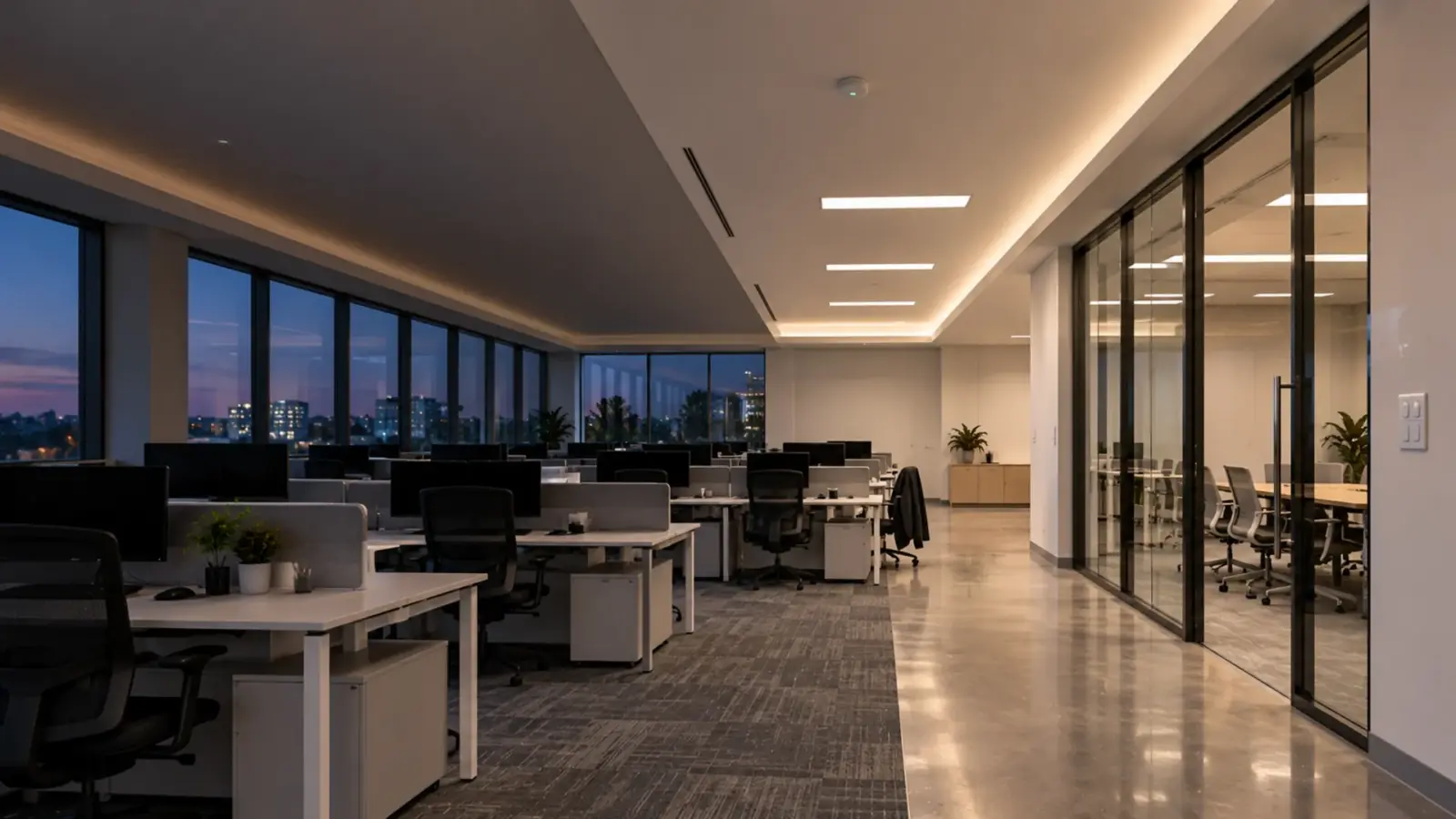
Here is a worked case, with assumed numbers. A 40 ft by 60 ft open-plan office is 2,400 sq ft. With control zones limited to 600 sq ft, that is at least four zones. Its 200 ft perimeter cove has to split into at least four driver groups that follow the sensor zones. Assume the cove divides evenly, 50 ft per zone. At 2.9 W/ft for UT-S2835-128-HE, each zone loads 145 W. Our drivers page keeps the load at or below 80% of the rating, so each zone needs about 182 W of driver, which is two 96 W UT-D96-24-010 drivers at 192 W. The office becomes four 0-10V zones and eight drivers, and the sensors can then dim the cove zone by zone.
Dimming: Where the Driver Decides
Most of the table asks for a reduced level, and the driver is where that happens. Our guide to 0-10V, TRIAC and DALI dimming covers the three families. Our drivers page lists 0-10V models such as UT-D60-24-C2-010 and UT-D96-24-010, a TRIAC model, UT-D60-24-TRC, a 0-10V wall panel, UT-CTP-010, and a DALI DT8 controller, UT-CDALI-DT8.
Three points follow from the rules. First, the daylight rows need continuous dimming, so a driver with no dimming input cannot meet them. The manual-reduction rows can also be met by switching circuits in alternate rows to 30% to 70%, which makes two driver groups per zone another way to comply, and the IECC rule applies only where no compliant occupant sensor covers the space. Second, the daylight rows set the level: 15% in the IECC and 20% or less in the DOE’s reading of 90.1, so check the driver’s minimum dim level on its datasheet, not only the word “dimmable.” Third, “off” can be a relay or a dim-to-off driver; our guide to occupancy sensors and drivers covers which one keeps a driver powered.
Exceptions shorten the list. For the IECC’s manual reduction, the SEDAC deck lists spaces with daylight or special application controls, one luminaire under 60 W, spaces under 0.45 W per sq ft, and corridors, lobbies and electrical and mechanical rooms. ASHRAE’s bi-level exceptions in Cooper’s summary include corridors, lobbies, restrooms, storerooms and loading docks.
Where Strip Bids Go Wrong
Six mistakes recur when a cove design moves between codes, and each traces to a line in the table.
- A non-dimmable driver where the controls need dimming. The daylight rows cannot be met without a dimming input, and the sensor rows ask for a reduced level.
- One driver across two control zones. The sensor can dim only the whole driver group, so a driver that crosses a zone line breaks the 600 sq ft limit in an open office.
- A minimum dim level above what the code asks. A driver that cannot reach 15% (IECC) or 20% (90.1) in a daylight zone fails the row no matter what the controller sends.
- An accent or under-cabinet strip left on the cove’s circuit. ASHRAE 90.1 section 9.4.1.3 and the IECC’s C405.2.5 want it controlled separately.
- An exit or emergency strip on the room’s sensor. It goes dark when the room empties.
- No test scheduled. The IECC asks for evidence before final inspection, and the DOE deck puts the 90.1-2019 test within 90 days of occupancy.
Hotel Guest Rooms, Accent and Under-Cabinet
Two cases leave the general chain. For hotel and motel sleeping units, nLight lists a master control that turns off all installed luminaires and switched receptacles within 20 minutes of the occupants leaving, with an exception for a captive key system (C405.2.5.2 in its 2021 guide, a number that moves between editions). The DOE deck and Leviton’s guide list a similar guest room master control in 90.1-2019 section 9.4.1.3. A headboard cove and a vanity strip are installed luminaires, so they likely sit on that master control. Local amendments change the timing; one city amends it to 30 minutes. Our guest room guide covers where strip belongs in the room.
ASHRAE 90.1-2019 section 9.4.1.3 lists specific applications whose lighting must be controlled independently of the space’s general lighting, and the IECC’s C405.2.5 lists similar ones. Cooper’s list includes display and accent lighting, display cases, supplemental task lighting and under-cabinet or shelf lighting. An under-cabinet strip in a break room therefore needs its own control, and on a strip job that usually means its own circuit and driver, not the cove’s.
Alterations and Testing
Replacing a T8 cove with strip on a floor can cross the alteration threshold, and then the controls come with it. Our Title 24 guide covers California’s version.
Both documents ask for a functional test. nLight reports that, before final inspection, a registered design professional provides evidence that the lighting controls were tested, with separate tests of occupancy sensors, time switches and daylight-responsive controls (C408.3.1.1 to C408.3.1.3). For 90.1-2019 the DOE deck puts functional testing in section 9.9.1, within 90 days of occupancy, by someone not involved in the design, manufacture or installation; Cooper’s summary shows the older number 9.4.3. Plan the test the way our commissioning guide plans handover, with every driver group labeled to its zone.
Put the evidence in the submittal before the test, not after it. A controls narrative that says which sensor, time switch or photosensor drives which driver group, the zone plan, and the datasheet pages for each driver’s dimming input and minimum level give the tester and the plan reviewer the same facts. Our submittal guide lists what else belongs in the package.
FAQ
Does a cove of LED strip have to meet energy code lighting controls?
The summaries attach controls to a space and its general lighting, not to a lamp type. Text quoted in an ICC proposal defines general lighting as the lighting that does not require specific application controls, so a cove that lights the room follows the space’s controls in our reading. Accent, display and under-cabinet strip is controlled separately. Confirm with the AHJ.
Does the IECC require dimming on LED strip?
In many spaces, yes. Where a space has no compliant occupant sensor, the IECC asks for a manual reduction by dimming or by switching to 30% to 70%. Daylight zones need continuous dimming to 15%. A strip on a driver that cannot dim meets only the switching route.
Does replacing a fluorescent cove with LED strip trigger the controls?
It can. For the 2021 IECC, the exception covers replacing fewer than 10% of the luminaires in a space without raising installed lighting power. For 90.1-2019, the DOE deck gives under 20% of the connected load. Confirm the threshold with the AHJ.
Are these the same as Title 24?
No. California enforces its own Title 24. Our Title 24 guide covers it; this article covers the IECC and ASHRAE 90.1 elsewhere.
What to Verify With the AHJ
- The adopted edition and the amendments, for the state and the city.
- Whether the cove and channel circuits are general lighting in that space, and which controls reach them.
- That each driver can dim to the required level and to off, from its datasheet.
- The control zones, with every driver group labeled to its zone.
- Which strips serve an exit or emergency path, and are kept out of the sensor zones.
- Whether accent, display or under-cabinet strip has its own control, circuit and driver.
- Who performs the functional test and when it is scheduled.
The drivers named above are on our drivers, controllers and connectors page.