A hotel guest room and an apartment in the same California tower both need JA8 lighting, and only the guest room must switch its lighting off within 20 minutes of vacancy. Under the 2025 code the room follows Section 150.0(k) plus that shutoff; the apartment follows Section 160.5(a) alone. Both need the strip certified with its driver.
Which Chapter Your Building Lands In
Two definitions in the 2025 Building Energy Efficiency Standards do the sorting. A hotel/motel is a building with six or more guest rooms, or a lobby serving six or more, and it includes Group R-1 buildings. A multifamily building is a Group R-2 building other than a hotel/motel or timeshare, a nontransient congregate residence in Group R-3, or a Group R-4 building. Hotels follow the nonresidential subchapter, Sections 130.0 to 130.5. Multifamily buildings follow Subchapter 10, Sections 160.0 to 160.9, and lighting is Section 160.5, whose dwelling-unit part says multifamily dwelling units “include dormitory and senior housing dwelling accommodations.” Our Title 24 guide covers the edition date and the nonresidential controls; the 2025 edition applies to permit applications on or after January 1, 2026.
A tower with both is a mixed occupancy. Section 100.0(f) says each space meets the provisions for its own occupancy. Its second exception lets the whole building’s indoor lighting follow one occupancy’s provisions when that occupancy is at least 90 percent of the combined conditioned and unconditioned floor area. If the floors are similar in area, a 5-floor hotel under 15 floors of apartments will not reach 90 percent either way, so expect two rule sets in the same riser.
One loose end is a high-rise apartment tower. The 2025 text defines a high-rise residential building as a Group R-2 or R-4 building of four or more habitable stories other than a hotel/motel, and a note under the nonresidential-building definition says “requirements for high-rise residential buildings and hotels/motels are included in the nonresidential sections of Part 6.” Subchapter 10 covers R-2 buildings other than hotels. We found nothing in the text that reconciles them, so the filing for a tall apartment tower goes to the energy consultant.
Inside the Room: Where Hotel and Apartment Rules Split
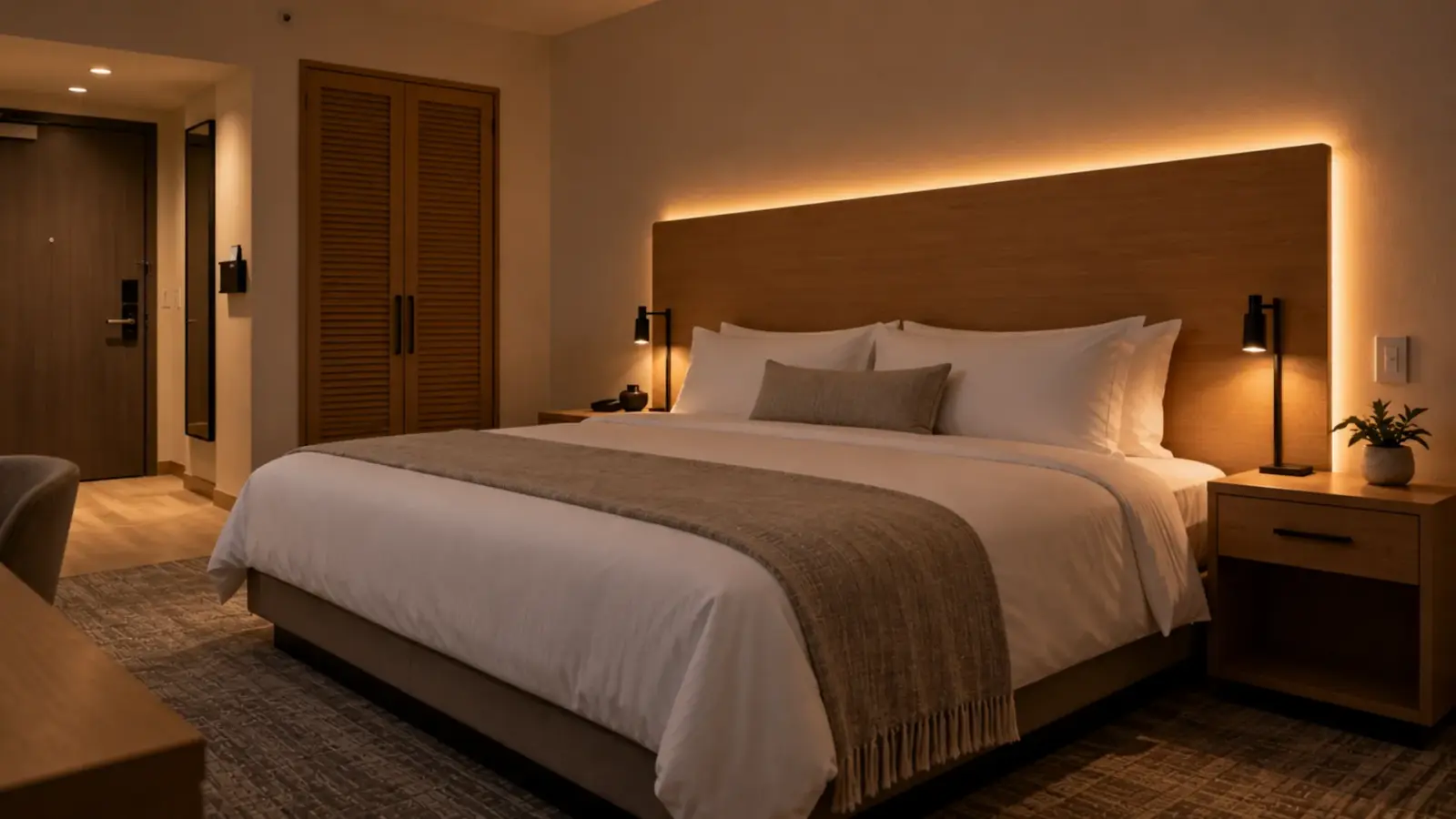
The code sends the guest room to the residential rules. Section 130.0(b)4 lists “hotel and motel guest rooms” among the functional areas that “shall comply with the applicable residential lighting requirements of Section 150.0(k),” and adds that they must also meet Sections 130.1(c)8 and 130.5(d)4. The lead-in adds that every other functional area in the building, “such as common areas,” follows the nonresidential rules, so the corridor outside the room is a different rule set. The code does not list which 150.0(k) items are “applicable,” so the guest room column below is our reading. The apartment reaches nearly the same wording through Section 160.5(a).
| Requirement | Hotel or motel guest room | Apartment dwelling unit |
|---|---|---|
| Route | 130.0(b)4 to 150.0(k) | 160.5(a) |
| JA8 light sources | 150.0(k)1A | 160.5(a)1A |
| Wall dimming in habitable rooms | 150.0(k)2F | 160.5(a)2F |
| Sensor in bathrooms and walk-in closets | 150.0(k)2E | 160.5(a)2E |
| Under-cabinet lighting on its own control | 150.0(k)2G | 160.5(a)2G |
| Off after the room is vacated | 130.1(c)8: within 20 minutes | Not in the text we read |
Both the 150.0(k) and 160.5(a) sets require “readily accessible wall-mounted dimming controls” in habitable spaces, and both require forward phase cut dimmers on LED sources to meet NEMA SSL 7A. One difference matters for short strip runs: Section 150.0(k)2F also exempts luminaires on a circuit with controlled lighting power under 20 watts, and the 160.5(a)2F exceptions carry no 20 watt clause. The split is the last row. A guest room’s lighting must be switched off within 20 minutes of vacancy by captive card key controls, occupant sensing controls or other automatic controls. The exception is a high-efficacy luminaire that meets Section 150.0(k)1A and is switched separately, with the switch within 6 feet of the entry door. So the one lamp by the door can stay on a manual switch, and the cove should be on the controlled circuit.
That last sentence is our reading. A driver fed from the room’s controlled circuit goes off with the room. A driver fed from an unswitched circuit that the card key does not reach is what a plan checker looks for first.
Corridors and Amenity Rooms Look Alike
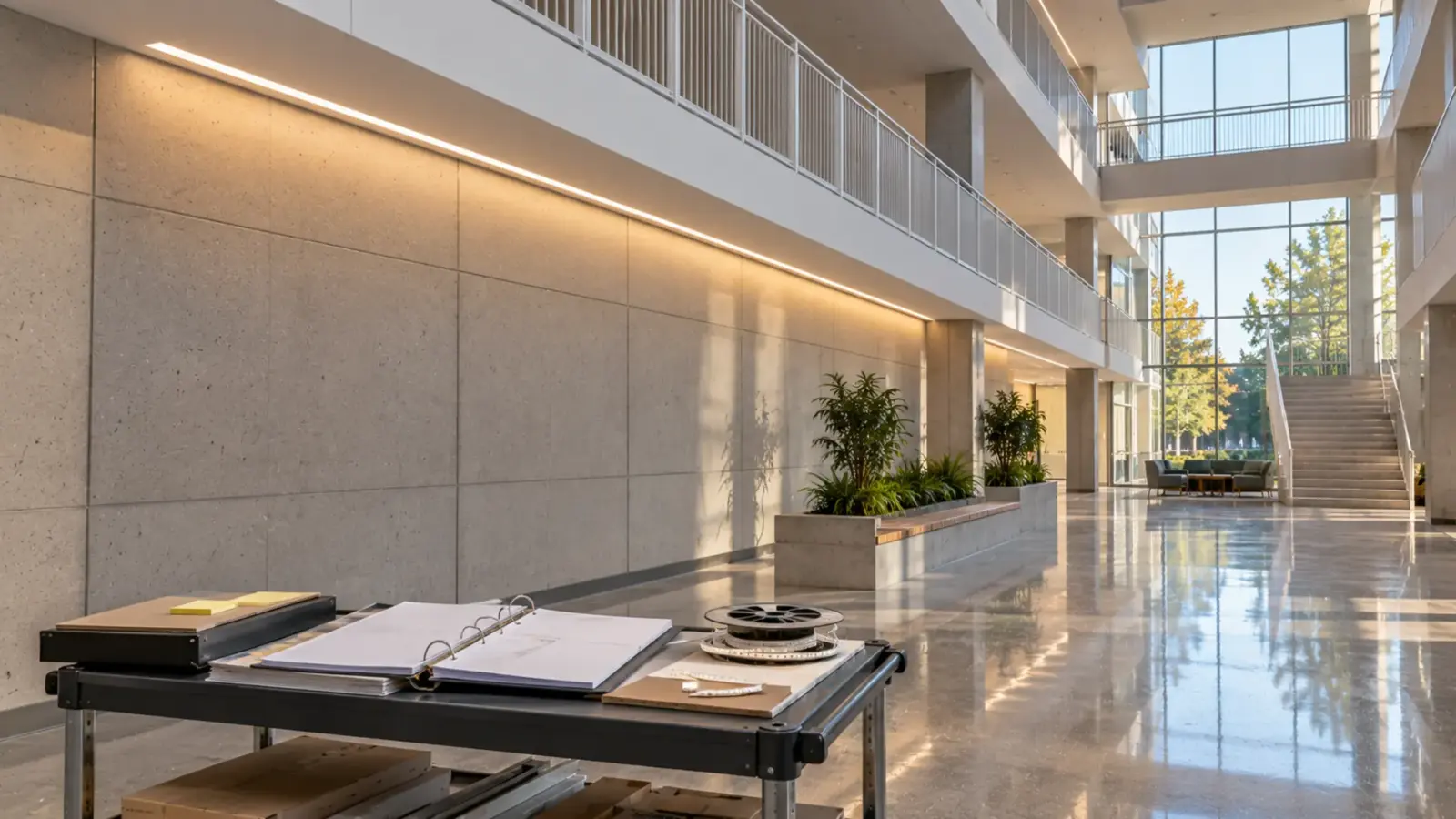
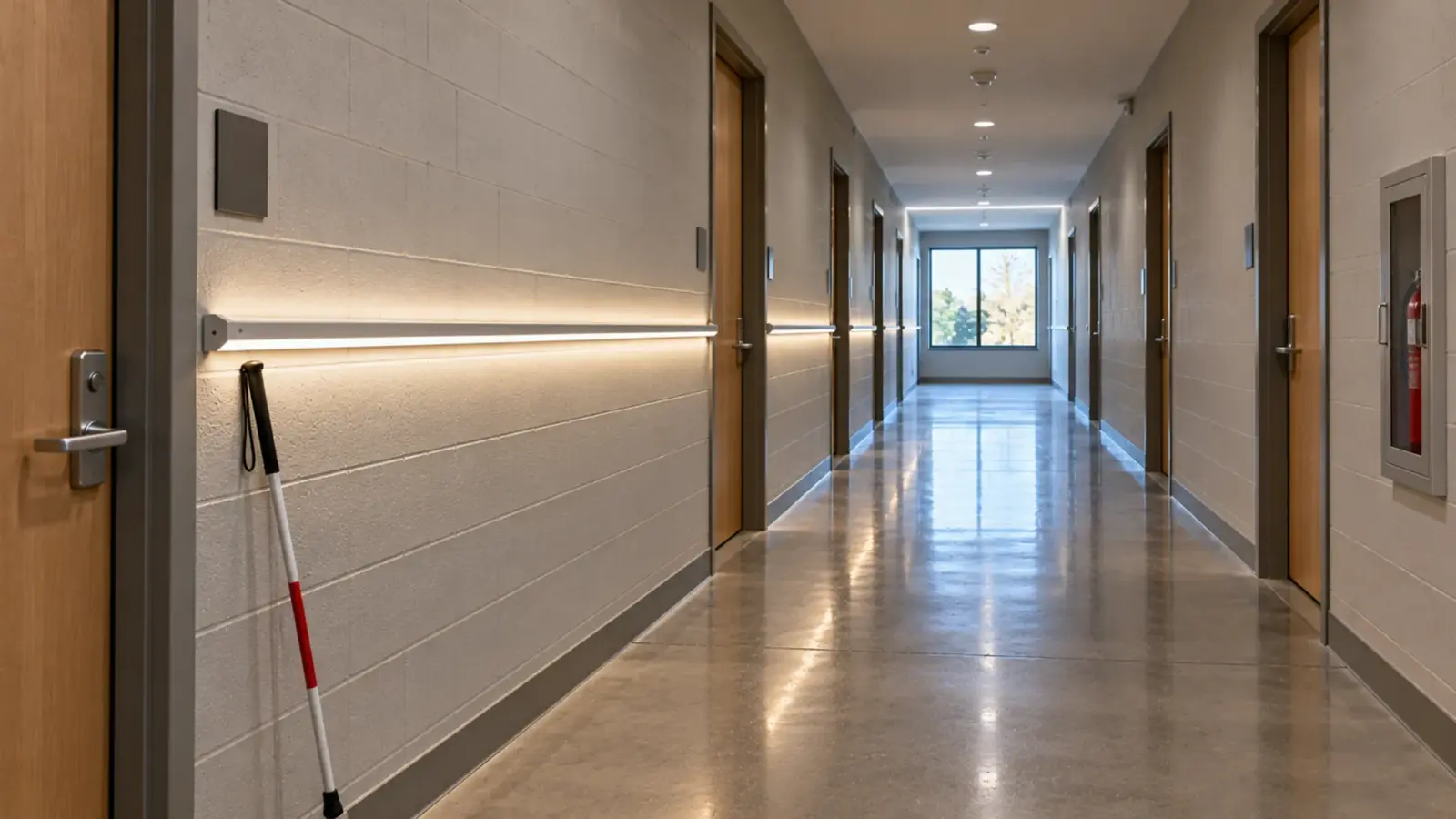
Outside the rooms the two buildings converge. The corridors and stairwells that give access to hotel guest rooms follow Section 130.1(c)6C, instead of the general shutoff rule: occupant sensing that separately reduces the lighting power in each space by at least 50 percent when it is unoccupied. Apartment corridors and stairwells have the same wording in Section 160.5(b)4C(vi)a. Both buildings also require multilevel controls for the general lighting of a space of 100 square feet or larger with a connected load above 0.5 watts per square foot, with continuous dimming from 100 percent to 10 percent or lower (130.1(b) and 160.5(b)4B), and restrooms are exempt in both.
For the strip circuit that means a driver that stays powered at the reduced level, which our occupancy sensor guide covers.
Both texts also protect the egress floor. Each allows up to 0.1 watts per square foot to stay continuously on for means of egress illumination (130.1(a) and 130.1(c); 160.5(b)4A and 4C), and each says egress lighting in the partial-off mode must provide no less than the illumination required by California Building Code Section 1008. In the nonresidential text, egress lighting within the 0.1 watt allowance is also released from the manual control requirement if the space is designated for egress on the plans and unauthorized personnel cannot operate its controls. A dimmed corridor is checked against the building code’s egress illumination, not only against the energy code.
What JA8 Asks of a Strip and Its Driver
Both rooms rely on Joint Appendix JA8, and the 2025 appendix treats the driver as part of the source. It says high luminous efficacy light sources “include ballasts or LED drivers if needed for operation of the light source: light sources shall be certified together with a driver or ballast.” As we read JA8.1, a strip alone is not the certified item.
Read as a purchase list, the appendix asks for:
- Efficacy of at least 45 lm/W, or the applicable standard if higher, a power factor of at least 0.90 and a start time of no more than 0.5 seconds (JA8.4.1 to JA8.4.3).
- CRI of at least 90 and R9 of at least 50, and a nominal CCT the source is capable of providing at 4000 K or less (JA8.4.4).
- Dimming down to 10 percent light output, with forward phase cut LED sources meeting NEMA SSL 7A (JA8.4.6). The floor is measured against the control’s maximum, so the dimmer is part of the test.
- Flicker below 30 percent at frequencies under 200 Hz and audible noise no higher than 24 dBA at 1 meter, with both also met at 20 percent output (JA8.4.6).
- Dimming, flicker and noise testing for each combination of source, driver, transformer type and dimmer type claiming compliance (JA8.3.7), and a “JA8-2025” marking, or “JA8-2025-E” for sources that qualify for enclosed fixtures (JA8.5).
The efficacy line is plain arithmetic. A strip drawing 2.4 W/ft must deliver at least 108 lm/ft at full output to reach 45 Lumens per watt: how much light the strip gives for the power it draws. Higher means less heat and less driver load per foot.. Counting the driver’s input power raises that figure, so a dim strip can fail on that line alone.
Two consequences for a strip job. First, a datasheet Color Rendering Index, 0–100: how truthfully the light shows colors next to a reference source. Ra≥90 is the usual bar for interiors. or CCT line is not JA8: the certification belongs to a tested pair with a named dimmer type, and the choice of strip can narrow to what is already certified. Our Title 24 guide noted that sources disagreed on the CCT limit; the 2025 appendix reads 4000 K or less. Second, Section 150.0(k)1D and 160.5(a)1D require separable light sources in enclosed or recessed luminaires to meet the JA8 elevated temperature requirements, including marking. Whether a strip behind a cover in a closed channel counts as an enclosed luminaire is a question for the consultant.
Our drivers page lists 0-10V and TRIAC (forward and reverse phase) dimmable drivers and says dimmer compatibility lists ship with every quote. It does not state a JA8 listing for any strip or driver, so the JA8 pair is a question for the quote request, before the design, not after the bid.
A Mixed Tower, Space by Space
A typical tower: hotel floors 2 to 6, a lobby restaurant, apartments above and an amenity floor. The example is ours, for the reading.
| Space | Rule set | What the strip circuit needs |
|---|---|---|
| Hotel guest room headboard cove | 150.0(k) via 130.0(b)4, plus 130.1(c)8 | JA8 pair, wall dimmer, controlled circuit for the 20-minute shutoff |
| Hotel guest bath mirror strip | 150.0(k)2E and 1A | JA8 pair, a sensor on at least one luminaire |
| Hotel corridor cove | 130.1(c)6C and 130.1(b) | Driver that stays powered at 50 percent or less, and dimming to 10 percent where the 100 sq ft and 0.5 W/sq ft trigger is met |
| Lobby restaurant cove | Nonresidential, Section 130.1 | Multilevel dimming and shutoff, as in our Title 24 guide |
| Apartment living room cove | 160.5(a) | JA8 pair, wall dimmer, NEMA SSL 7A on forward phase cut |
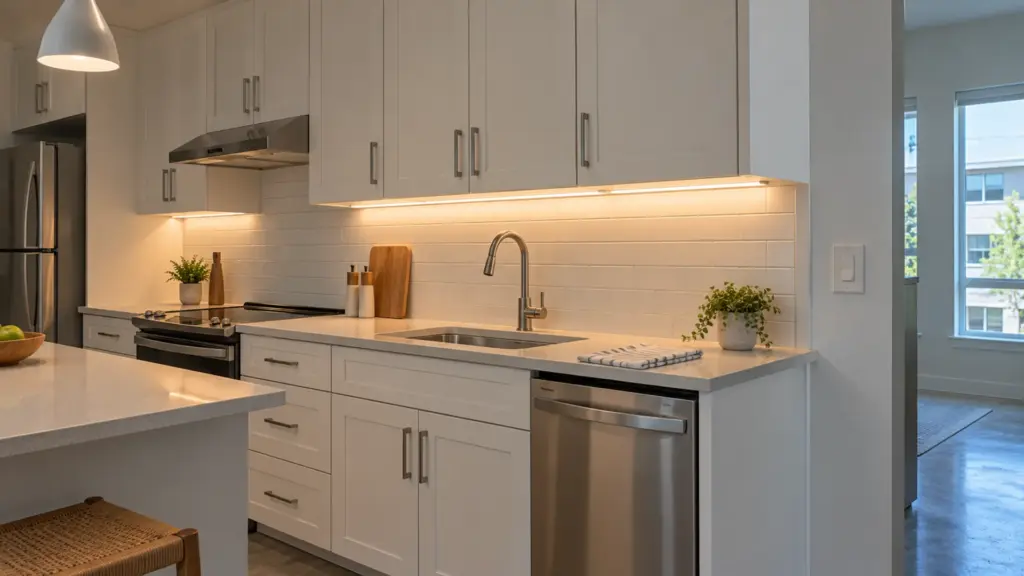
| Apartment kitchen under-cabinet strip | 160.5(a)2G | JA8 pair, its own control apart from the ceiling lighting |
| Apartment corridor | 160.5(b)4C(vi) | As the hotel corridor |
| Amenity lounge | 160.5(b)4B and 4C | Multilevel dimming to 10 percent, sensing controls |
The submittals split the same way. Put the hotel rooms and the apartments in separate schedules, each against its own section, and put the corridors and amenity rooms of both buildings in a third, because their controls match and their JA8 duty does not.
Read down the right column. Four of the eight rows ask for a JA8 pair, and each pair is one strip, one driver and one dimmer type. Order the three together, per space type, and write the pair on the submittal.
What the Sources Leave Open
We read the CEC’s 2025 PDF as extracted text, not the Building Standards Commission publication, and local amendments govern. We did not check the Energy Commission’s certification database for any product. The text does not say how a tunable white source that reaches 4000 K or less is counted against “capable of providing.” And alterations in existing buildings follow Sections 141.0 and 180.0, which this article leaves out.
What to Verify With the Consultant
- The occupancy of each space as filed: hotel/motel, multifamily or another, and how a high-rise tower is filed.
- The JA8 certification record for each strip and driver pair, with the dimmer type it was tested with.
- Whether a strip in a closed channel needs the JA8-2025-E marking.
- The guest room shutoff device and which circuit carries the cove.
- The reduced level and dimming floor of each corridor driver, from the datasheet for the exact model.
The strips and drivers named above are on our COB LED strip and tunable white LED strip pages.