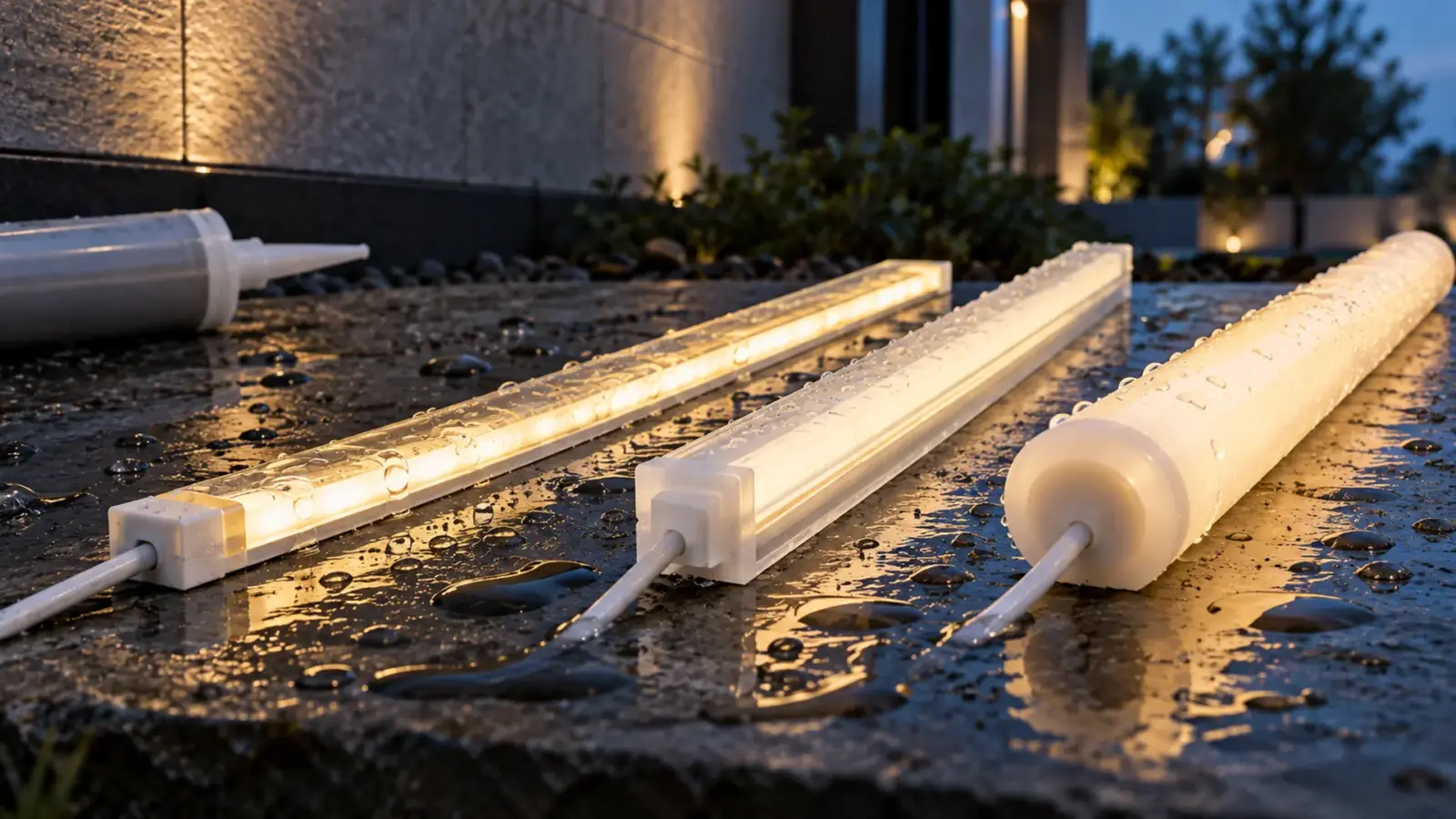
Dust-tight, and protected against temporary immersion in water. The usual rating for wet or outdoor runs that are not submerged all the time. is a number, not a construction. Behind it sit different ways of keeping water off the circuit board: a silicone top coat, an extruded sleeve, a full silicone tube, and sealing compound at the ends and joints. Each is rated for a different exposure, and each is exposed in a different place, usually where the strip was cut.
This guide covers the processes only. What the IP codes mean, and why a code is not a wet location rating, is in our guide to IP68 and wet locations.
Four Ways to Keep Water Off the PCB
Our outdoor and waterproof LED strip page lists three constructions, and a fourth step, sealing, applies to all of them.
| Method | What it is | Rating on our page | Exposure the page gives | Example models |
|---|---|---|---|---|
| Silicone top coat | A silicone film over the strip’s surface | IP65 | Rain and splash, eaves, covered facades | UT-O120-10-65, UT-O320-8-65 |
| Extrusion sleeve | The strip inside an extruded silicone sleeve | IP67 | Temporary immersion, planters, hardscape | UT-O320-8-67, UT-O480-10-67 |
| Full silicone tube | The strip fully enclosed in a silicone tube | IP68 | Continuous submersion, fountains, wells | UT-O480-12-68, UT-O120-12-68 |
| Sealed ends and joints | A matching silicone end cap and adhesive at every cut | Restores the strip’s rating | Every cut end | Included with the series |
The rating goes with the construction. The same LED board in a top coat, a sleeve and a tube carries three different ratings, and none of them is a statement about where the strip may be installed. That comes from the listing.
Silicone Top Coat
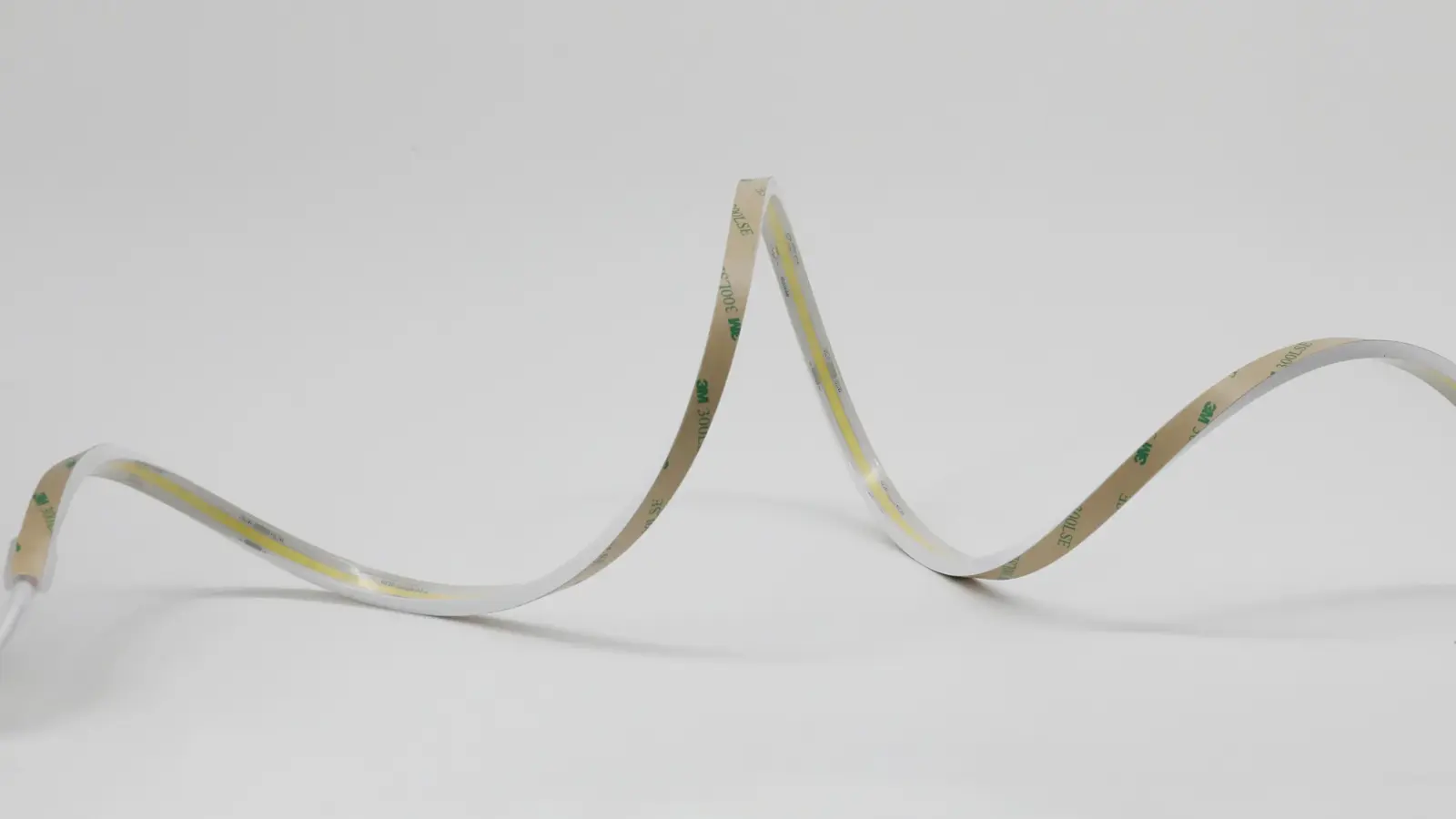
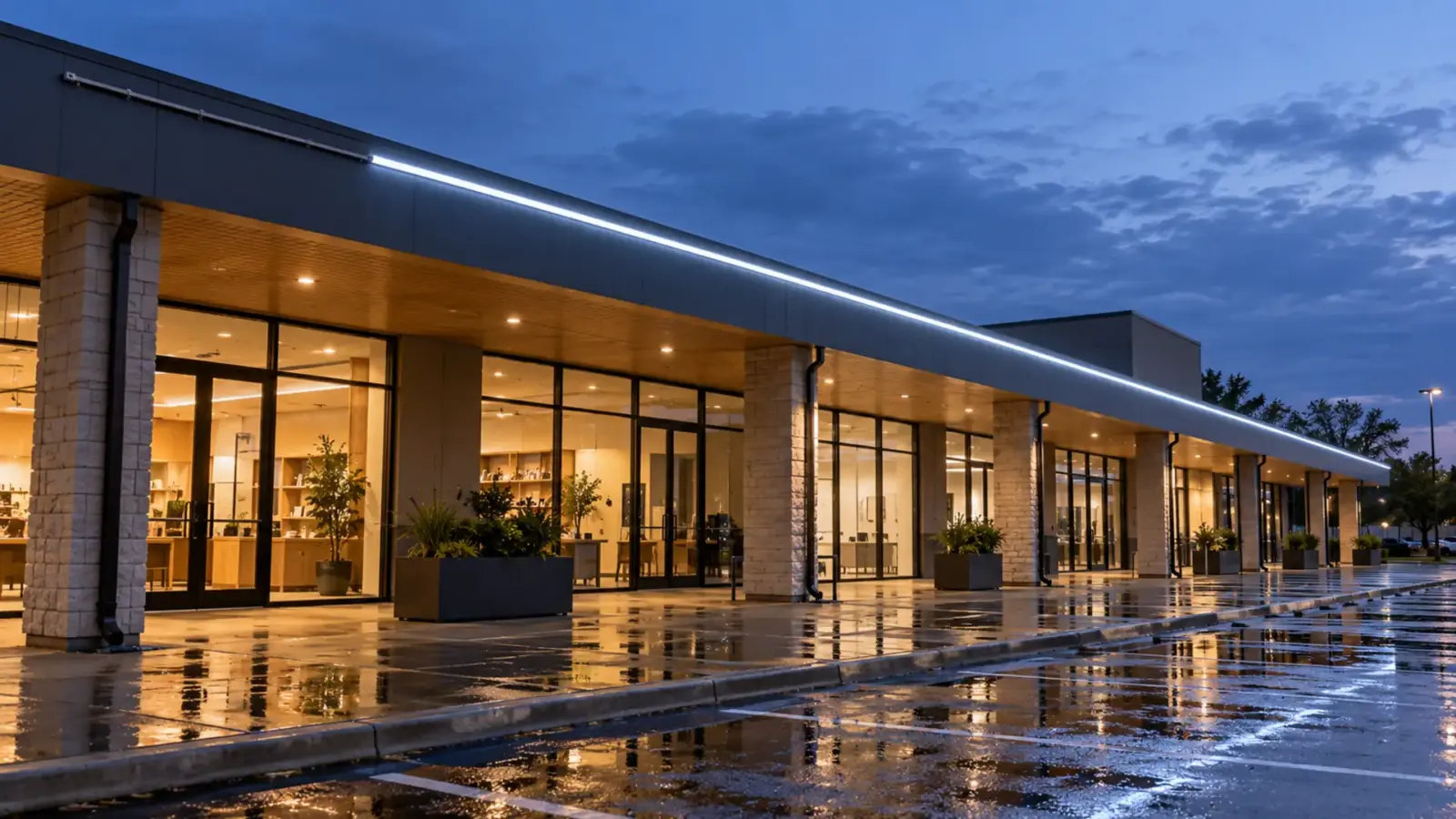
A top coat is a film applied over the strip and its chips, a conformal-style layer that follows the surface. It is the lightest of the three methods and the most common outdoors. Our page rates it for rain and splash: eaves, facades and covered exterior details.
The coat protects the surface it covers. Where it can be exposed is at its edges, on any cut face, and wherever the film is scraped by a clip, a channel lip or a tool. A film is thin, so abrasion matters more than it does for a sleeve. That is reasoning from the construction, not failure data; we have no field-failure figures for any of these methods.
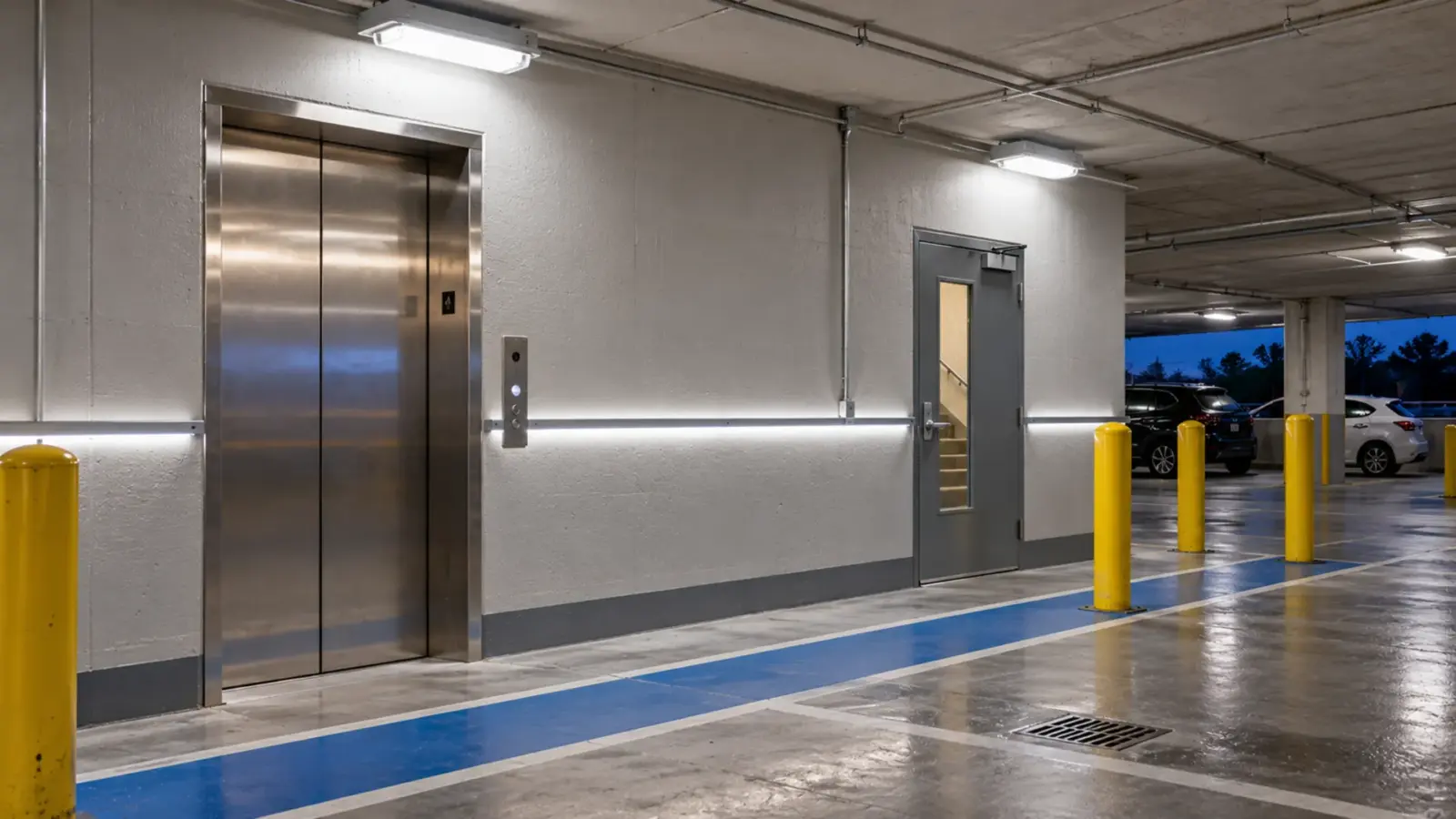
For the practical choice: a top coat suits a strip that sits under cover and is not handled, such as a soffit. It is the wrong tool for standing water.
Extrusion Sleeve
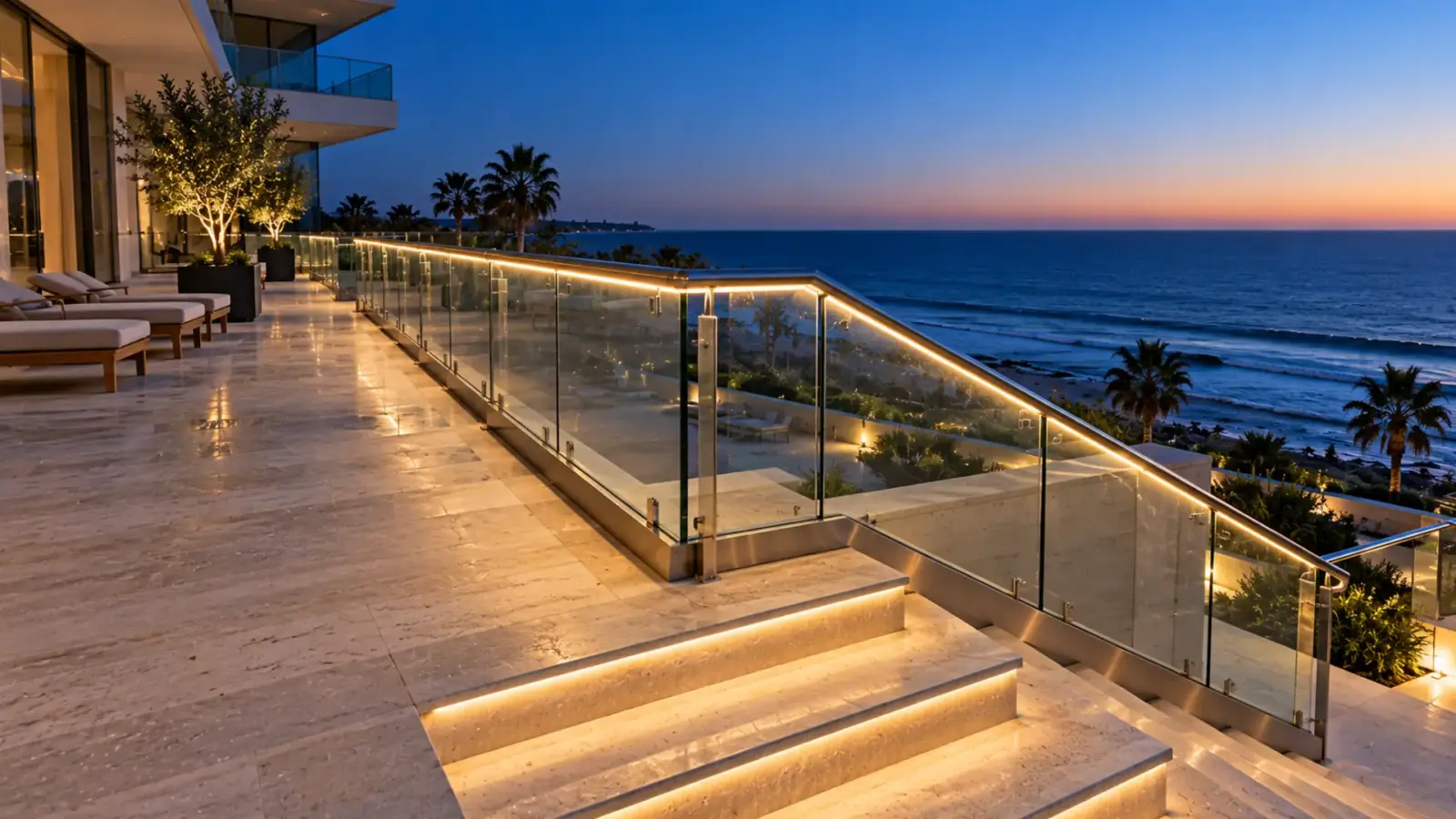
A sleeve puts the strip inside a silicone tube formed by extrusion. The strip is protected by a layer of material, not by a film, which is why the page rates it for temporary immersion: grade-level planters, hardscape channels and splash-heavy zones.
What the sleeve depends on is its ends. A sleeve is open at both ends until it is closed, so the seal at each end and at every cut is what keeps the water out. Any gap between the sleeve and the strip is also a path, and a cut in the sleeve is a hole. Check the ends first when a sleeved strip fails.
Vendor explainers draw the same line between sleeve and tube: Signlite, a strip maker, describes hollow extrusion as spray-resistant and prone to leaking under long submersion, with solid silicone used for IP67 and IP68 builds. Our page does not use those terms, so use the model’s own datasheet for the construction.
Full Silicone Tube
A full tube is the strip enclosed in silicone along its whole length, and our page rates it for continuous submersion: fountains, water features and below-grade wells. It is also the basis of our pool series, UT-O120-12-PL and UT-O240-15-PL, which run on 12V and feed 10 ft (3 m) at a time.
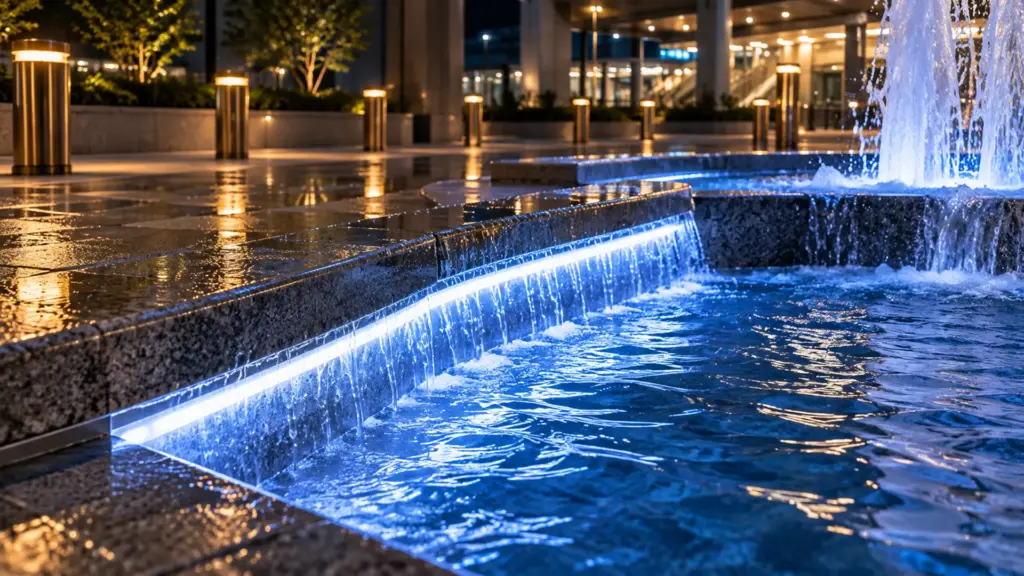
It is the most protective method and the least forgiving to change. A tube is harder to cut cleanly, and every cut exposes the electronics until it is sealed. Anything below the waterline also needs a listed underwater luminaire where the code asks for one, and our page says so. An IP68 tube alone does not meet that.
Cut Ends, Joints and Potting
Every method fails at the same place. The factory seals the strip along its length, and the installer opens it at each cut. Our outdoor page says the open end must be re-sealed with a matching silicone end cap and adhesive to restore the IP rating, and that cuts fall every 25 to 50 mm on most series and every 100 mm on the pool series.
Count the exposures on a real job. A 60 ft (18 m) cove cut into four 15 ft pieces opens eight ends, and each is capped or joined. Each one is a place where the construction depends on the installer.
Our page names the silicone end cap with adhesive. Makers also use potting compounds at ends and joints; we have no source for how potting compounds behave as a family, so check the datasheet for the compound’s temperature and UV limits. A compound is only as good as its bond to the strip, so clean and dry the surface before it goes on.
A connector’s own IP rating covers the joint, not the strip end past it and not the point where the wire enters. Seal each.
Heat Inside the Seal
A sealed strip holds heat. Silicone around the strip slows its heat leaving, so the temperature rating of the construction matters as much as the water rating.
Our page lists a high-temperature silicone family, UT-O320-8-SA and UT-O640-10-SA, rated IP68 and to +221 °F (+105 °C), for saunas, steam-adjacent details and enclosed fixtures. It states that silicone-construction strip is rated for permanent installation across -4 °F to +221 °F (-20 °C to +105 °C). Our CSP page reports the sealed series verified through 1,000 hours at 185 °F (85 °C) and 85% humidity with zero measured lumen loss.
For a strip in a closed space, mounting in an aluminum channel still helps heat, as our channel guide explains, and the channel must be rated for the location too.
UV and Age
Outdoor materials age in sun. Our page says UV-stable silicone avoids the yellowing that shortens the life of cheaper PU coatings, and that rated life is L70 ≥ 50,000 hours, the same as our indoor lines. A yellowed or cracked cover is also a leak path, so the cover’s UV rating belongs in the comparison, not only the IP code.
Material matters across the range. Some of our products use polyurethane potting where the datasheet says so, such as the PU-potted wall washer family rated IP65. Read the UV and temperature statement for the exact model.
Reading a Datasheet for Construction
The IP code is one line on a datasheet. The construction is in the rest, and five lines tell you what you are buying.
- The construction name. Top coat, sleeve, tube or potted. A datasheet that gives only “waterproof” has not said.
- The IP rating, and what it covers. The rating is for the strip as built; it does not cover the cut end, the connector or the wire entry.
- The cover material and its UV statement. Silicone, PU or another material, and whether it is rated for sun.
- The temperature range. The operating range of the construction, not only of the LEDs.
- The end-seal parts. What end cap, compound or adhesive restores the rating after a cut.
Our outdoor page answers these by series, and the listing for the model answers where it may be installed. The two are different documents, and a spec needs both.
Names Differ Between Makers
The same construction is called different things in different catalogs, which makes comparison across makers hard. This is how our terms line up with the words vendors use, as best we can tell from their explainers. Check the datasheet for the exact build.
| Our page | Words vendors use | What to confirm |
|---|---|---|
| Silicone top coat | Silicone coating, conformal coating | Film thickness is not published; ask for the cross-section |
| Extrusion sleeve | Hollow extrusion, silicone sleeve | Whether the sleeve is bonded to the strip or loose |
| Full silicone tube | Solid extrusion, fully filled silicone | Whether the strip is encapsulated or only enclosed |
When two quotes list the same IP rating at different prices, the construction is the first thing to compare. A sleeve and a tube can both say IP67, and they are not the same product.
Asking for a Sample
A cut sample of the exact construction answers questions a datasheet cannot. Cut it across with sharp shears, look at the section, and check three things: whether the silicone fully surrounds the PCB, whether there are voids between the strip and the cover, and whether the cover is bonded or loose. Then check the end cap fit on a cut end. A sample takes minutes, and it is the cheapest test of a method before it goes on a job. Samples are available on request.
Keep the cross-section in the submittal next to the datasheet, so the approval records the construction and not only the rating.
Choosing by Exposure
| Exposure | Start with | Check |
|---|---|---|
| Eaves, soffits, covered facades | Silicone top coat, IP65 | Edges, cut ends, UV |
| Planters, hardscape, splash and temporary standing water | Extrusion sleeve, IP67 | Sleeve ends, end caps |
| Fountains, water features, wells | Full silicone tube, IP68 | The listing for the location |
| Pools | Pool series, 12V, full tube | A listed underwater luminaire where required |
| Saunas, steam-adjacent, enclosed fixtures | High-temperature silicone, IP68, to +221 °F | Heat and the listing |
| Permanent year-round soffit | Permanent outdoor series | UV and seal at every cut |
Match the strip, the connectors and the driver to the same rating and the same location marking; the system is only as protected as its weakest part.
The Short Version
Waterproofing is a construction and a set of seals, not a rating. A top coat is a film for splash, a sleeve is a layer for temporary immersion, a tube is the full enclosure, and every cut reopens whichever one you chose. Pick the method for the exposure, then seal and test every cut. Our outdoor page lists the series by construction and IP rating.