In patient areas of a locked behavioral health unit, LED strip in a channel with a clip-in diffuser does not belong. What belongs there is a luminaire tested as a whole: tamper-resistant fasteners, a secured polycarbonate lens, mounted flush without gaps. Strip fits in staff-only rooms, on the staff side of the nurse station and outside the locked unit.
Designers who want coves to make a unit feel less institutional have a good goal. The way to reach it is strip where the risk assessment allows it and tested fixtures everywhere else, not a field-built detail argued into a patient room.
What the Rules Ask For
No single code section bans LED strip on a psychiatric unit. The rules work through risk assessment, and lighting comes up in CMS’s guidance and the most detailed product standard.
CMS’s interpretive guidance for hospitals, revised in September 2025, lists the risks hospitals should identify and minimize, and “accessible light fixtures” are on that list next to ligatures and sharps. It asks for an environmental risk assessment for every unit. CMS’s April 2019 draft guidance was blunter: locked psychiatric units “are expected to achieve a ligature resistant environment”, and its sample risk-tool prompts included “light fixtures or projections from ceilings” and “unprotected lighting fixtures”.
The Joint Commission defines ligature resistant as “without points where a cord, rope, bedsheet, or other fabric/material can be looped or tied to create sustainable point of attachment”. It does not recommend products; it expects each organization to assess its environment and install products based on the manufacturers’ instructions.
Some of the most detailed product criteria come from the New York State Office of Mental Health. Its Patient Safety Standards were listed as a national reference in the 2018 FGI Guidelines, according to a 2018 OMH announcement, and designers outside New York often consult them. The 36th edition, dated July 31, 2026, sorts spaces into three risk levels, sets general criteria for light fixtures, and marks each listed fixture for the risk levels it suits.
Risk Zones Decide It
The OMH guide defines risk levels by how patients use a space, and each facility assigns its own rooms through a room-by-room risk assessment that, in OMH’s words, may vary with patient profile, staffing or unit geography. The room examples below are ours:
| Risk level (OMH) | What defines it (OMH) | Typical rooms (our examples) | LED strip |
|---|---|---|---|
| High | Solitary or unsupervised patient use | Patient bedrooms, patient bathrooms | No; tested behavioral-health luminaires only |
| Medium | Patient access controlled, or use supervised | Corridors, day rooms, group rooms, the patient side of the nurse station | No in reach of patients; tested luminaires |
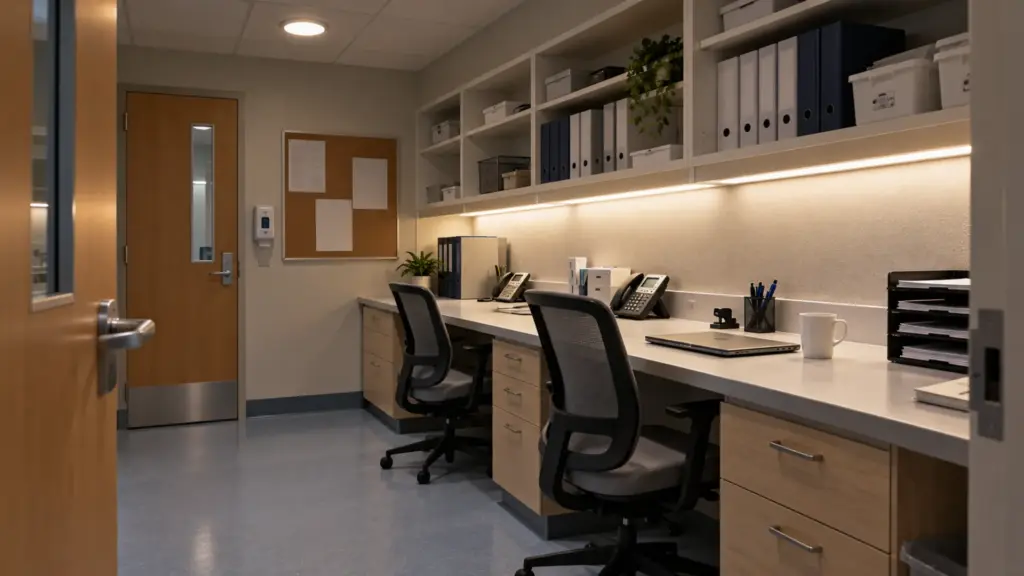
| Low | Staff only, no patient use | Staff workroom, med room, staff lounge, offices | Yes, as in any healthcare staff space |
Areas outside the locked unit, such as the lobby and administration, follow the hospital’s own risk assessment for those spaces.
The light fixtures listed in the OMH guide are surface, recessed, downlight, vanity, task and night-light fixtures, each tested as a complete product, with no LED tape or open cove detail among them. A line of light is still possible: the list includes sealed linear and slot luminaires, some 2 to 8 ft long and joinable into continuous runs, with polycarbonate lenses of 0.187 to 0.25 in. The absence of tape is not a ban, but it shows how far a site-built strip detail sits from what has been tested for these rooms.
Why a Strip Detail Fails in Patient Areas
Set the OMH criteria for light fixtures next to a typical strip-in-channel detail and the gaps are plain:
| OMH light fixture criterion | Typical strip-in-channel detail |
|---|---|
| Lens of polycarbonate at least 1/8 in thick, securely retained within the frame | Clip-in PC diffuser held by its fit in the profile; our channels ship with click-in diffusers |
| Housing durable and abuse resistant | A light aluminum extrusion with push-in end caps that re-seat by hand |
| Exposed fasteners tamper-resistant | Standard mounting clips and screws |
| Installed flush with no gaps; gaps filled with tamper-resistant sealant | A cove lip or ledge along its length; even a flush plaster-in profile leaves a lift-out diffuser seam |
| Recommended for medium and high risk ceilings: mechanically fastened to the ceiling system | Clipped into the profile, the profile screwed or clipped to the substrate |
| Only the tested model; changed properties need a new test | A new, untested detail on every project |
Each line matters. A ledge or lip is a place to loop a cord, the definition of a ligature point. A diffuser that lifts out by hand, as ours are designed to for strip service, is an accessible part of a light fixture, and an end cap that pops off exposes the strip and its wiring. The strip may carry its own listing, but the assembly in the wall was never tested as a behavioral-health fixture.
Even tested fixtures come with conditions. The OMH guide notes that only the listed models were tested, that changing the size, lens thickness, housing or finish warrants another test of a sample, and that photometrics with polycarbonate lenses should be checked during design. A detail assembled on site has none of that history behind it.
Ceilings: Height Does Not Make It Safe
The usual answer is to put the strip high, in a ceiling cove out of reach. The Joint Commission’s FAQ closes that door: “There is no height requirement for a ligature risk.” Its guidance on ceilings points the same way. Dropped ceilings are allowed in corridors and common areas where staff are regularly present, provided patients have nothing to climb on to remove a panel and reach ligature points above. A concealed grid is acceptable instead of a solid ceiling only when panels “can in no way be removed by the patient” and no impact will dislodge them.
A cove or slot in the ceiling of a patient room is the kind of opening those tests exist to remove. If the design needs indirect light in a patient room, ask the owner’s team for a behavioral-health luminaire tested in that mounting, and set it flush with the ceiling substrate, gaps sealed and fastened to the ceiling system, as the OMH guide describes.
Where Strip Fits
Strip still has real work on a behavioral health unit, all of it where patients do not go unsupervised:
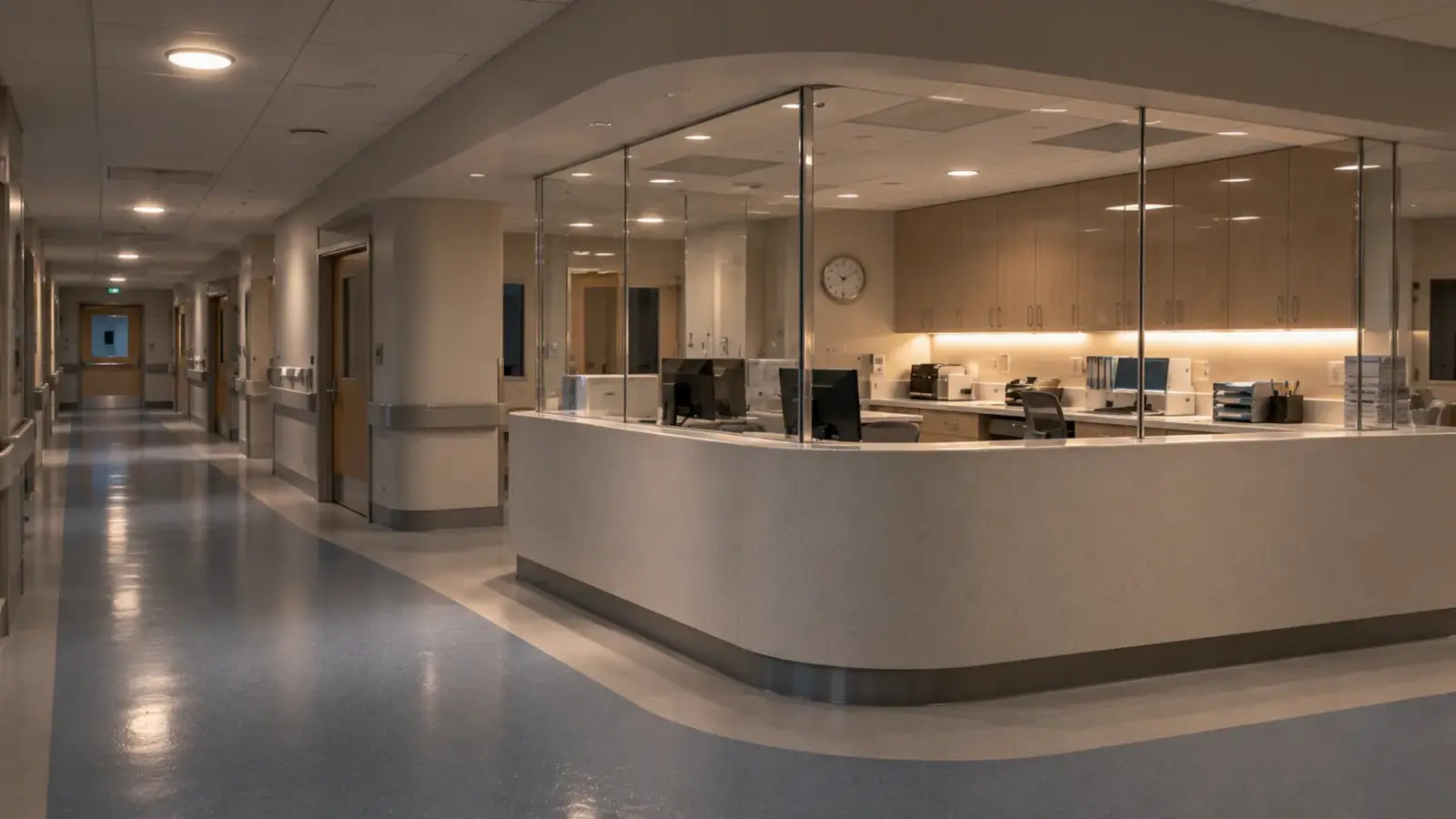
- The staff side of the nurse station. Under-shelf and back-counter task light for charting, behind the barrier and out of patient reach. The patient-facing side of the station is a medium-risk surface; keep strip off it.
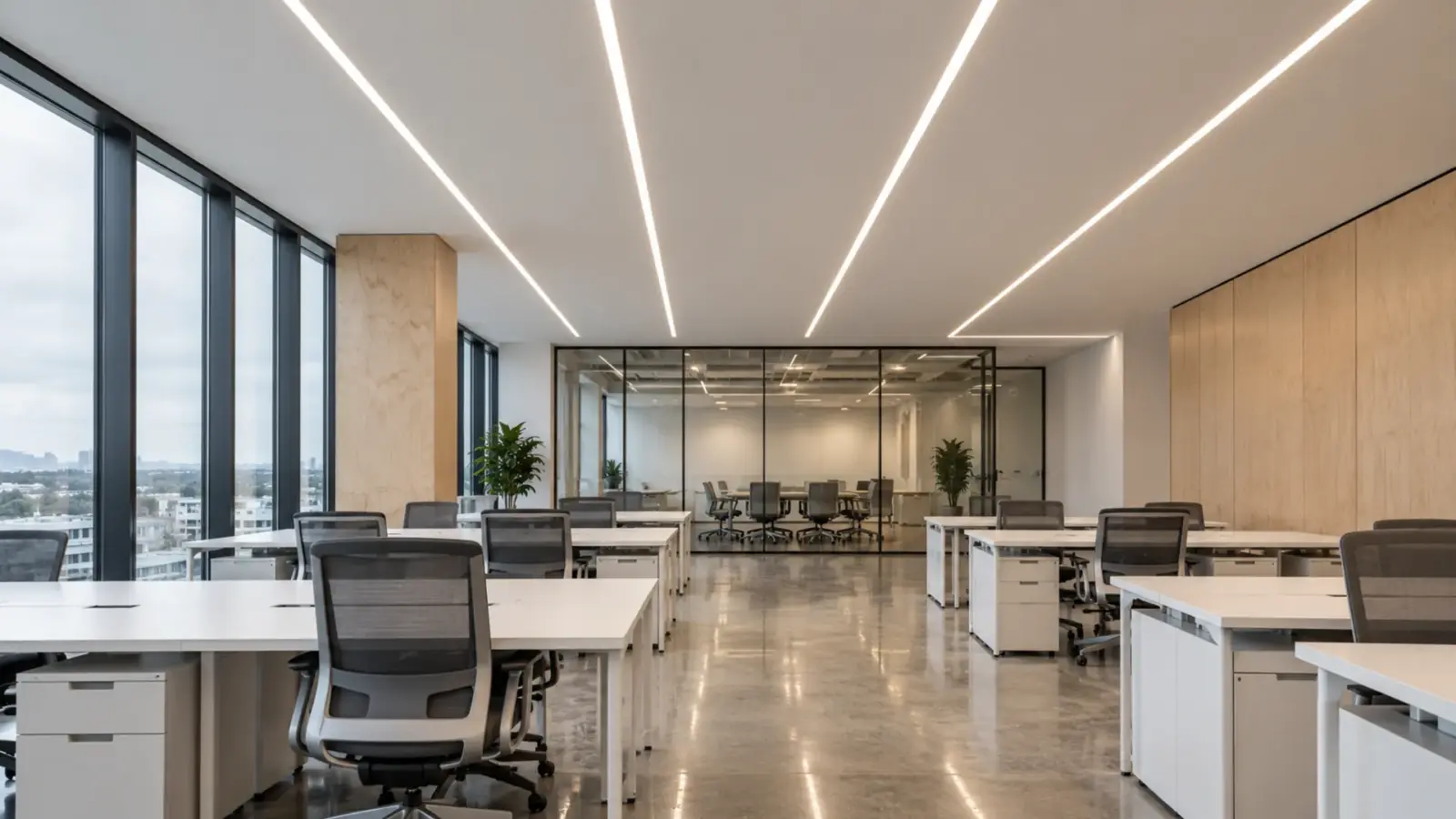
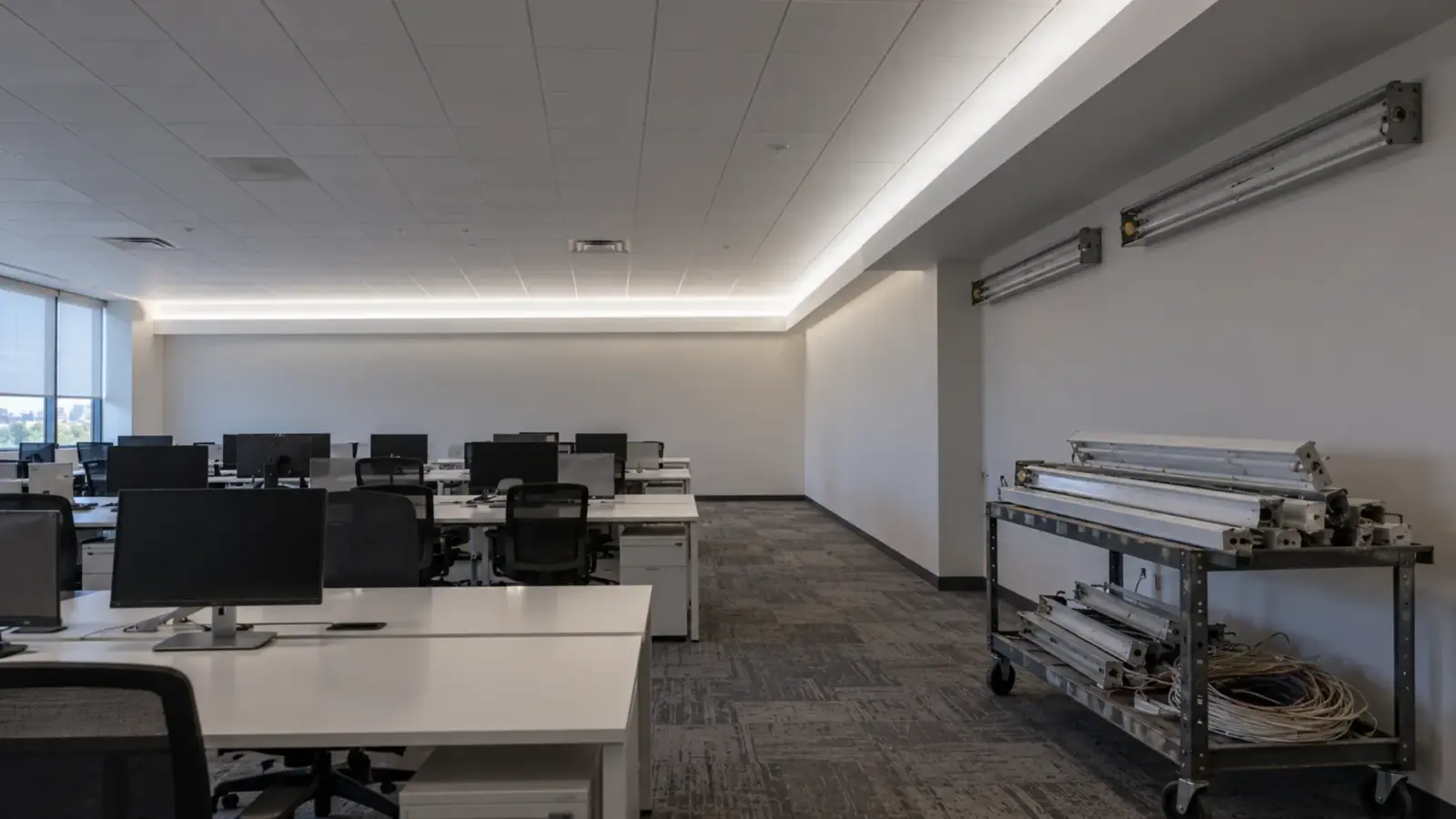
- Staff workrooms, med rooms, lounges and offices. These are low-risk, staff-only rooms. Strip in a channel with an opal diffuser does the same job here as anywhere in a hospital, and our hospital and clinic guide covers the detail.
- Outside the locked doors. Lobbies, family waiting and administration follow the hospital’s assessment for those spaces.
- Inside tested luminaires. The listed behavioral-health fixtures are LED luminaires in sealed or welded housings. That is the maker’s design, tested as a whole, not a license to build the same on site.
For a unit serving older adults with dementia rather than acute psychiatric care, the risk picture differs; our memory care guide covers that setting.
Night Lighting and Controls
Designers often reach for strip for night lighting. The OMH guide lists tested night-light fixtures, recommends amber LEDs at patient bedrooms, and recommends mounting night lights 12 to 18 in above the finished floor for proper use and to minimize ligature risk. Low strip along a bedroom wall is not a substitute for a tested night light.
Controls follow the same logic. The guide lists behavioral-health switches and wall stations, calls for tamper-resistant sealant around each device, and notes that switch, controller and fixtures must be coordinated, because customization can change the safety of an evaluated product. Where staff areas use dimming or tunable white, keep those controls in staff space; our tunable white guide for schools and healthcare covers the scheduling.
Drivers and Wiring
Strip in staff areas still needs a driver. Mount drivers in staff-only rooms or a locked electrical room, never in a ceiling or wall box a patient could reach; CMS’s guidance already expects hazardous non-clinical rooms such as electrical rooms to be secured. The OMH guide places circuit breakers “within secure electrical panels outside of the patient environment”, and the same reasoning applies to drivers and junction boxes. Low-voltage cable from staff areas should not run exposed through patient space, where it would add the kind of attachment point the guide works to remove.
Units That Sometimes Hold At-Risk Patients
A medical-surgical floor or an emergency department sometimes cares for a patient at risk of self-harm. CMS’s 2019 draft said the ligature-resistant expectation does not apply to non-psychiatric units, which protect such patients with measures like continuous observation and removing hazards. The 2025 guidance asks every unit’s risk assessment to consider that it may sometimes care for at-risk patients. On those floors, strip coves can follow normal hospital practice, provided the hospital’s assessment accepts them and its plan for at-risk patients, such as continuous observation and removing hazards, covers the rest.
FAQ
Can LED strip be used in a behavioral health patient room?
Not as a field-built strip-in-channel detail. Patient rooms are typically high-risk areas, used alone or unsupervised, and the reference criteria call for a tested luminaire with a secured polycarbonate lens, tamper-resistant fasteners and a flush, sealed installation.
Is a high ceiling cove out of reach acceptable?
Height alone does not settle it. The Joint Commission states there is no height requirement for a ligature risk, and its ceiling guidance assumes patients may climb. A cove or slot in a patient room ceiling is an opening the risk assessment will flag.
What makes a light fixture ligature resistant?
No point where a cord or fabric can be looped or tied to form a sustainable attachment, plus, in the OMH criteria, a durable housing, a polycarbonate lens of at least 1/8 in held in its frame, tamper-resistant fasteners and a flush installation with gaps sealed.
Where can LED strip go on a psychiatric unit?
In staff-only rooms, on the staff side of the nurse station and in areas outside the locked unit, as the facility’s risk assessment allows. Drivers stay in staff-only or locked spaces.
What to Settle With the Owner’s Risk Assessment
- The risk level of every room on the drawings, set by the owner’s assessment, not by the lighting layout.
- Which rooms are staff-only and can take strip, and where the nurse station barrier sits.
- The tested luminaires the owner accepts for high and medium risk areas, by model and mounting.
- Ceiling type per room: hard, concealed grid or dropped, and whether any opening is allowed.
- Night lighting and controls by tested model, with sealant at every device.
- Driver and junction box locations outside patient reach.
For the staff areas, our LED channels and diffusers page lists the profiles and opal covers; we make no behavioral-health or ligature-resistance claim for them.