IP68 answers one question: does water get into the strip during the maker’s test? A pool inspector asks three others: is the product listed for use underwater, what supplies it, and how far is everything else from the water. LED strip belongs in a pool or fountain only when all three answers are right.
That is why most strip sold as “IP68” is fine in a planter, a below-grade well or a water feature basin, and still not approvable below the waterline of a swimming pool. The rest of this article separates those cases.
IP68 Is a Test, Not a Pool Listing
An IP rating is a lab test of how well an enclosure keeps out dust and water. IP68 means the product survived continuous immersion under conditions the maker states, usually a depth and a time. It says nothing about electric shock protection, chemical resistance, the supply, or the installation.
A listing is different. It says a lab has evaluated the product for a use and keeps following up on production. Pool-rated strip exists: Prizm Lighting and Alcon Lighting both describe strip products listed to UL 676, the standard used for underwater luminaires, alongside IP68. That pairing, a listing for underwater use plus an IP code, is what a pool needs.
Our own outdoor page says it the same way: IP68 is a lab test of ingress, the wet location marking comes from the product’s listing, and anything below the waterline needs a listed underwater luminaire. Our guide to wet location LED strip covers the difference between the IP code and the location marking in detail.
Three Zones Around the Water
Think of a pool or fountain as three zones. The rules get stricter as you move toward the water.
| Zone | Examples | What has to be true |
|---|---|---|
| In the water | Below the pool waterline, inside a fountain basin, a submerged step edge | A product listed for underwater use, a supply that meets the pool rules, a full IP68 system including connectors |
| Wet edge | Coping, deck edge, splash zone, a scupper face | Wet location marking, sealed connections, IP65 or higher by exposure, supply located away from the water |
| Near the water | Planters, benches, walls and canopies within the distance the code sets | Distance and GFCI rules for the adopted edition, wet or damp location as exposed |
Low-voltage lighting is not automatically allowed close to the water. According to EC&M’s “Code Rules for Low-Voltage Lighting,” lighting systems under Article 411 are kept 10 ft from the nearest edge of pools, spas and fountains unless Article 680 permits otherwise. Check the edition your jurisdiction has adopted; these rules have moved between editions.
Voltage and GFCI: What the Code Columns Say
The NEC’s pool article sets a “low-voltage contact limit.” According to EC&M’s series on NEC rules for pools and fountains, that limit is 15 V RMS for sinusoidal AC and 30 V for continuous DC. The same column notes that under older editions, luminaires operating above 15 V had to be protected by a GFCI.
Two consequences for strip:
- The supply matters as much as the strip. EC&M describes the transformers used for pool lighting as having a grounded metal barrier between the primary and secondary windings. An ordinary LED driver is not that product. On the Mike Holt forum, electricians answering a question about low-voltage pool lighting put it plainly: a luminaire in a pool has to be approved for pools, and so does its transformer.
- Low voltage is necessary, not sufficient. A 12V strip is below the contact limit, but that does not make it listed for underwater use or make its driver acceptable.
Our pool series runs at 12V for this reason: the outdoor page notes that 12V is the requirement for low-voltage pool and water-feature installations. Run length on that series is 10 ft (3 m) per feed, shorter than on our 24V outdoor strip, so plan more feed points.
Fountains and Water Features
Fountains are not pools, and the rules are written differently. According to EC&M, fountain luminaires and submersible equipment need GFCI protection unless they are listed for operation at or below the low-voltage contact limit and supplied by a transformer or power supply that complies with 680.23(A)(2). IAEI’s article on fountains and reflection pools walks through the same distinctions for decorative water.

In practice, three kinds of water feature come up on commercial jobs:
- Decorative basins and reflecting pools in plazas and lobbies, where people are not meant to enter the water. These follow the fountain rules.
- Wall water features and scuppers, where strip lights the falling water from below or behind. The strip is often in the wet edge zone rather than in the water.
- Planters and below-grade wells that collect water but are not water features. IP68 construction is often the right answer here, without any pool rules.
Our IP68 full silicone tube construction is rated for continuous submersion and is built for fountains, water features and below-grade wells. Whether a given model carries the marking a specific fountain needs is confirmed per model at quote.
Strip, Connectors and Driver Each Need the Rating
A strip with an IP68 rating is one part of a system. The system is only as protected as its weakest part:
- End caps and cut ends. Every cut end has to be resealed with a matching end cap and sealant. Our outdoor page lists the pool series cut interval as every 3.94 in (100 mm); a cut anywhere else breaks the seal and the circuit.
- Connectors and joints. An IP68 strip with an IP65 connector is an IP65 system at the joint. Put joints above the water or in a sealed box rated for the location.
- The driver. Keep the driver out of the water and away from the wet edge. A potted Dust-tight, and protected against temporary immersion in water. The usual rating for wet or outdoor runs that are not submerged all the time. driver such as our UT-D100-24-67 suits a damp equipment space; it is not a pool transformer and is not meant to sit in water.
- Cable entry. Where the strip’s lead enters a basin wall or a niche, the penetration needs a sealed fitting designed for it.
Our article on how LED strip is waterproofed shows how each construction is sealed, and why a field cut changes the rating.
Lighting the Pool Without Putting Strip in It
Most commercial pool designs that want a line of light do not need strip in the water at all. Three approaches keep the strip in an easier zone:
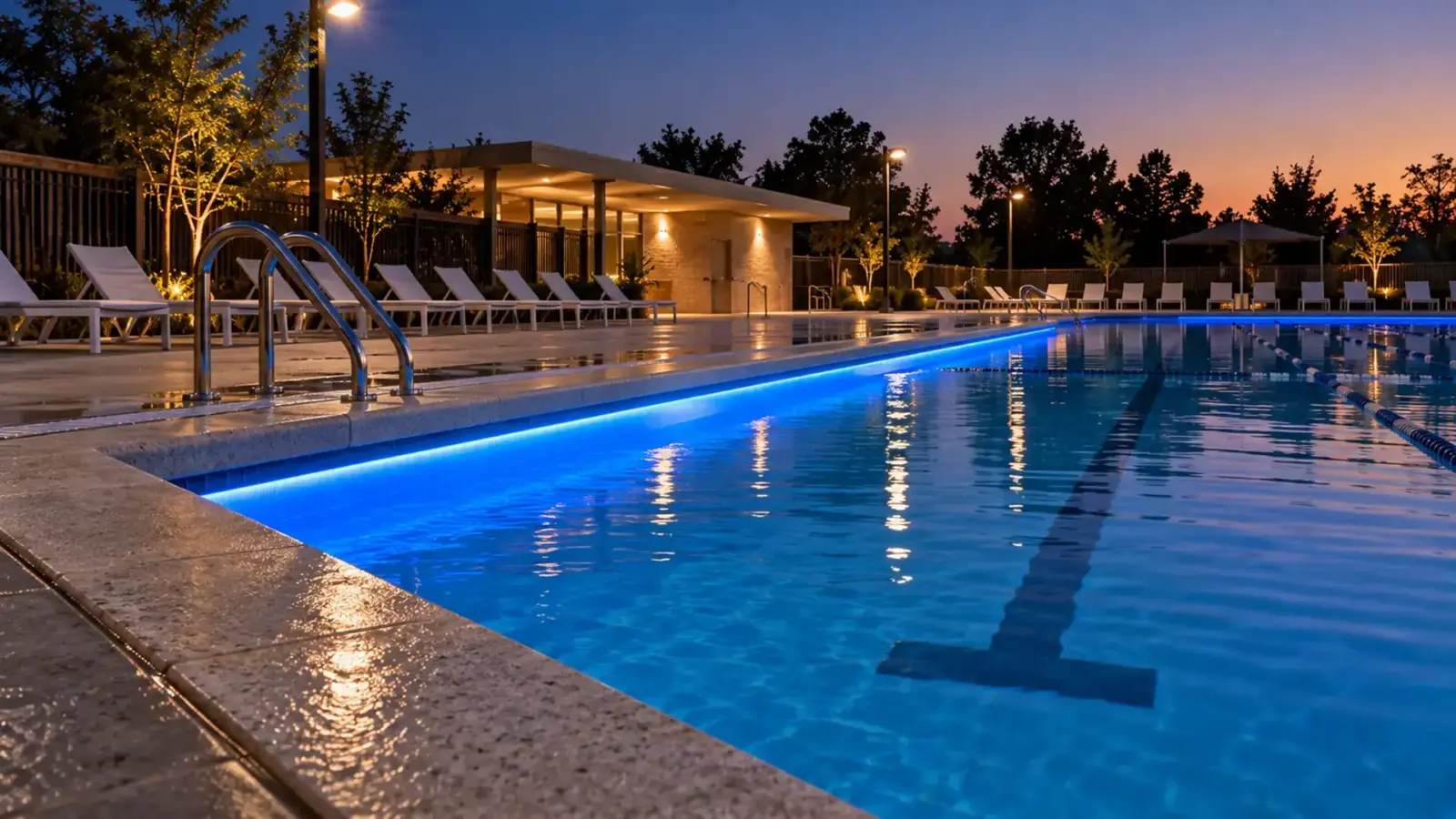
- Wash the pool wall from the coping. A strip in a recessed slot under the coping lights the band of pool wall just above the waterline and reflects in the water. The strip sits at the wet edge, not below the waterline, and the look is close to an underwater line.
- Light the deck and the benches. Strip under bench fronts, along step nosings on the deck and in planter edges defines the space and keeps people’s eyes off dark corners. These are wet or damp locations, not underwater ones.
- Use listed pool luminaires in the water. Where the design really needs light below the waterline, listed underwater luminaires do that job, and the strip handles the edges.
Each of these still needs the distance and GFCI checks for the adopted code edition, and every joint and cut end sealed to the rating of the location. They avoid the hardest requirement, a product listed for submersion in a pool, without giving up the effect.
Spas, Hot Tubs and Splash Pads
Spas and hot tubs sit in the same article of the NEC as pools, with their own provisions, and the EC&M series treats them alongside pools and fountains. Warm water and closer contact make them stricter in practice, and a strip detail that passes at a decorative fountain will not automatically pass at a spa.
Interactive water features, where people walk or play in the spray, are not decorative fountains either. Treat any feature people can enter as a pool-type case until the AHJ says otherwise, and ask early, because the answer can change the lighting design.
Materials: Chlorine, Salt and Aluminum
Pool and fountain water attacks materials that survive rain. According to LEDYi’s guide to pool strip, chlorine corrodes aluminum profiles, which is why aluminum channels are not used in pools. Salt water and treated fountain water do similar damage over time.
- Use the strip’s own silicone construction or profiles made for submersion, not standard aluminum channel, below the waterline.
- Choose stainless steel or the maker’s specified clips and fixings.
- Indoor pool rooms carry chlorine in the air too. Strip above the water in a natatorium needs a sealed construction even though it is never wet.
- Check the cleaning program. Pool and fountain maintenance uses strong chemicals and pressure washing on the deck and the basin; sealed ends and joints have to survive the cleaning, not only the water.
FAQ
Can I put IP68 LED strip in a swimming pool?
Only if the product is also listed for underwater use and supplied as the pool rules require. IP68 alone is an ingress test. Our outdoor page states that anything below the waterline needs a listed underwater luminaire.
What voltage is allowed in a pool?
The NEC sets a low-voltage contact limit for pools. According to EC&M, it is 15 V RMS for sinusoidal AC and 30 V for continuous DC. Low voltage does not replace the listing and supply requirements.
Does pool LED strip need GFCI protection?
It depends on the product, the supply and the code edition. According to EC&M, older editions required GFCI for luminaires above 15 V, and fountain equipment needs GFCI unless it is listed for low-voltage operation with a compliant supply. Confirm with the AHJ.
How far from a pool can low-voltage strip go?
According to EC&M, Article 411 low-voltage lighting is kept 10 ft from pools, spas and fountains unless Article 680 permits closer installation. The adopted edition and local amendments decide the final distance.
What to Verify With the AHJ
Before ordering strip for any pool or fountain job, confirm these with the authority having jurisdiction:
- The NEC edition adopted and any local amendments to the pool and fountain rules.
- Whether the water is a pool, a spa, a fountain or a decorative basin under the code.
- The listing the product in the water must carry, and the listing of its supply.
- GFCI requirements for the supply as designed.
- Distances for every light within reach of the water.
Bring the listing records to that conversation; our guide on the NEC rules for LED strip systems covers the general low-voltage rules. Our outdoor and waterproof LED strip page lists each construction and the pool series, and the marking for the model you specify is confirmed at quote.