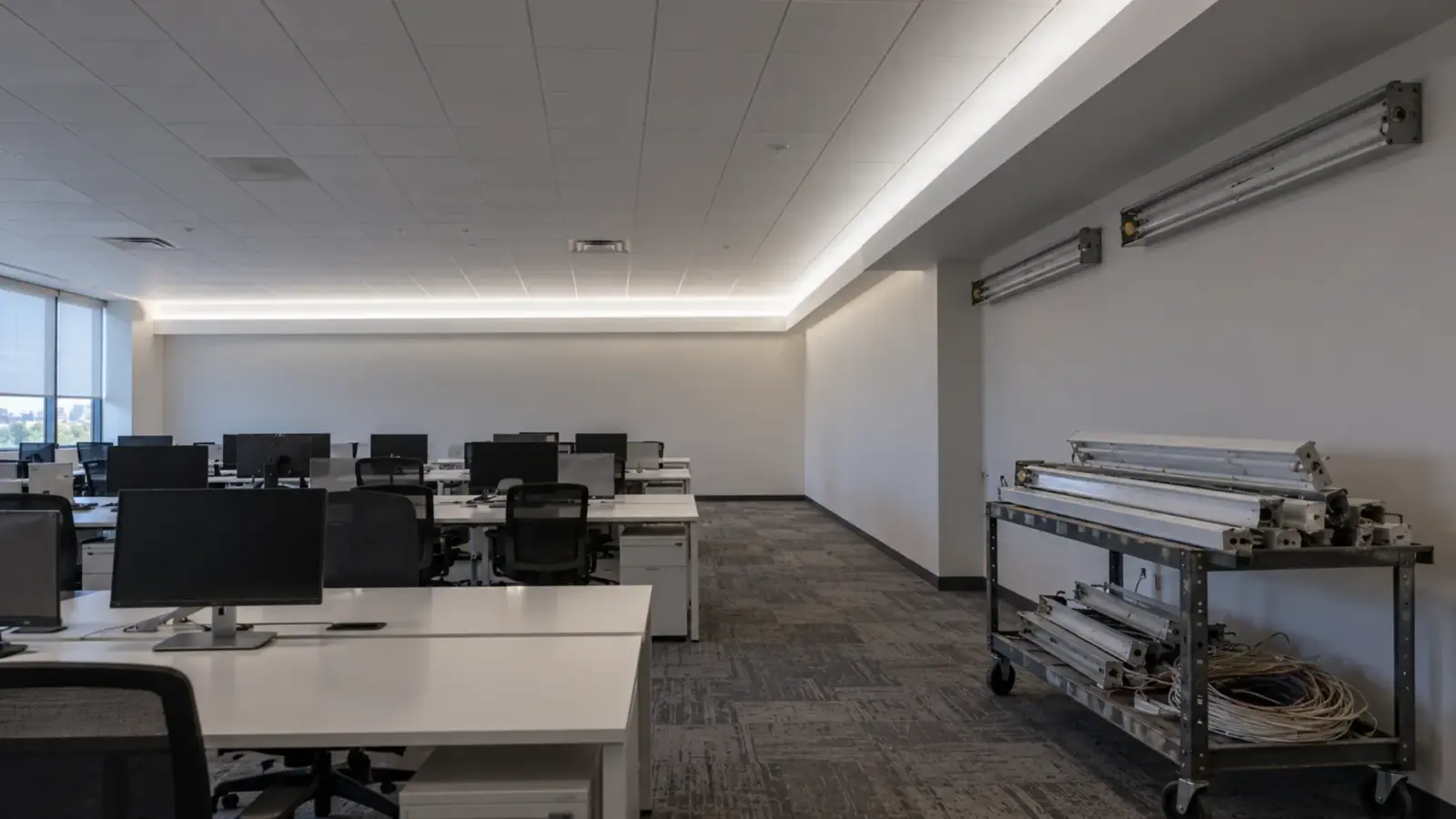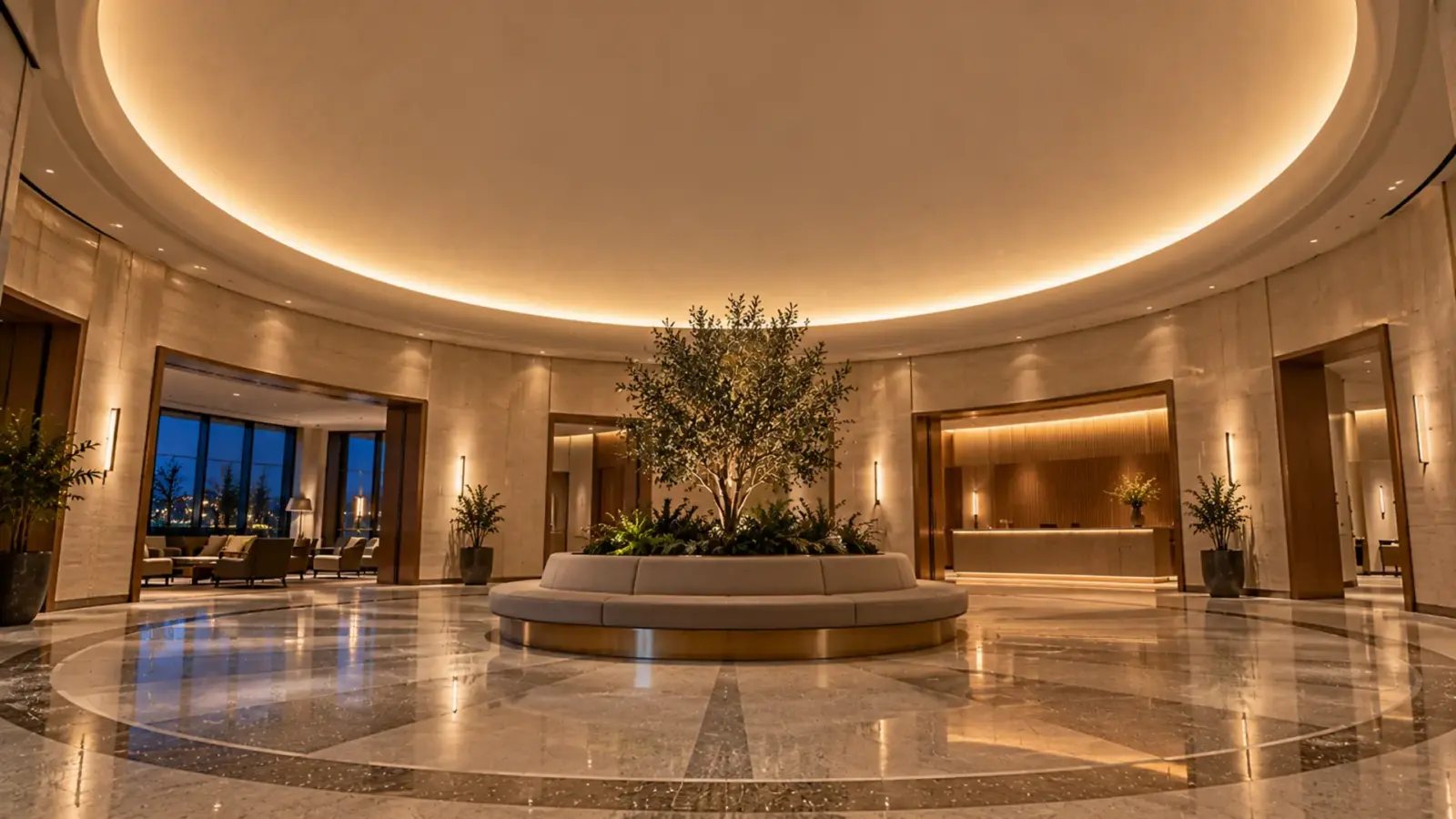
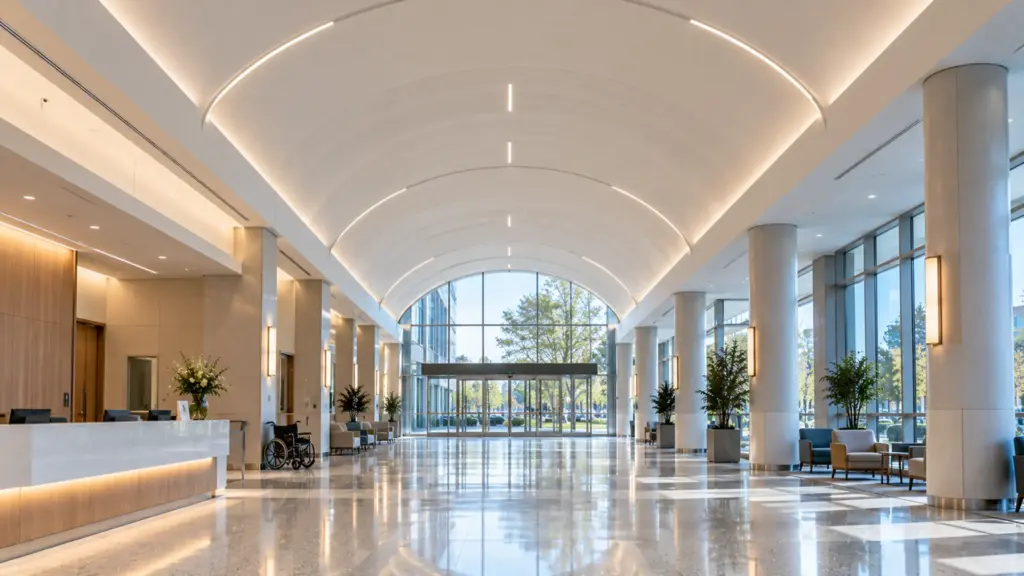
A hotel lobby rotunda, 24 ft across, with a cove the rendering shows as one unbroken ring of light. On site, standard strip refuses to lie flat around the curve, the channel arrives in straight 2 m lengths, and the ring becomes a polygon. Curved cove LED strip works when the product bends in the plane of the curve.
That is the whole problem in one sentence, and the fix starts with knowing which plane each product bends in. Then the curve sorts itself into one of three kinds, and each kind has a short list of things that follow it.
Which Way Strip Bends
Standard LED strip is a flat ribbon. It bends easily one way, up and down like a ribbon over a pencil, and hardly at all the other way, sideways in its own plane. Push a standard strip around a curve drawn on the floor of a cove and it buckles, lifts off its tape or kinks at a component. Our guide to side-emitting, S-bend and ultra-narrow strip explains the forms built to get around that.
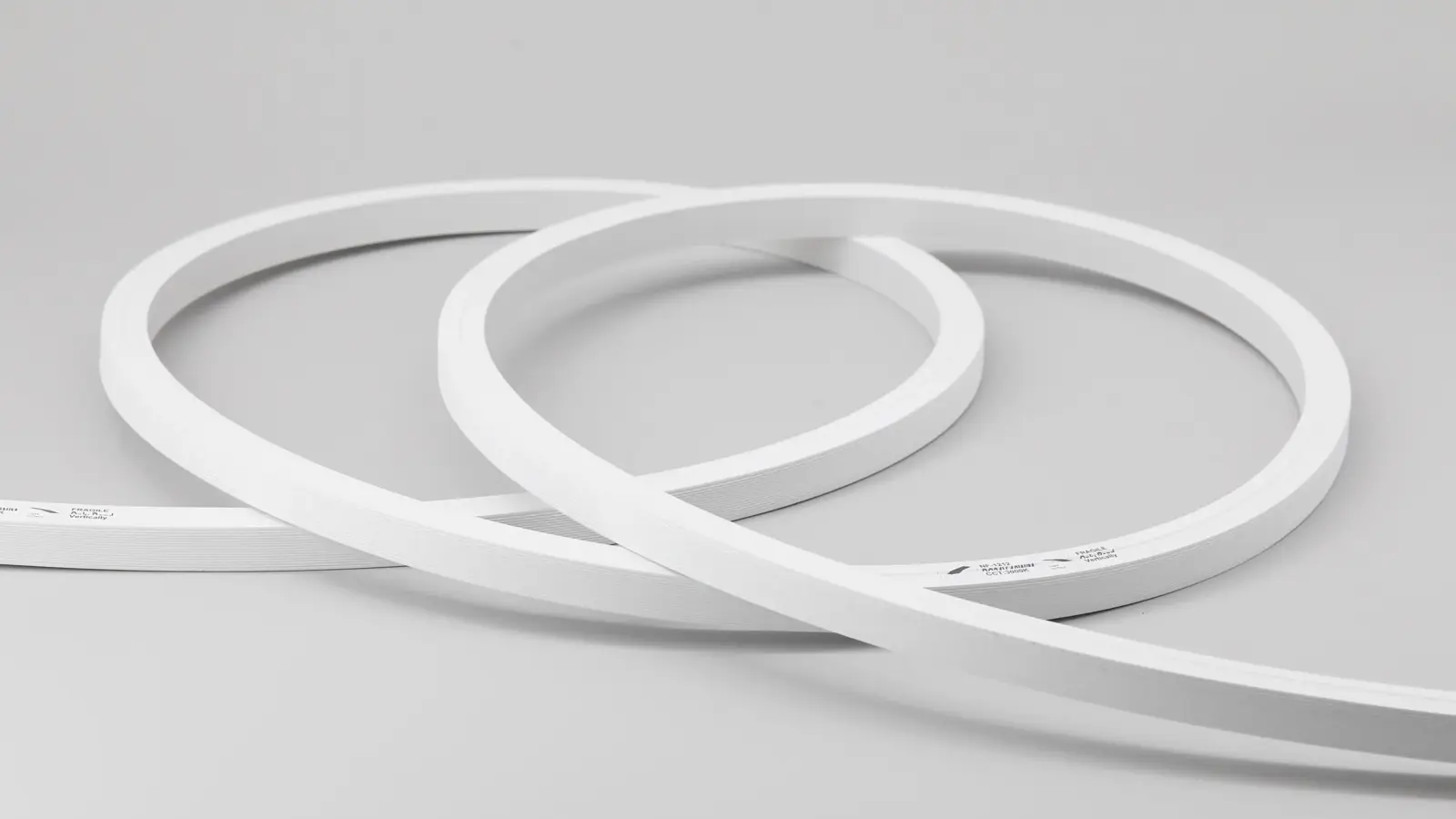
Neon flex has a rated bend direction too. Our neon page puts it plainly: bend only in the rated direction, top, side or 3D, “and never below the rated radius.” Rigid aluminum channel bends in neither direction; ours is an extrusion that “holds a straight line.” Silicone wall washer bars go further than most: UT-WB27 is “extruded silicone rather than a metal housing, so it bends on both axes and follows curved walls and corners.”
Three Kinds of Curve
Every curved detail is one of three kinds, and naming it on the drawing decides the product:
| Curve | Example | Strip bends | What follows it | Rated radius |
|---|---|---|---|---|
| Plan curve (curve seen from above) | Rotunda cove, curved wall slot, curved desk front | Sideways, in its own plane | S-shape COB UT-C400-8-SS; S-shape SMD UT-S2835-120-SS; side-view strip on edge; side-bend neon UT-N1212-SB | 30 mm on the S-shape COB; 120 mm on side-bend neon |
| Section curve (curve seen in elevation) | Barrel vault edge, rounded bulkhead, curved soffit | Flat, the easy way | Standard strip on the surface or in bendable channel; top-bend neon UT-N1010-TB | 60 mm on top-bend neon; bendable channels about 6 in (peers) |
| Compound curve | Dome ring, column wrap, sculptural form | Both | 3D neon UT-N1010-3D or UT-N1616-3D; silicone wall washer UT-WB27; round neon UT-ND18-360 for column wraps | 80 to 100 mm on 3D neon; 80 mm on round neon |
Plan Curves: Rotundas and Curved Walls
A plan curve is the hard one, because it asks strip to bend sideways. Four ways through it:
- S-shape strip. The PCB is cut in a zigzag, so it bends flat around the curve. Our page rates the S-shape COB to bend “flat around curves down to a 30 mm radius”, far tighter than any cove. The SMD version, UT-S2835-120-SS, runs 2.9 W/ft with 16 ft (5 m) per feed.
- Side-view strip stood on its edge. Side-emitting strip such as UT-C320-6-SV lights from its edge, so it can be mounted with its face against a curved upstand, and a plan curve then becomes a flat bend for it. It suits slots and reveals where the light leaves sideways; that row is 12V with 10 ft (3 m) per feed.
- Side-bend neon. UT-N0612-SB and UT-N1212-SB bend edgewise to 4.72 in (120 mm), and UT-N1212-SB, a constant-current profile, runs 62 ft (19 m) per feed, so a large ring needs few feeds. Neon brings its own diffuser, so there is no channel to bend. Our neon bend guide matches profile to curve.
- Straight pieces. Where the radius is large, short straight pieces of ordinary strip in ordinary channel may sit close enough to the curve that nobody sees the difference; the next section gives the numbers.
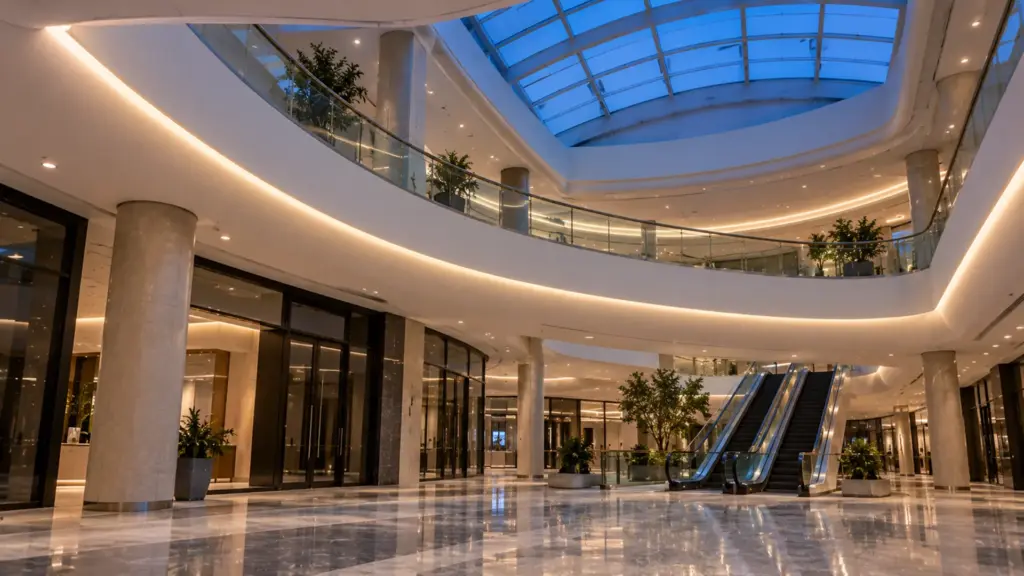
Watch the cove geometry, too. A strip that follows a plan curve has to stay the same distance from the back wall all the way round, or the wash on the ceiling widens and narrows. Mark the strip line on the cove floor as an offset of the wall, not as a free-hand arc. For curved slots in a flat drywall ceiling, purpose-made bendable drywall profiles exist; one, Klus’s KOZMA-BD, bends in the lighting plane to a 500 mm minimum radius and needs “specialized aluminum bending equipment” to form. Our cove page covers the setback and sightline rules that apply to a straight cove and a curved one alike.
Section Curves: Barrel Ceilings and Rounded Edges
A section curve is easier for the strip and harder for the channel. Standard strip bends the easy way over a barrel vault or a rounded bulkhead, but a rigid aluminum profile does not. Three answers:
- Bendable channel. Several makers sell thin aluminum profiles meant to be bent on site. Luminii’s KL Bendable Channel is “field cuttable and bendable (radius 6″ or greater)”, and GM Lighting’s bendable channel lists a minimum radius of 6 in. Use profiles made for bending; a standard extrusion is not made to bend.
- Factory-formed profile. For radii larger than a field-bendable channel’s, ask the profile maker whether the profile can be formed to the radius at the shop, and give the radius measured on the finished surface.
- Top-bend neon. UT-N1010-TB bends the flat way to 2.36 in (60 mm) and carries its own diffuser, so the curved soffit gets a continuous line without a channel.
Compound Curves: Domes and Columns
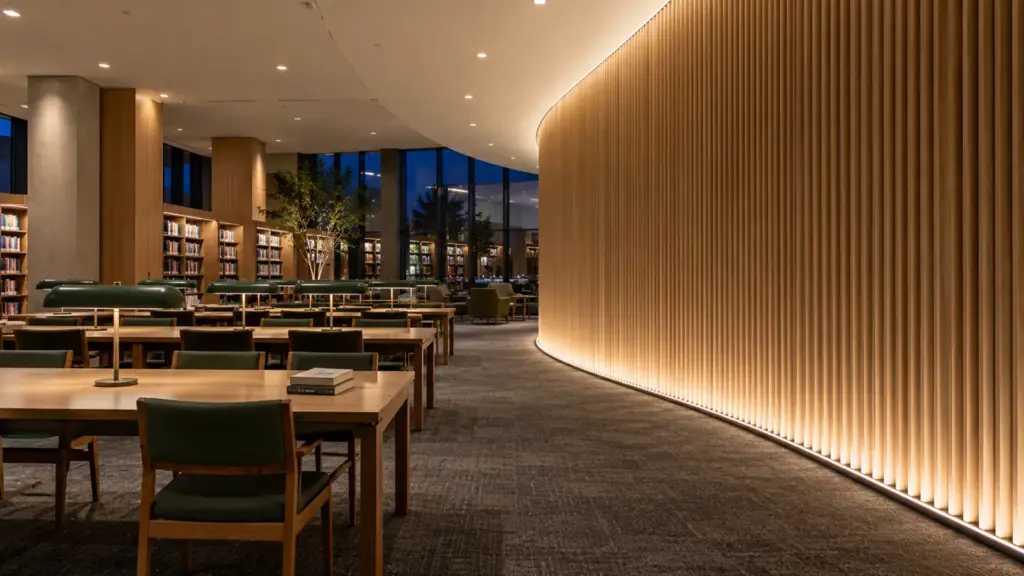
A dome ring or a column wrap bends both ways at once. 3D neon is built for it: UT-N1010-3D bends vertically and horizontally in one run to 3.15 in (80 mm), and UT-N1616-3D to 3.94 in (100 mm). Round neon such as UT-ND18-360 glows all the way round and bends to 3.15 in (80 mm), which suits wrapped columns seen from every side.
Where the curved surface should be washed rather than lined, the silicone wall washer bar UT-WB27 bends on both axes and comes in 1040 mm sections, and our UT-WS20-30-3D, at 70 LEDs/m, is the one in its family that bends on both axes; the 140 LED/m versions bend on one. Our grazing vs washing guide explains the difference in how close to the surface each one mounts.
Straight Pieces on a Curve
Straight pieces are not always wrong. A straight piece laid on a curve touches the curve at its ends and sits off it in the middle, and how far off depends on the radius and the piece length. The sag, the distance between the middle of the piece and the curve, works out as follows:
| Radius of the curve | 12 in pieces | 24 in pieces | 39 in (1 m) pieces | 79 in (2 m) pieces |
|---|---|---|---|---|
| 3 ft | 0.50 in | 2.06 in | 5.86 in | does not fit |
| 6 ft | 0.25 in | 1.01 in | 2.74 in | 11.72 in |
| 12 ft | 0.13 in | 0.50 in | 1.35 in | 5.48 in |
| 20 ft | 0.08 in | 0.30 in | 0.81 in | 3.25 in |
Read it against the cove. In a 24 ft rotunda, a 12 ft radius, 12 in pieces sit an eighth of an inch off the curve: invisible from the floor, and ordinary strip in ordinary channel works, with a joint every foot. A 2 m channel length on the same curve sits more than 5 in off in the middle, which turns the wash into visible scallops and breaks the cove lip’s line. On a 3 ft radius, a curved desk front or a column, only a true curve-following product works.
On curves whose radius changes, such as an ellipse or a freeform wall, the sag table works piece by piece: short pieces where the curve is tight, longer ones where it relaxes, so no piece sits far off the line.
The joints are the other cost. Every straight piece has two ends, and each end leaves a short dark gap where the light stops. Seventy-five joints in a 75 ft ring is seventy-five gaps, which is why short chords work best where the cove lip hides the strip itself and only the wash is seen.
A 24 ft Rotunda, Worked
Take the rotunda from the opening: a cove ring 24 ft across, a strip line of about 75 ft. Two ways to light it with a continuous line:
| Approach | Product | Load | Feeds | Joints in the ring |
|---|---|---|---|---|
| S-shape strip on the cove floor | UT-S2835-120-SS, 2.9 W/ft | about 219 W | 5 at 16 ft (5 m) per feed | At the feed points only |
| Side-bend neon on the cove floor | UT-N1212-SB, 3.7 W/ft | about 279 W | 2 at 62 ft (19 m) per feed | At the two feed points |
| Straight chords in channel | UT-C480-8 in 12 in channel pieces | about 241 W at 3.2 W/ft | 6 at about 12.5 ft each, to stay within 48 W per 60 W driver | About 75 channel joints |
The S-shape strip gives the most even wash for the fewest watts; the neon gives the fewest feeds and no channel; the chords use the most ordinary parts and the most labor. All three need the strip line laid out as a true offset of the back wall. On the S-shape layout each of the five segments is about 15 ft and carries about 44 W, inside the 48 W we load a 60 W Class 2 driver to, so the ring takes five such drivers, one per feed point. The neon feeds carry about 140 W each and go on constant-current drivers, as every constant-current profile does, never a 24V constant-voltage supply. Our lumens per foot guide helps set how bright the ring should be.
Feeds, Joints and Color on a Ring
A ring has no ends, so the feed points are a choice. Space them evenly so each segment stays inside the strip’s run limit, put the drivers where they can be reached, usually above an access panel behind the cove or in an adjacent ceiling, and run the leads to the cove at those points. On the S-shape example that is five feed points about 15 ft apart; on the neon, two opposite each other. Every feed point is also a joint, so place them where the cove lip is deepest or the view is blocked.
Color matters more on a ring than on a straight run, because the eye travels all the way round and compares the far side with the near side. Order the whole ring from one production lot and install the reels in sequence; our color consistency guide explains why two reels of the same model can differ.
Curved slots in drywall add one trade. Where a curved slot or reveal is formed in gypsum, the drywall crew builds the curve, and the channel or neon has to match the radius they build, not the radius on the drawing; agree the radius at the framing stage and check it before the slot is finished. Our trimless channel guide covers coordinating with the drywall crew on straight runs, and the same handoff applies on a curve.
Mockup the Curve
A curve is the one place where a mockup on a straight bench lies. Mock up a quarter of the ring, or the tightest part of the curve, in the real cove with the real lip and the final paint finish, and look from the floor where people stand. Check for kinks at the tightest radius, dark joints at feed points, the wash staying even on the ceiling, and the strip staying put on its tape or clips where it is under bending stress. A curved strip that holds on the bench may creep on a ceiling; plan clips or a retaining profile at the tightest part.
Spec Notes for This Job
- Name the curve on the drawing: plan, section or compound, with the radius at the strip line.
- Plan curves: S-shape strip, side-view strip on edge, or side-bend neon; straight pieces only where the sag table says they disappear.
- Section curves: bendable channel at its rated radius, a factory-formed profile, or top-bend neon.
- Compound curves: 3D or round neon, or a silicone wall washer that bends both ways.
- Lay the strip line as an offset of the wall, and keep feeds and joints where the lip hides them.
- Mock up the tightest part of the curve in place.
Unitop Lighting supplies S-shape and side-view strip on our COB LED strip and SMD LED strip pages and side-bend, 3D and round profiles on our neon flex page. Send the reflected ceiling plan with the radii marked and we will propose the product for each curve, the feed points and the cut list: request a quote.