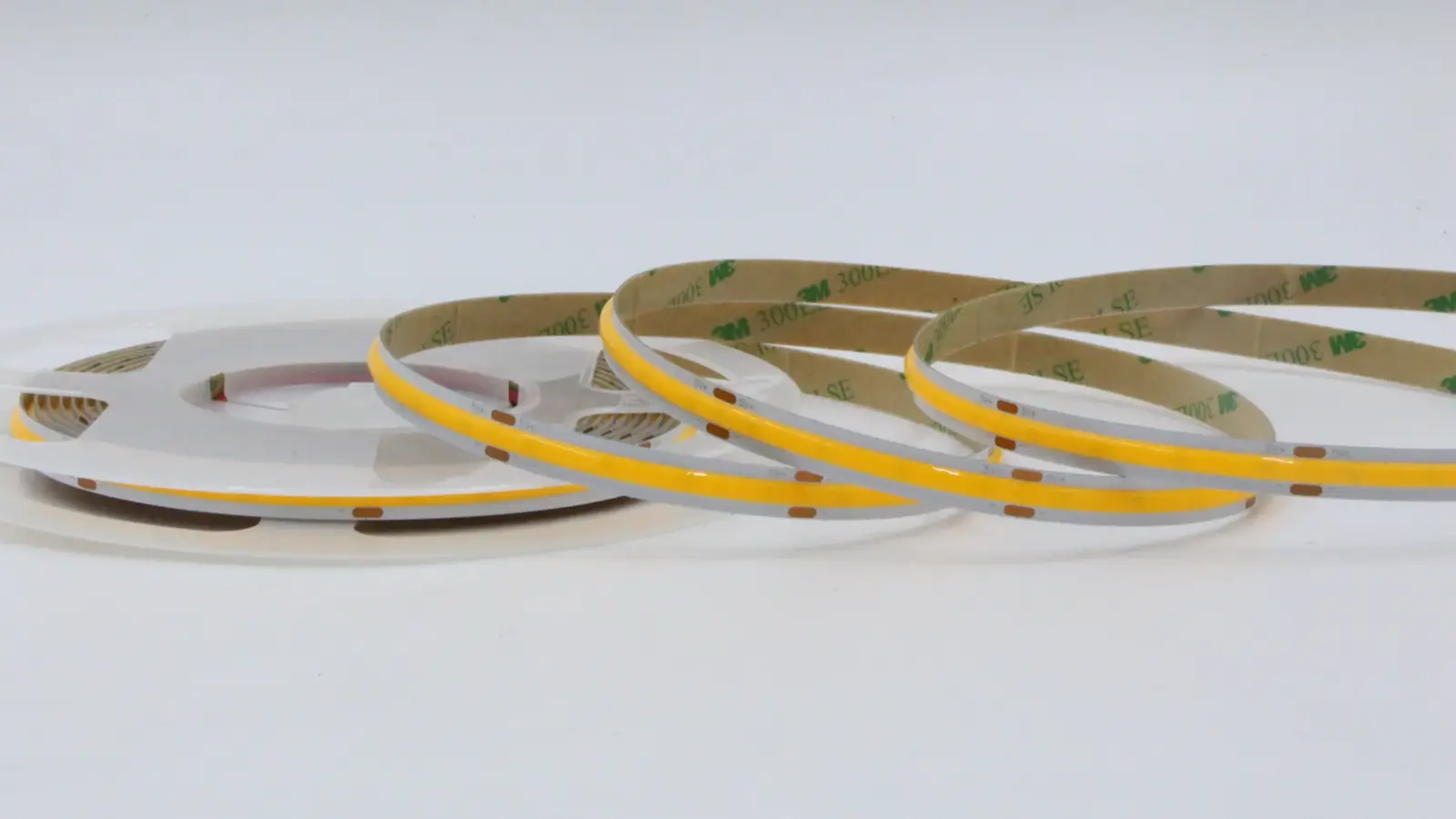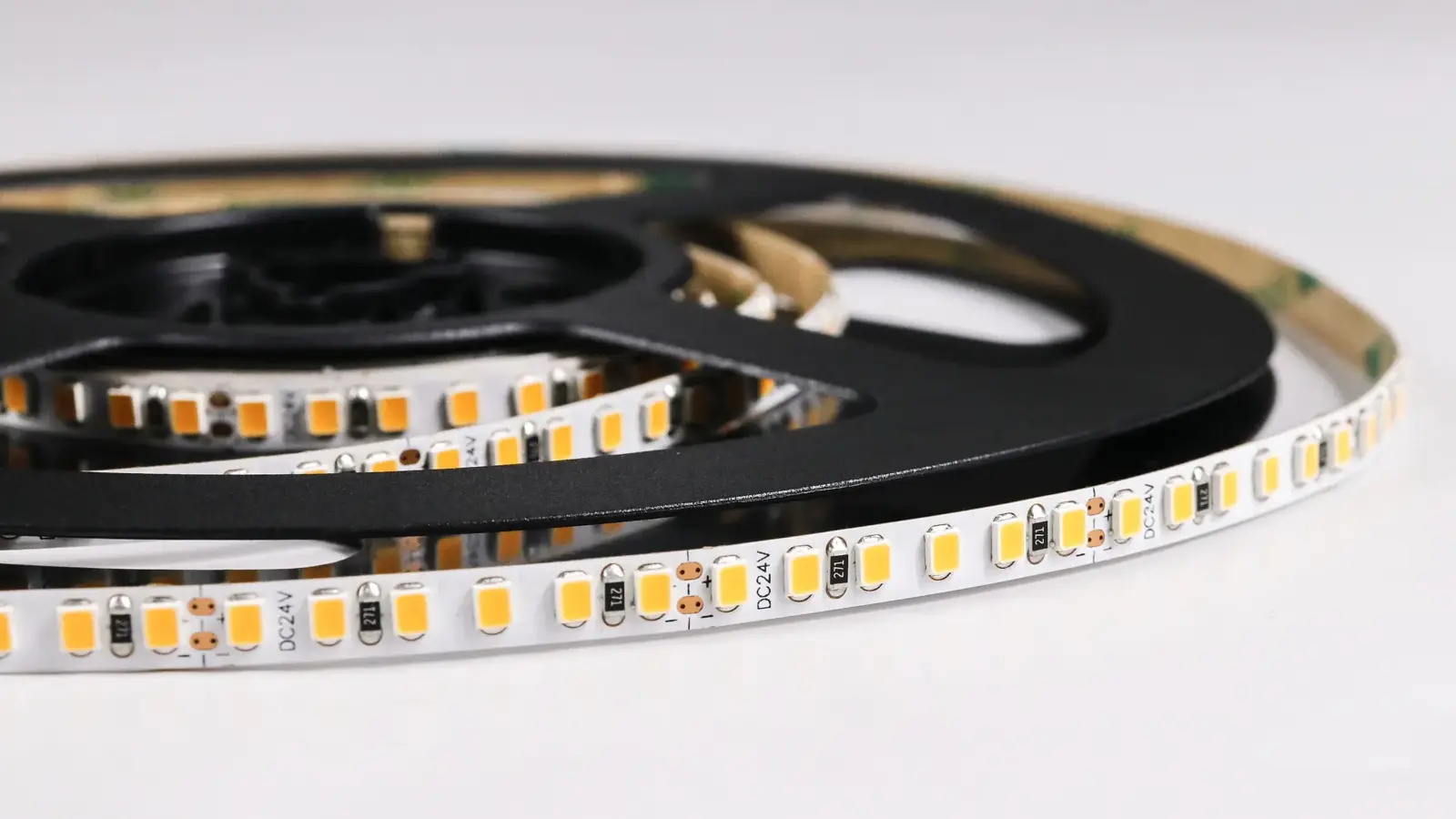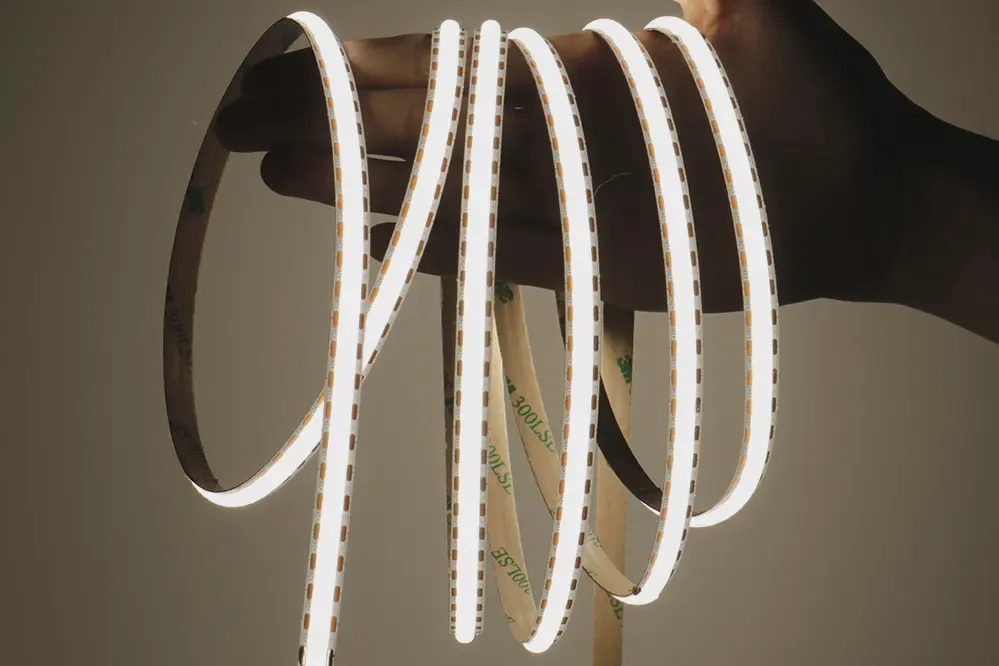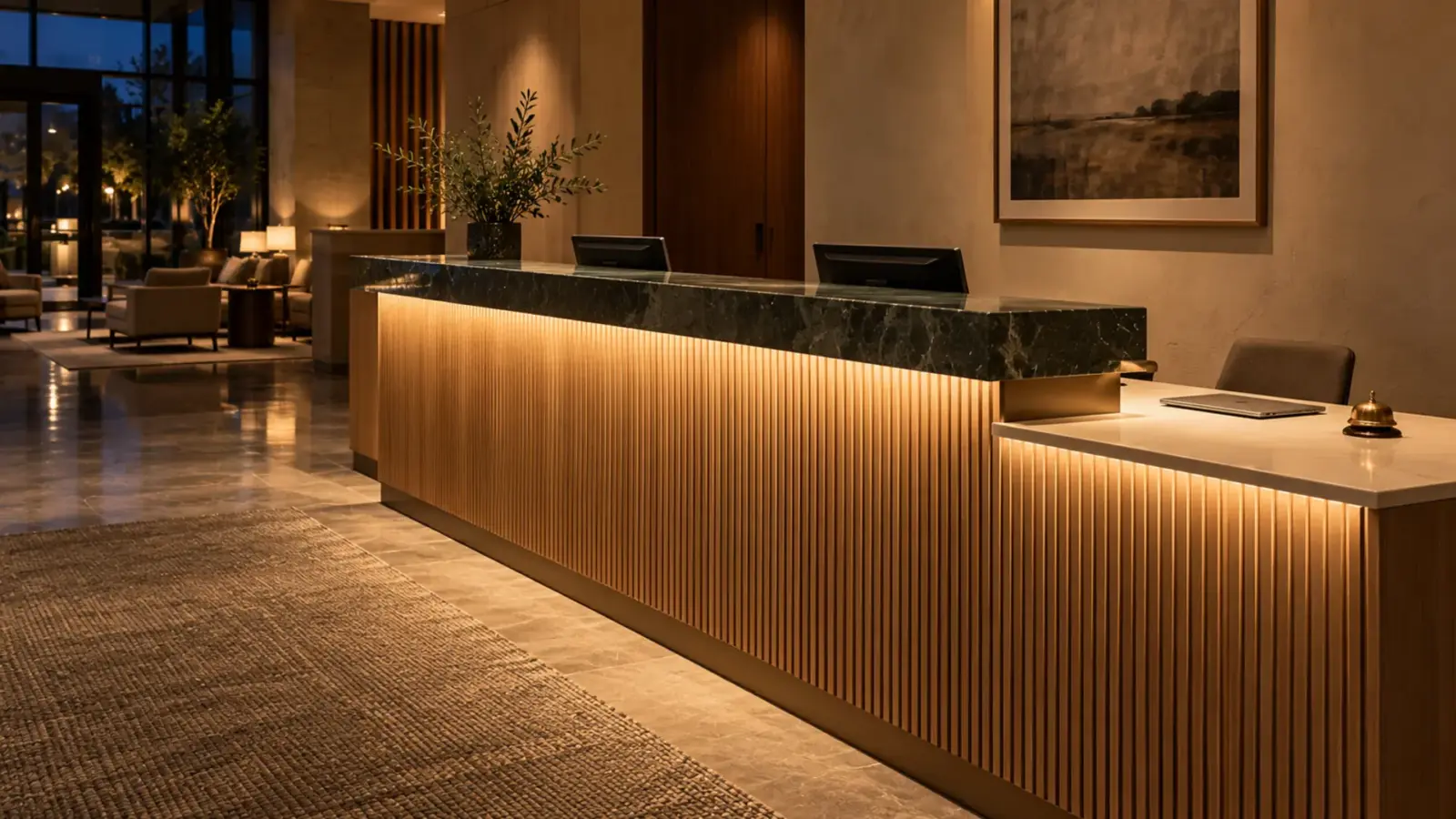
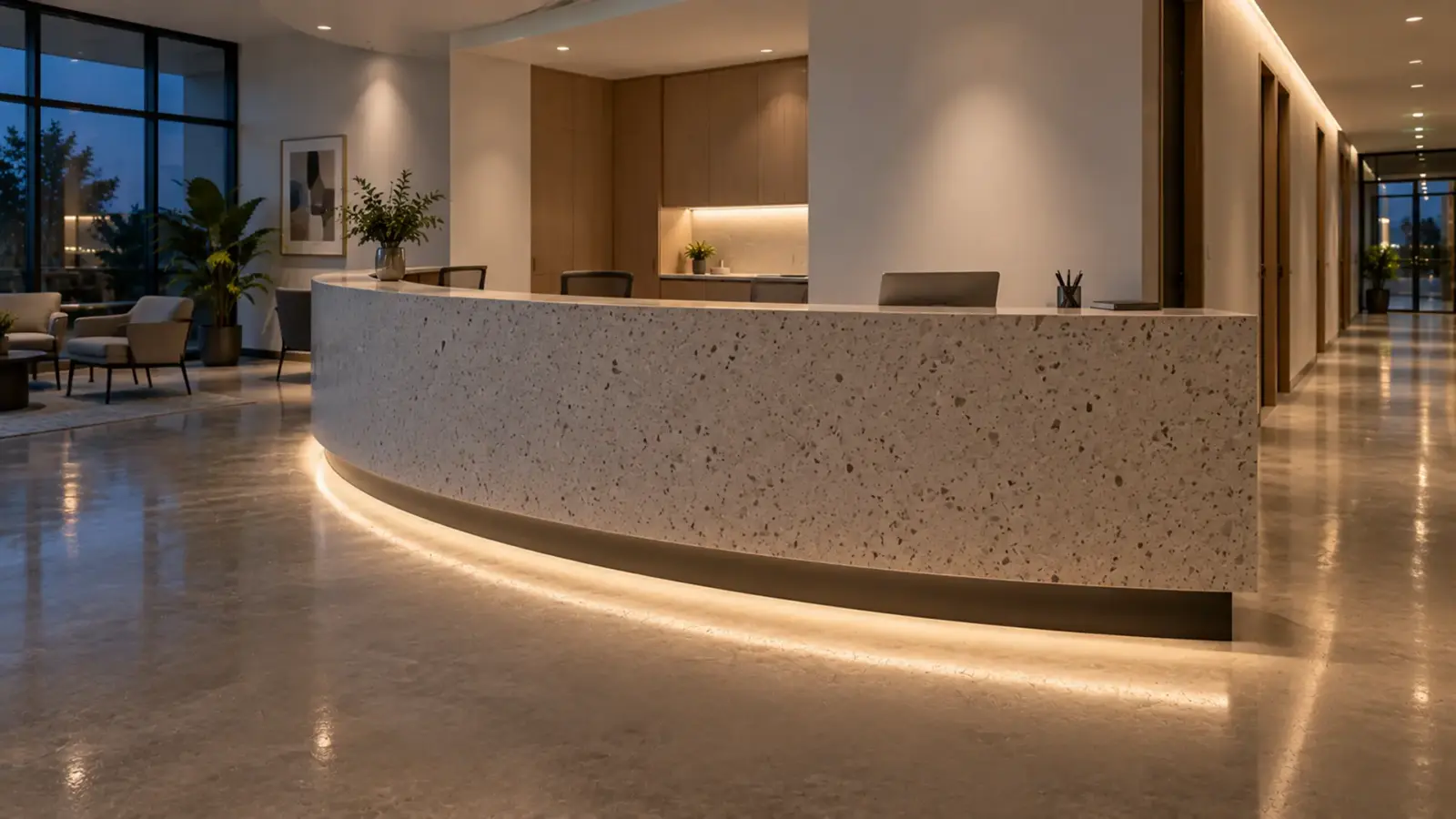
Pick by the shape the strip must follow. Side-emitting strip sends light out of its edge, for profiles and shelf fronts. S-bend strip has a zigzag board that turns flat, for letters and curves in plan. Ultra-narrow strip is 3 to 5 mm wide, for slim reveals and grooves. Each gives up some output or run length.
| If the job needs | Choose | Our models |
|---|---|---|
| Light out of the side of a thin profile or shelf edge | Side-emitting | UT-C320-6-SV, UT-S3014-120-SV |
| A curve or corner in the plane of the mounting surface | S-bend | UT-S2835-120-SS, UT-C400-8-SS |
| A slot or groove 3 to 5 mm wide | Ultra-narrow | UT-C400-3, UT-C480-4, UT-S2835-120-UN |
| A curve and a dot-free line in a narrow return | Side-view COB | UT-C320-6-SV |
| A very tight 3D shape outdoors | Neon flex | See the neon range |
The rest of this guide explains each choice, what it costs, and how to mount it.
Standard Tape Bends in One Plane Only
A standard LED strip is a flat ribbon. It bends easily one way: up and down, like a ribbon over a pencil. That lets it follow a curved ceiling or wrap around a column. It does not bend the other way, sideways in its own plane, without kinking. Push a standard strip around a curve drawn on a flat wall and the board twists, the edge lifts, and the copper can crack.
That one fact explains most special-form strip. A channel letter’s curved stroke, a round reception desk seen from above, a radius in a shelf edge: all of them ask the strip to bend sideways. Cutting the strip at every turn and joining it with connectors works on large radii, but it adds joints, each one a failure point and a possible dark spot. Our guide on how to cut and connect LED strip shows what each joint involves.
The second problem is width. Standard strip runs 8 to 12 mm wide. A 4 mm reveal in a stair handrail or a millwork joint will not take it.
The three special forms answer those two problems in different ways.
Side-Emitting: Light Leaves the Edge
On a standard strip the LEDs face up, away from the board. On a side-emitting strip, sometimes called side-view, they face sideways. According to Oznium, the light runs parallel to the board instead of straight out of it. Mount the strip flat on a surface and the light travels along that surface.

That solves a specific geometry. In a thin shelf, a glass edge or a narrow profile, there is room to lay the strip flat but no depth to stand it on edge. A side-emitting strip lies flat and still throws its light forward out of the edge.
Our side-view range has two constructions. The COB version UT-C320-6-SV is a 6 mm board at 320 LEDs per meter on 12V, 2.4 W/ft, cut every 0.25 in, with a run of 10 ft per feed. It gives a dot-free line from the edge. The SMD version UT-S3014-120-SV uses 3014 side-view packages on an 8 mm board, on 12V or 24V, 2.9 W/ft, cut every 1.97 in, with 16 ft per feed.
A side-emitting strip also bends more willingly in one more direction than you might expect: because the board is mounted on its face, the “easy” bend becomes a bend across the surface. That is why side-view strip is often chosen for narrow returns of letters. Our signage page names the side-view COB for exactly that job.
Naming is inconsistent across the trade. According to Domus Lighting, some sellers use “side view” for the bend direction rather than the light direction. Read the datasheet’s drawing, not the product name.
S-Bend: A Zigzag Board That Turns Flat
An S-bend strip, also sold as S-shape or zigzag strip, solves the sideways bend directly. The board is cut in a zigzag, so it can be pulled into a curve in its own plane, the way a folded paper strip can be fanned around a corner. According to Luxalight, the zigzag board bends sideways where a standard board cannot, and it usually carries fewer LEDs per meter to make that possible.
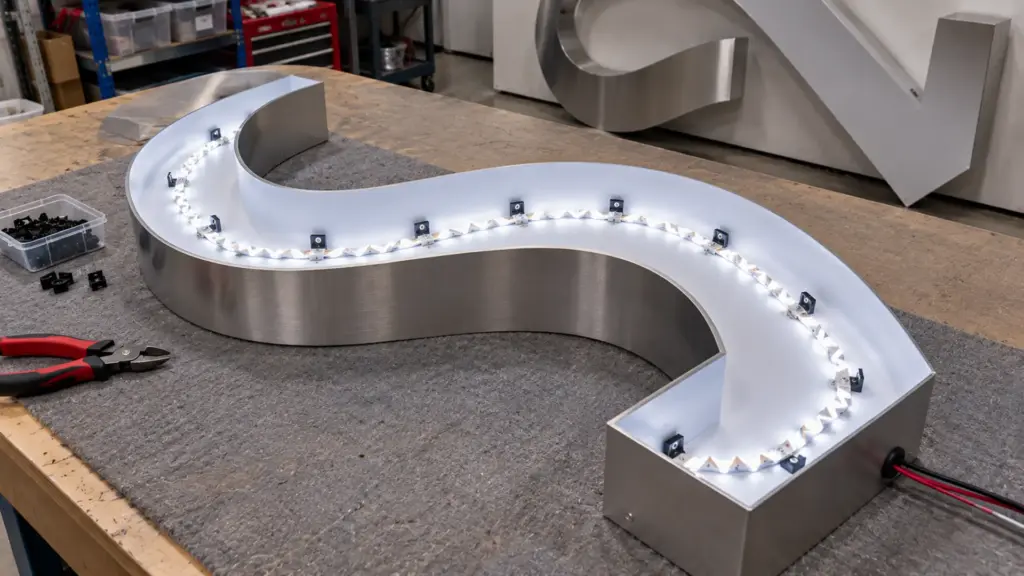
That makes S-bend the natural strip for letters and logos in channel letters, curved coves seen in plan, and corners where a standard strip would need a cut and a connector. Our S-shape SMD strip UT-S2835-120-SS carries 120 LEDs per meter of 2835 packages on an 8 mm zigzag board, on 12V or 24V, at 2.9 W/ft, cut every 1.97 in, with 16 ft per feed. A COB version, UT-C400-8-SS, puts 400 LEDs per meter on an 8 mm S-shape board on 24V for runs where the line will be visible.
Two cautions. The zigzag board is less stable when straight, so it needs a channel or clips more often than a standard strip. And the minimum radius depends on the model; take it from the datasheet, and test the tightest curve on a sample before the order.
Ultra-Narrow: When the Slot Is 3 to 5 mm
Ultra-narrow strip is ordinary strip made very thin. According to Signlite, “ultra-thin” in this market usually means the width of the circuit board, not its thickness. The board bends in the same plane as standard strip; what changes is that it fits where standard strip cannot.
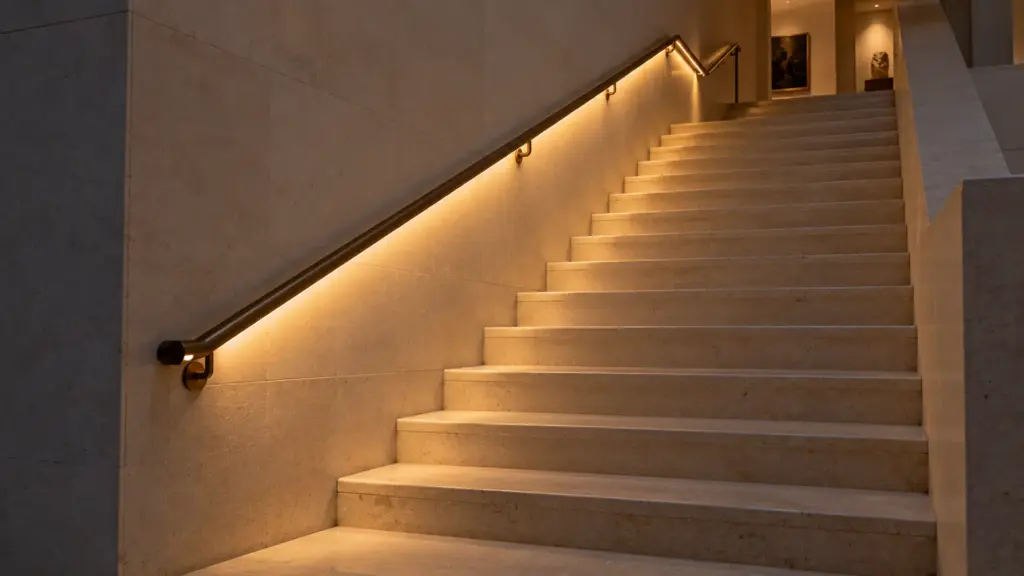
Our narrowest are COB. The UT-C400-3 is 2.7 or 3 mm wide, at 400 LEDs per meter on 12V or 24V, 2.1 W/ft, cut every 0.39 or 0.79 in, with 16 ft per feed. The UT-C480-4 comes in 3, 4 and 5 mm widths, and the UT-C528-3 is a 3 mm 12V board. In SMD, the UT-S2835-120-UN fits 4 and 5 mm reveals at 2.9 W/ft with 16 ft per feed. The super-slim UT-SC336SS-6 runs 5 mm at 1.8 W/ft.
Narrow strip is the one to use in a millwork joint, a handrail groove, a display case corner or a slat wall groove. It is also the one most often asked to do too much.
What Each One Gives Up
Every special form trades something for its shape. The trade is what decides the spec, so it is worth stating plainly.
| Form | Gives up | Watch |
|---|---|---|
| Side-emitting | Output per foot and choice of densities | Light direction on the drawing; run per feed on 12V |
| S-bend | Stability when straight; some density | Minimum radius per model; needs clips or a channel |
| Ultra-narrow | Current capacity and heat spreading | Voltage drop on long runs; output per foot |
The ultra-narrow trade deserves the most attention. According to Signlite, a narrower board affects current-carrying capacity, heat dissipation, mechanical strength and voltage-drop behavior. A 3 mm board has less copper than an 8 mm one, so the same run length drops more voltage and the same power runs hotter. Plan feeds as the datasheet says and keep runs within the stated length per feed. Our guide to LED strip voltage drop shows why the far end goes dim first.
The side-emitting COB on 12V has the shortest run of these at 10 ft per feed. On a long shelf, that means more feeds and more drivers or a feed plan worked out early.
Channels and Mounting
Each form changes how the strip is held.
- Side-emitting strip usually lies flat on a surface or the floor of a channel. Aim matters: the light leaves one edge only, so the drawing should show which edge faces the target.
- S-bend strip needs support along curves. In a channel letter it is held by clips or adhesive to the letter’s back, following the stroke; in millwork it sits in a routed groove of the right radius.
- Ultra-narrow strip needs a channel or groove sized to it. A 3 mm strip in an 8 mm channel slides and twists. Our channel range starts with the UT-CH1207, which takes strip up to 8 mm; narrower grooves are usually routed into the material itself.
Our guide to LED strip width and channel fit lists which channels take which widths, and LED channel selection covers recessed and surface profiles. The channel catalog is on our LED channels and diffusers page.
By Application
| Application | Usual choice | Why |
|---|---|---|
| Channel letters, curved strokes | S-bend, or side-view COB in narrow returns | Bends in the plane of the letter back |
| Shelf front edges, glass shelves | Side-emitting | Light leaves the edge of a thin shelf |
| Curved reception desk toe-kick | S-bend | Follows the curve in plan without cuts |
| Stair handrail groove | Ultra-narrow | Fits a 4 to 5 mm groove |
| Display case corners | Ultra-narrow COB | Thin, dot-free line in a small case |
| Slat wall grooves | Ultra-narrow | Fits the groove between slats |
| Tight 3D shapes outdoors | Neon flex | Sealed, bends in more than one plane |
For tight shapes outdoors or in wet locations, none of these bare strips is the right answer. LED neon flex is built to bend top, side or in 3D, and our neon range includes a side-view micro family down to 3 by 6 mm. Our LED neon flex selection guide covers it.

Mistakes That Cost a Remake
Special-form strip fails in predictable ways. Each of these has sent a job back to the shop.
- Ordering side-view when the drawing meant S-bend. Because some sellers use “side view” for the bend direction and others for the light direction, the name on a purchase order is not enough. Put the intended light direction and bend plane in words on the order, and attach the drawing.
- Forcing standard strip around a curve in plan. It looks fine on install day. The twisted board lifts off its adhesive within weeks and the copper cracks at the tightest point. If the curve is in the plane of the surface, it needs S-bend or cuts and connectors.
- Running ultra-narrow strip as far as standard strip. A 3 mm board on a long handrail run dims at the far end because it carries less current. The run per feed on the datasheet is shorter in practice than the same model in a wider board; follow it.
- No support for S-bend on straight runs. The zigzag board wanders when it is not held. A straight section of a letter or a cove needs clips or a channel just as much as the curves do.
- A narrow strip in a wide channel. A 3 mm strip in an 8 mm channel shifts sideways, and the line of light moves with it. Size the groove or channel to the strip.
- Forgetting the cut interval. The COB side-view strip cuts every 0.25 in; the SMD side-view and S-shape strips cut every 1.97 in. On a letter or a shelf with fixed lengths, the long cut interval can leave a gap at each end. Check it against the shop drawing before ordering.
Sample the Shape Before the Order
Every one of these strips should be tried on the real shape before the order is released, because the limit that matters is the one the job meets: the tightest radius, the narrowest slot, the longest run.
- For S-bend, bend a sample around a template of the tightest curve on the drawing and leave it there for a day. If the board lifts or the light shows a dark spot at the turn, the radius is too tight for that model.
- For side-emitting, mount a short piece on the real shelf or profile and look at it from where people will stand. Check that the light lands where the design wants it and that the strip itself is hidden.
- For ultra-narrow, put a full-length piece in the groove, feed it from one end at the planned voltage, and compare the far end with the near end.
Ask for samples in the exact model, not a “similar” one. A different board width or density changes both the bend and the light.
FAQ
What is side-emitting LED strip used for?
It lights along a surface from a strip laid flat: shelf front edges, glass edges, thin profiles and narrow returns of channel letters. The light leaves the edge of the board instead of its face.
Can LED strip bend sideways?
Standard strip cannot bend in its own plane without kinking. S-bend strip, with a zigzag board, is made to do exactly that. Take the minimum radius from the model’s datasheet and test the tightest curve on a sample.
What is S-type LED strip?
Another name for S-bend or zigzag strip: a board cut in a zigzag pattern so it can curve in its own plane for letters, logos and curves seen in plan. It usually carries fewer LEDs per meter than a straight strip.
How narrow can LED strip be?
Our narrowest COB strip is 2.7 to 3 mm wide (UT-C400-3), and SMD versions fit 4 and 5 mm reveals. Narrow boards carry less current, so keep within the stated run per feed.
Which One to Spec
- If the strip must bend in the plane of the surface it sits on, spec S-bend.
- If the light must leave the edge of a thin part, spec side-emitting, COB when the line is visible.
- If the slot is under 8 mm, spec ultra-narrow, and plan feeds for its shorter effective run.
- If the shape is tight, three-dimensional or outdoors, spec neon flex instead.
- Test the tightest radius and the longest run on a sample before the order.
We supply side-view, S-shape and ultra-narrow strip in COB and SMD, with the channels and drivers to match. Send the shape, a section through the slot and the run lengths, and we will check the radius, the feed plan and the channel fit before you release the order: request a quote.