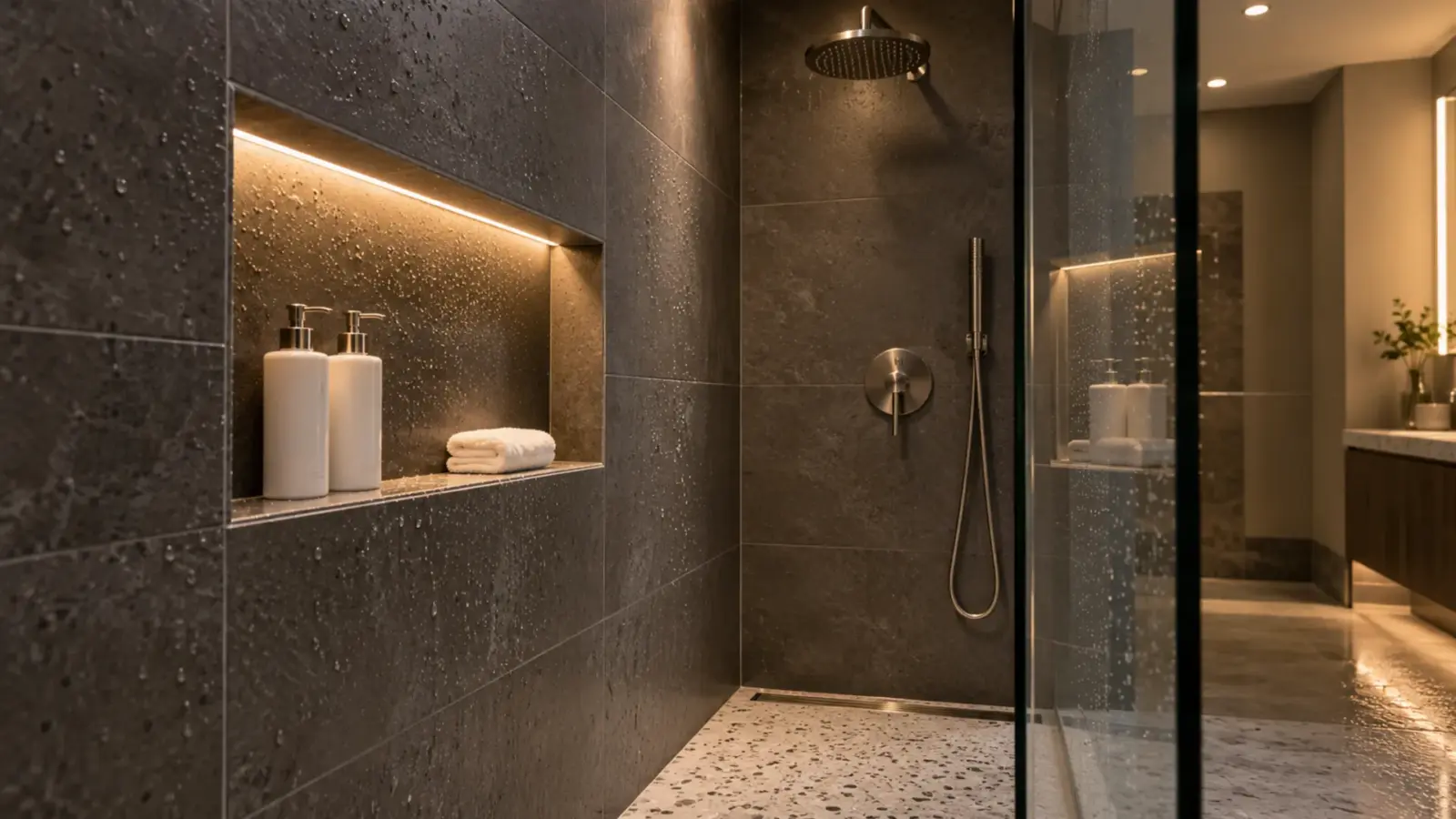
The niche is tiled, the strip glows, and the inspector asks where the driver went. LED strip can go in a shower niche when the strip is marked for wet locations where spray reaches it, runs on a low-voltage Class 2 supply, and the driver sits outside the shower zone in a dry place someone can reach.
The strip rarely fails inspection; a driver sealed behind tile, a plug-in supply inside the shower zone, or a damp-marked strip in the spray usually does. The sections below follow the shower niche code requirements in the order an inspector checks them, using the 2020 and 2023 NEC; your adopted edition and local amendments govern.
The Shower Zone: What 410.10(D) Says
NEC 410.10(D) covers luminaires in bathtub and shower areas. The 2020 edition split it into two items; an electrical continuing-education site reproduces the text:
- The zone. No parts of cord-connected luminaires, chain-, cable- or cord-suspended luminaires, lighting track, pendants or ceiling-suspended paddle fans within 3 ft (900 mm) horizontally and 8 ft (2.5 m) vertically from the top of the bathtub rim or shower threshold, including the space directly over the tub or shower.
- The marking. Luminaires within the outside dimension of the tub or shower, up to 8 ft (2.5 m) above the rim or threshold, marked suitable for damp or wet locations, and for wet locations where subject to shower spray.
According to IAEI Magazine, the 2023 edition keeps both items as 410.10(D)(1) and (2).
Item 2 decides the product. A niche in the shower wall sits inside the shower’s outside dimension and below 8 ft, and most face the shower head. Plan for the wet marking. Item 1 decides the power: a strip fed from a plug-in supply can be read as a cord-connected luminaire, and no part of one may sit in the zone. Hardwire the driver outside the zone and the question never comes up.
Wet Marking, Not an IP Number
An IP code is a lab test of how much water gets in. The wet location marking comes from the product’s listing, and it is what the inspector reads. See the wet location guide.
An IP67 extrusion-sleeve strip handles direct spray and water standing on a niche shelf; an IP65 top coat suits splash. Our IP67 COB model UT-O320-8-67 runs at 24V, loads 3.0 W/ft, cuts every 1.97 in (50 mm) and comes in 2700K to 6000K, so it reads as one dot-free line at arm’s length. For our outdoor and waterproof LED strip, we confirm the wet location marking for the model you specify at quote.
Our connectors are rated IP20, IP62 or IP65, so the joint between strip lead and cable does not belong in the niche. And each cut end is closed again with a matching silicone end cap; the IP67 cut-end sealing steps apply to a 2 ft niche run too.
Voltage at the Niche: Why 48V Stays Out
Section 411.3 of the 2023 NEC, as reproduced by Leviton, limits low-voltage lighting systems to 30 volts ac or 60 volts dc, and to 15 volts ac or 30 volts dc where wet contact is likely. A shower niche is the textbook case.
12V and 24V DC strip sit inside the wet-contact limit; 48V DC does not, so it stays out of the niche even when the rest of the bathroom runs on it. Our NEC low-voltage guide explains where Article 411 ends and the Class 2 wiring rules begin.
A niche run is under 3 ft, so voltage drop does not choose between 12V and 24V. Match the other strip on the same switch so one driver serves both. UT-O320-8-67 is 24V only; UT-O120-12-67 comes in 12V or 24V and needs an opal cover to hide its dots. The 12V, 24V and 48V comparison covers the rest.
Does a Shower Niche Need GFCI?
Not because of 410.10(D): its two items are the zone and the marking. Members of the Mike Holt Forum say the NEC does not require GFCI for shower lighting unless the manufacturer does. We found no national rule behind one strip vendor’s claim that GFCI is required in most jurisdictions, but a requirement can reach the niche four ways:
- A receptacle. If the driver plugs into a 125-volt bathroom receptacle, NEC 210.8 requires GFCI for it. Hardwiring removes the receptacle.
- A local amendment. A DMF Lighting bulletin cites the City of Seattle Electrical Code, which adds GFCI for luminaires with exposed grounded metal parts in the tub and shower zone.
- The instructions. NEC 110.3(B) requires listed equipment to be installed per its instructions, so a GFCI the instructions call for is required.
- A spa or hydromassage tub. According to EC&M’s Code Basics, luminaires within 5 ft of an indoor spa must be 12 ft above the water without GFCI, or 7 ft 6 in with it, and a hydromassage tub needs its own GFCI circuit. A niche beside either falls under Article 680 too.
The GFCI sits on the 120-volt side. A typical Class 2 LED driver isolates its output, so a fault on the 24V side in the niche does not pass through the GFCI’s sensing; protection there comes from the low voltage and the Class 2 limit. On hotel and multifamily jobs, settle GFCI on the bathroom lighting circuit before rough-in, when it costs a device instead of a tile repair.
Driver Location: Dry, Reachable, Hardwired
Our Class 2 drivers are IP20 and stay dry. That rules out the shower wall, the niche cavity and the ceiling over the shower, and leaves the vanity base (high on a side panel, away from the trap), a linen or adjacent closet, or a ceiling access panel outside the zone.
A hardwired driver’s line-side connection is a splice, and splices belong in accessible enclosures (NEC 300.15, as IAEI summarizes it). Electricians on the Mike Holt Forum found rules that let Class 2 output wiring be concealed, and nothing that extends that to the input side. A potted Dust-tight, and protected against temporary immersion in water. The usual rating for wet or outdoor runs that are not submerged all the time. driver such as UT-D100-24-67 is rated for wet locations, but that is not permission to bury it.
Distance is not the limit at niche loads. A 24 in niche at 3.0 W/ft draws about 0.25 A at 24V; over 25 ft of 18 AWG each way (about 6.4 Ω per 1,000 ft*), the drop is about 0.08 V, roughly 0.3 percent. The remote driver layout guide and the driver placement guide for millwork cover hatches and cabinet mounting; the drivers and controllers page lists the Class 2 and potted models.
*Typical value for this class of wire, rounded down. Confirm against the cable maker’s data.
Getting the Cable Through the Membrane
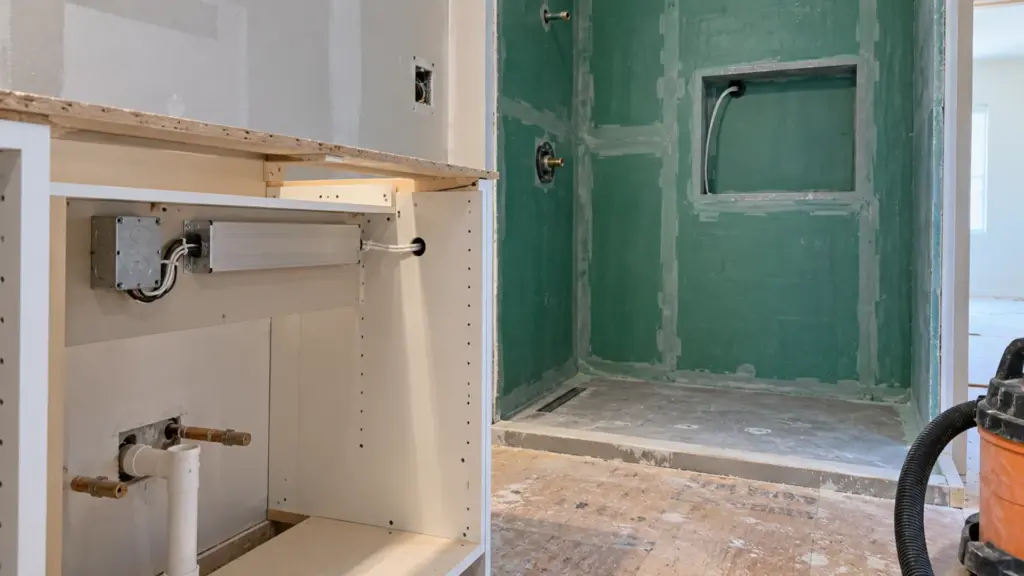
The membrane is the tile trade’s work and the penetration is the electrician’s, so agree on who seals the hole before the board goes up. Strip vendors’ install guides agree on bringing the cable in at the top back of the niche, so the strip sits out of standing water and there is one penetration to seal.
- Frame the niche and pull the Class 2 cable to the top back corner, with slack, before the board goes up.
- The tile trade installs the membrane and seals the penetration by the membrane maker’s method.
- Flood-test the shower before tile, with the penetration in view.
- Tile, then set a shallow aluminum channel under the niche’s top edge, with an opal cover and sealed end caps from our LED channel range.
- Join the strip lead to the cable on the dry side, in a box at the driver.
Some tile-system makers, Schluter among them, sell niches with strip and a waterproof connection box built in; the driver still goes somewhere dry and reachable. Keep the channel off the shelf, since condensation runs along cold metal. The spa and wet area guide covers condensation further.
Niche Loads: Smaller Than the Smallest Driver
The table uses UT-O320-8-67 at 3.0 W/ft and its 1.97 in cut interval: the longest strip on a cut point, before end-cap allowance.
| Niche inside width | Strip on 1.97 in cut points | Load at 3.0 W/ft | Share of UT-D40-24-C2 at 80% (32 W) | Share of UT-D60-24-C2 at 80% (48 W) |
|---|---|---|---|---|
| 12 in | 11.8 in (6 segments) | 3.0 W | 9% | 6% |
| 16 in | 15.8 in (8 segments) | 3.9 W | 12% | 8% |
| 24 in | 23.6 in (12 segments) | 5.9 W | 18% | 12% |
| 36 in | 35.5 in (18 segments) | 8.9 W | 28% | 18% |
On paper, one 60 W Class 2 driver carries eight 24 in niches. On a job, the switch sets the driver count. Each hotel room and apartment has its own switch, so the niche gets a driver per bathroom, shared only with other strip on the same switch, such as a mirror or toe kick. A driver shared across two units puts one unit’s equipment in the other’s ceiling. If the bathroom is dimmed, match the driver to the dimmer: a TRIAC driver such as UT-D60-24-TRC with a phase-cut dimmer, or 0-10V with 0-10V.
A Typical Hotel Bathroom, Worked
A typical job, not a specific client: a 160-key hotel renovation, each guest bathroom with a walk-in shower and a 24 in by 12 in niche about 4 ft up the side wall, in line with the shower head.
- Marking: spray reaches it, so wet. UT-O320-8-67 at 3000K to match the vanity, 23.6 in in a shallow channel with an opal cover, 5.9 W.
- Voltage: 24V, the same as the mirror strip.
- Driver: UT-D40-24-C2 hardwired high in the vanity base, on the mirror’s switch, line-side splice in a box, combined load under 32 W.
- GFCI: settled with the AHJ at preconstruction; where required, the lighting circuit is protected ahead of the driver.
- Penetration: one, top back of the niche, sealed and flood-tested before tile.
The mockup room is built and photographed first; 159 rooms repeat it. The hotel guestroom guide covers the same rooms’ coves.
What the Inspector Looks At
| Stage | What gets checked | What to have ready |
|---|---|---|
| Rough-in | Driver outside the zone, dry and reachable; box for the line-side splice | Drawing with the driver location |
| Rough-in | Cable type in the wall (CL2, or CL2R in a riser) and its route | Cable marking visible before cover |
| Before tile | One sealed penetration at the top back of the niche | Flood-test record, photo of the penetration |
| Final | Strip marking for the location: wet where spray reaches | Listing documentation for the exact model |
| Final | Driver label: Class 2, output voltage, load within rating | Nameplate and the load from the table |
| Final | GFCI where the AHJ, an amendment or the instructions require it | Test it in front of the inspector |
| Final | Cut ends capped; no joint inside the niche | Spare end caps on site |
FAQ
Can you put LED strip lights in a shower niche?
Yes, with strip marked for wet locations where spray reaches the niche, a 12V or 24V Class 2 driver, and the driver outside the shower zone where it can be reached without removing tile.
What IP rating does shower niche LED strip need?
IP67 handles direct spray and water standing on the shelf; IP65 suits splash only. Neither replaces the wet location marking from the product’s listing.
Can the LED driver go inside the shower wall?
No. It could not be reached without cutting tile, its line-side splice belongs in an accessible box, and IP20 drivers must stay dry.
Is 12V or 24V LED strip better for a shower niche?
Both are inside the 2023 NEC wet-contact limit of 30 volts dc; 48V is not. Match the other strip on the same switch so one driver serves the group.
What to Verify With the AHJ
- The adopted NEC edition and any local amendment to 410.10(D) or GFCI for luminaires.
- Whether the niche counts as subject to shower spray.
- Whether the driver’s supply circuit needs GFCI.
- That the driver location is accepted as accessible.
- The cable type allowed between driver and niche.
- Article 680, if the niche is near a spa or hydromassage tub.
The IP67 models above come from our outdoor LED strip line; send the niche sizes with your quote request and we will confirm the wet location marking for the exact model.