The pixel strip tests fine on the bench. Then it goes up in a hotel lobby soffit, the controller lands in a closet 80 feet away, and the first 20 feet of strip flicker random colors. That is usually not a bad reel. It is a protocol decision made too late.
Here is the short version. SPI addressable LED strip is the simpler, lower-cost choice when the controller can sit within a few feet of the first pixel and the job runs on its own. DMX512 addressable LED strip is the better choice when the data has to travel long distances, tie into a lighting console or building control system, or survive a single failure without blacking out the run. On most large pixel jobs we quote, the answer is both: a DMX or Art-Net backbone for distance, and SPI at the strip for pixel density and cost.
The Short Answer: SPI vs DMX at a Glance
“SPI” in the pixel strip world is a loose label. Chips like the WS2811 don’t use true four-wire SPI; they take a single-wire serial data stream that each IC reads, trims, and passes along. The industry calls the whole family SPI, so this article does too.
| SPI addressable strip | DMX512 addressable strip | |
|---|---|---|
| Signal | Single-ended serial, chip to chip | DMX512 (RS-485 levels on the data pair) |
| Data wires on strip | 1 data (2 on breakpoint-resume strip) | 2 data (DA/DB), plus an address line, per vendor descriptions |
| Practical data distance | Short; controller near the first pixel | Up to about 1,300 ft (400 m) of proper cable |
| One failed IC | Everything downstream goes dark (unless breakpoint resume) | Vendors describe the rest of the run as unaffected; confirm for the model |
| Addressing | By position in the chain, automatic | Address set per IC before it responds correctly |
| Controller | SPI pixel controller | DMX console, architectural controller, or Art-Net node |
| Typical jobs | Signs, feature walls, bars, retail displays | Facades, long perimeters, venues on a console, building control |
| Unitop examples | UT-A720-12-BP, UT-AW60-12, UT-A30-10 | UT-A540-12-DMX, UT-AW80-12-DMX |
How the Signal Travels: Clocked Chain vs Addressed Bus
On SPI strip, the controller sends one long stream of color data into the first IC. That IC keeps the first chunk (its own color), rebuilds the signal, and sends the rest to the next IC. Every pixel is a relay. That is why SPI strip is cheap and easy to wire, and it is also why position is everything: the tenth IC in the chain is pixel ten, full stop.
On DMX512 strip, the controller broadcasts one universe of 512 channels, and each IC listens only for the channels at its own address. According to vendor explainers such as Signlite’s SPI vs DMX comparison, DMX strip is a parallel-style system and a pixel whose signal is interrupted does not stop the transmission to the ones after it. How the ICs are connected inside a given strip differs by IC family, so read the datasheet for the model.
That 512-channel limit sets your pixel math. An RGB pixel uses 3 channels, so one DMX universe carries 170 RGB pixels. An RGBW pixel uses 4 channels, so one universe carries 128 RGBW pixels. At one pixel per 3.94 in (100 mm) section, one universe covers roughly 55 ft (17 m) of RGB strip. Pixel spacing varies by model, so we confirm the universe count per run at quote; our pixel and DMX universe calculator gives the first estimate per model.
SPI has no fixed universe. The limit is the controller’s pixel count per output and the frame rate you can accept as the chain gets longer. Our UT-CSPI-2048 controller handles 2,048 pixels.
Data Distance: Where the Controller Can Live
Distance is the question that decides most SPI vs DMX calls on commercial jobs.
SPI data is a single-ended signal referenced to ground. It is fine over the short hops between pixels on the strip. According to the WS2811 datasheet, two points up to 32 ft (10 m) apart can pass the signal without added circuitry. Treat that as a best case on a clean bench, not a plan for a job site. A long, unshielded lead from a closet to the first pixel picks up noise from nearby power wiring, and the symptom is flicker or random colors at the start of the run.
The rule we give contractors: mount the SPI controller as close to the first pixel as the ceiling allows. If the controller must live in a closet, you have three options:
- Move the controller to an accessible spot near the strip (above an access panel, inside a millwork base).
- Add a data amplifier or signal extender between the controller and the strip. Our addressable page says a long data cable may need an amplifier, and we plan it at quote.
- Run DMX or Art-Net to a pixel controller near the strip, or spec native DMX strip.
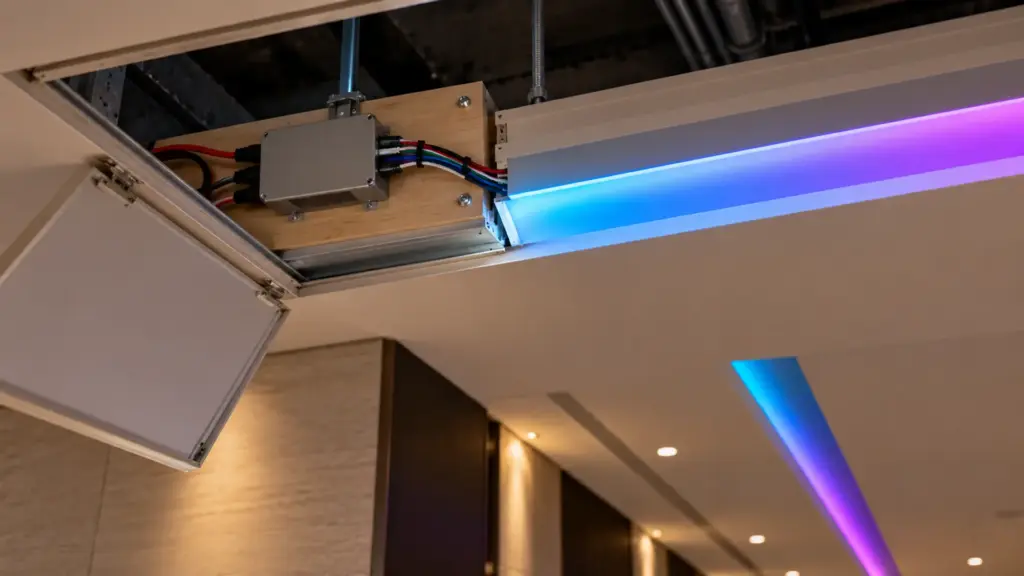
DMX was built for distance. It runs on EIA-485, the same balanced signaling used in industrial controls. ANSI E1.11, the DMX512-A standard published by ESTA, calls for 120-ohm twisted-pair cable, a limit of 32 unit loads per link, and a 120-ohm terminator at the far end. The commonly cited maximum run is about 1,300 ft (400 m). An 80 ft homerun from a closet is well inside that.
Skip the terminator and long DMX runs get unreliable in ways that look like a bad strip. Put it on the drawings.
Wiring and Power Injection: What Changes in the Field
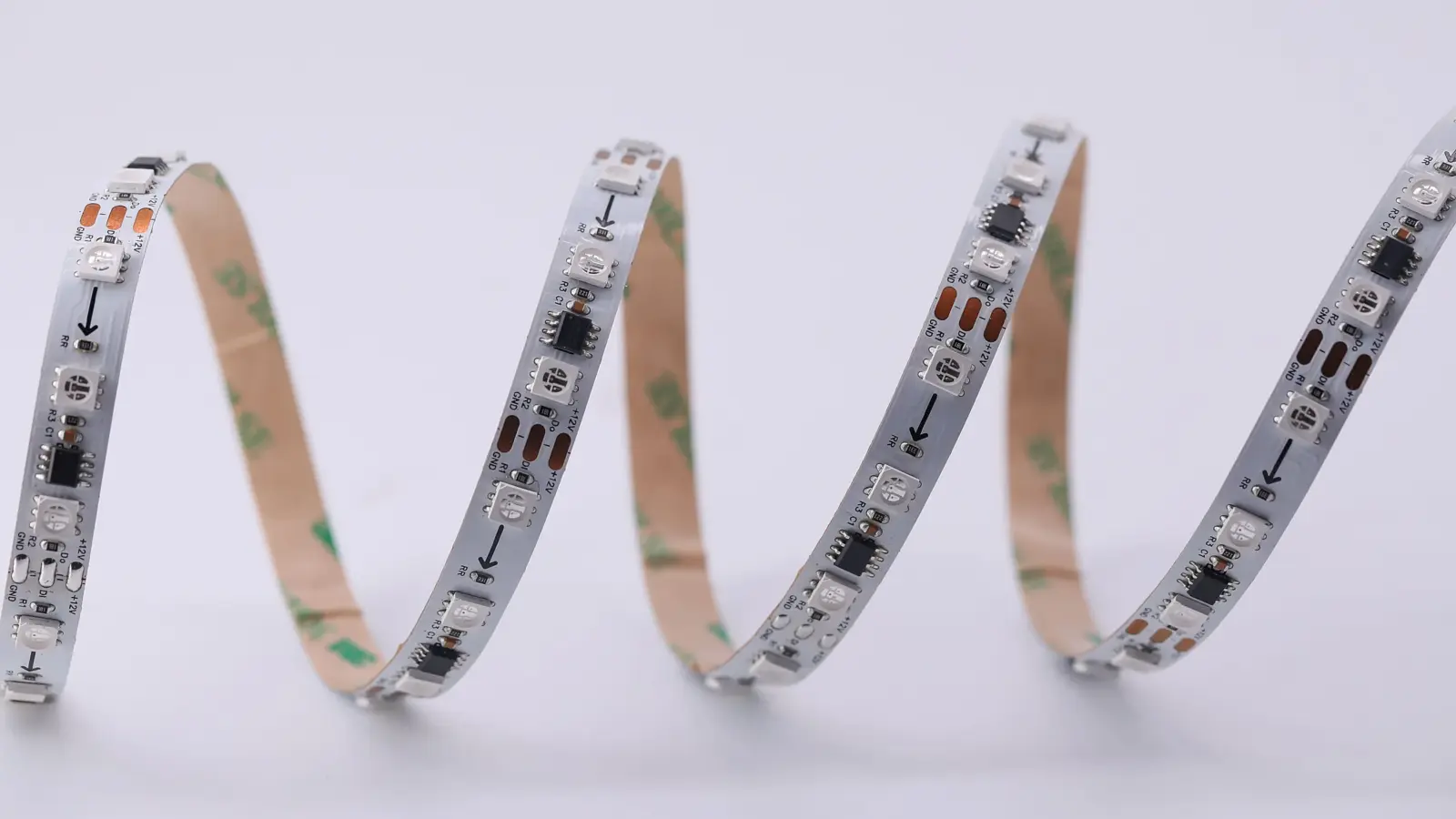
SPI strip is usually three wires: V+, ground, and data. Breakpoint-resume strip such as UT-A720-12-BP (WS2818 IC) adds a backup data line, so four wires. Connectors are 3-pin or 4-pin to match.
DMX strip carries more wires. According to Signlite, all DMX LED strips have five: two for power, two for data and one for setting addresses. Our addressable page notes that breakpoint-resume and DMX models carry extra data lines, so connectors have to match the model’s pinout. More wires means bigger connectors and more terminations per splice.
Power injection works the same way on both. Plan feeds by the model’s rated run, not by the data run. From our spec tables:
- 24V strip such as UT-A540-12-DMX, UT-AW80-12-DMX, and UT-A720-12-BP: 16 ft (5 m) per feed.
- 5V/12V SPI strip such as UT-A30-10: 10 ft (3 m) per feed.
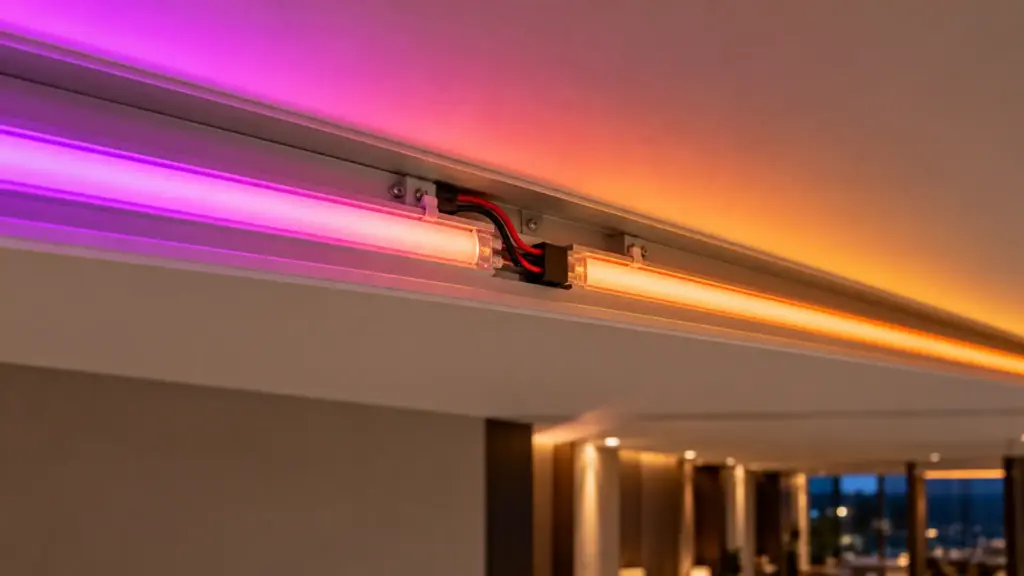
A 60 ft cove of 24V strip needs at least four feeds whether it runs SPI or DMX. The difference is what happens to data at each feed point. On SPI, data continues down the strip and power is simply injected alongside it. On DMX, the data pair continues, and each run on the bus has to be terminated and planned against the universe count.
Two details that cause most callbacks:
- Tie the grounds. On SPI, the data signal is referenced to ground. The controller ground and every power supply ground feeding that run must be common, or the data gets corrupted at the injection point.
- Voltage drop still shows first as color. A pixel strip short on voltage shifts color toward red at the far end, which is easy to mistake for a data fault. Check voltage at the end of each feed before you blame the controller.
Failure Modes: One Dead Pixel vs One Dead Segment
This is where the two protocols separate on a long public run.
On standard SPI strip, every IC relays data to the next one. If one IC fails, every pixel downstream loses its signal. On a 16 ft (5 m) section, every pixel past the bad chip goes dark or freezes on a random color. On a hotel facade or a retail sign, that is a service call.
Breakpoint resume closes most of that gap. On UT-A720-12-BP, the WS2818 IC carries a backup data line, so if one pixel fails, the data passes through and the rest of the run keeps playing. You lose one pixel instead of the section. For signage and long architectural runs on SPI, we spec a BP model by default. Addressable neon flex is a separate family with its own bend and run limits, covered in the LED neon flex selection guide.
On DMX strip, vendors describe a failed IC as taking out its own pixel while the rest of the run keeps its data. We have not seen a published failure test for DMX strip, or for SPI, so treat that as a vendor description and ask for the model’s datasheet. The weak point also moves from the chip to the bus: a cut, a crushed cable, or a shorted connector on the data pair can still drop everything past the fault. Clean terminations matter more on DMX than on SPI.
So the ranking on long runs comes from design intent, not from tests: native DMX strip and SPI with breakpoint resume are both built to survive one failed pixel, and standard SPI is not.
Addressing and Commissioning: The Labor Nobody Quotes
SPI strip addresses itself by position. The controller maps pixel 1 to the first IC in the chain and counts from there. When a section fails, you cut in a new piece and it works. Commissioning labor is mostly mapping effects in the controller software.
DMX strip needs every IC’s address set before it will respond correctly. Signlite describes connecting a DMX encoder to set up the address, and the address line on the strip is there for that purpose. It is usually done on site after the strip is installed and cut to length, and the tool differs by IC, so confirm the procedure for the model. Three things follow from that:
- Budget commissioning time. Addressing a long DMX run takes a technician and the addressing tool. Put it in the bid.
- Record addresses in the as-builts. Label each run with its universe and start address. The next tech will need it.
- Repairs need re-addressing. A replacement section of DMX strip arrives unaddressed. Plan for the addressing tool on service calls, not only at install.
If the job has no lighting programmer on the team and no one to maintain an address plan, that alone is a reason to lean SPI.
System Integration: Consoles, Building Controls, and Art-Net
Read the controls spec before you pick a strip. If the drawings say the pixel strip is controlled from the building’s lighting control system, a theatrical console, or a media server, the signal arriving at your strip is DMX or Art-Net (DMX carried over Ethernet). You then have two paths:
- Native DMX strip. UT-A540-12-DMX (dot-free COB, RGB, UCS512CLN IC) or UT-AW80-12-DMX (5050 SMD, RGBW) patches straight into the DMX line. No bridge device, and the address plan lives in the strip.
- DMX or Art-Net to SPI. A pixel controller mounted near the strip takes DMX or Art-Net in and drives SPI strip out. This keeps the higher pixel densities and lower strip cost of SPI, and the long cable run carries DMX or Ethernet instead of SPI data. Our addressable page says the controller is matched at quote, so send the universe count.
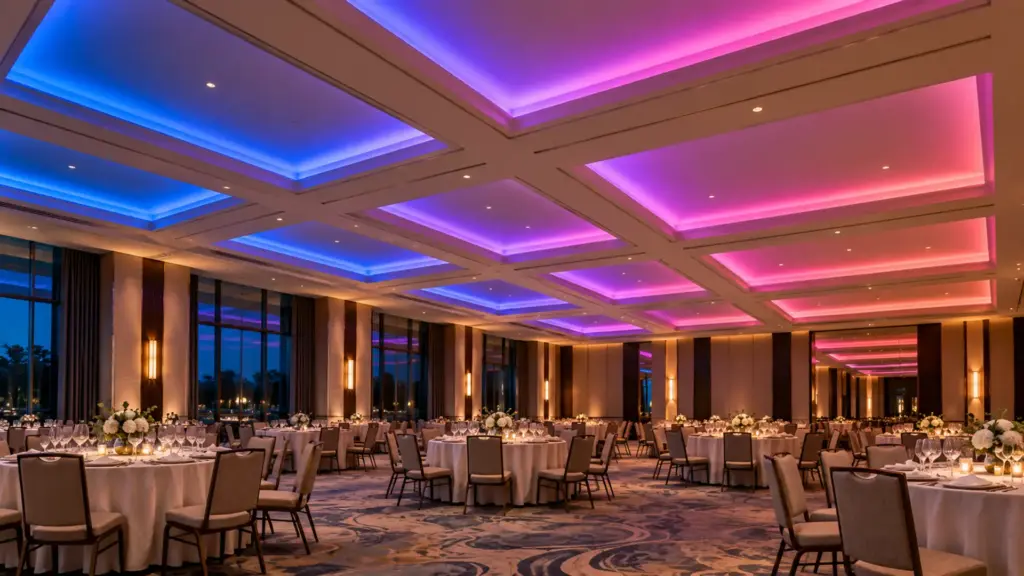
Path 2 is what most facade and large feature-wall jobs end up using: Ethernet or DMX cable covers the long run to the node, and SPI data only travels the last few feet.
If the job is standalone, with no console and no building control, a dedicated SPI controller is the simplest answer. UT-CSPI-2048 drives up to 2,048 pixels with app and RF remote control, so the owner changes scenes without a programmer. Check the pixel count per run against that limit at layout. Controllers, amplifiers, and power supplies for either path are on our LED drivers, controllers, and connectors page.
Which One to Spec: A Decision Rule by Job Type
| Job | Our usual spec | Why |
|---|---|---|
| Retail sign or feature wall, controller within reach | SPI, breakpoint resume for public runs | Short data run, low cost, easy repairs |
| Bar or restaurant, standalone scenes | SPI with an app/RF controller | No console, owner changes scenes from a phone |
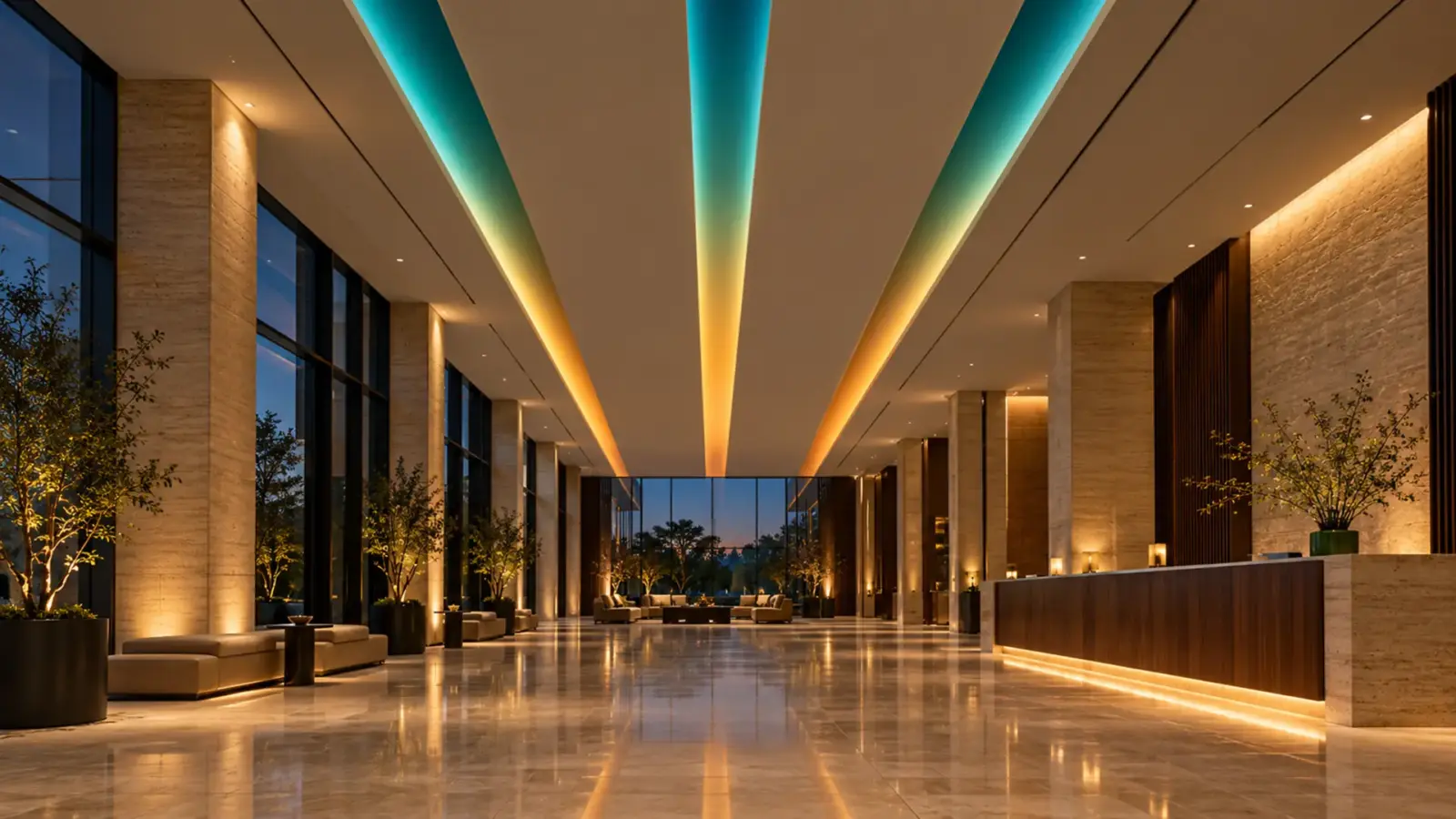
| Hotel lobby on the building lighting control | Native DMX strip, or DMX-to-SPI node near the strip | Control signal arrives as DMX anyway |
| Building facade or long perimeter | Art-Net/DMX backbone, SPI nodes near each run | Distance plus pixel density across many universes |
| Venue or event space on a console | Native DMX strip | Patches into the console, failures stay local |

Two questions settle most jobs. How far is the controller from the first pixel? And what system sends the signal? If the answers are “a few feet” and “nothing else,” spec SPI. If either answer is “a closet down the hall” or “the lighting console,” plan for DMX somewhere in the chain.
Our full SPI, addressable COB, and DMX512 lineup, with IC, pixel config, and feed length for every model, is on the addressable LED strip page.
FAQ
Can a DMX console control SPI pixel strip?
Yes, through a DMX-to-SPI pixel controller mounted near the strip. The console sends DMX, and the controller converts each universe into SPI data for the strip. This is the most common setup on facade and feature-wall jobs, because it combines DMX distance with SPI pixel density.
How many pixels fit in one DMX universe?
One DMX universe carries 512 channels. That is 170 RGB pixels at 3 channels each, or 128 RGBW pixels at 4 channels each. Longer runs need more universes, and each universe needs its own DMX output or Art-Net address.
How far can SPI data run from the controller?
SPI data should run as short a distance as the job allows, ideally a few feet from the controller to the first pixel. The WS2811 datasheet lists 32 ft (10 m) between points as a best case. For longer runs, use an SPI signal extender or send DMX or Art-Net to a pixel controller near the strip.
Is DMX strip more reliable than SPI strip?
Standard SPI strip loses every pixel downstream of a failed IC, which our addressable page states. SPI strip with breakpoint resume, such as UT-A720-12-BP, passes data past a failed pixel. Vendors describe DMX strip as tolerant of a single failed pixel too, but we have no published test for either, so check the datasheet for the model.
Can I mix SPI and DMX on one job?
Yes, and most large pixel jobs do. A common layout is a DMX or Art-Net backbone from the control system to pixel controllers near each run, with SPI strip on the last few feet. Native DMX strip can share the same backbone where a run needs to patch directly into the console.
Does DMX strip need addresses set on site?
Yes. DMX strip needs its addresses set, usually after the strip is installed and cut to length, with the tool for that IC. Replacement sections also arrive unaddressed, so plan for re-addressing on service calls.
What to Mark on the Drawings
SPI addressable LED strip wins when the controller sits near the strip, the job runs standalone, and cost and pixel density matter most. DMX512 addressable LED strip wins when data travels far or the signal comes from a console or building control. On large jobs, use both: DMX or Art-Net for distance, SPI for the last few feet.
Mark on the drawings where each controller will live and what system sends it data. Those two notes decide the protocol, the wiring and the commissioning time. Send them with the run lengths, and we will return the strip models, the controller and the feed plan for each run, with a breakpoint-resume model on every public SPI run: request a quote.