A single DMX512 universe carries 512 channels, so it addresses 128 RGBW zones at four channels each or 170 RGB zones at three. A single daisy chain carries only 32 devices, so the chain limits a strip job before the universe fills. Plan addresses and chains on the drawing, then order decoders.
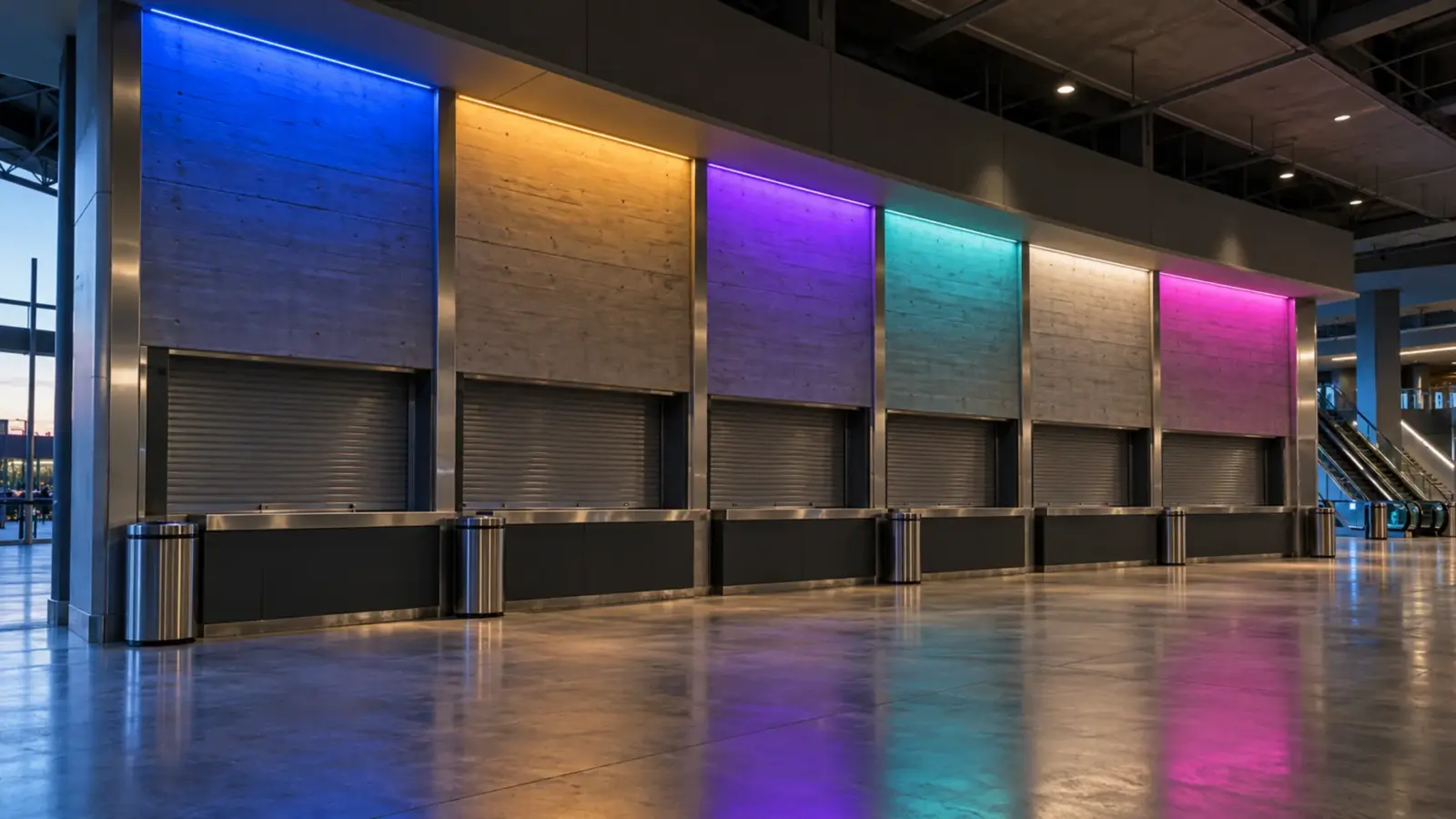
A typical facade job: 36 bays, each lit by an RGBW strip run, and a control integrator who has been told “one universe.” The channel count is fine at 144. The wiring is not, because 36 decoders on one chain is past the usual limit and a splitter has to be on the drawing before anyone pulls cable.
Universe Math
A DMX universe is 512 channels of 8-bit values. A fixture, or a decoder driving a strip, listens to a block of consecutive channels starting at its address, and the block length is the number of colors it controls. Our RGB vs RGBW guide covers the color difference.
| Controls | Channels per zone | Zones in one universe | Channels used |
|---|---|---|---|
| RGB | 3 | 170 | 510 |
| RGBW | 4 | 128 | 512 |
| Single color or CCT pair | 1 or 2 | 512 or 256 | 512 |
According to lighting-industry guides from ENTTEC, B&H and Stage Supply, these counts agree: 170 RGB fixtures use 510 channels, with two spare, and 128 RGBW fixtures use all 512. A universe can mix zone types as long as the blocks do not overlap. Overlapping addresses are a common cause of erratic behavior.
The Chain Limit
Every device on a DMX chain sees the full stream and acts only on its own block. The guides agree that one daisy chain carries up to 32 devices, with a 120 Ω terminator on the last device, and past that a splitter or repeater is needed. One source advises a more conservative figure of about 16 fixtures per run, and another notes that some fixtures terminate automatically when nothing is plugged into their output. The decoder’s documentation decides which applies.
This is the limit that stops a strip job first. A 36-bay facade with one decoder per bay needs 36 devices, which is more than one chain carries. The fix is a splitter, or two outputs from the console or node, each feeding its own chain. It is a drawing note, not a site surprise. DMX is a serial RS-485 signal, and its formal name is USITT DMX512. Cable length and type are the maker’s call, so we do not give a figure here.
Decoder Load
A DMX decoder turns the 512-channel stream into PWM output for a strip, so it also has a power rating. Our UT-CDMX-480 takes 12 to 24V DC, has four channels, and carries 480 W at most. Four channels means one RGBW zone per decoder, with the load split across them.
A decoder loaded to 80 percent carries 384 W. For an illustrative RGBW strip at 6 W/ft, which is not a model, that is 64 ft per decoder. A zone of 16 ft at 6 W/ft is 96 W, so one decoder could carry up to four such zones if they are wired in parallel and run as one color. If each zone must change on its own, each needs its own decoder or its own native address.
The address plan follows the channel count. Four channels per decoder means start addresses 1, 5, 9, 13 and so on.
| Decoder | Zone | Start address | Channels used |
|---|---|---|---|
| D-01 | Bay 1 | 1 | 1 to 4 |
| D-02 | Bay 2 | 5 | 5 to 8 |
| D-03 | Bay 3 | 9 | 9 to 12 |
| D-04 | Bay 4 | 13 | 13 to 16 |
| D-05 | Bay 5 | 17 | 17 to 20 |
| D-06 | Bay 6 | 21 | 21 to 24 |
Set the address on each decoder, label it, and write the chart on the drawing. A decoder set to the wrong address lights the neighbor’s bay and leaves its own dark.
Native DMX Strip
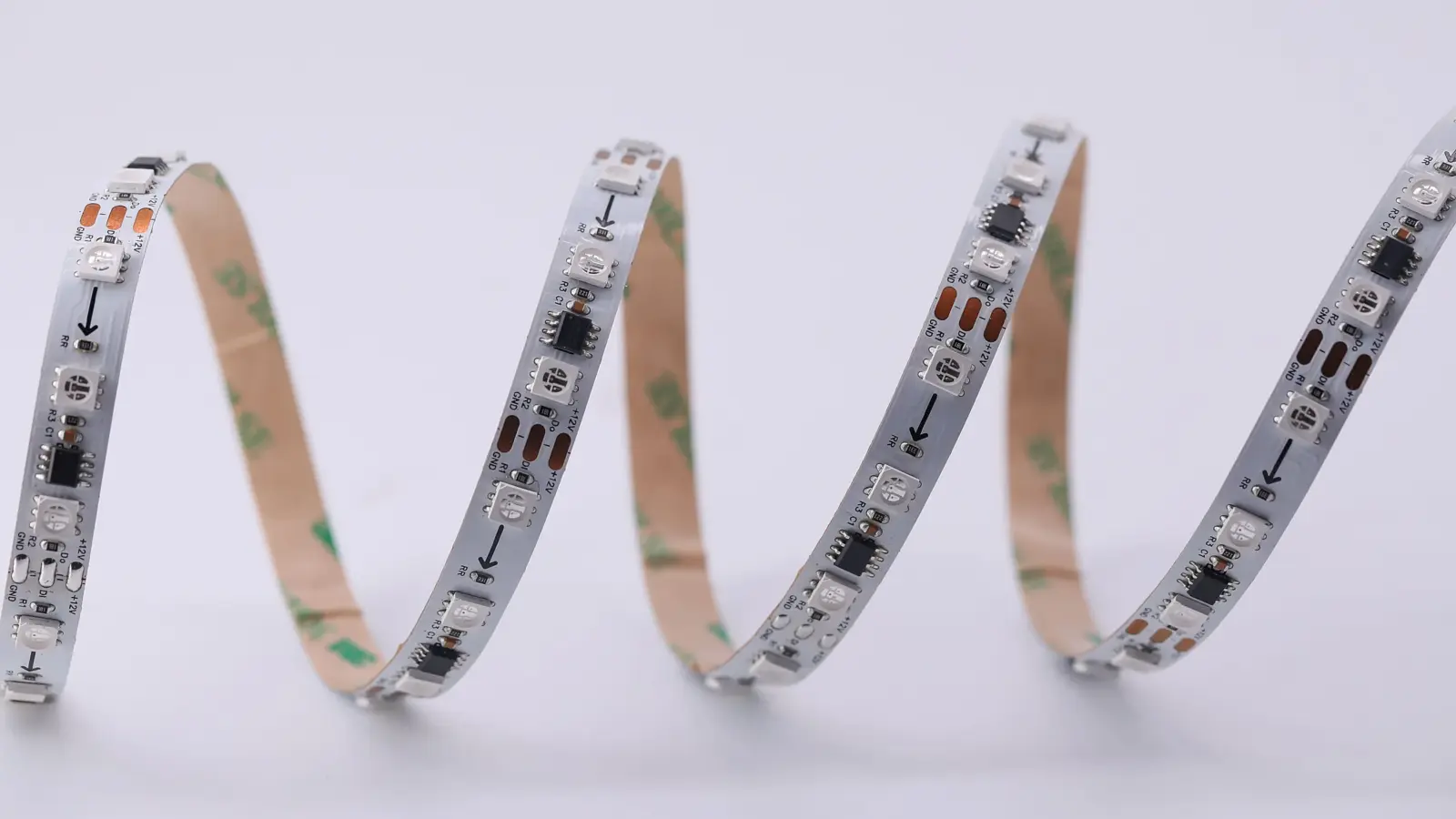
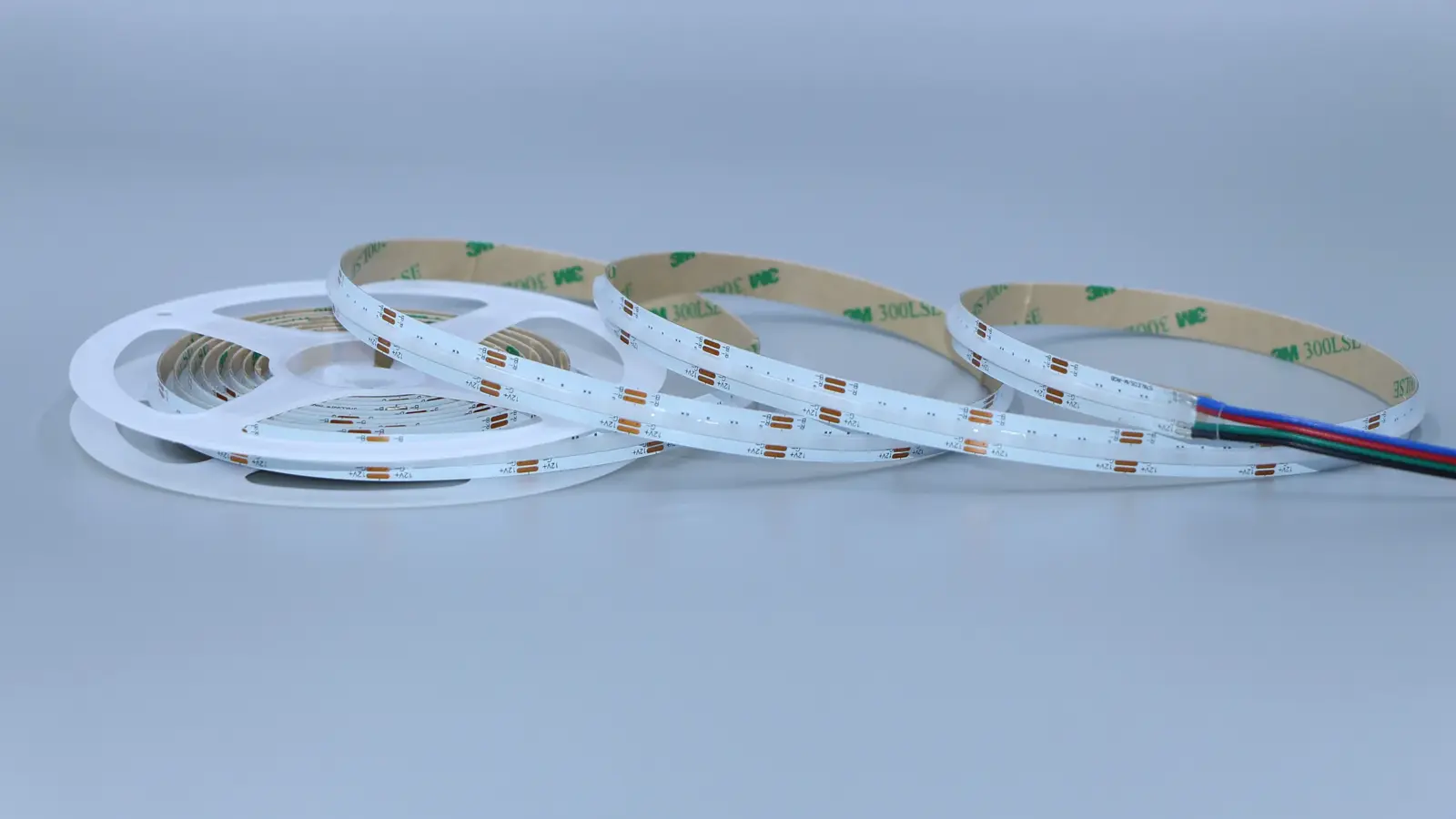
A decoder drives a whole strip as one zone. A native DMX strip has an IC in each segment, and each segment has its own address, so the strip is a pixel run. Our UT-A540-12-DMX is a dot-free COB strip with a UCS512CLN IC, RGB, at 4.3 W/ft on 24V with a 3.94 in (100 mm) cut and 16 ft (5 m) per feed. Our UT-AW80-12-DMX is a 5050 SMD strip with a DMX512 IC, RGBW, at 5.8 W/ft, with the same cut and feed. Our addressable strip page lists both.
The universe length follows the pixel count. If each pixel uses three channels, a universe holds 170 pixels. If each pixel is one 100 mm segment, which is an assumption to confirm on the datasheet because the IC pitch is not on the spec table, 170 pixels is 17 m (55.8 ft) of strip per universe. With four-channel RGBW pixels at the same pitch, 128 pixels is 12.8 m (42 ft).
That is shorter than people expect. A 200 ft pixel run, at 55.8 ft per universe, needs four universes; our pixel and DMX universe calculator does this count per model and run. Count them before you choose the control system, because each universe needs its own output from a console or a node. Our guide to SPI vs DMX covers the choice between the two, and the data distance and failure modes.
Decoder or Native DMX Strip
The two paths control a strip at different grain, and the choice sets the channel count.
| Question | Decoder with RGBW strip | Native DMX strip |
|---|---|---|
| Control grain | One color per zone | One color per pixel segment |
| Channels | 4 per zone | 3 or 4 per pixel |
| Parts | Strip, decoder, power supply | Strip, power supply, DMX feed |
| Wiring | Decoder at the zone, strip in parallel | Data in series through the strip |
| Universe use | Low: 4 channels per bay | High: 128 to 170 pixels per universe |
| Best for | Washes and coves in a bay | Effects, gradients and chases |
If every bay is one color at a time, a decoder is the simpler path, and the 128-zone universe is plenty for most facades. If the facade needs a gradient across the bay, only a pixel strip can do it, and the universe count rises quickly. Decide that before the control system is chosen. Our addressable strip page covers the pixel family, and the guide to SPI vs DMX covers the protocol choice.
Console, Node and Output
A universe comes from an output, either on a console or on a network node. One output carries one universe, so the output count is a purchase item. For each output, draw one chain with its own terminator, or an isolated splitter if the chain has to branch. Many integrators specify isolated splitters on long or mixed runs, and the decoder maker’s documentation says what the decoder expects. Keep the data cable and the strip power separate on the drawing: data is a low-voltage control signal, and power is a load with its own voltage drop.
Power Is Not Data
DMX carries data only. The strip still needs power, and the strip’s own feed limit still applies: 16 ft (5 m) per feed on the native DMX strips above, and the decoder’s 480 W rating on the decoder path. A long data run is not a long power run. Put the supplies near the loads, send the data wherever the chain goes, and check the voltage at the far end of each strip run. Our voltage drop guide covers the arithmetic.
Bench Test Before Install
Test every decoder and every pixel run on the bench before it goes into a closed place. Set the address, send each color alone and confirm the channel order, then send a short fade and look for flicker or steps. A decoder that is wired red-green-blue but patched green-red-blue shows up in ten seconds on a bench and in a day on a facade. Label each unit with its address as it passes the test.
Fades, Scenes and Resolution
DMX values are 8-bit, so each channel has 256 levels. Slow fades at low brightness can show steps, because each step is a visible fraction of a small output. Ask whether the decoder smooths between values and whether the console can send finer control on one channel. Save scenes on the console against address ranges, not against devices, so a replacement decoder at the same address takes the same scene without reprogramming.
Addressing Mistakes
Most DMX trouble on a strip job is addressing. The ones that recur:
- Overlapping blocks. A decoder at address 1 and a second at address 3 share channels, and both react to the same values.
- Four-channel spacing mistaken for three. An RGB plan applied to RGBW decoders puts every block one channel off.
- Starting at 0. The first DMX channel is 1.
- Chain over the limit. More than 32 devices without a splitter loses the far end.
- No terminator. The last device reflects the signal, and flicker follows.
- No chart. Nobody can tell which bay a decoder serves.
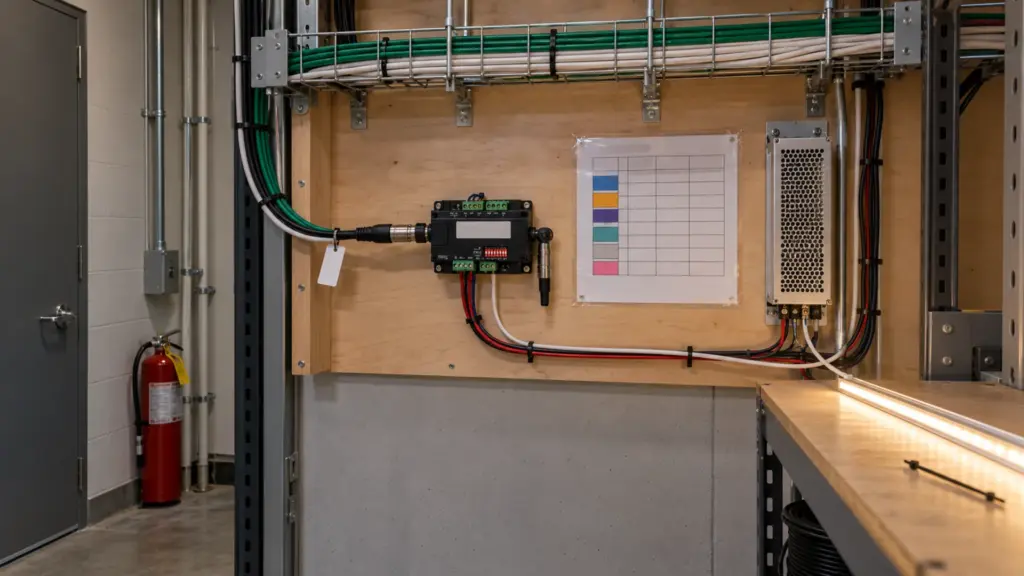
Write the address chart before the order and put it on the drawing, so the electrician sets it as they install.
More Than One Universe
A job with more than 512 channels uses more than one universe, each with its own output. Networked control carries many universes over Ethernet, which is the reason large installations use nodes. Our SPI vs DMX guide covers Art-Net and integration. For planning, give each universe a name, a range of addresses and a physical output, and keep decoders of one facade face in one universe so a failure maps to a face.
A 36-Zone Facade, Counted
| Item | Count or figure | Note |
|---|---|---|
| Zones | 36, RGBW | One per bay |
| Channels | 144 (36 × 4) | Fits in one universe |
| Decoders | 36 UT-CDMX-480 | One per bay |
| Chain | 2 chains of 18, or a splitter | A single chain of 36 is past 32 |
| Load per decoder | 96 W for a 16 ft zone at 6 W/ft | Well under 384 W |
| Total load | 3,456 W (36 × 96) | Power per decoder is local |
The channel count says one universe and the device count says two chains. The universe is not the limit; the chain is.
What to Mark on the Drawing
- Each decoder or pixel run with its zone name and start address.
- The universe and the output each chain connects to.
- The chain length, the splitter locations and the terminator on the last device.
- The decoder load at 80 percent of its rating.
- The address chart as a table in the control schedule.
Our drivers, controllers and connectors page lists the DMX decoder with the rest of the control range. Send the zone list and the control scheme with your quote request, and we will match the decoders and strip against the channel count.