Private-label LED strip comes in three routes: your brand on an existing model, an existing platform built to your specification, or a new product developed from your brief. The first changes labels and documents only; the second changes the build; the third is development. Minimums, lead times and testing follow from the route you pick.
Five points decide a private-label program:
- Pick the route first. Label only, custom specification, or development.
- Know what stays fixed. On a label-only program the product, its test records and its listing route do not change.
- Agree testing cost before work starts. Changes to the build can need new testing.
- Read the minimum and lead time on the quote. Both depend on the route.
- Approve a reference sample. It is the standard every later run is checked against.
Three Routes: Label, Specification or Development
Our OEM and private label service describes the three routes this way.
Private label on an existing model. A model from our range under your brand: your reel labels, packaging, datasheets and part numbers. The product, its test records and its listing route stay as they are. This is the fastest route and the one most distributors start with.
Custom specification. An existing platform built to your numbers: CCT, CRI, chip density, PCB width, voltage, connector, lead length, reel length and packaging. The strip is a known design, but the build changes, so the samples and records are new.
ODM development. A product that does not exist yet, developed with our manufacturing partners from your brief: a new form factor, optics, profile or control, with prototypes before tooling. This is a project with its own schedule, not an order.
The common mistake is to start on one route and drift into another. A distributor asks for a label-only program, then asks for a different reel length and a different connector, and the program has become a custom specification with a different minimum, lead time and testing question. Decide the route at the brief and change it deliberately.
Checkpoint: the brief names one route.
What the Brief Should Contain
The T16 page asks for four things at the brief: the target specification, the market, the volumes you expect and whether the product is exclusive. Each one changes the answer.
- The target specification. For a label-only program, the model numbers from the range you want under your brand. For a custom specification, the numbers that differ: CCT, CRI, density, PCB width, voltage, connector, lead length, reel length. For development, a description of the product and where it will be used.
- The market. Where the product will be sold and installed decides which listings and documents it needs, and in which language the installation sheets are written.
- The volumes you expect. A first order and an annual estimate. Volumes set the minimum that makes sense and how any testing cost is spread.
- Exclusivity. Whether the build is yours alone. An exclusive build carries its own testing cost; a shared one may not.
A brief with all four gets a route and a written specification back. A brief that only says “your strip with our logo” gets questions.
What Can Change on Each Route
| Item | Label only | Custom specification | Development |
|---|---|---|---|
| Reel labels, cartons, datasheets, part numbers | Yes | Yes | Yes |
| CCT and CRI | No, from the range | Yes | Yes |
| Chip density and PCB width | No | Yes | Yes |
| Voltage, connector, lead length, reel length | No | Yes | Yes |
| Form factor, optics, profile, control | No | No | Yes |
| Test records and listing route | Stay as they are | May need new testing | New testing |
Read the table from the left. Every column to the right adds freedom and adds work: samples, records and possibly testing. If what you need is a familiar strip with your brand on it, the first column is enough, and it is the cheapest and fastest.
Labels, Packaging and Documents
On every route, the branded parts are the same: reel labels, carton marks, datasheets and installation sheets carrying your brand and part numbers. The T16 page lists exactly those.
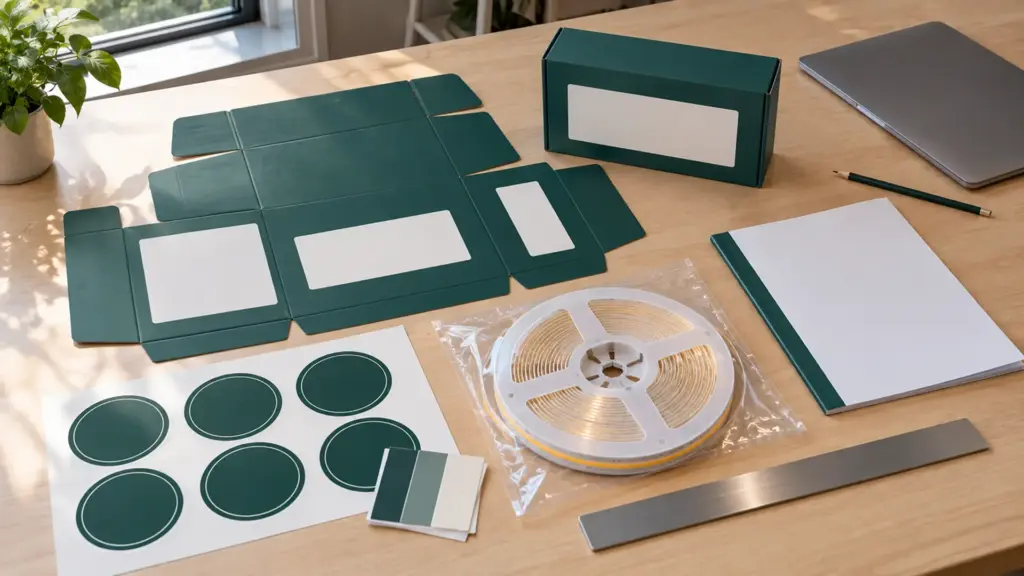
Three details save trouble:
- Part numbers that carry information. Build your part numbers so a contractor can read the CCT, CRI and voltage from them. It cuts wrong orders.
- Datasheets that match the build. A branded datasheet is a technical document. It has to state the real figures for the model, and it changes if the build changes.
- Installation sheets with the real instructions. Cut points, sealing and the supply type belong on it. Inspectors read installation instructions, and a private-label sheet that leaves them out creates a problem for the contractor, not for the brand.
Artwork is proofed together with the samples, so the labels are approved against the product they will go on.
Listings and Who Pays for Testing
This is the question buyers ask most, and the T16 page answers it directly.
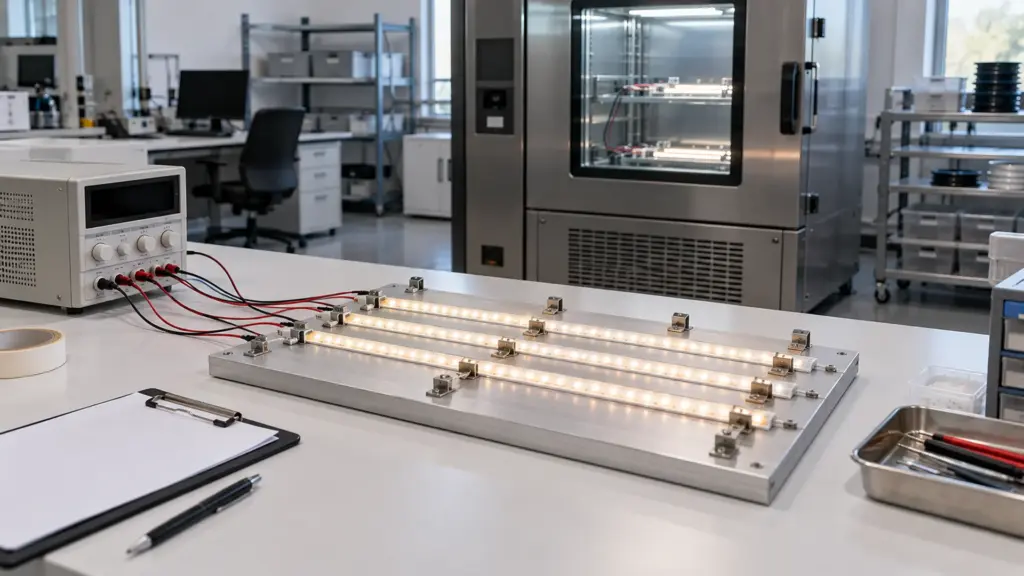
- A private label on an existing model keeps its listing route. How your brand is covered is agreed with the certification body for each model.
- A new build or a changed specification can need new testing.
- The cost is agreed before the work starts.
According to the same page, the split of certification cost depends on the program: if the product is exclusive to your brand, you pay the full certification cost; if follow-on volume is large, the cost can be spread over later orders. Either way it is in writing before anything is built.
For what each listing covers and why the mark matters to an inspector, see our guide to UL listings for LED strip. Certification is held by the original manufacturing partner, and documentation for the model is provided on request.
Checkpoint: the listing route and the testing cost are agreed before samples are made.
Minimums
Our ordering terms for private-label work are short: custom and private-label work is quoted per job, and every quote states the minimum. Standard items start at one full reel per SKU.
Why per job? Because the minimum depends on what changes. A label-only program on a standard model is close to a standard order. A custom density or PCB width means a dedicated production setup. A development project has tooling. According to Signlite’s wholesale guide, buyers across the market meet higher minimums as customization deepens, which matches the logic, though every supplier sets its own.
Two ways to keep minimums workable:
- Start label-only on models from the range, and move to a custom specification once the volumes justify it.
- Consolidate SKUs. Fewer variants, each in larger quantities, meet minimums more easily than many small variants.
Lead Times
The T16 page states the lead times this way: standard color temperature and CRI combinations ship in 1 to 2 weeks; custom builds, such as a nonstandard density, PCB width or connector, add roughly two to three weeks. Development projects are scheduled at quote.
The calendar has steps before production too: the specification and quote, the samples and the artwork approval. Plan the first order with those steps in it. Reorders of an approved product go faster, because the sample and the artwork are already approved.
Checkpoint: the quote states the minimum and the lead time for the route.
Samples, Artwork and the Reference Sample
The T16 page lays out the order: brief, then specification and quote, then samples and artwork. Pre-production samples are built to the specification, and your labels, packaging and datasheets are proofed with them.
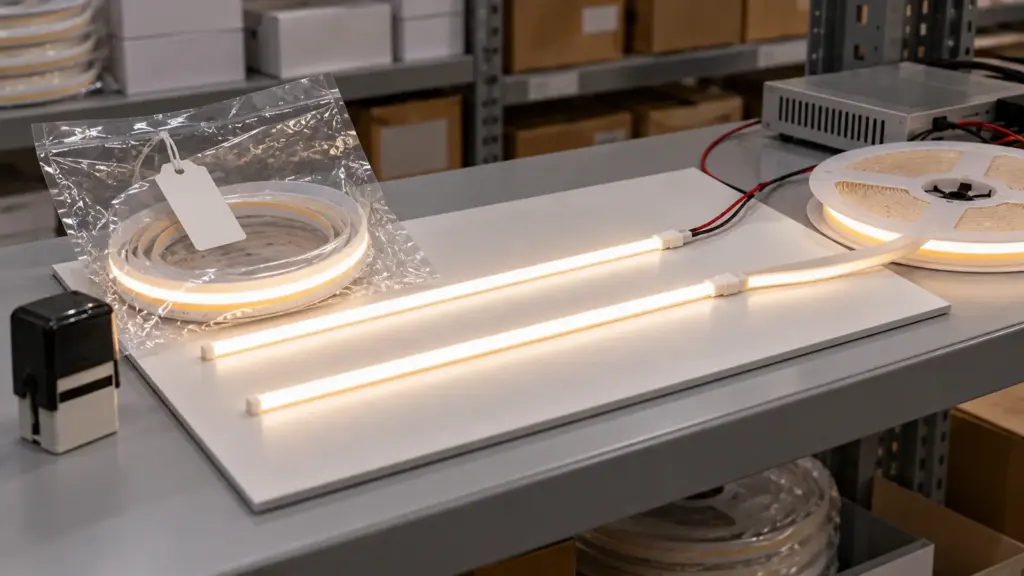
The approved sample matters long after the first order. In the page’s words, production runs through our manufacturing partners under our quality checks; binning and test records are shared before anything ships, and the approved sample is the reference for every run. Keep your own copy of the approved sample, labeled and dated. When a contractor reports that a reorder looks different, it is the reference you compare against; our guide to color consistency and SDCM explains what to check.
Reorders and Phased Programs
A private-label program lives on reorders, and reorders have their own risks.
- Color between orders. Each production run is binned. Ask for the bin of the approved sample to be matched on reorders, and compare each delivery with your reference sample before it goes to contractors.
- Unannounced changes. A component or a phosphor can change between runs. Ask that any change to a part, a material or a process be notified before it ships, and that a changed build gets a new sample.
- Forecasts. Sharing a rolling forecast lets the supplier plan production and keeps reorder lead times close to the standard figure.
- Records. Keep the binning and test records that come with each shipment, filed by your part number. They answer a contractor’s question in minutes.
Questions to Ask Any Private-Label Supplier
Whoever builds your private label, the same questions protect you:
- Which route is this, and what exactly changes?
- Does the listing route stay, and if not, what testing is needed and who pays?
- What is the minimum and the lead time, in writing, for this route?
- Will binning and test records come with every shipment?
- Is the approved sample the reference for every run, and how are changes notified?
- Who holds the certification documents, and how do I get them for a submittal?
Our guide to the LED strip submittal package shows which of those documents a contractor will ask your brand for.
What Buyers Usually Get Wrong
- Asking for a label and a new build at once, then expecting label-only minimums and lead times.
- Skipping the installation sheet, so contractors install a branded product without its real instructions.
- Changing the specification after sample approval, which restarts the samples.
- Not keeping the reference sample, so later disputes about color have no reference. Keep it sealed, dated and away from light, and keep a second one at the supplier.
- Assuming the listing follows the brand automatically. It is agreed per model with the certification body.
Who Private Label Fits
Private label suits distributors and resellers who sell strip under their own brand to contractors, and contractors large enough to standardize on their own part numbers. For buyers who simply buy repeatedly and want account terms, a trade account is often the better fit; our trade and wholesale program covers that route. Our guide to choosing a factory, importer or distributor explains who holds the paperwork on each channel.
What the Contractor Downstream Needs
A private-label strip is still installed by a contractor and inspected by an AHJ who has never heard of the brand. That contractor needs the same things from your brand that they would need from any maker: a datasheet with the real figures, installation instructions with the cut points, sealing and supply type, the listing documents for the submittal, and a way to get a matching reel for a repair. If your program provides those, your brand is easy to specify. If it does not, the contractor substitutes a brand that does, and the private label loses the job at the submittal stage, not on price.
Before You Commit
- The route is chosen: label only, custom specification or development.
- The changes are listed against the route, and nothing extra slipped in.
- The listing route and any testing cost are agreed in writing.
- The quote states the minimum and the lead time.
- Labels, datasheets and installation sheets are proofed with the samples.
- The approved sample is kept as the reference for every run.
We build private-label LED strip on existing models, to custom specifications and as new developments. Send the target specification, the market, the volumes you expect and whether the product is exclusive, and we will reply with the route that fits, a written specification, the minimum and the lead time: request a quote. Ordering terms are also on our ordering FAQ.