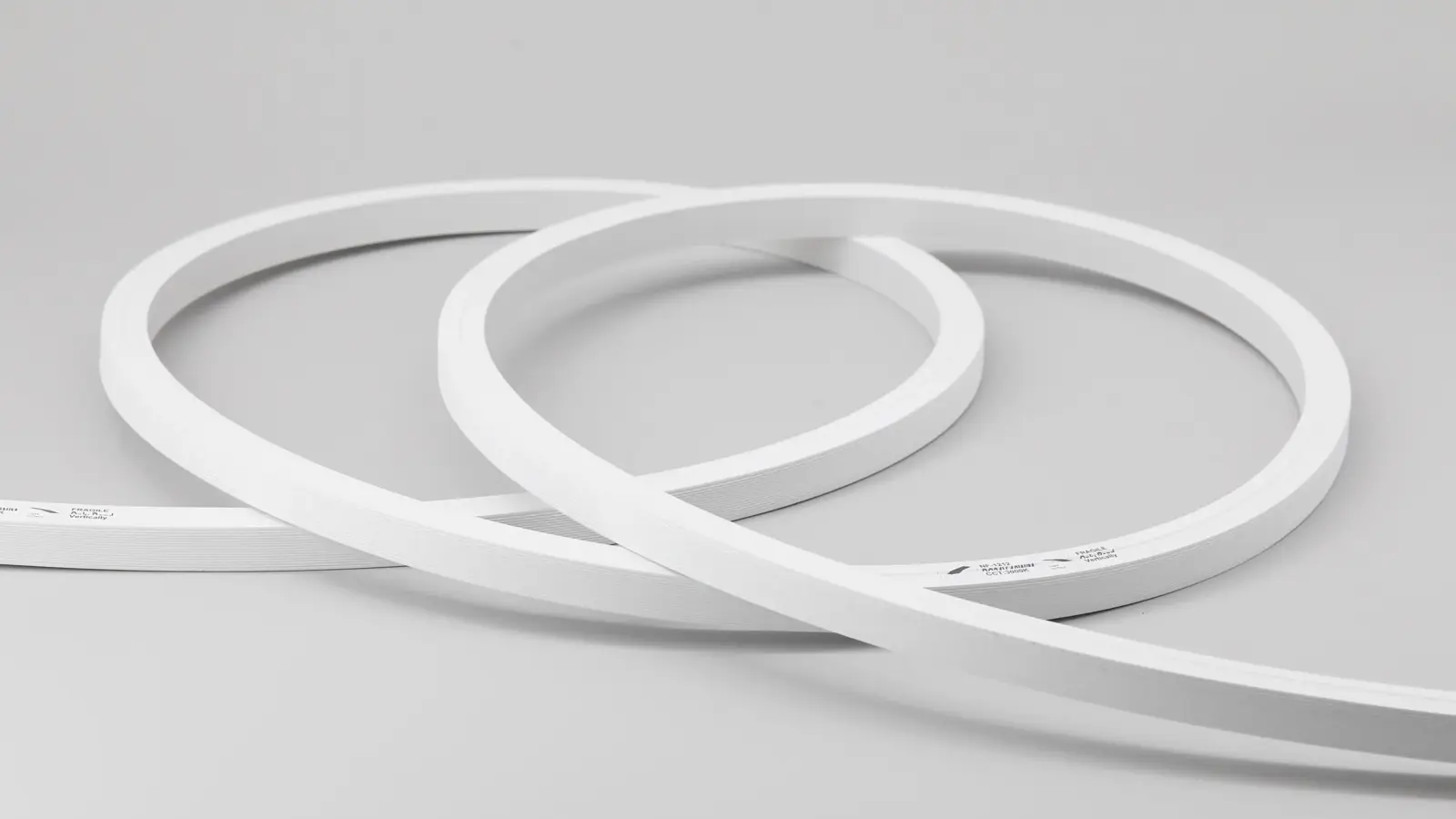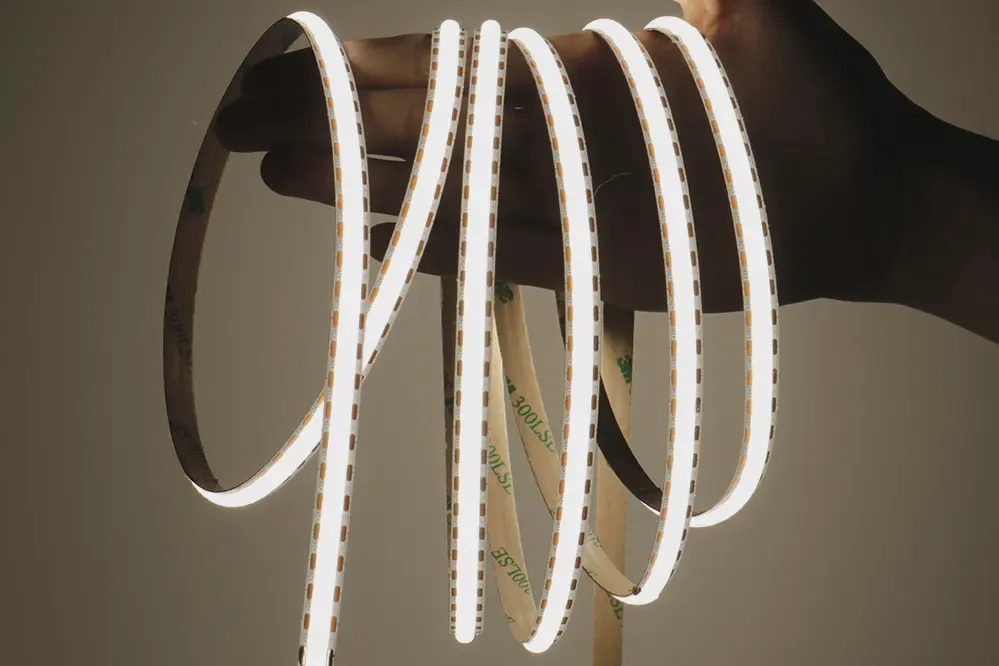
The same 320 LED/m strip on our CSP page puts out 296 to 316 Lumens per foot, the brightness rating of a strip. Multiply by the run length for the total; divide by watts per foot for efficacy. bare and 183 to 201 lm/ft inside a white silicone jacket, at the same 3.05 W/ft. LED neon flex gives fewer lumens per watt for the same reason: its diffusing silicone scatters and absorbs light before it leaves.
Published neon datasheets land around 45 to 66 lm/W for static white, against about 100 lm/W for a normal bare white strip. Here is where the difference goes, which neon loses more, and when it matters.
Same Strip, Five Coatings: Where the Light Goes
Our CSP LED strip page lists one 320 LED/m board in six builds; the five below show the spread. Same LEDs, same 3.05 W/ft, different coating. It is the cleanest comparison we have, because only the coating changes.
| Build (our model) | Coating | Output | Efficacy | Light lost vs bare |
|---|---|---|---|---|
| UT-CSP-320-N | None, IP20 | 296–316 lm/ft | 97–103 lm/W | — |
| UT-CSP-320-68 | Sealed silicone sleeve, IP68 | 293–302 lm/ft | 96–99 lm/W | about 1–4% |
| UT-CSP-320-DD | Diffusing dome, IP20 | 238–271 lm/ft | 78–89 lm/W | about 14–20% |
| UT-CSP-320-68WJ | White jacket, IP68 | 183–201 lm/ft | 60–66 lm/W | about 36–38% |
| UT-CSP-320-68BJ | Black jacket, IP68 | 91–104 lm/ft | 30–34 lm/W | about two thirds |
Two things stand out. A sealed silicone sleeve costs almost nothing, so silicone as such is not the problem. Diffusion is: the more the coating scatters to hide the LEDs, the more light it keeps. A neon profile is a thick diffusing body by design, which puts it at or below the white-jacket row.
What Published Neon Datasheets Show
Neon makers that publish full photometrics show the same range. Two examples, read from their own datasheets:
| Neon (maker’s datasheet) | Power | CCT | Output | Efficacy |
|---|---|---|---|---|
| PureEdge FlexNeon LRF5, static white | 2.5 W/ft | 2200–3500K | 114–137 lm/ft | 45–55 lm/W |
| PureEdge FlexNeon LRF5, static white | 5 W/ft | 2200–3500K | 210–254 lm/ft | 48–58 lm/W |
| PureEdge FlexNeon LRF5, tunable white | 2.5 and about 4.5 W/ft | across the range | — | mostly 31–46 lm/W |
| Rhea RLL neon top bend, tunable white | 20 W/m | warm, cool or both | — | 61–65 lm/W |
| Rhea RLL neon top bend | 16–24 W/m | 4000K | — | 63–65.6 lm/W |
| Rhea RLL neon top bend | 20 W/m | 2400K | 1,040 lm/m | 52 lm/W |
| Rhea RLL neon top bend | 20 W/m | Pink | 520 lm/m | 26 lm/W |
The two sheets do not use the same units. PureEdge lists lumens per foot at fixed watts per foot; Rhea lists lumens per meter at 20 W/m and gives its 4000K efficacy at three power levels. Converted, Rhea’s 2400K row is about 317 lm/ft at 6.1 W/ft, which is why a per-foot figure means little until the watts per foot sit next to it.
PureEdge labels its figures “nominal delivered lumens”, meaning light out of the finished neon, not the LEDs inside. Static white neon from both makers sits between 45 and 66 lm/W. A profile like our UT-N1212-TB at 3.7 W/ft would give roughly 165 to 245 lm/ft if it falls in that range; the figure for the exact profile and CCT comes from its own datasheet.
Why White Silicone Costs Light
Light leaving a bare strip goes straight out. Inside a neon profile it has to cross several millimeters of silicone loaded with a diffusing filler, which is what turns a row of points into an even line. Each scatter sends part of the light sideways or back toward the board, where some of it is absorbed and some escapes through the sides of the profile instead of the lit face. The longer the path and the denser the filler, the smoother the line and the lower the output.
That is why the order in the CSP table holds for neon too:
- Sealed sleeve: little diffusion, almost no loss, LEDs still visible.
- Diffusing dome: a thin diffusing layer, a modest loss, LEDs softened.
- White jacket and neon body: thick diffusion, a dotless line, a third or more of the light gone.
- Black jacket: the body absorbs as well as scatters, so most of the light is gone.
The LEDs inside a neon profile are not weaker. They are behind more material.
Warm, Tunable and Colored Neon
The same datasheets show where neon loses more on top of the jacket, and where it does not.
- Warm white. On the PureEdge sheet, 2200K gives 45 lm/W at 2.5 W/ft and 3500K gives 55. Warm white LEDs are less efficient before the jacket is added, and the jacket keeps the gap.
- Tunable white. The makers differ. PureEdge’s tunable rows run mostly 31 to 46 lm/W, below its static white; Rhea lists its tunable version at 61 to 65 lm/W, the same as its white. Ask for the tunable row itself rather than assuming the static-white figure carries over.
- Colored. Rhea’s pink version gives 26 lm/W at 20 W/m, half the 52 lm/W of its 2400K white at the same power. Colors differ widely on the same sheet: red about 26.5, green 62 and blue 13.5 lm/W, because lumens weight green light most. The sheet does not say whether the color comes from the LEDs or the jacket; ask, because a tinted jacket filters light the LEDs already made.
Per Watt, What Reaches the Room
The fair comparison for a line of light is lumens per watt after whatever covers the strip. Our channel and diffuser page gives the cover losses: a clear PC diffuser passes roughly 90–95% of the strip’s output and an opal one roughly 70–80%.
| What covers the strip | Lumens per watt reaching the room |
|---|---|
| Nothing (UT-CSP-320-N, bare) | 97–103 |
| Clear PC cover in a channel | about 87–98 |
| Opal PC cover in a channel | about 68–82 |
| White silicone jacket (UT-CSP-320-68WJ) | 60–66 |
| Static white neon, published | 45–66 |
| Tunable neon, published | 31–46 (PureEdge), 61–65 (Rhea) |
| Pink neon, published | 26 |
The covered rows multiply the bare strip’s 97–103 lm/W by the cover’s share. Even behind opal, a strip in a channel delivers roughly a third more light per watt than typical static white neon, and about twice as much as PureEdge’s tunable neon.

A 40 ft Wall Line, Worked Both Ways
A typical job: a 40 ft horizontal line along a restaurant or lobby wall, meant to give the wall a lit band. Two ways to build it, using our listed power and the efficacy ranges above:
| Neon: UT-N1212-TB | Strip in a channel: UT-CSP-320-N behind opal | |
|---|---|---|
| Power | 3.7 W/ft × 40 ft = 148 W | 3.05 W/ft × 40 ft = 122 W |
| Lumens per watt to the room | 45–66 (published neon range) | 68–82 (97–103 × 70–80%) |
| Light out | about 6,700–9,800 lm | about 8,300–10,000 lm |
| Per foot | about 165–245 lm/ft | about 207–250 lm/ft |
The channel delivers about the same light or more on 26 W less, about 18% fewer watts; at the middle of each range it is about 9,150 lm against 8,200. If the line is the sign, the neon’s look may be worth that. If the line is there to light the wall, the channel does it on less power. Treat the neon column as a range until the exact profile’s datasheet is in hand.
When Neon’s Efficacy Matters
For a sign, an outline or a script, the line itself is what people look at. A neon line at 45 to 66 lm/W still reads bright against a dark wall at night, and the efficacy is a power-budget question, not a design problem.
It matters when the neon is meant to light something: a wall, a counter, a cove, a walkway. Then lumens on the surface decide whether the job looks right, and a strip in a channel puts more of them there for each watt. Neon flex or strip in a channel covers that choice by what the eye sees.
Buying a higher-watt neon does not close the gap. More watts per foot add lumens per foot: PureEdge’s 5 W/ft rows give about 85% more than its 2.5 W/ft rows. They do not add lumens per watt, and they narrow the heat the profile can take: Rhea’s sheet drops the maximum ambient from 131°F (55°C) at 16 W/m to 95°F (35°C) at 24 W/m. That is why neon stays at modest power per foot; our LED neon flex profiles list 2.4 W/ft on the 6 × 6 mm up to 6.1 W/ft on the largest.
Efficacy does not change how the driver is sized, either. The driver follows the profile’s watts and run length: constant-voltage neon goes on a constant-voltage supply loaded to no more than 80% of its rating, and constant-current profiles such as UT-N1212-TB take a constant-current driver matched to the profile on the quote. Low efficacy shows up as fewer lumens for those watts, not as a bigger driver.
Reading a Neon Datasheet
Neon sheets are harder to compare than strip sheets because the numbers come in more forms. Before two products are set side by side:
- Per foot or per meter. Convert to one unit; 1 lm/m is 0.305 lm/ft.
- Delivered or LED lumens. Delivered lumens are the light out of the finished neon. A figure for the LEDs inside says nothing about the jacket. If the sheet does not say, ask.
- Which CCT. Compare at the CCT the job will use. A sheet that quotes only its coolest CCT flatters the warm versions.
- White or colored, and how. Colored neon is a separate row. Ask whether the color comes from the LEDs or a tinted jacket.
- Efficacy against the sheet’s own numbers. Divide lumens by watts at the same length. If the result does not match the stated lm/W, ask which one is right.
- Measured or calculated. A figure from a photometric test of the finished product (an LM-79 report) is worth more than one worked out from the LED package’s rating. Ask which it is, and for the report if the job’s lighting design depends on it.
A sheet that answers all six lets a neon profile be compared with a strip-and-channel option on the same footing: lumens per foot reaching the room, at the job’s CCT, for the watts the driver has to supply.
For the general method across all strip types, LED strip lumens per watt sets out how to compare rated and delivered figures.