A stair, a planter wall and a canopy on the plan each show a recessed line, and the product is left to you. Exterior recessed linear LED lighting can be built from strip in a channel or bought as a sealed fixture. Load, water in the recess and service decide which.
Here is the short version, then the reasoning behind each row.
The Short Answer: Decide by Location
Strip in a channel wins where the line is out of reach of feet and wheels, sheds water, and can be reached for service: wall slots, soffits, canopy edges and bench lips. A sealed fixture, or an encapsulated line rated for impact, wins where the line is walked or driven on, sits in standing water, or is set in stone that nobody will open again.
| Location | Strip in a channel? | What we would use | Why |
|---|---|---|---|
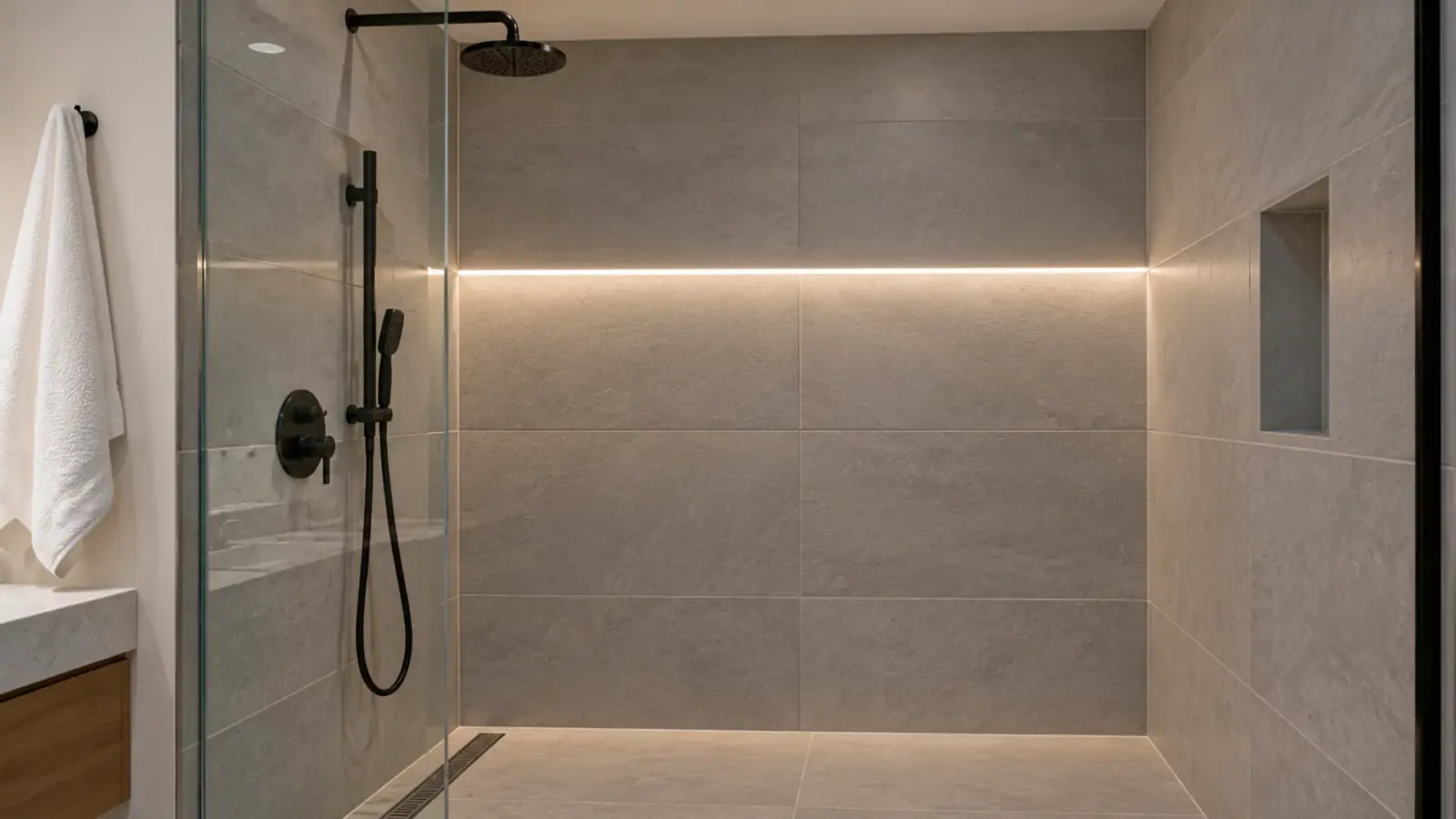
| Wall slot in stucco or plaster | Yes | IP65 strip in a plaster-in channel | Sheltered from feet, sheds water, reachable |
| Soffit or canopy recess | Yes | IP65 strip, IP67 where open to rain | No load, little water |
| Bench lip or planter cap, set back under the edge | Yes | IP67 strip in a channel | Hosed down, but no heel reaches it |
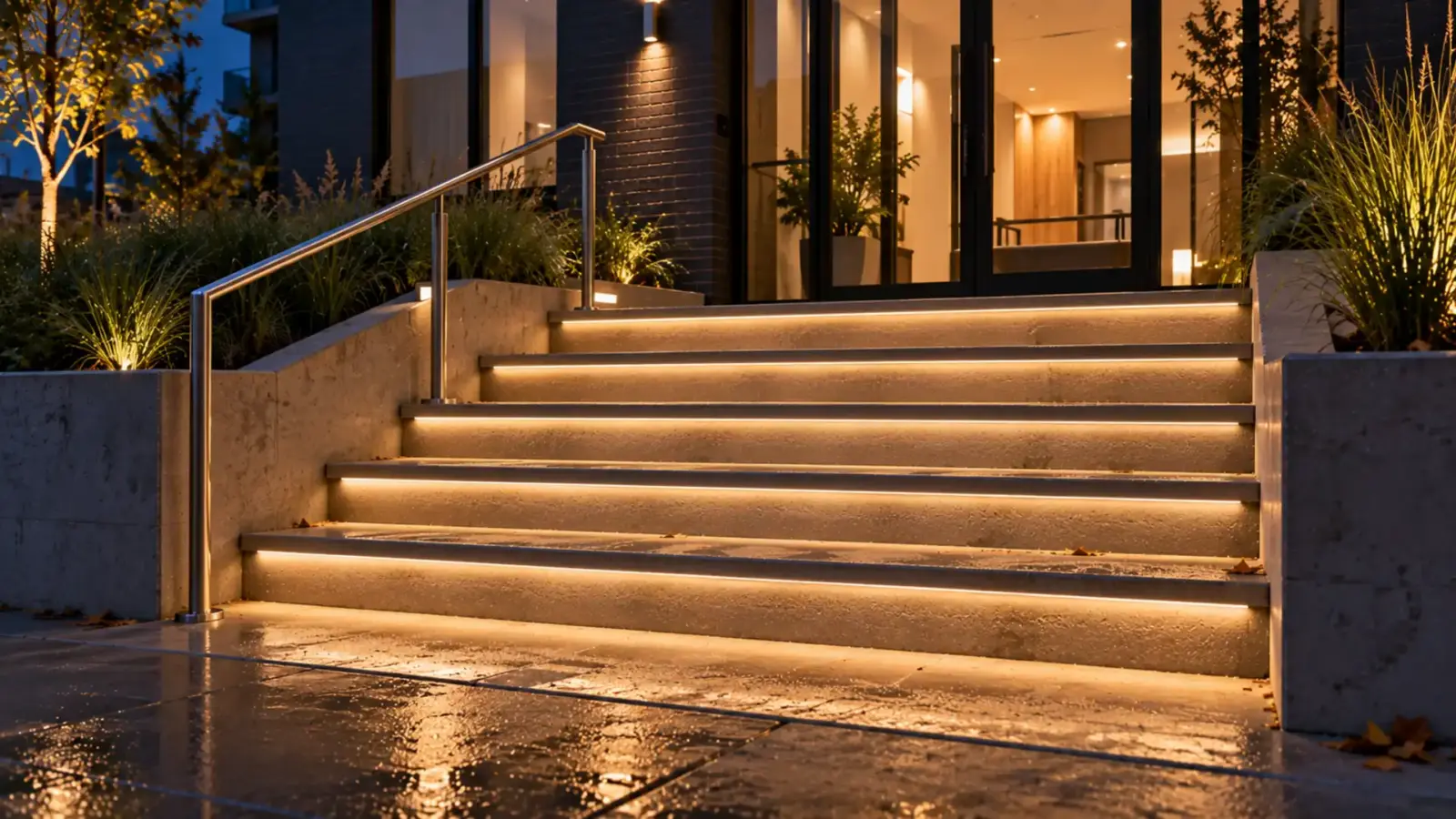
| Stair nosing, under the tread lip | Yes, with care | IP67 strip under a deep nosing no foot can reach; IP68, IK10 neon flex where feet pass close | Feet nearby, splash, cleaning |
| Walkway or plaza, flush in the paving | Encapsulated line or fixture | IP68, IK10 line, or a fixture rated for the load | Impact and rolling load |
| Driveway or loading area | No | A fixture rated for vehicle load | Strip products are not rated for wheels |
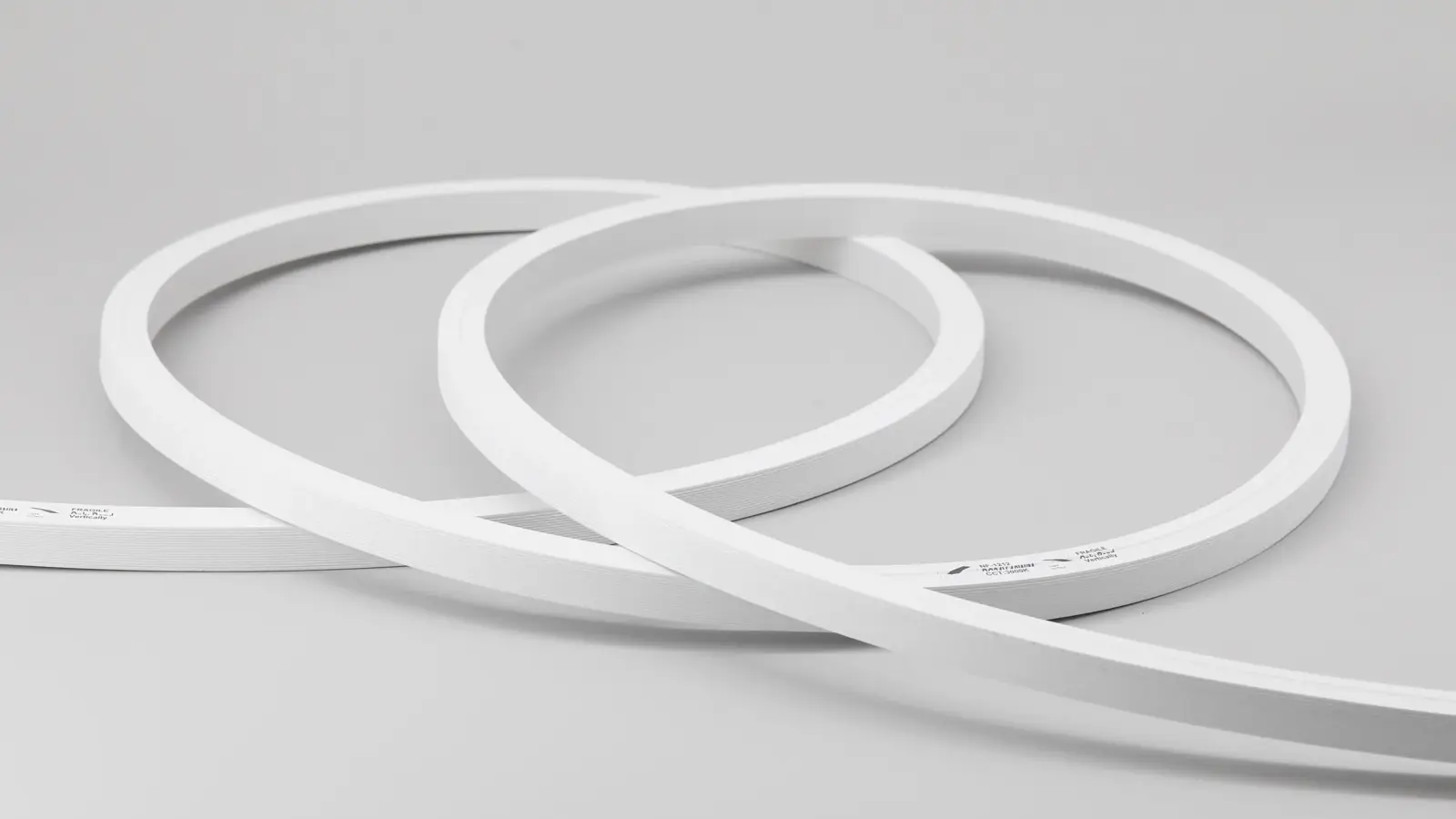
Our outdoor and waterproof LED strip covers the IP65 to IP68 builds, and our LED neon flex includes the IP68, IK10 UT-N1616-68 for lines at foot level.
Strip in a Channel vs a Sealed Fixture, Side by Side
The two routes differ in more than the price line, and each wins somewhere.
| Strip or neon in a channel or profile | Sealed recessed linear fixture | |
|---|---|---|
| Length | Cut to the run at the product’s cut marks; one continuous line | Fixed lengths with joints or end gaps between units |
| Water | The strip carries the IP rating; the recess must drain | The housing carries the rating; in-grade units are built to drain |
| Impact and load | Set by the product; our IP68 neon is IK10, open channels are not load rated | Set by the housing; some are rated for foot or vehicle traffic |
| Recess | Shallow slot or plaster-in channel | Deeper pocket or sleeve for the housing |
| Service | Lift the cover or unclip the piece, if the detail allows it | Replace the unit from its sleeve, if one was set |
| Optics | Diffused line; a wash from the position of the slot | Choice of optics on many fixtures |
| Drivers | Remote 24V drivers, one feed per run | Integral or remote, by model |
Load and Impact: What the Line Has to Carry
Ask first whether anyone will stand, drop a chair or drive on the line. Water ratings do not answer that. Our walk-over floor guide makes the point in its title: walk-over strip in floors is an impact problem, not a water one. Impact is rated by the IK code, and a line that people step on needs a high IK rating and a flush, slip-resistant cover.
For lines within public reach, our facade page lists the IP68 and IK10 UT-N1616-68 neon flex rather than an open channel. Rolling load is a separate claim again. Some sealed recessed profiles are sold with a drive-over rating; one maker’s Dust-tight, and protected against temporary immersion in water. The usual rating for wet or outdoor runs that are not submerged all the time., IK10 recessed profile states drive-over loads up to 5,000 kg with its aluminium outer casing. A strip or neon product without such a rating does not go where wheels go.
Rule: if a heel or a wheel can reach the cover, the product needs a rating for that, stated by its maker.
Water in a Recess
A recess is a place water collects. Water runs into it from the surface around it and has to leave by a path the detail provides. Three details decide whether it does.
- The strip’s rating follows the exposure. Our wet location guide and outdoor page map exposed facades and soffits to IP65, planters, hardscape and splash zones to IP67, and submerged details to IP68. A recess that cannot drain behaves like the next row down, because the strip sits in water for hours.
- Give the recess a way out. A recess in a wall or a riser can slope its floor outward. A recess in the ground needs a drain path at its low point, or it fills. In-grade fixtures are built around that problem; a channel set in paving is not.
- Keep the joints out of the water. The feed lead leaves the recess through a sleeve or conduit to a junction box above grade, not into the soil. Our wet location guide treats the strip, the connectors and the driver as one system.
Channels themselves carry no IP rating. Ours are aluminum profiles with click-in covers, and the strip inside is what keeps water out. Our waterproof LED strip channel guide explains why beading every seam of the channel traps water instead.
Finish Sequence: Cast, Cut or Plastered
An exterior recess is formed by another trade, and the lighting contractor’s job is to tell them what to leave.
- Cast in concrete. Steps and curbs are poured once. A sleeve or blockout set in the form leaves the pocket and the conduit; the line goes in after the concrete has cured. Fixture makers sell step lights with sleeves made for this, poured first and fitted later. For a strip line, the blockout is a slot sized to the channel with the conduit stubbed into it.
- Cut into stone or pavers. A saw-cut slot works on a retrofit, but the cut faces are rough and the slot floor is flat, so water has nowhere to go. Plan a weep or a slope before cutting.
- Plastered in. A plaster-in channel sets the line flush with a stucco or plaster wall. Our UT-CH2020 is a trimless plaster-in channel, 20.2 × 19.5 mm, that takes a strip up to 12 mm wide; the plasterer finishes up to its edge. It is suitable for exterior plaster and stucco walls as well as interior drywall; the strip inside still carries the IP rating. Aspect’s mud-in channel guide describes the same idea indoors: set the channel, finish over the flange, then sand the joint once it has dried.
Rule: the recess size, the conduit route and the drain go on the architectural detail, not on the lighting schedule.
Service: Replacing a Line Set in Stone
Every recessed line fails eventually, and the detail decides whether replacing it is an afternoon or a demolition.
- Strip in a channel. The cover lifts out, the strip comes out of the channel, and a new length goes in, provided the lead can be reached at the junction box and the channel was not grouted over.
- Encapsulated neon in a profile. The piece unclips from its profile and is replaced with a factory cut-and-sealed piece of the same length.
- Sealed fixture. The fixture comes out of its housing or sleeve, if the detail kept one. A fixture grouted straight into stone is replaced with a grinder.
Draw the access before the paving is laid: which junction box serves which run, and how a technician reaches it.
Soffits and Canopy Recesses
A recess in the underside of a canopy or soffit is the easiest exterior line to build from strip. Nothing touches it, water reaches it only on the wind, and the electrician can reach it from a ladder or the roof side. Our soffit guide usually starts soffits at IP67; our facade page allows IP65 under a deep soffit and moves to IP67 where rain, spray or hose washing reaches it. Set the channel back from the fascia so water drips past it, and aim it at the wall or the walkway rather than straight down at a bright band.
Light and Glare From a Recess
A recessed line is close to eyes and feet. A wall slot at eye height that shows its source to people walking toward it reads as glare; set it so the lens faces down or along the wall. A step line belongs under the nosing, lighting the tread, so a person going down sees the edge, not the LEDs. Our stair lighting guide covers when exterior stair lighting counts toward egress and where the light should land.
Keep one color temperature across every recessed line that can be seen together, and check them at night in a mockup before the paving or plaster closes; a line that looks right in a drawing can read as a hot stripe in place.
Drivers and Feeds Outdoors
Every exterior recessed run in this article feeds 16 ft (5 m) or less from one end, so a long line is several runs, each with its own feed. Where the drivers go is part of the detail.
- Indoors or in a dry enclosure for our Class 2 drivers, which are IP20, with the 24V leads run out to each recess. Long leads drop voltage before the strip starts, so size them for the distance.
- Potted IP67 drivers where the driver has to sit in a damp or wet place, such as a planter or under a stair, out of standing water and reachable.
- Surge protection on long exterior feeds, planned with the drivers; our facade surge guide covers the layers.
Load each driver to 80% or less, and give each run its own feed so one failed piece does not take the whole line down.
Steps, Worked
A typical multifamily building entrance has six exterior concrete steps, 6 ft wide, with a recessed line under each nosing. Feet pass close to it, the steps are hosed and salted in winter, and the line must not show its source to someone walking down.
| Item | Value |
|---|---|
| Product | UT-N1616-68 neon flex, IP68, IK10, 4.3 W/ft, 16 ft (5 m) per feed |
| Length | 6 runs of about 5.9 ft (1,800 mm at the 100 mm cut marks), one per step, each fed separately |
| Load | 5.9 ft × 4.3 W/ft ≈ 25.4 W per step, about 152 W in total |
| Drivers | 2 × UT-D100-24-67 (100 W, potted IP67): 3 steps each ≈ 76.2 W, 76%, inside our 80% limit |
| Recess | Blockout under each nosing, cast with the steps, conduit stubbed to a junction box beside the stair |
The drivers sit in a dry, reachable place beside the stair or inside the building; the potted housing is there because a stair entry is wet. Where the nosing is deep enough that no foot can kick the line, an IP67 strip in a channel also works, as our facade page shows for steps; here feet pass close, so the line is the Impact protection per IEC 62262, IK00 to IK10. Floor channels and handrails are where it is specified. neon. Each step has its own feed, so one damaged step can be replaced without lifting the others.
A Planter Wall Slot, Worked
A typical campus plaza has a 40 ft stucco planter wall with a plastered-in slot near its cap, washing the paving in front of the wall. Rain reaches it, feet do not, and the slot sheds water outward.
| Item | Value |
|---|---|
| Product | UT-O320-8-65, IP65 silicone top coat, 2.4 W/ft, 16 ft (5 m) per feed |
| Channel | UT-CH2020 plaster-in trimless channel with an opal cover; check the coated strip’s width against its 12 mm limit at quote |
| Feeds | 3 runs: 16 ft, 16 ft and 8 ft |
| Load | 38.4 W, 38.4 W and 19.2 W; 96 W in total |
| Drivers | 2 × UT-D100-24-67: the two 16 ft runs on one (76.8 W, 77%), the 8 ft run on the second |

If the slot faced up into the rain or could hold water, the table would move to IP67 strip. Long aluminum runs on a sunny wall also move; our expansion gap guide gives the gaps and the fixed point.
Mistakes on Exterior Recessed Lines
- Choosing by IP alone. An IP68 line in a walkway can still crack under a dropped chair. Check impact and load first.
- A recess with no way out. The first rain fills it and the strip sits in water. Slope it or drain it.
- Joints in the soil. A splice buried beside the recess fails before the strip does. Bring the lead to a box above grade.
- Grouting the channel in. The line works on day one and cannot be serviced on day one thousand.
- Strip under wheels. No strip or neon product here is rated for vehicles; driveways take a fixture rated for the load.
FAQ
Can LED strip be recessed into concrete?
Yes, in a channel set into a blockout cast with the concrete, where the line is out of reach of wheels and the recess can drain. Where people walk on the line, use a product rated for impact, such as an IP68, IK10 neon flex, or a fixture rated for the load.
Is IP68 enough for an in-ground line?
IP68 answers water, not impact or load. An in-ground line also needs an impact rating, a cover that is flush and slip resistant, and a drain path for the recess.
Do exterior recessed lines need a special driver?
The driver has to suit where it sits. Our Class 2 drivers are IP20 and stay in a dry space; potted IP67 drivers such as the UT-D100-24-67 go where the driver location is damp or wet.
How long can one recessed run be?
Our outdoor strip and neon series named here run 16 ft (5 m) per feed. Longer lines are fed from several points, each run on a driver loaded to 80% or less.
Decision Rule
Build the line from strip in a channel when no heel or wheel can reach it, the recess sheds water, and the cover can be lifted out later. Use an IP68, IK10 encapsulated line where feet pass close, and a fixture rated for the load where people walk on it or vehicles cross it.
If you are pricing exterior recessed lines now, send the landscape plan and the sections. We will mark which lines can be strip or neon from our range, size the feeds and potted drivers, and flag the ones that need a fixture: request a quote. The channels named here are on our LED channels and diffusers page.