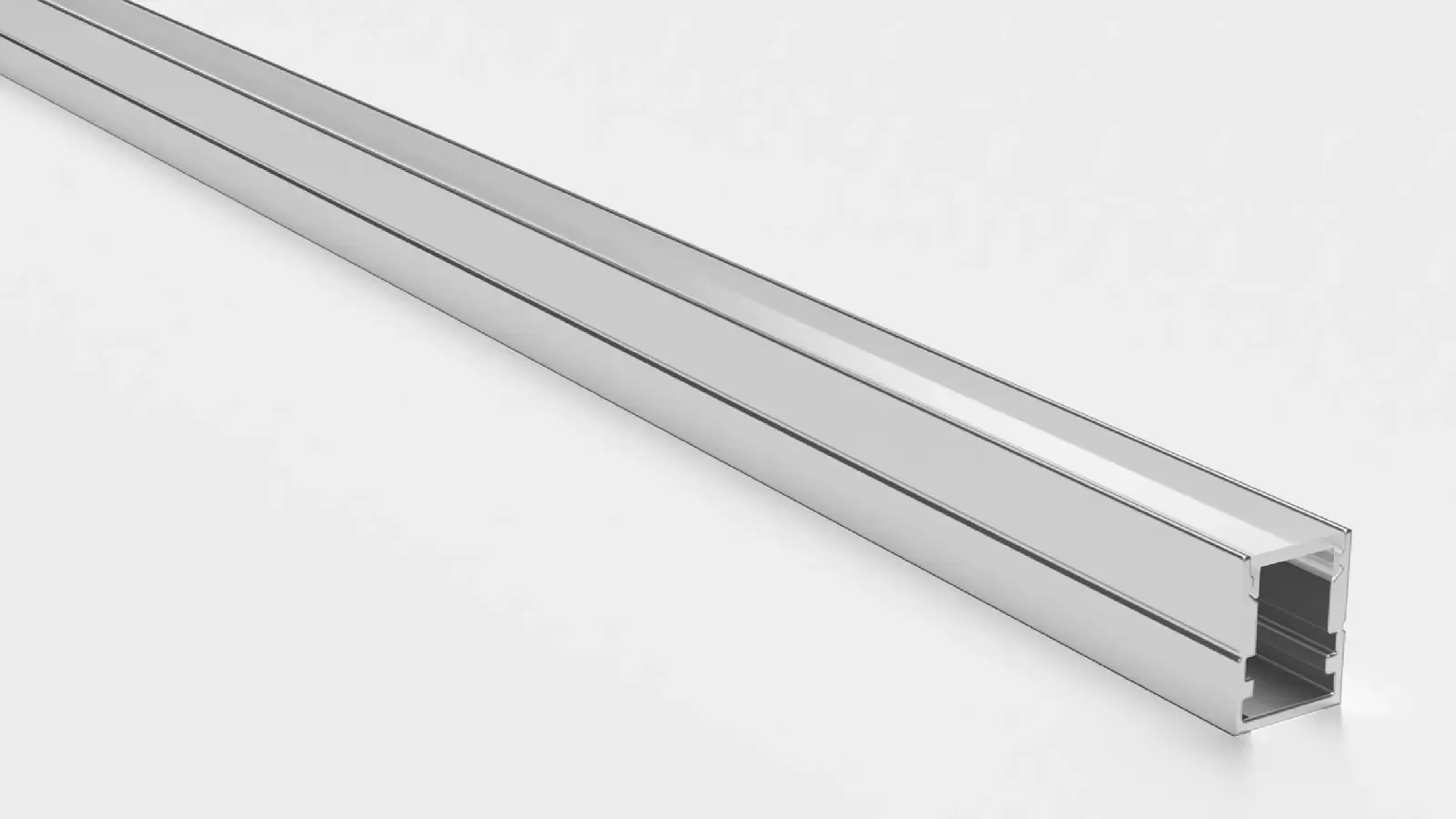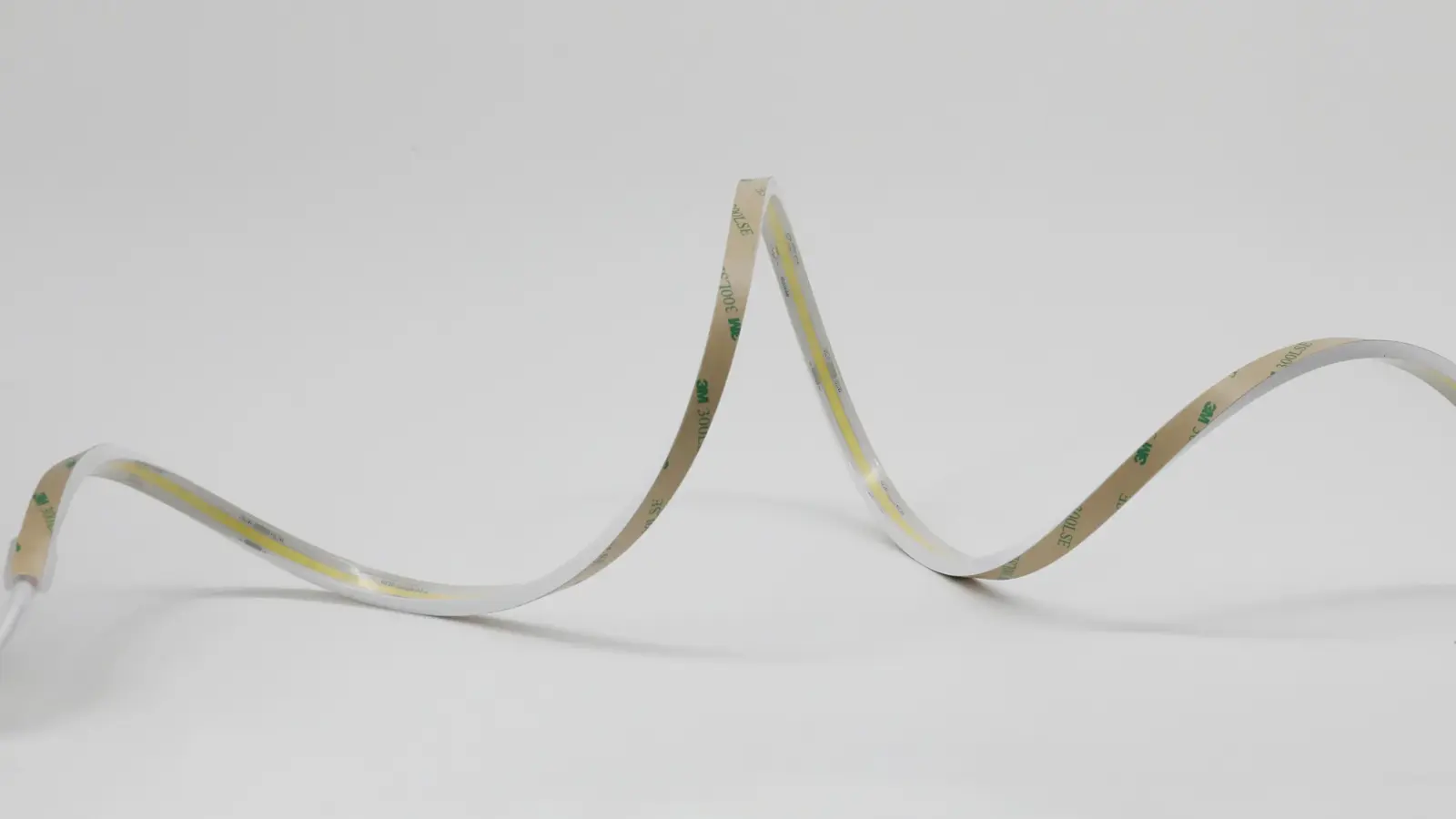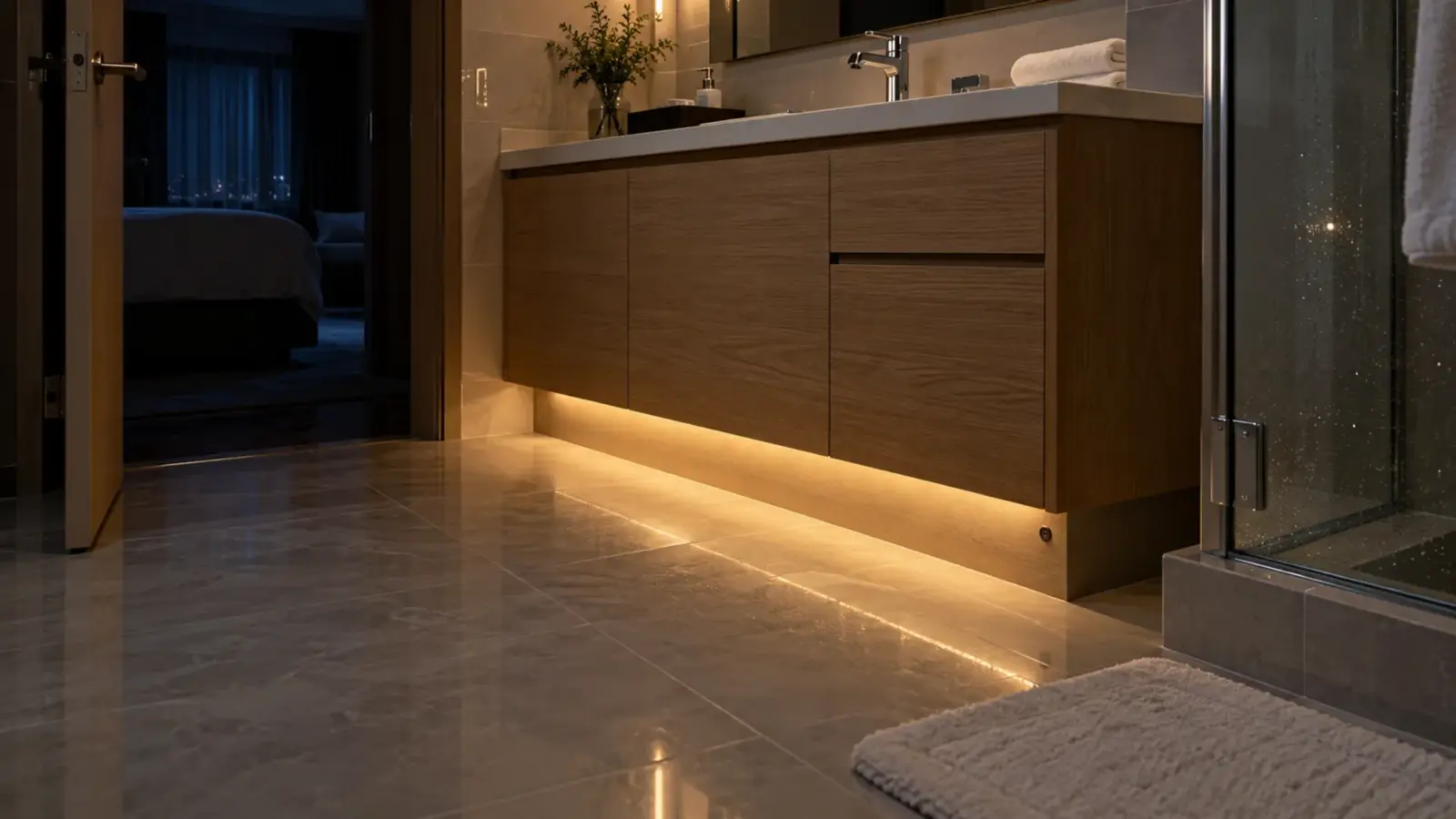
A waterproof LED strip light channel is usually an aluminum profile with two The closure at the end of a channel or neon section. On IP-rated product it is part of the seal; on channels it finishes the extrusion. and a bead of silicone. The rating that keeps an outdoor run alive belongs to the strip inside it. Build the run around a strip rated for the exposure, and let the channel hold the line, carry heat and shield the strip.
That order changes how you detail an outdoor channel run, how you seal it and how you size the feeds.
The Myth: The Channel Makes It Waterproof
Shops list “waterproof LED channels” and “outdoor LED strip light channels”, and the wording suggests the profile keeps water out. Read the listings closely and the rating comes with a condition. One vendor lists its profile as IP65 when the end caps are sealed with glue, and Integral LED lists a recessed profile sold for IP65 strip as IP20 for the profile, with Dust-tight, and protected against temporary immersion in water. The usual rating for wet or outdoor runs that are not submerged all the time. as the highest strip rating to put inside it. The profile and the strip carry separate ratings.
A HitLights guide on putting indoor strip outdoors in a channel reaches the same point: the channel adds physical protection, but it does not replace a waterproof strip where the run is exposed. Our own LED channels and diffusers carry no IP rating at all. They are AL6063 anodized aluminum with click-in polycarbonate covers, end caps and mounting clips; the cover seats by hand and lifts out with a trim tool for service, which is the opposite of a sealed enclosure.
So the first line of an outdoor channel spec is the strip, not the profile.
Wrong Fix: Silicone Every Joint
The usual field fix is to run silicone along the cover, around both end caps and over the cable hole, and call the run sealed. On an outdoor run that fix tends to fail in one of three ways.
- The run breathes. A strip warms when it is on and cools when it is off, and the air in a closed profile expands and contracts with it. In one vent maker’s test on two IP66 LED street lights, the pressure inside followed the on/off cycle and the leak path was in the wire fitting. A beaded channel goes through the same cycle every night, and its weakest seam is where damp air finds its way in.
- Water gets in and cannot get out. A bead that is perfect on day one cracks at a joint after a season of sun and movement. Water that enters at the crack collects at the low end, because every other exit is sealed.
- The strip inside was never rated. When the channel is treated as the enclosure, an IP20 strip often ends up inside it. Once water reaches the strip, the channel holds it there.
None of this means silicone has no place. It belongs on the strip’s own cut ends and at the cable entry, where the product maker specifies it. It does not turn a cover that clicks in into a sealed box.
Right Fix: A Rated Strip in a Channel That Drains
Choose the strip by the exposure, then put it in a channel that keeps sun, impact and debris off it, and let any water that gets past the cover find its way out.
| Exposure | Typical locations | Strip rating we would start from | Our series |
|---|---|---|---|
| Rain and weather | Facade, parapet, open eave, canopy fascia | IP65 | UT-O480-8-65 or UT-O320-8-65, silicone top coat |
| Splash and temporary standing water | Planters, hardscape, hosed decks, splash zones | IP67 | UT-O480-10-67, extrusion sleeve, 3.2 W/ft |
| Submerged | Fountains and other details under water | IP68 | UT-O480-12-68, full silicone tube, 3.2 W/ft |
This is the same mapping as our wet location guide and our outdoor page. All the series named run 16 ft (5 m) from one feed. A channel adds one consideration: if a run cannot drain, water can sit against the strip for hours, so treat a channel that holds water as the next row down. Our outdoor and waterproof LED strip page lists the rest of the range, and our wet location guide explains why IP68 alone is not a wet-location marking.
Two fit checks before the order:
- Jacket width. The model number gives the board width, not the outside of the jacket. UT-O480-10-67 has a 10 mm board inside an extrusion sleeve, so its outside is wider than 10 mm. Check it against the channel’s maximum strip width, such as 15 mm for our UT-CH2415 deep surface channel, before the channel is ordered.
- A way out for water. On a channel that slopes or runs vertically, leave the low end able to drain instead of sealing it shut; we would rather see a dry strip in a channel that drains than a wet strip in one that does not.
Caps, Cuts and the Feed End
Every opening in a rated strip has to be closed to the strip’s rating, and the openings multiply with every cut.
- Count every cut on the drawing. Our outdoor page puts it plainly: after cutting, the open end must be resealed with a matching silicone end cap and adhesive to restore the IP rating. A 60 ft run in four feeds has eight strip ends to seal, not two.
- Seal on the bench where you can. Cut and cap the strip to length before it goes up, and let the adhesive cure before the run sees water. Our guide to sealing a cut end of IP67 strip shows the method.
- Bring the feed in from below. A lead that drops into the channel from above carries rain to the entry. Enter from below or from the side, with a drip loop so water falls off before it reaches the cap.
- Channel end caps are for looks and debris. They finish the profile and keep leaves and insects out. The strip’s own caps keep the water out.
Our waterproofing guide explains how a top coat, a sleeve and a full tube are made, and where each one fails.
The Cover: UV, Heat and Cleaning
The cover is one of the first parts of an outdoor channel to age. Our covers are polycarbonate, in clear and opal. Clear passes roughly 90 to 95% of the strip’s output and shows the LEDs; opal passes roughly 70 to 80% and blends them into a line. Outdoors that choice carries three more questions.
- Sun. Polycarbonate takes impact well, and vendors sell UV-stabilized grades for outdoor use. Ask for the grade and its UV data on any exterior run in full sun; a cover that yellows changes the color of the light along the whole line.
- Heat. A jacketed strip under a cover holds more heat than a bare strip in open air, and a sunlit black channel adds to it. Our channel thermal guide shows why there is no per-millimeter rule and how to test the pair.
- Cleaning. Exterior covers collect dust and pollen. A cover that lifts out for cleaning and strip service, as ours do, is worth more over ten years than one glued in place.
Fixing and Movement
Outdoor runs move, and the fixing has to let them.
- Screws or clips, not the strip’s tape. Our soffit guide cites Wired4Signs’ warning that adhesive alone lets go through summer heat cycles. Fix the channel with screws or clips; our channels ship with clips at 19.69 in (500 mm) spacing.
- Room to grow. An aluminum run grows about 0.52 in (13 mm) over 33 ft (10 m) in a 100°F (56°C) swing, at a typical alloy rate, according to our expansion gap guide. Fix each piece at one point, leave a gap at the joints, and let the strip span the gap with slack.
- Behind the drip edge. On a soffit or canopy, keep the channel back from the fascia lip so roof water drips past it; our soffit guide covers that detail.
Handrails, Steps and Deck Edges People Touch
Outdoor channel lines often sit where people put their hands or feet: a handrail, a stair nosing, a bench lip, the edge of a ramp. Those places add two questions to the water one.
- Impact and load. A cover within reach gets kicked, leaned on and hit by carts. Where the line is walked on, the rating that matters is impact, not water; our guide to walk-over floor channels explains the IK scale and why an IP68 strip does not make a floor light. On a bench lip or a stair edge, set the channel back under the edge so a heel cannot reach the cover.
- Grip and glare. A channel set into a handrail changes the rail’s grip and puts the light at eye level on a stair. Our handrail guide covers the grip rules, aiming the slot at the treads and where the wire leaves the rail.
In both cases the strip rating still follows the exposure. Our handrail guide uses an IP67 strip for exterior rails, where hands, rain and cleaning all reach the line.
A 60 ft Deck Edge, Worked
A typical multifamily rooftop amenity deck has a 60 ft bench edge lit by a channel line, with the deck hosed down and water standing on the boards after rain. That is splash and temporary standing water, so the table says IP67: UT-O480-10-67 at 3.2 W/ft.
| Item | Value |
|---|---|
| Strip | UT-O480-10-67, IP67 extrusion sleeve, 3.2 W/ft, 16 ft (5 m) per feed |
| Feeds | 4 runs of about 15 ft, cut at the 1.97 in marks |
| Load per feed | 15 ft × 3.2 W/ft = 48 W |
| Driver | UT-D60-1224-67, 60 W, IP67, rated −13 to 140°F (−25 to 60°C): 48 W is 80% of it, our limit |
| Drivers | 4, one per feed, each beside its run in a place a technician can reach |
| Strip ends to seal | 8, two per run |
| Channel | UT-CH2415 deep surface channel with an opal cover, if the jacket fits its 15 mm limit; 3 m (9.8 ft) pieces: 6 full pieces plus one of about 1 ft, 6 joints |
| Movement | about 0.94 in (24 mm) over 60 ft in a 100°F swing, spread across the joints |
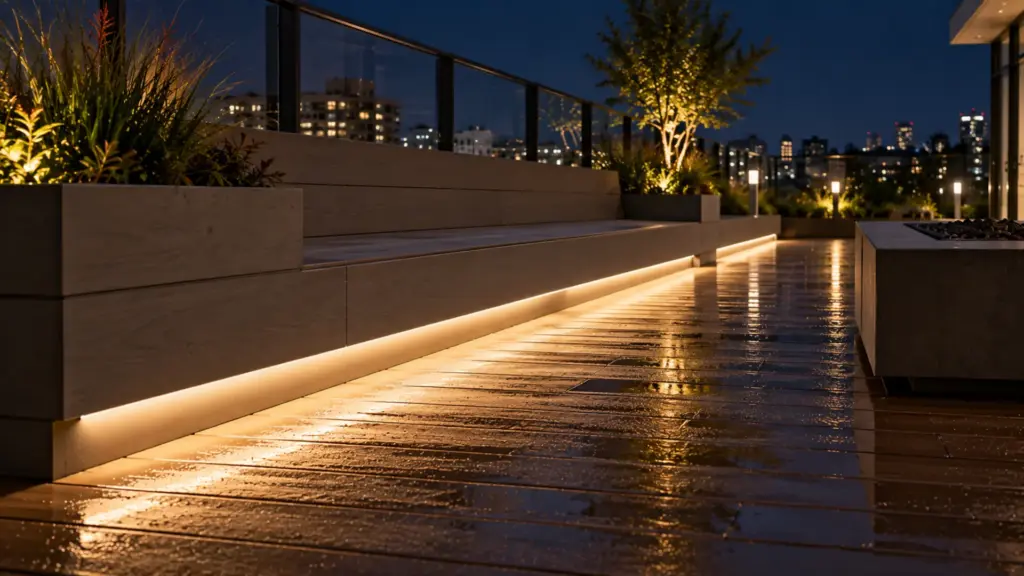
The 80% line is exact here, so a longer run per feed would need a bigger driver or a fifth feed.
Where the drivers sit is the other choice. Potted IP67 drivers beside each run keep the 24V leads short. An IP20 driver inside the building keeps the electronics dry, but the 24V cable to the deck then carries the full load over its length, and a long lead costs voltage before the strip starts; our voltage drop guide shows how to size that wire. Our drivers page lists the potted drivers, and we can lay out the feeds against the deck plan before the order: send the run lengths and request a quote.
Rules of Thumb
- The strip carries the IP rating; the channel carries the line, the heat and the sun.
- Pick IP65, IP67 or IP68 by exposure, and check the jacket width against the channel.
- Seal the strip’s ends and the cable entry, not the cover.
- Let water out at the low end.
- Fix with screws or clips, leave gaps at joints, and keep sun-facing covers UV-stabilized.