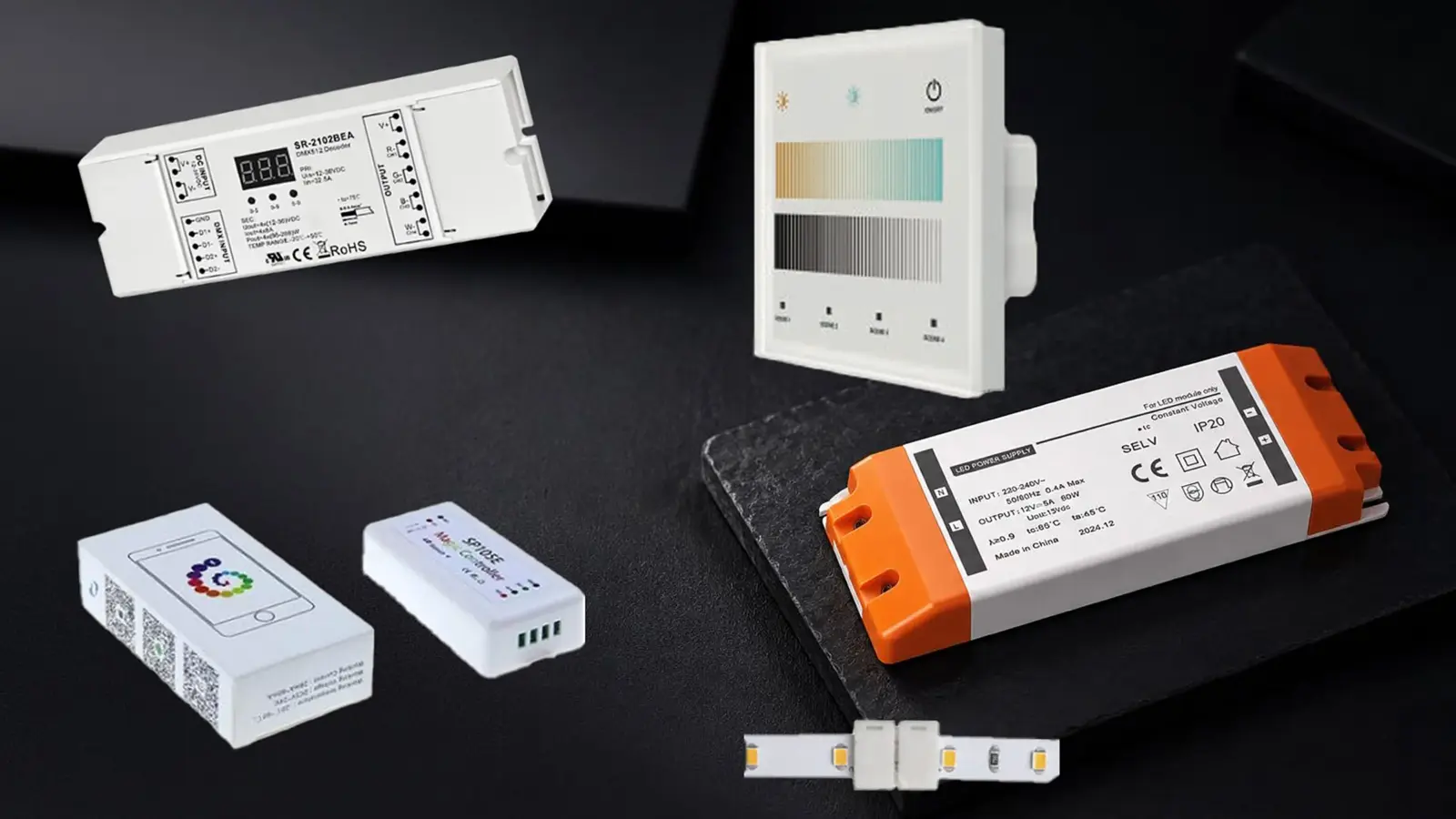
How big does the box need to be, and does it need vents? An outdoor LED driver enclosure is sized by the heat the drivers waste, not by how much fits inside, and a sealed box that keeps rain out will still collect water if it cannot breathe.
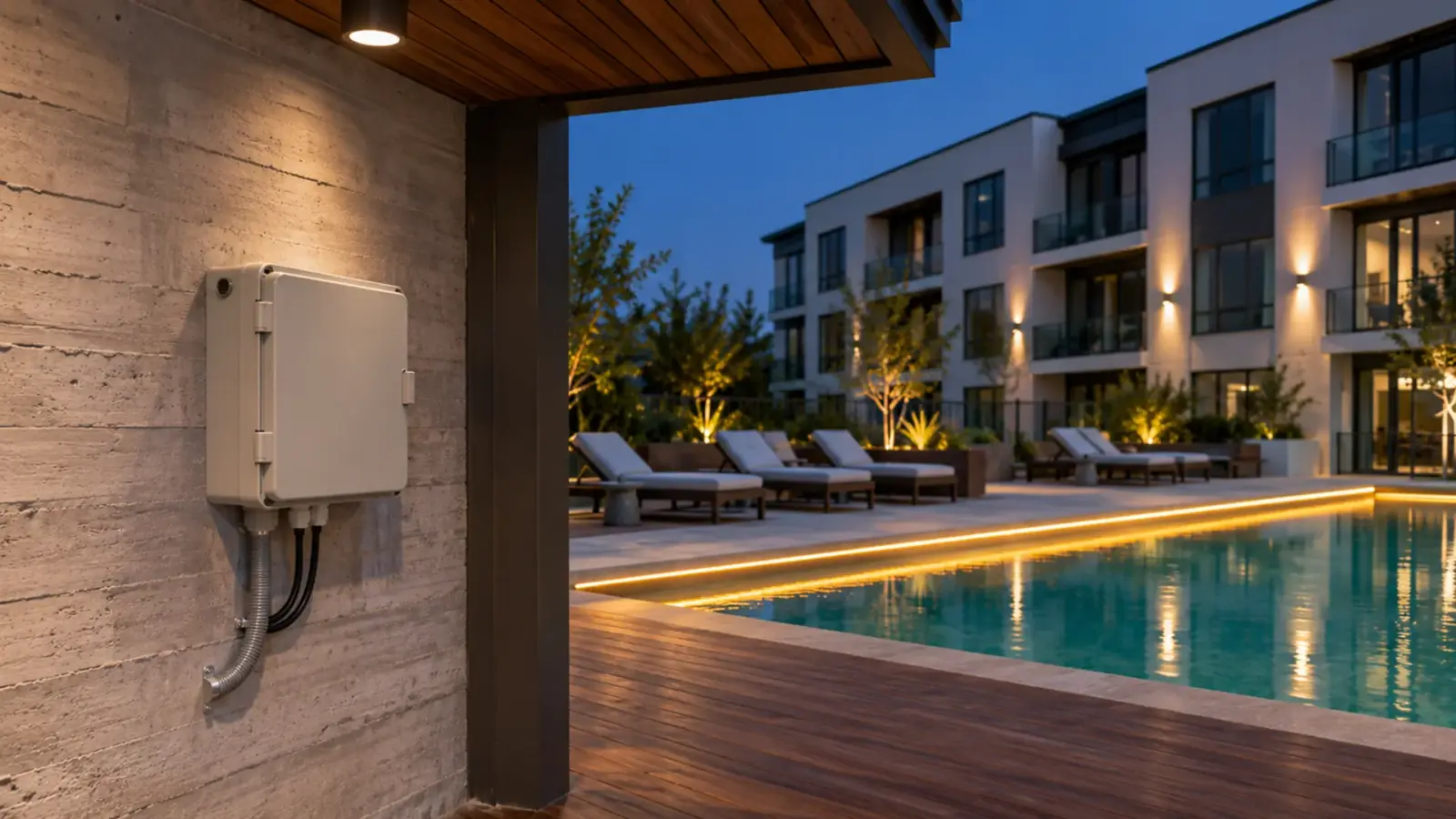
That is the question when four drivers, a DMX A device that turns DMX or DALI data into PWM output for constant-voltage strip. One decoder serves a few channels; large jobs use many. and an amplifier have to live on an outside wall because there is no electrical room near the pool deck or the canopy.
The usual fix is a bigger gasketed box, sealed tight. It handles the rain and makes the other two problems worse. Here is how to size the box, which part fails first, and when the drivers should not be in a box at all.
What the Box Changes: Rain, Not the Rating
An outdoor enclosure gives the equipment inside a dry place out of the weather. It does not change what the equipment inside is rated for. An IP20 driver is still an IP20 driver with the same ambient rating, and that rating now applies to the air inside the box.
Three things decide whether a boxed driver passes:
- The enclosure type. The informational note to NEC Table 110.28 says “raintight” is typically used with Types 3, 3S, 3SX, 3X, 4, 4X, 6 and 6P, and “rainproof” with 3R and 3RX. Only Types 4, 4X, 6 and 6P are rated for hosedown, so a pool deck that gets washed down wants a 4 or 4X box, not a 3R.
- The fittings. NEC 314.15 asks for boxes and fittings in damp or wet locations to keep moisture from entering or collecting, and in wet locations to be listed for wet locations. A wet-rated box with an indoor cord grip is not a wet-rated assembly.
- The driver’s own instructions. The inspector reads the driver label. Our own IP20 Class 2 drivers are sold for dry spaces, and the drivers page says so plainly: for damp and wet locations it points to a potted IP67 driver such as UT-D100-24-67. Our advice is to treat a boxed IP20 driver as the second choice: use potted IP67 drivers or an indoor location first, and if IP20 drivers have to go in an outdoor box, get the inspector’s approval in writing before the boxes and drivers are ordered, not after they are on the wall.
The IP rating of the strip and the wet-location marking are separate questions, covered in IP68 vs wet location.
Where the Heat Comes From
The strip’s watts leave the box on the output cable. What stays inside is the drivers’ loss: the input power the driver turns into heat instead of output. For a constant-voltage driver that loss is the output times (1 ÷ efficiency − 1).
| Driver (our model) | Output at 80% load | Efficiency* | Heat left in the box |
|---|---|---|---|
| UT-D60-24-C2 (60 W, IP20) | 48 W | ≈85% | about 8.5 W |
| UT-D96-24-010 (96 W, 0-10V, IP20) | 76.8 W | ≈88% | about 10.5 W |
| UT-D400-24-L (400 W, IP20) | 320 W | ≈90% | about 36 W |
*Efficiency figures are the typical full-load values for each driver class listed on our drivers page; the datasheet for the exact model, including efficiency at part load, is confirmed with the quote.
The 80% load comes from the sizing rule on the same page: keep the strip load at or below 80% of the driver’s rating. Add the decoder’s and the amplifier’s own consumption from their datasheets, because it is heat in the same air. A box with four 96 W drivers loaded to 80% carries about 42 W of heat before the controls are counted.
Box Size: Watts per Square Foot
A sealed box gets rid of heat through its skin, so the number that matters is the heat per square foot of surface. nVent Hoffman publishes a chart for gasketed, unventilated enclosures that turns watts per square foot into a temperature rise above the outside air. Its own worked case, reprinted by Border States, is 300 W inside a 48 × 36 × 16 in enclosure: about 42 sq ft, 7.1 W per sq ft, and a rise of about 30°F (16.7°C).
Read from the same chart’s curve for painted steel and non-metallic boxes:
| Heat per sq ft of surface | Rise above outside air |
|---|---|
| 2 W | about 9°F (5°C) |
| 4 W | about 19°F (11°C) |
| 6 W | about 28°F (16°C) |
| 8 W | about 36°F (20°C) |
| 10 W | about 42°F (23°C) |
| 12 W | about 48°F (27°C) |
The curve flattens as the load climbs, but the low end is where outdoor driver boxes live, and there every watt per square foot costs 4 to 5°F.
The method, step by step:
- Add up the heat: drivers’ losses plus the controllers’ consumption.
- Work out the surface in square feet: 2 × (H×W + H×D + W×D) in square inches, minus the back if the box is mounted flat on a wall, divided by 144. Hoffman’s method subtracts any face that sits against a wall.
- Divide the heat by that surface and read the rise from the chart.
- Add the rise to the hottest shade temperature on site. Compare the result with the lowest maximum ambient of any part in the box. Hoffman recommends a 25% safety margin on the rise.
Worked Example: 96 ft of Canopy Strip
A typical job: a hotel porte-cochère with 96 ft of IP67 outdoor strip, UT-O480-10-67 at 3.2 W/ft, in eight 12 ft runs of 38.4 W each. Two runs per driver puts four UT-D96-24-010 drivers at exactly 80% load. Heat in the box is about 42 W. The box is on a wall, so the back face is left out. The design day is 95°F (35°C) in the shade.
| Box A: 16 × 12 × 6 in | Box B: 24 × 20 × 8 in | Box C: 30 × 24 × 10 in | |
|---|---|---|---|
| Surface, back left out | 528 sq in = 3.7 sq ft | 1,184 sq in = 8.2 sq ft | 1,800 sq in = 12.5 sq ft |
| Heat per sq ft | 11.4 W | 5.1 W | 3.4 W |
| Rise from the chart | about 46°F (26°C) | about 24°F (13°C) | about 16°F (9°C) |
| Inside air on a 95°F day | about 141°F (61°C) | about 119°F (48°C) | about 111°F (44°C) |
| Against the 122°F (50°C) driver limit | Over | 3°F of margin; fails with Hoffman’s 25% | 11°F of margin; passes with 25% |
Box A has room for the four drivers and cooks them. Box B looks fine on a quick count of all six faces and fails once the back is taken out. Box C passes in the shade, and only in the shade. Near its upper limit a driver also has to be derated, which the hot-ceiling derating guide covers with the Ta and Tc curve.
Which Part Hits Its Limit First
In a mixed box, the part with the lowest rating sets the limit for everything in it. On the hot side and the cold side the order is different.
| Part (our models) | Rated ambient* | What it means in a box |
|---|---|---|
| IP20 drivers: UT-D60-24-C2, UT-D96-24-010, UT-D400-24-L | -4 to 122°F (-20 to 50°C) | The usual hot-side limit |
| IP65 linear driver UT-D150-24-L | -4 to 122°F (-20 to 50°C) | Same window as the IP20 drivers |
| Decoders and amplifier: UT-CDMX-480, UT-C010-350, UT-CSPI-2048, UT-CAMP-4 | -4 to 122°F (-20 to 50°C) | Same window; no IP rating listed, so treat them as indoor gear |
| Potted IP67 drivers: UT-D100-24-67, UT-D100-24-010-67 | -13 to 140°F (-25 to 60°C) | 18°F more headroom on the hot side, 9°F on the cold side |
| Wall panel UT-CTP-010, TRIAC dimmer UT-CTRC-240 | 32 to 104°F (0 to 40°C) | Rated only down to freezing, so not for an outdoor box |
*Typical values for the class from our drivers page; the datasheet for the exact model is confirmed with the quote.
Two things follow. A box that passes for the drivers also passes for the decoders and amplifiers, because they share the 122°F (50°C) ceiling. And in a northern winter the cold end matters: Minneapolis averages about ten January nights below 0°F, according to NOAA’s 1991–2020 normals, and the parts in a box that is off at night get no help from their own heat.
Sun on the Box
The chart above is for a box out of the sun. Hoffman treats sun as a separate load, and its guide puts the solar rise on a gray box in full sun at about 40°F, more than the whole margin in the worked example. Its tests of sun shields cut that rise roughly in half. So keep the sun off the box instead of adding it to the sum:
- Mount the box on the north or east side, under the canopy or eave.
- Choose a light-colored box, or add a sun shield with an air gap behind it.
- Keep the box away from glass and light paving that reflect sun onto it.
- Spend the margin from the worked example on hot days, not on more drivers.
Condensation: How a Sealed Box Takes On Water
Much of the water found in outdoor driver boxes is not rain through the gasket. As the box heats in the afternoon and cools at night, the pressure inside swings. With no vent, that swing works on the gasket and every fitting, and humid air gets in wherever the seal is weakest. The moisture condenses on the cold walls and runs down. The note to NEC Table 110.28 says as much: the enclosure types do not protect against condensation inside the box or water that enters through the conduit.
The fixes, in this order:
- Bring every cable in from the bottom, with a drip loop below the box so water runs off the loop instead of along the jacket.
- Seal the conduit where it comes from a warmer space inside the building. NEC 300.7(A) calls for this where parts of a raceway see very different temperatures, so warm, humid building air does not flow into the cold box.
- Fit a membrane vent high on a side wall. Gore describes its vents as equalizing pressure quickly while blocking water, which reduces condensation and extends seal life, and its positioning guide puts the vent near the top of a vertical wall so warm, humid air can escape as it rises. A drilled hole is not a vent.
- Keep the driver terminals off the box floor. Mount the drivers on the back panel so any water that does collect runs past them.
Three Places for the Drivers
When the box is hard to size or hard to keep dry, move the drivers instead.
| Placement | When it fits | What it costs |
|---|---|---|
| Potted IP67 drivers on the wall or canopy structure, no box | Static white, or 0-10V dimming with UT-D100-24-010-67 | A driver per zone outside; controllers still need a dry place |
| Everything in one outdoor box | Color or pixel control where the decoder and amplifier have to sit near the strip | The heat budget, a vent, bottom entry, shade, and the inspector’s written approval of IP20 parts before ordering |
| Drivers and controls indoors, 24V cable out | A mechanical room, garage or storage room within reach | Longer cable sized for voltage drop. Class 2 drivers (our UT-D60-24-C2 family, 60 W each) keep Class 2 wiring; higher-power outputs such as the 96 W drivers above use the wiring method the AHJ requires. See the remote driver guide |
For exterior lines that sit in the ground or in a wall, the exterior recessed linear guide shows where the feeds and drivers go.
Rules of Thumb
- Size the outdoor box from the drivers’ losses: load × (1 ÷ efficiency − 1), plus the controllers.
- Count the surface without the back face, and keep the heat at or under about 3.5 W per square foot when the parts top out at 122°F (50°C) and the shade high is 95°F (35°C). That leaves Hoffman’s 25% margin.
- That figure holds only in shade: put the box out of the sun or under a shield, bring cables in from the bottom, and fit a membrane vent high on a side wall.
- If the box keeps coming out too big, use potted Dust-tight, and protected against temporary immersion in water. The usual rating for wet or outdoor runs that are not submerged all the time. drivers outside or move the drivers indoors.
- Boxing IP20 drivers outdoors comes last: only with the inspector’s approval, obtained before anything is ordered.
The drivers named here are on our drivers page with their ratings, and we match driver count and placement to the run lengths when a job is quoted.