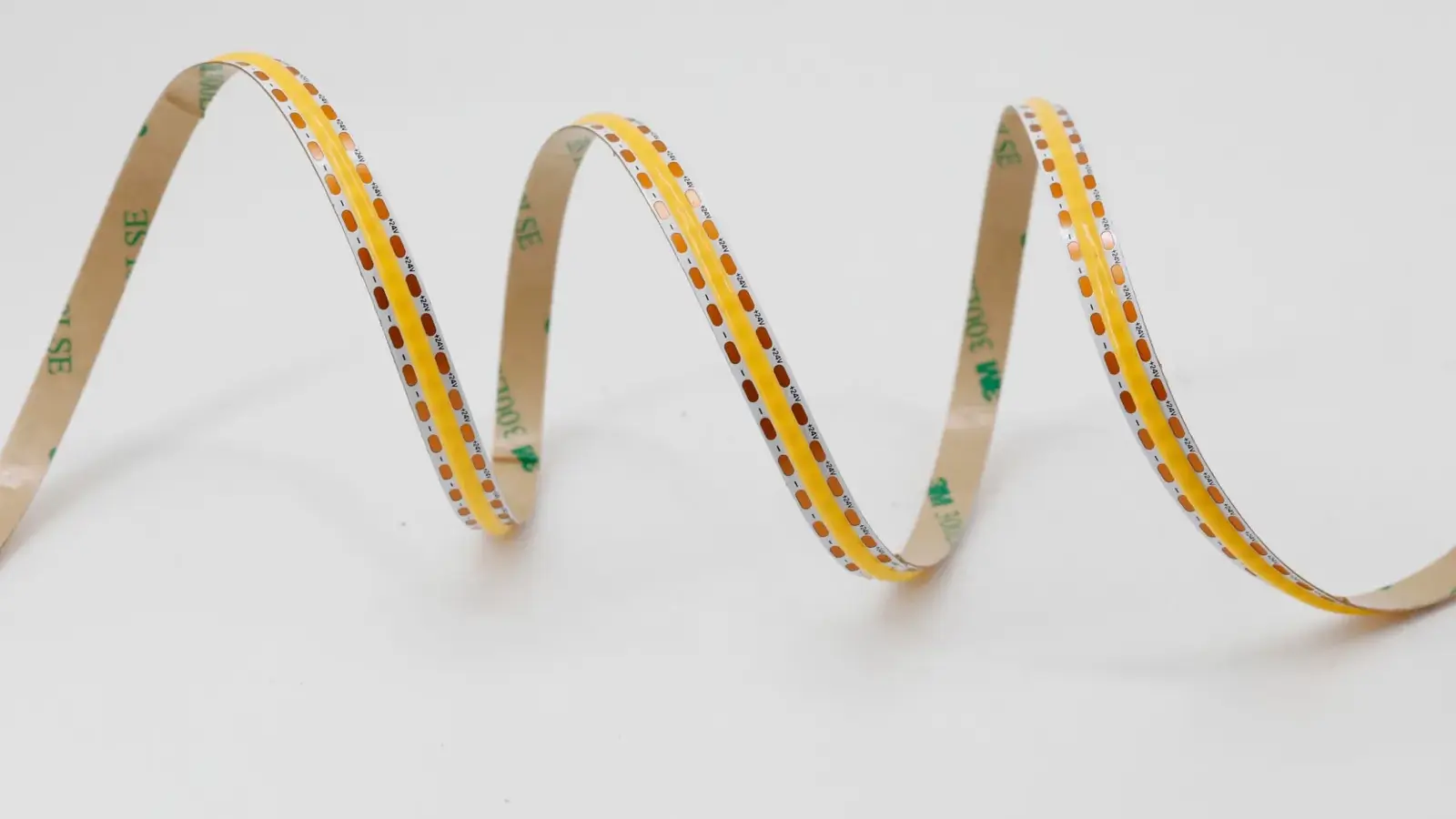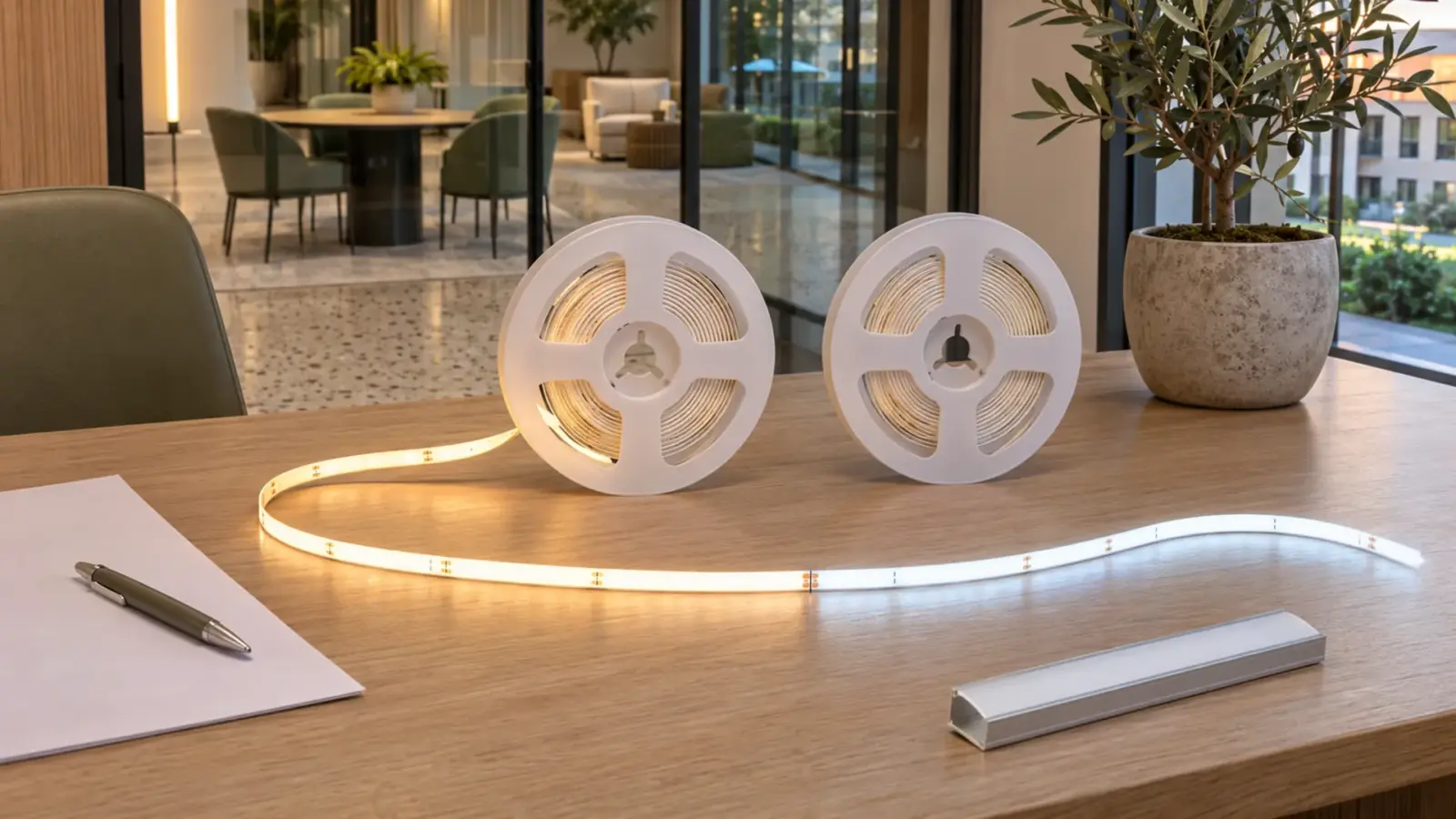


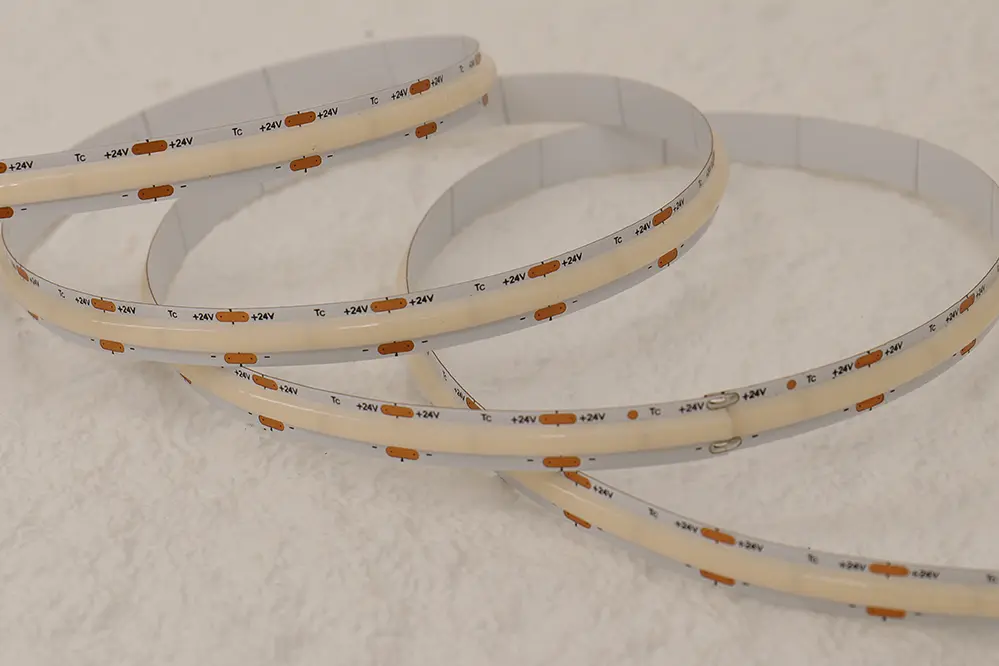
SOB, SCOB, WCOB and DOB are labels sellers use for one family of LED strip: small packaged SMD LEDs at a tight pitch under one continuous line of white silicone, so the run lights as a dot-free line. The names come from different suppliers and catalogs, and we found no standard that defines any of them.
Picture three quotes for the same dot-free cove. One lists SOB strip, one SCOB, one WCOB, and a fourth catalog files a similar reel under DOB. Read them as one family and compare the numbers. This guide lists what each label is said to stand for, where each one shows up, the one meaning of DOB that is a different product, and what tells the family apart from COB.
One Build Behind Four Labels
The strip under all four names starts as SMD strip with very small packages. One sign-lighting strip maker lists package sizes such as 2216, 2110 and 1612, far smaller than the packages on ordinary strip: a 2216 package is about 2.2 by 1.6 mm, a 2835 about 2.8 by 3.5 mm. The packages sit close together on the board, and a line of white or milky silicone over them blends the points into one line.
That is the difference from COB. On COB strip, bare LED dies are bonded to the board and covered with a line of phosphor silicone, which is why a white COB line looks yellow when the power is off. On the SOB family, each LED is a finished package before it reaches the board.
We met the naming problem in our own range. The catalogs our SOB strip comes from use different words for it: one calls the strip WCOB, another files it under an “SCOB DOB series”. When we asked, the suppliers confirmed that SOB, SCOB and WCOB describe the same strip, and that their DOB uses packaged SMD LEDs like SCOB. We list all of it on one page, SOB LED strip: 28 models in seven series, including the boards sold as DOB.
What Each Name Is Said to Stand For
None of the four labels has an agreed expansion. These are the ones we could trace to a page, with the kind of company that uses each:
| Label | Said to stand for | Where we found it | What it really describes |
|---|---|---|---|
| SOB | SMD-on-Board, or Segment-on-Board | A US strip brand’s blog and launch page | The packaged SMD LEDs |
| SOB | Silicon On Board | An Italian strip maker’s guide | The silicone over the LEDs |
| SCOB | Stereoscopic Chip on Board | A sign-lighting strip maker’s comparison | No agreed meaning; it keeps “COB” though the LEDs are packaged |
| SCOB | “the Superior alternative to COB strip lights” (no expansion) | Another seller’s product page | A sales claim |
| WCOB | White COB: SMD LEDs with a silicone coating “for a white COB effect” | A European retailer’s product page | The white line |
| DOB | Diffused on board | A UK strip maker’s datasheet: “Diffused on board flexible LED tape” | The diffusing line |
| DOB | Driver on board | LED module makers | A different product (next section) |
Read across the rows and a pattern shows. Most expansions name one feature of the strip: the SMD packages, the silicone, the white color, the diffusion. “Stereoscopic” names nothing a buyer can check. None is a standard, which is why one reel can carry any of the four labels depending on who sells it.
Two traps sit in the letters. SCOB and WCOB keep “COB” in the name, so a buyer can read them as chip-on-board strip; they are not, because the LEDs are packaged. And SOB is sometimes expanded as “Silicon” on board, a word that fits COB too, since COB strip is also covered in silicone. The label alone will not settle which build is on the reel.
The Other DOB: Driver on Board
In LED modules, DOB also means driver on board, a use that has appeared in trade news since at least 2014. The driver circuit sits on the same board as the LEDs, so the module runs straight from mains voltage with no separate driver. Module makers sell these as driverless AC modules, and LEDs Magazine has covered them for years.
That DOB is a different product from DOB strip. The strip sold as DOB in the sense of this article runs on low-voltage DC and needs a driver like any other tape: our DOB series, such as UT-SC280-10, is 24V.
The check takes one line of the datasheet. Look at the input voltage. A DOB strip of the kind described here lists low-voltage DC (24V on every DOB strip we found) and a driver. A driver-on-board module lists a mains input, anywhere from 120V to 277V AC, and no driver. If a quote for “DOB strip” shows a mains input, it is either a driver-on-board module or a mains-voltage strip, not the low-voltage DOB tape described here, and the run lengths, dimming and listing questions all change with it.
Same Label, Different Build Inside
The family shares a look, not one recipe. In the pages we could open, three builds go out under these names:
- Phosphor in each package, silicone over the row. A US strip brand describes its SOB strip this way: the phosphor sits inside each SMD package, and the silicone over the row can be “completely clear or milky-white”.
- A phosphor layer over the chips, then milky silicone. A sign-lighting strip maker describes its own SCOB this way: high-density LED chips on the board, a phosphor adhesive over them, then semi-transparent milky white silicone, in a process it calls the same as for COB strip, while listing SMD technology among the features.
- SMD strip molded into a silicone housing. The same maker lists SOB as a separate category built this way.
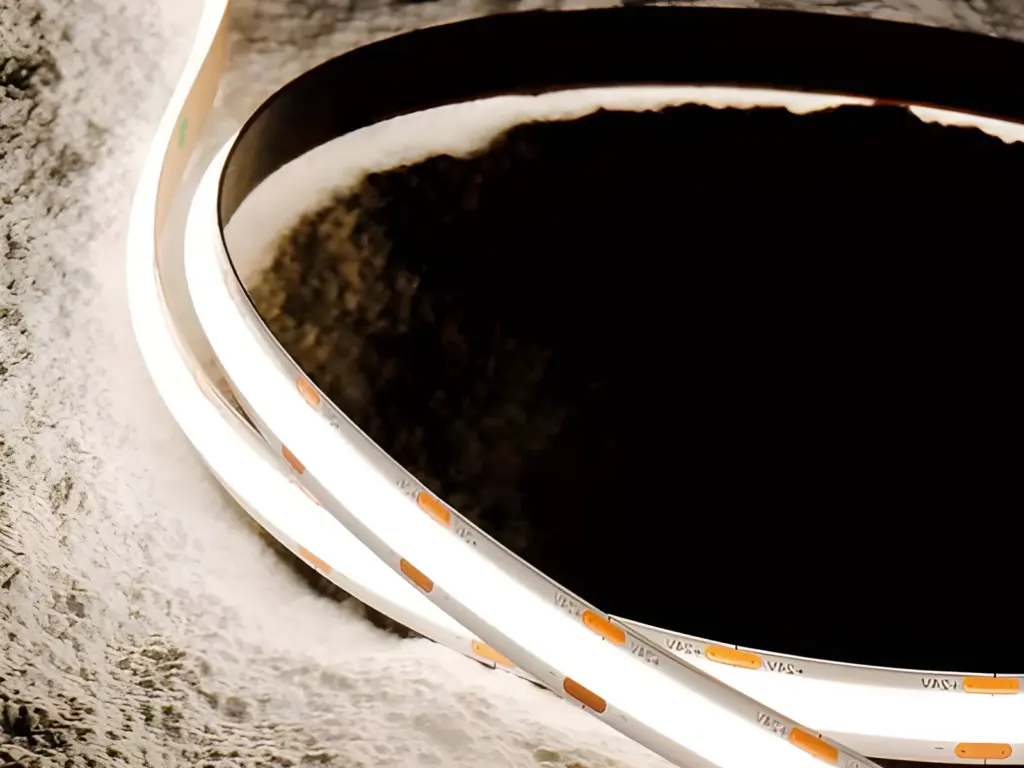
Our own SOB strip is the first build: wire-bonded SMD packages, each with its own phosphor, under silicone mixed with diffusion powder, which is what makes the line milky white.
So two quotes with the same label can hold different builds, and two quotes with different labels can hold the same one. The differences show in the numbers, not the name: LEDs per meter, efficacy at a stated CRI, color consistency per reel, cut step and run per feed. They also show in the unlit strip. A milky line hides the packages; a clear one can show a row of small packages under it.
Five questions settle which build a quote holds, whatever it is called:
- Are the LEDs packaged SMDs or bare dies, and what package size?
- Where is the phosphor: in each package, or in a layer over the row?
- Is the silicone over the row milky or clear?
- What is the efficacy at the stated CRI, measured on bare strip, and what is the color tolerance per reel (bin, or SDCM)?
- What is the cut step and the run per feed at the stated voltage?
The answers go on the datasheet, not in an email, so the submittal can be checked against them later.
What Buyers Type, and Where
The names are used very unevenly, and that matters when you choose which one goes in a spec.
In the United States, Google’s suggestions include “sob led strip”, “sob strip light”, “sob vs cob”, “cob vs wcob”, “dob led meaning” and “dob led full form”. The last two show buyers meeting DOB and asking what it means.
In the United Kingdom the suggestions include “sob led strip light”, and buyers also search by the look: “led strip without dots”, “led tape no dots”, “led tape dotless”.
In Germany, Spain and Italy, typing SOB, SCOB or WCOB brings back almost no suggestion that uses those names; the closest are COB or generic strip terms. Buyers there name the look instead: “LED Streifen ohne Lichtpunkte” (without light dots), “tira LED sin puntos” (without dots), “striscia LED senza puntini” (without little dots).
Our own Search Console shows the same split. Over 90 days, from late August to late November 2026, searches containing SOB brought our pages 82 impressions, every one from the US. Searches containing SCOB brought 29, of which 14 came from Japan, 6 from India and 1 from the US. WCOB brought none.
The volumes are small everywhere. Keyword tools put “sob led strip”, “scob led” and “dob led strip” at about 10 US searches a month each, and “wcob led strip” at none. “Dob led” reaches about 30, a figure that may mix both meanings of DOB.
For a US spec, our Search Console figures point one way. SOB is the name US searchers use, so it is the one a US bidder is most likely to recognize, and the other three belong in a note: “SOB (also sold as SCOB, WCOB or DOB)”. That is how our SOB page is named.
SOB Family vs COB on the Spec Sheet
The labels blur, but the two builds do not. From our two product pages:
| SOB family (our SOB page) | COB (our COB page) | |
|---|---|---|
| What sits on the board | Small packaged SMD LEDs | Bare LED dies |
| LEDs per meter | 256 to 420 | 280 to 1,600 |
| PCB width | 4 to 10 mm | 2.7 to 30 mm |
| Highest listed efficacy | 142 lm/W at Ra≥90 | 109 lm/W at Ra≥90 |
| Color tolerance per reel | One bin, SDCM<3 on every model | SDCM<5 as standard, SDCM<3 one bin on request |
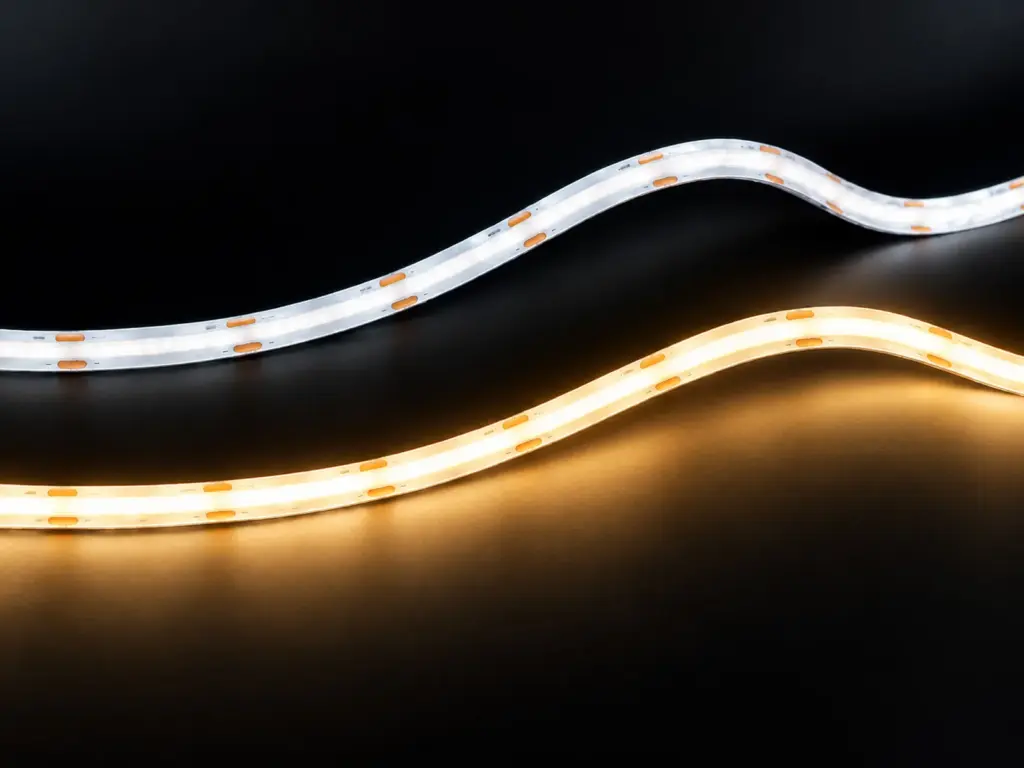
Unlit, strip makers describe a white COB line as yellowish-orange, while the SOB family is white or milky, or shows its packages under clear silicone. The SOB family wins on efficacy, and on color tolerance as standard, because its packages are sorted before they go on the board. The catalogs we buy from show the same split: one compares the two builds side by side at SDCM<3 for WCOB and SDCM<5 for COB, and the other offers COB at SDCM<3 only as a one-bin option. COB wins where the job needs density above 420 per meter, a board narrower than 4 mm or wider than 10 mm, or side-view and S-shape forms. The full build-to-build comparison, with lumens per watt and watts per foot, is in SCOB beats COB on lumens per watt, and the COB names, from FCOB to FOB, are in COB vs FCOB LED strip.
If a submittal names one family where the spec names the other, treat it as a substitution, even when the lit samples look the same on the mockup board. The wider family tree, from DIP to SCOB, is in our guide to LED package types.
Writing It Into a Spec
Because the labels drift, the safest spec describes the build and the numbers, then lists the names as aliases. A line in that form, using the values of one of our 24V boards, UT-SC320HE-10, as the example:
- Product: linear LED tape, SOB build: packaged SMD LEDs under one continuous white silicone line (also sold as SCOB, WCOB or DOB). COB and SMD-with-diffuser builds are substitutions.
- Electrical: 24V DC, constant voltage, 3.0 W/ft (10 W/m), 65 ft (20 m) run from one end.
- Optical: 320 LEDs/m on an 8 mm board, 131 to 140 lm/W at Ra≥90, one bin per reel.
- Fit: cut step 0.98 in (25 mm), IP20 for dry locations.
- Submittal: datasheet with the five answers above, and one lit and one unlit sample on the mockup board.
The same frame works for any SOB-family strip: change the numbers, keep the build description. A bidder who sells the strip as SCOB or WCOB can match it line by line, and a bidder who offers COB or a different voltage has to say so.
Rules of Thumb
- SOB, SCOB, WCOB and DOB strip are one build: packaged SMD LEDs under a white silicone line. Compare the numbers, not the label.
- None of the expansions is a standard. “SMD”, “silicon”, “white” and “diffused” each describe one feature; “stereoscopic” describes nothing you can check.
- DOB has a second meaning, driver on board. Check the input voltage: low-voltage DC with a driver is the DOB strip; a mains input means a driver-on-board module or a mains-voltage strip.
- The same label can hide different builds. Ask for LEDs per meter, efficacy at a stated CRI, bin or SDCM per reel, cut step and run per feed, and look at an unlit sample.
- In a US spec, write SOB first and list the other names after it.
Our SOB LED strip page lists all 28 models, the boards sold as DOB included, by density, width, efficacy, cut step and run per feed.