An LED package is the chip plus what makes it a part: pads or leads, usually a phosphor, and an encapsulant or lens. LED strip uses five: DIP (through-hole, now rare), Surface-mount LEDs placed along the strip as discrete packages, named by size in tenths of a millimeter: 2835 is 2.8 by 3.5 mm, 5050 is 5 by 5 mm. (2835, 5050 and relatives), COB (bare chips under one phosphor line), CSP (flip chips barely bigger than the die) and SCOB (SMD packages under a COB-style coating).
The package decides what the installed line looks like, how color is controlled (part by part or across the whole run), how short it can be cut and where its efficacy sits. This page gives each one a short definition and our range, then points to the comparison that settles a choice between two of them.
What a Package Is, and Why the Strip Inherits It
The light comes from a die, a speck of semiconductor. Everything around it is the package: the frame or pads that carry current, the phosphor that turns blue light white, and the silicone or lens on top. On strip, the package decides three things before anyone picks a model:
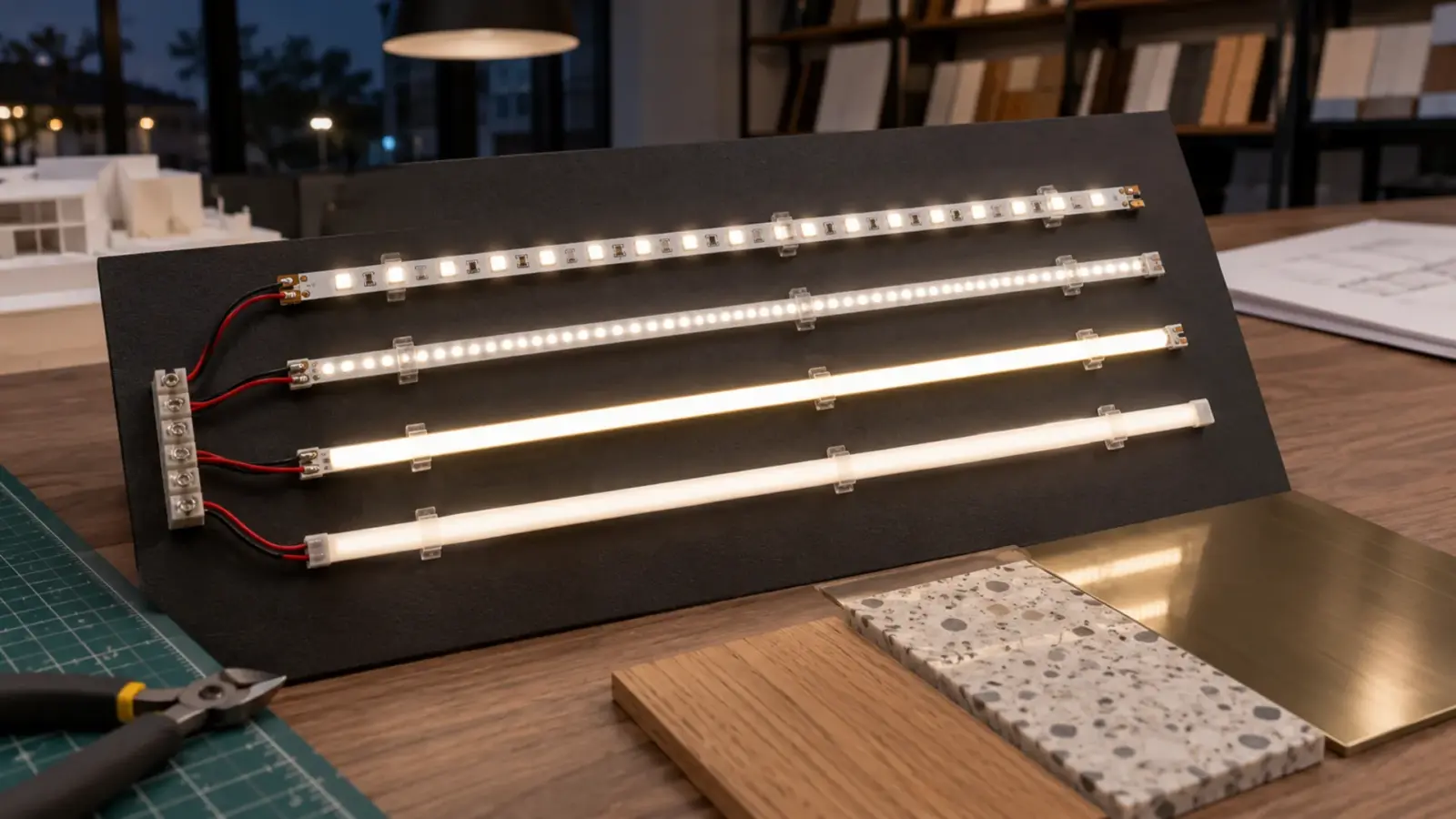
- Points or a line. Separate packages read as dots until a diffuser blends them. A continuous coating reads as one line.
- When color is sorted. Packaged LEDs can be tested and binned before they reach the board. A phosphor poured over a whole run is set for the whole run.
- Where the board can be cut. Small, dense parts allow short cut intervals; long groups of large parts do not.
The Five Side by Side
The ranges below come from our own category tables. Efficacy is the span across the white rows that list it; the low ends are jacketed, mini-cut or free-cut, or dense small-package builds.
| Package | How it is built | The line it makes | Our range | Efficacy across our rows | Shortest cut in our tables | Pick it when |
|---|---|---|---|---|---|---|
| DIP | Through-hole lamp with two leads and a molded lens | Separate points, often narrow beams | Not in our range | n/a | n/a | Rarely, for strip |
| SMD | Packaged chip soldered to pads; the number is its size in mm | Dots unless diffused | Nine packages, 60 to 960 LEDs/m | 72–180 lm/W (PRO rated 200 at Ra≥80) | 0.20 in (5 mm), UT-S2835-200-FC | Efficacy, color options, RGB, a diffuser with depth |
| COB | Bare chips bonded to the board under one phosphor layer | One continuous line | 280 to 1,600 LEDs/m | 52–138 lm/W (138 on the DOB row UT-D280-10) | Any point on free-cut UT-C528-8-FC; shortest marked step 0.12 in (3.02 mm) at 12V, UT-C1328-10 | A visible line, shallow channels |
| CSP | Flip-chip die bonded to the board, package barely larger than the die | Points close together | 160 to 540 LEDs/m | 30–103 lm/W | 0.39 in (10 mm), UT-CSP-300-MC12 | Compact builds with fewer joints; harsh environments with type tests on file |
| SCOB | SMD packages on an SMT line, then a COB-style coating | One continuous line | 256 to 320 LEDs/m | 80–142 lm/W | Any point on free-cut UT-SC300G-15; marked 0.26 in (6.66 mm), UT-SC300-12 | A COB look with binned color and higher efficacy |
Read the LEDs-per-meter column with care. On COB the count is bare dies under one coating, on SMD, CSP and SCOB it is packages, and one package can hold one die or several. A COB run at 1,600 per meter and an SMD run at 240 per meter are not comparable by that number; compare light per foot and the look of the line instead.
SMD: The Numbers Are the Package Size
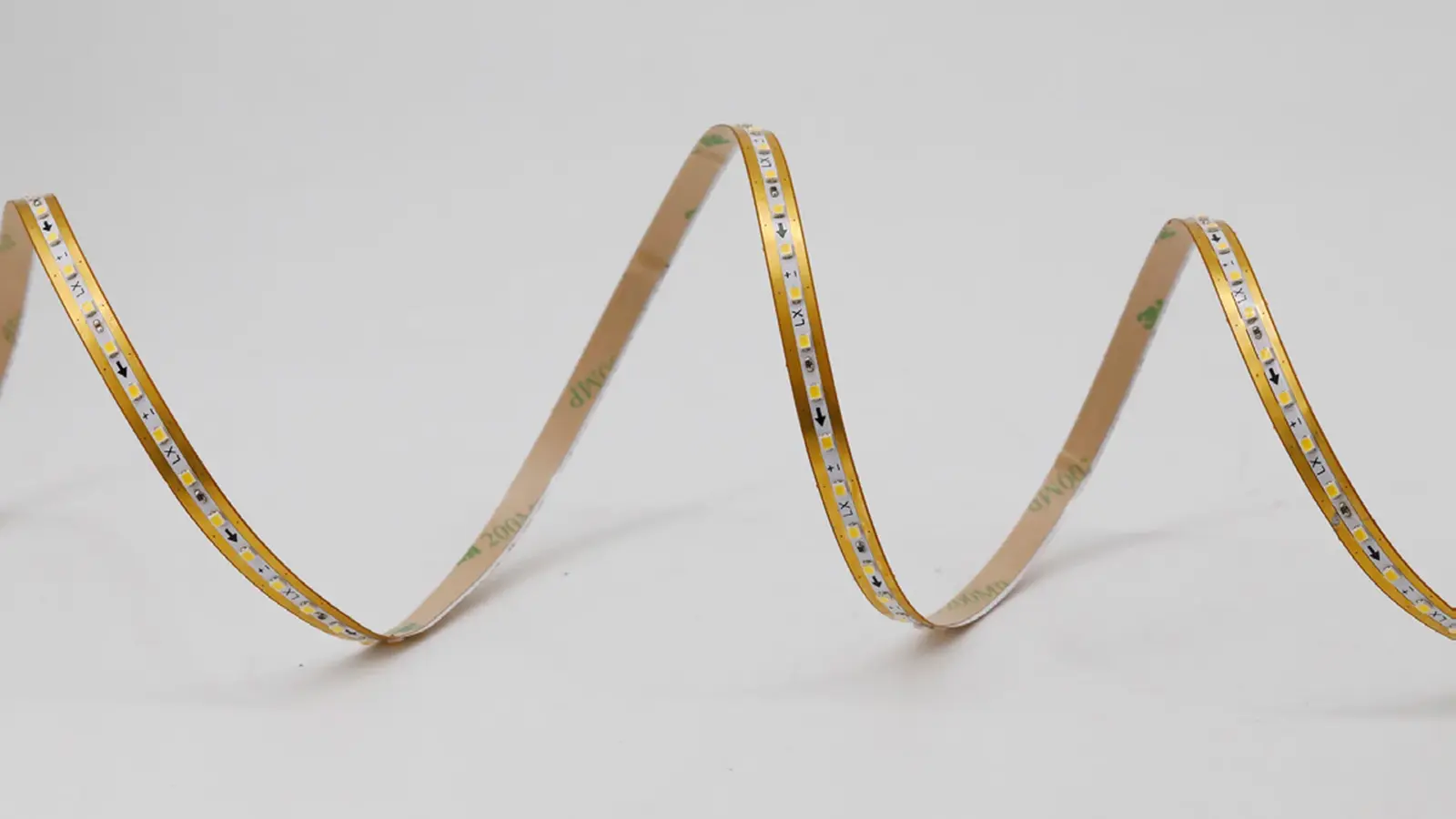
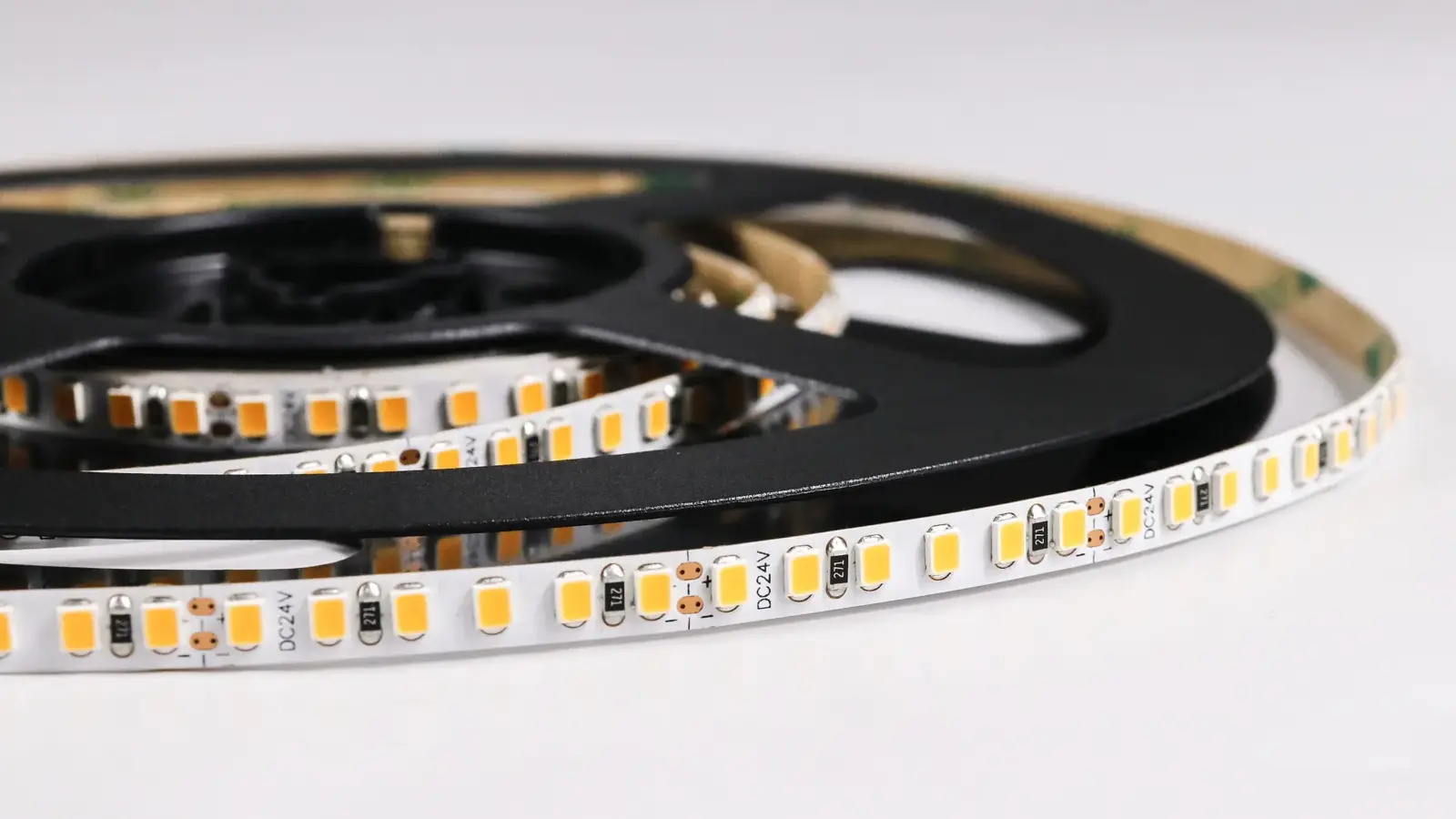
An SMD LED is a surface-mounted package soldered to pads on the board. The four digits are its size: as our SMD LED strip page puts it, a 2835 package measures 2.8 × 3.5 mm and a 5050 measures 5.0 × 5.0 mm. Our SMD range covers nine packages, from 2835 and 5050 to 2110, 2216, 3014 and 3838, at 60 to 960 LEDs per meter.
The size is not a grade. A larger package can hold more dies, which is why 5050 is the classic package for RGB, while 2835 is the white-light workhorse. Our 2835 vs 5050 comparison goes through what each package size changes, and our LEDs per foot guide shows how density and diffuser depth decide whether the dots show.
COB and SCOB: Two Ways to a Dot-Free Line
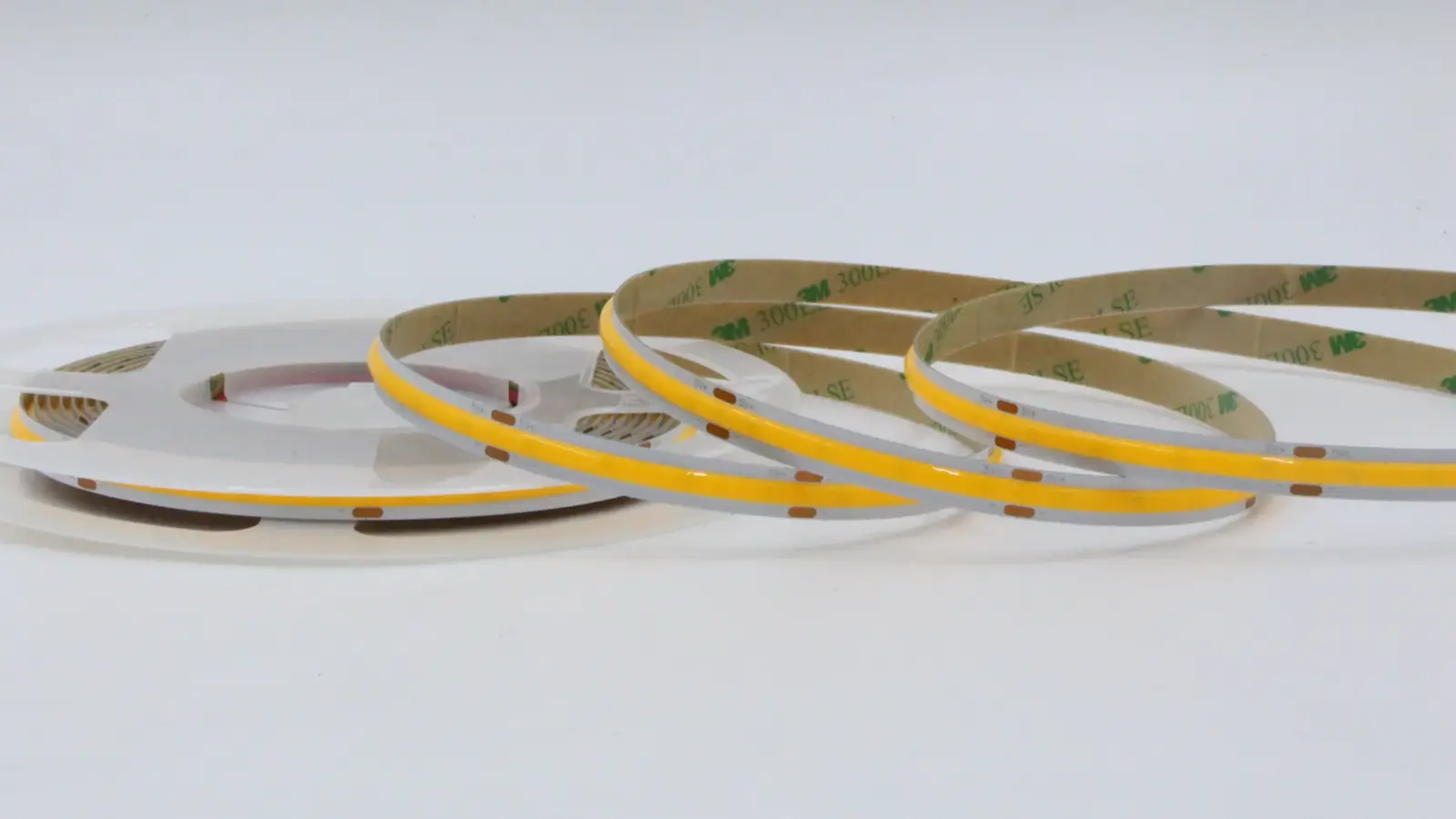
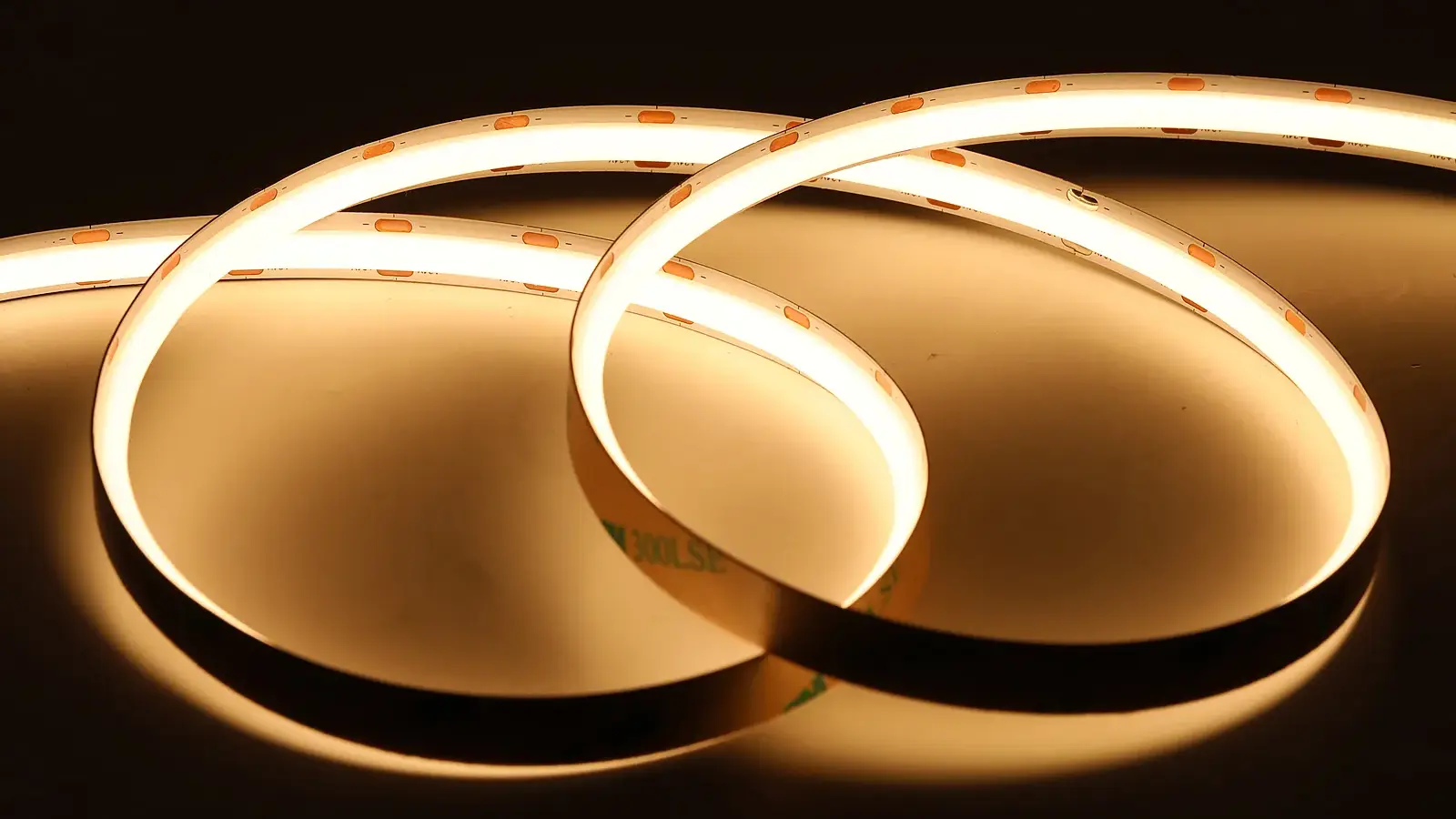
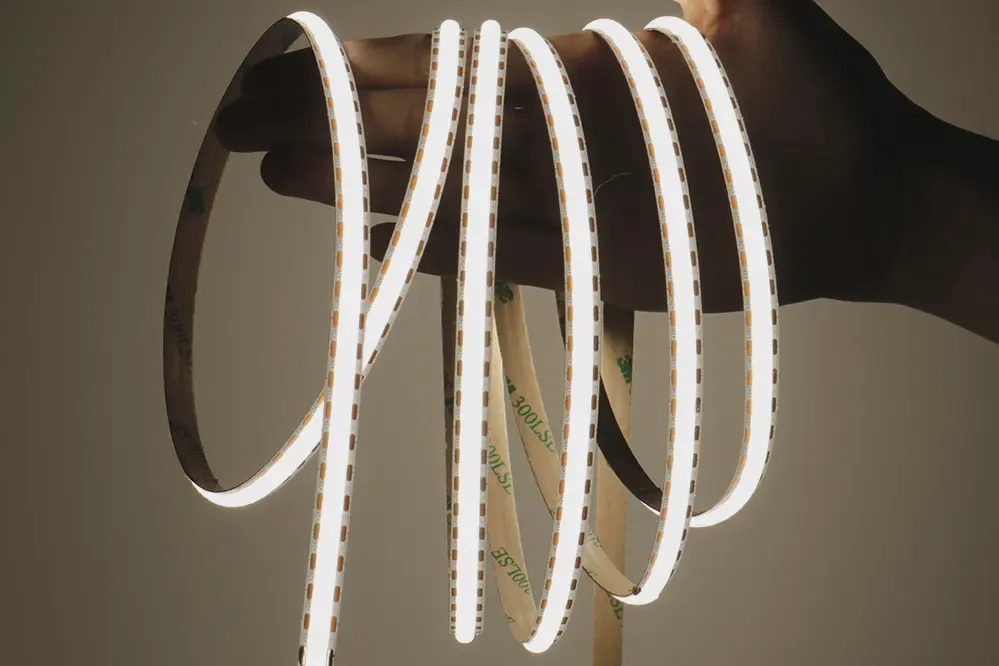
COB strip skips the package. Bare chips are bonded straight onto the flexible board and one continuous phosphor layer covers the run, so the light reads as a band, not points. Our COB LED strip range runs 280 to 1,600 LEDs per meter at CRI 90 to 98. Because the phosphor is set for the whole run, color is controlled across the run rather than sorted part by part; our COB page lists ±2 SDCM binning across every reel. Our COB vs SMD guide covers where that line is worth it in a cove.
SCOB reaches the same look from the other side. Small packaged SMD LEDs are soldered on an ordinary SMT line, and then the strip is coated the way COB is; in one common process, a phosphor adhesive goes on first and a milky silicone layer on top. Because the LEDs were tested before assembly, they can be picked for efficacy and color point; our SCOB LED strip page lists every reel as built from one bin to SDCM<3, with efficacy reaching 142 lm/W at the top of its range. The SCOB vs COB comparison has the trade-offs, including watts per foot at the driver.

CSP: Small Packages, Fewer Joints
CSP stands for chip-scale package. The die is a flip chip bonded straight to the board, in a package barely larger than the chip itself; RS’s DesignSpark describes it as no more than about 20% larger than the chip. There are no gold bond wires and no plastic bracket around each emitter, which a conventional SMD package carries.
Read the reliability claim carefully. Fewer parts is a statement about construction; our CSP page presents it as fewer points of failure, but we have no field failure data comparing CSP, COB and SMD, and this page does not claim one. Our CSP LED strip range runs 160 to 540 LEDs per meter with cut intervals down to 0.39 in. The CSP vs COB comparison covers line quality, type tests and where each wins.
DIP: Why It Rarely Appears on Strip
DIP is the trade name, borrowed from dual in-line package, for the through-hole LED most people picture: a 3 mm or 5 mm lamp with two wire leads that pass through holes in the board and a molded plastic lens. Water-clear 5 mm lamps often list a narrow beam, 20° on several common datasheets; diffused versions run wider, about 30°.
A thin flexible tape is built for surface-mounted parts, not leads through holes, and a narrow-beam lamp can make hot spots behind a shallow diffuser. That is why DIP survives in indicators and some older sign modules but rarely in modern strip. We do not list DIP strip. If an old fixture uses DIP modules, the replacement is usually an SMD or COB strip chosen for the depth behind the face.
Which Package for Which Job
| Job | Usual package | Why | Read next |
|---|---|---|---|
| Visible line in a shallow channel or cove lip | COB or SCOB | No dots without depth | COB vs SMD; SCOB vs COB |
| Deep channel or cove with a diffuser, energy limits | SMD (2835 high-efficacy, PRO) or SCOB HE | Efficacy | LEDs per foot |
| RGB, RGBW or pixel effects | SMD 5050 class or addressable; COB RGB for a continuous band | Several dies per package | 2835 vs 5050 |
| Tight color match across reels and phases | Any family, from one lot: SCOB SDCM<3, COB ±2 SDCM per reel, CSP ≤3 | Ask the SDCM per reel | SDCM guide |
| Very short cut lengths in millwork | Free-cut COB or SCOB (any point), cuttable SMD (5 mm), mini-cut CSP | Short or free cut intervals | Free-cut strip guide |
| Compact build, fewer joints on the reel | CSP | Construction | CSP vs COB |
The job decides the package first; the model comes from the table on that package’s page.
FAQ
What are the main types of LED packages?
For strip, five: DIP, the through-hole lamp with leads, now rare on strip; SMD, packaged chips soldered to pads, named by size such as 2835 or 5050; COB, bare chips on the board under one phosphor line; CSP, flip chips in a package barely larger than the die; and SCOB, SMD packages under a COB-style coating.
What is an SMD LED?
An SMD LED is a surface-mount device: an LED chip in a small package that is soldered flat onto pads on the board, with no leads through holes. On strip, the four digits name the package size, so a 2835 measures 2.8 × 3.5 mm and a 5050 measures 5.0 × 5.0 mm.
Is COB better than SMD?
Neither is better everywhere. COB gives one continuous line with no dots, which suits visible lines and shallow channels. SMD reaches higher efficacy in our tables, 180 lm/W at Ra≥90 and a PRO rating of 200 at Ra≥80, with more CCT and color options, and looks smooth once there is enough depth behind a diffuser. Pick by what the eye will see.
What does CSP mean on an LED strip?
CSP means chip-scale package: the LED die is a flip chip bonded straight to the board in a package barely larger than the chip, with no bond wires or plastic bracket. It allows a compact strip with fewer joints. Our CSP range runs 160 to 540 LEDs per meter.
What is the difference between COB and SCOB strip?
Both make a Light with no visible LED points. Reached by COB construction, a dense pitch, or enough distance between the LEDs and the diffuser. line. COB bonds bare chips to the board and covers the run with one phosphor layer, so color is controlled per reel; our COB page lists ±2 SDCM. SCOB solders packaged SMD LEDs first and then coats them, so the LEDs can be tested and binned beforehand; our SCOB page lists one bin per reel to SDCM<3.
Spec Notes: Name the Package and the Line
Write the package and the look into the specification together: “COB, continuous line, no visible dots at 18 in” or “2835 SMD behind an opal cover in a 20 mm deep channel.” A package name alone lets two quotes differ by more than price, and the line description is what the mockup will be judged against. Each package’s models, cut intervals and run limits are on its own page, starting from our SMD LED strip and COB LED strip tables.