White sign acrylic is not one material: according to distributor Harbor Sales, 7328 white passes about 28% of the light behind it, 2447 about 47% and 2406 about 64%. The backlit sign face material sets how bright the sign gets and how much of the LED strip it hides, so pick the face first, then the strip and depth.
Two Numbers on Every Face: Light Through and Rows Hidden
Every face has a light-through figure and a hiding figure, and the second one is not on the data sheet. Harbor Sales describes 2447 as brighter when lit but dull white to light gray by day, where 7328 stays milk-white, so the grade changes the daytime look as well as the output. How well a given sheet hides the rows at your depth is something only a sample shows: a face that passes more light can show rows sooner, even when the grade is sold for even diffusion.
Thickness moves both numbers. An eplastics product page lists 0.125 in 7328 at 31% light transmittance and states that the thicker the white material, the less light it passes. Compare grades at the thickness on the shop drawing, not from a chart for another gauge.
Depth is the other half. The farther the strip sits from the face, the more each row’s light spreads before it lands, so a deep cabinet hides rows that a shallow one shows. Most LED suppliers publish depth and on-center spacing charts for this, according to Sign Media Canada, and the figures differ by product. Our backlit panel depth guide walks through the geometry; this article is about what the face changes.
White Acrylic: 7328, 2447 and 2406
White acrylic is the default flat face for cabinet signs, and the grade decides the look by day and by night.
| Grade | Light through (Harbor Sales) | By day, unlit (Harbor Sales) | Harbor Sales lists it for |
|---|---|---|---|
| 7328 white | about 28% | milk-white | translucent cut graphics and router-cut acrylic graphics |
| 2447 white | about 47% | dull white to light gray | full-color translucent graphics |
| OPTIX LD MAX 2406 | about 64% | translucent white haze | bright illumination of translucent graphics |
The figures are for each grade as the distributor lists them, without a thickness, so treat them as a ranking, not a design value.
What 7328 asks of the strip is output. With under a third of the light getting through, the rows behind it carry more load for the same face brightness. What 2406 changes is the headroom: more light passes, and the distributor describes it as made for even diffusion. Whether that lets the rows open up at your depth is a One section of the real product installed on site for approval before the full order. The cheapest way to settle CCT, brightness and diffuser questions. question, not a table one.
Polycarbonate: Impact First, Light Second
Polycarbonate goes on a sign for one reason: it survives what breaks acrylic. SABIC’s sign-sheet brochure states that its LEXAN sheet has 30 times the impact strength of acrylic and 10 times that of impact-modified acrylic, and lists flat cabinet, formed, monument and pylon signs as uses. Federal Heath points to polycarbonate or impact-resistant acrylic faces where vandalism or frequent contact is likely.
Two things change for the strip. First, a polycarbonate white is its own grade with its own transmission; SABIC sells a separate white for LED signs. Ask for the grade’s light transmission at your thickness and lay out the rows against that sheet, not against the acrylic you priced first.
Second, polycarbonate is common for formed faces, and a formed face changes the depth. Sign Media Canada notes that total depth includes the face, and that formed faces add to it noticeably. The rows sit the same distance from the cabinet back, so on a formed face the flat border is closer to them than the raised center. Check the row spacing against the closest part of the face, where hot spots show first.
Flex Face: Big Cabinets, a Face That Moves
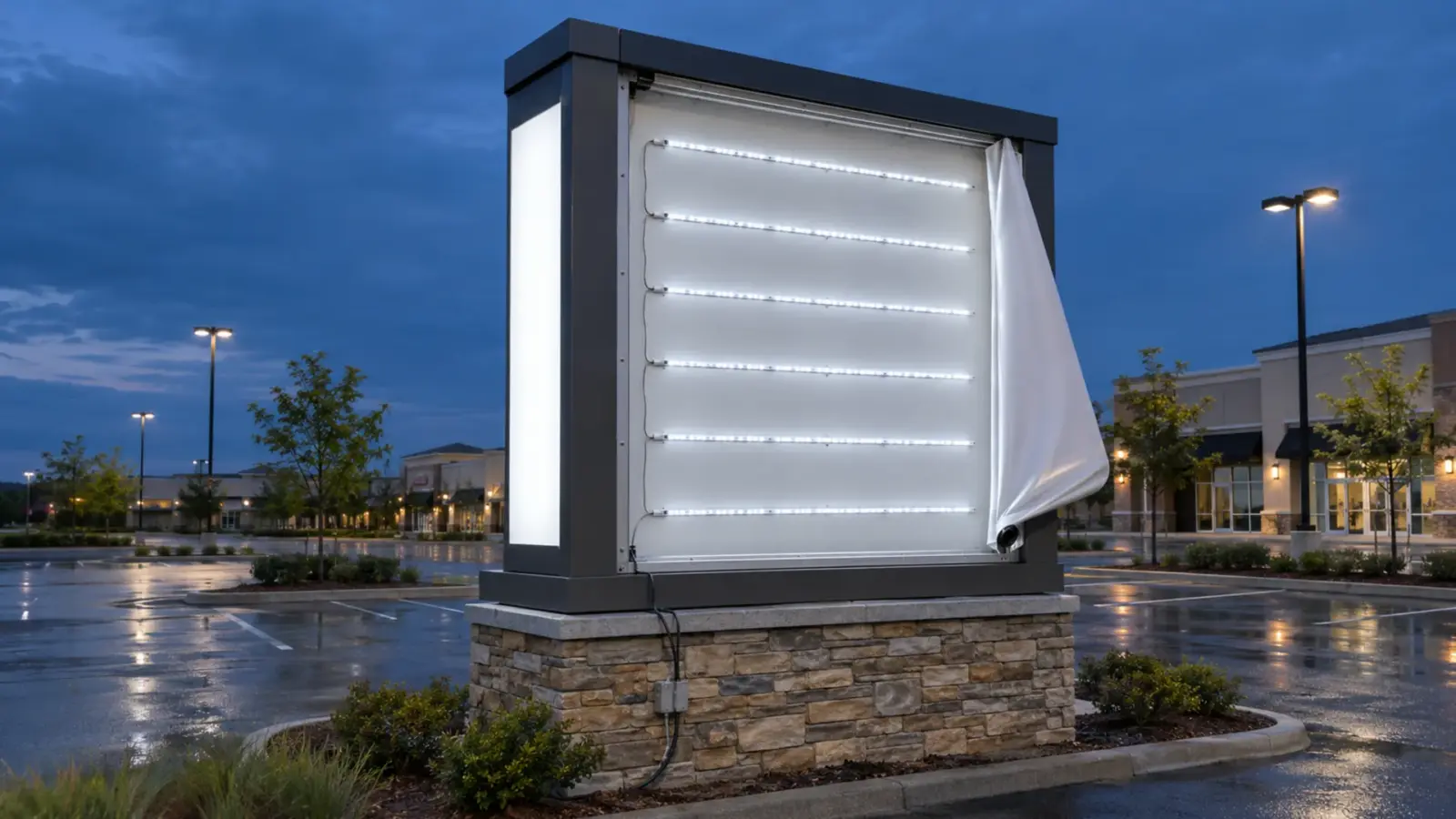
Flex faces are flexible vinyl stretched over a lightbox frame with a tension system, according to sign maker Federal Heath. They are the usual answer once a cabinet is too big for rigid sheet: Federal Heath puts the sweet spot at signs over 10 ft in any dimension and says the benefits fade under 4 to 6 ft. The same source warns that vinyl is not shatterproof, and points to polycarbonate or impact-resistant acrylic where slashing or contact is likely.
The face also moves. Sign Media Canada reports that wind can push a flex face off center, which shows up as spots and stripes in the lighting. A face that bows in toward the strip shortens the distance the rows have to blend. So we design the spacing for the face’s closest point in a wind, not its rest position, and treat the tension hardware as part of the lighting. Sign Media Canada’s field fix is a clear nylon line tied across the sign to hold the face flat.
Flex-face cabinets are big, so the rows are long. A 24V strip such as UT-S2835-120 lights 16 ft (5 m) from one feed, so a 30 ft row needs feeds at both ends or a split. The 120V UT-H120-60 runs 98 ft (30 m) from a single feed and is IP65, but it cuts only every 19.7 in (500 mm). Plan each row on that interval so the ends of the cabinet are not left dark.
Fabric (SEG) Frames: Shallow by Design
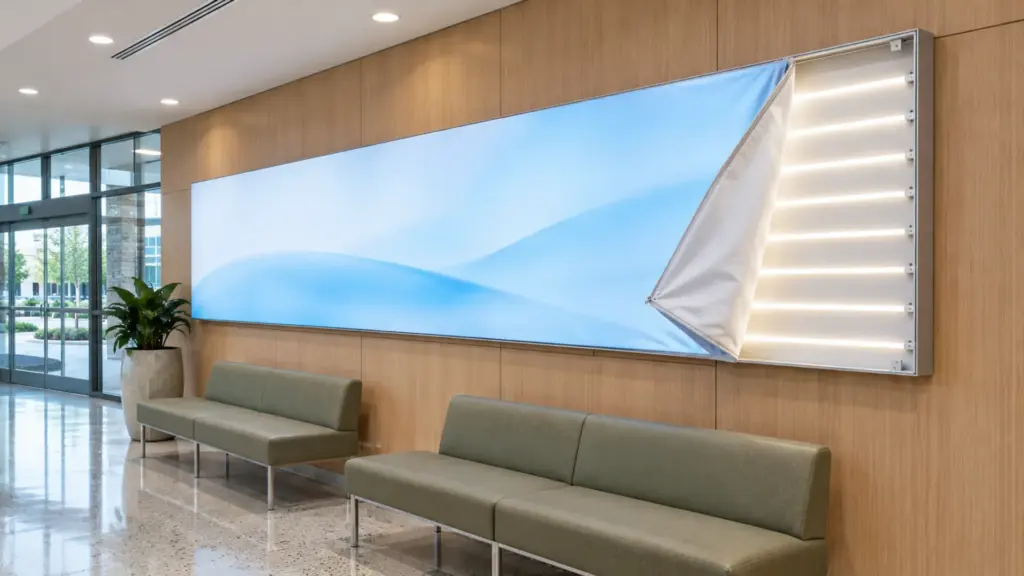
Silicone-edge graphic (SEG) frames hold a printed fabric face in a thin aluminum frame, in lobbies, wayfinding walls and retail backdrops. Their selling point is a slim profile. Strip aimed into the edge of glass or acrylic so the panel glows. Clear edges and a tight channel matter more than brightness. frames light the fabric from the perimeter and are the slimmest; backlit frames are sold in profile depths such as 3.15 in and 4.7 in. This section is about the backlit kind.
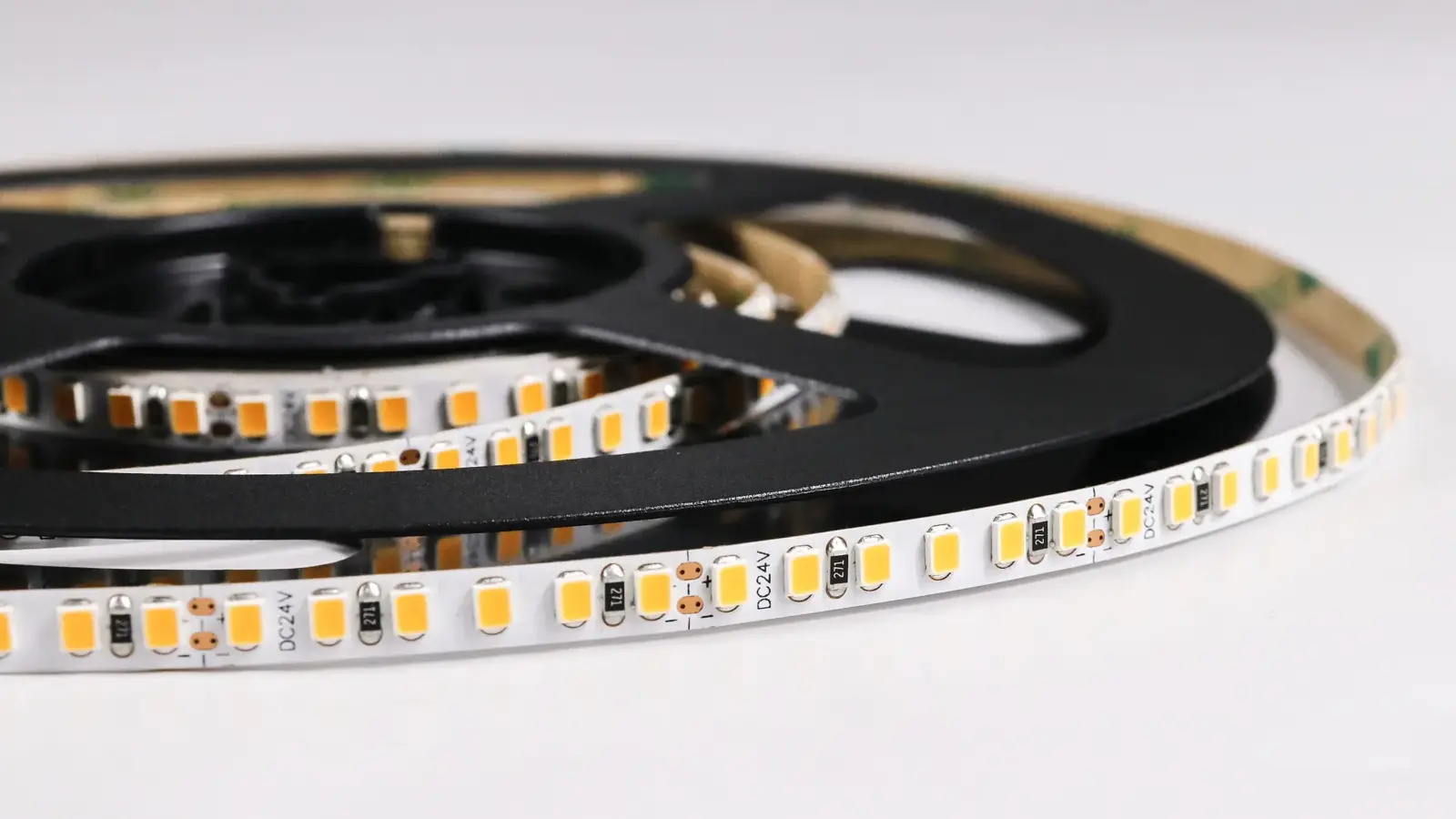
Backlit fabric is where depth runs out first. In a 3 in frame, with less than that between the strip and the fabric, rows of widely spaced LEDs print through as dots and stripes. Dense strip helps here: UT-C480-8 COB strip has 480 LEDs/m and reads as one line, so the rows blend sooner than rows of discrete LEDs at the same spacing. It draws 3.2 W/ft (10.5 W/m) and lights 16 ft (5 m) from one feed, which suits frames sized for a wall. Lay out the rows close and dim to brightness, rather than spacing them wide and hoping the fabric hides them.
Face by Face Side by Side
| Face | Light through | Hides rows | Usual cabinet | Starting strip from our tables | Watch for |
|---|---|---|---|---|---|
| 7328 white acrylic | about 28% (Harbor Sales) | well | flat cabinets, letters | UT-S2835-120, 24V, rows to the depth chart | output: more load for the same face brightness |
| 2447 / 2406 white acrylic | about 47% / 64% | less | translucent graphics | UT-S2835-120 or UT-C480-8, closer rows | rows showing through; prove on a sample |
| White polycarbonate | ask for the grade’s figure | depends on the grade | pylons, low faces, formed faces | as for acrylic, checked at the face’s closest point | formed faces cut the depth at the border |
| Flex face (vinyl) | ask for the material’s figure | depends on the material | large cabinets over about 10 ft | UT-H120-60 IP65 for long rows; 24V strip with fed ends | face movement in wind; 19.7 in cut steps |
| SEG fabric, backlit | depends on the fabric | least depth to work with | interior frames, about 3 to 5 in deep | UT-C480-8 COB, close rows | dots and stripes on the fabric |
The strip column is a starting point taken from our spec tables, not a spacing chart. The face you will install, at the depth you will build, sets the final row spacing.
A Worked Cabinet: Same Rows, Three Whites
Take a 4 × 8 ft (1.2 × 2.4 m) cabinet face with rows running the 8 ft length at 8 in (200 mm) spacing. That is six rows and 48 ft of strip. In UT-S2835-120 at 4.4 W/ft, the load is about 211 W; with drivers loaded to 80%, that is at least 264 W of driver capacity.
Now change only the face. Using the Harbor Sales figures as a ratio:
| Face | Light through | Relative to 7328 | Same face brightness at |
|---|---|---|---|
| 7328 | about 28% | 1.0 | full output |
| 2447 | about 47% | about 1.7 | about 60% output |
| 2406 | about 64% | about 2.3 | about 44% output |
This is first-order arithmetic. Light bounces inside a white cabinet, and the figures are for flat sheet, so expect the real gap to be smaller than the table suggests. The safe reading is that the brighter white buys dimming headroom first. Opening the rows to save strip is a second decision, and only a mockup with the real sheet at the real depth can show whether bands come back. Until then, keep the rows, put the strip on a dimmable driver, and set the brightness on site.
The cut interval still has to fit. At 24V, UT-S2835-120 cuts every 1.97 in (50 mm), so an 8 ft row lands within 2 in of the cabinet length. The fluorescent cabinet retrofit guide shows the same cabinet with 120V strip, where the 19.7 in step leaves a gap.
Outdoor Cabinets and the Listing
An exterior cabinet is not a dry interior. The SMD and COB models above are IP20, for dry indoor locations only; exterior cabinets take strip from the outdoor or 120V IP65 range, sealed at every cut end. A face change does not change that, but it often comes with a re-face of an old cabinet whose gaskets and drain holes have aged.
A sign is also a listed product as a whole, and swapping parts such as the strip or the power supply can affect that. Our UL 48 and UL 879 guide covers what each standard covers; check with the sign’s listing holder before a re-face changes parts. For face-lit channel letters, where the return depth is the cabinet, see the halo-lit vs face-lit letter guide.
Rules of Thumb
Pick the face for the site first: rigid acrylic for most flat faces, polycarbonate where it can be hit, flex face for big cabinets, fabric for interior frames. Then lay out the strip for that face at its closest point, and build one mockup with the real sheet at the real depth before the rows are cut. A brighter face buys dimming first; wider rows only after the mockup says so.
Send the box depth and the face material with the sign drawing, and we will match the strip, the row spacing and the power together; our signage page lists the strips we usually supply for light boxes and letters.