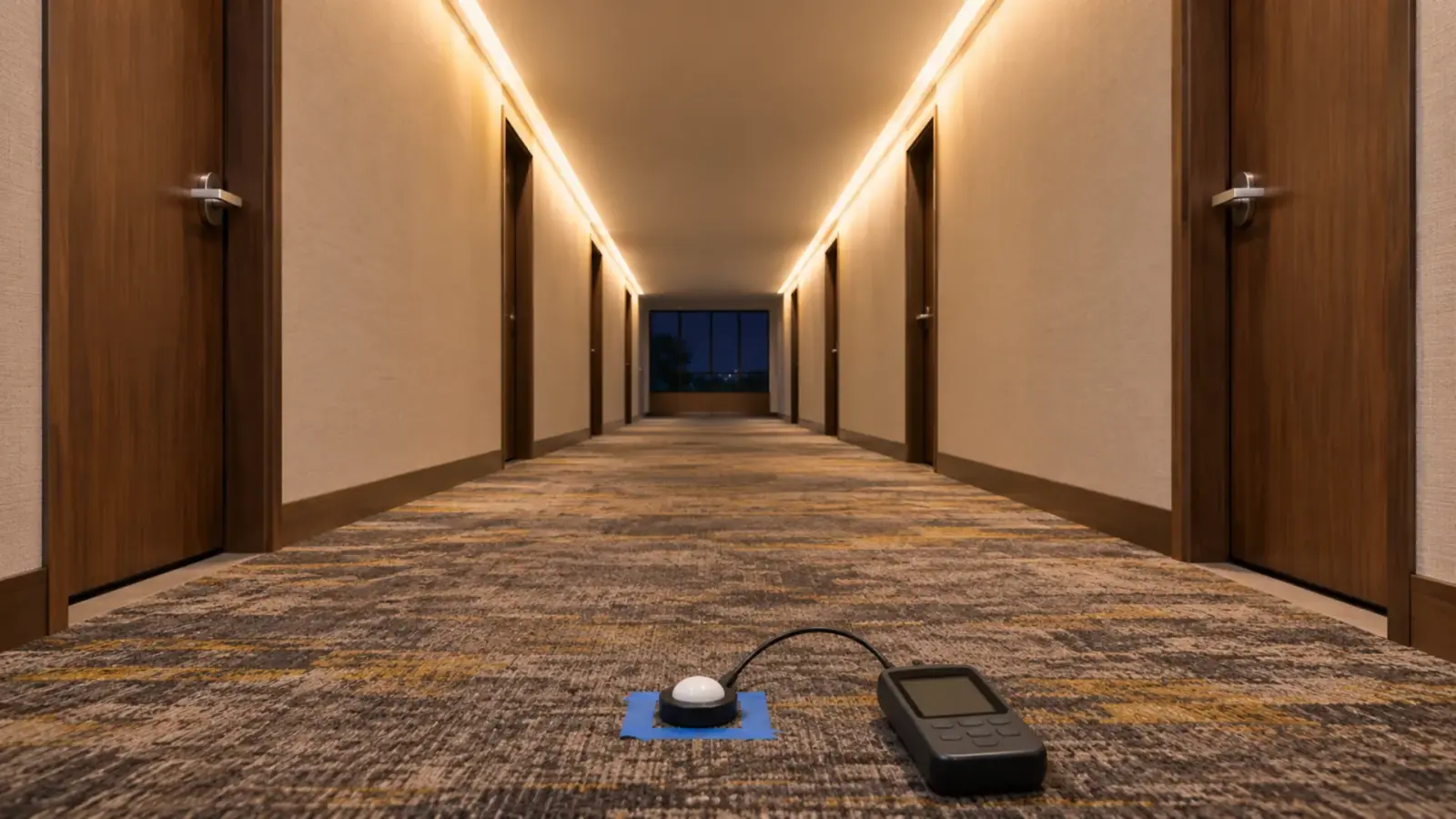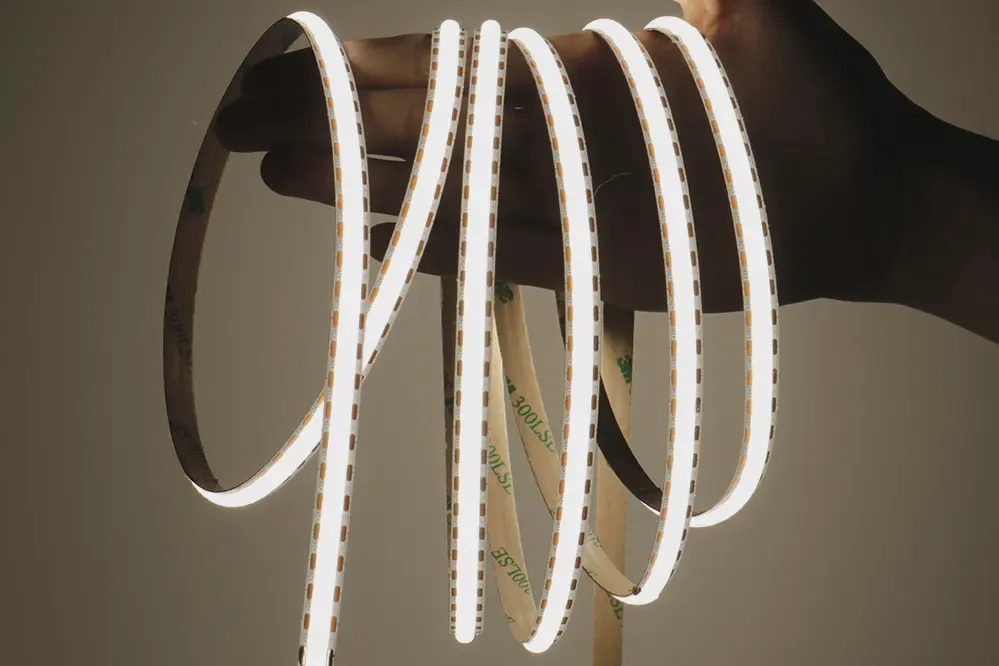
Efficacy is light out per watt in, in lumens per watt: our UT-S2835-60 strip is rated 81–102 Lumens per watt: how much light the strip gives for the power it draws. Higher means less heat and less driver load per foot.. Efficiency is a ratio of like quantities, a percentage: a driver delivering 85% of its input, a cover passing 75% of the light. The lumens per watt reaching the room are the strip’s efficacy times every efficiency after it.
That is why the same strip can read 81 lm/W on its spec table and under 50 at the wall meter, and neither number is wrong. Our lumens per watt guide covers how to compare a rated figure with a measured one. This page is about the words themselves and the chain that connects them.
Efficacy: Lumens per Watt, and What It Is Not
Efficacy has units. Lumens are light weighted by how the eye sees it; watts are electrical power going in. Divide one by the other and you get a number such as 81 lm/W, which says how much visible light each watt buys. As Buildings.com summarizes the CIE definition, the source efficacy of a lamp or strip is luminous flux out divided by electrical power in.
Efficacy is not a percentage of anything obvious, because a lumen is not a watt. The SI fixes the conversion at one frequency, and everywhere else it follows the eye-sensitivity curve V(λ). According to NIST, the maximum luminous efficacy of radiation is 683 lm/W, at a frequency of 540 × 10^12 Hz, a green near 555 nm where the eye is most sensitive. A source that put every watt into that one green would reach 683 lm/W, but nobody lights a room in one green.
White light spreads its power across the spectrum, so its ceiling is lower and depends on the spectrum. The useful split, from the CIE terms, is:
- Luminous efficacy of radiation (LER): lumens per watt of light actually emitted. It is set by the spectrum alone.
- Radiant efficiency: the share of electrical watts that leave the LED as light, a true percentage.
- Source efficacy = LER × radiant efficiency. Buildings.com cites NIST work showing an RGB white LED could theoretically reach an LER over 400 lm/W, so an RGB source at 200 lm/W would be turning about half its input into light.
In our reading, warmer and higher-CRI spectra usually score lower on LER, because more of their power sits in deep red, where the eye is less sensitive; part of their lower efficacy on a strip is also phosphor loss, which counts against radiant efficiency.
Dividing 100 lm/W by 683 gives about 15%, but that is not the strip’s efficiency. Turning lm/W into a percentage takes the spectrum, which a strip datasheet usually does not give. When an owner asks how efficient the lighting is, answer in lm/W at a stated level, or in watts per square foot as the energy code counts them.
Efficiency: Three Percentages Between the Wall and the Room
On a strip job, three efficiencies sit between the wall meter and the room, and each is a plain percentage:
- Driver efficiency: DC watts out over AC watts in. Our drivers page shows UT-D60-24-C2, a Class 2 driver, at about 85%, a typical full-load figure; drivers are usually less efficient at light load, so read the datasheet curve at your load.
- Wire efficiency: the share of the driver’s output that reaches the strip. The rest heats the feed. The loss is current squared times resistance, so it grows fast with current.
- Optical efficiency: the share of the strip’s lumens that leave the channel. Our diffuser guide puts clear polycarbonate at roughly 90–95% and opal at roughly 70–80% on our channels.
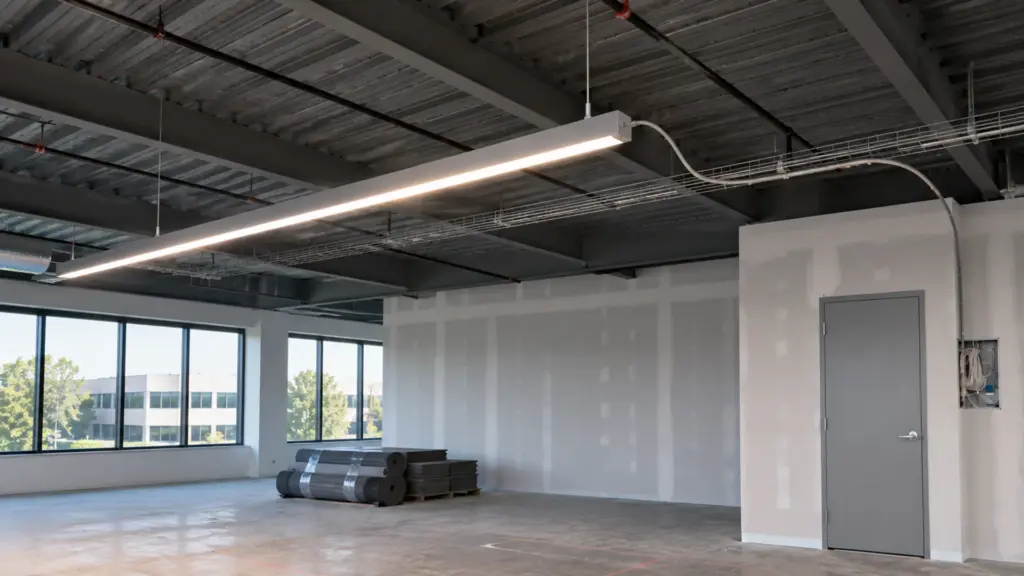
Heat is a fourth loss that our lumens per watt guide covers; it is left out here to keep the chain to what you can read off a datasheet and a drawing.
System Efficacy, Worked From Strip to Wall
Take one 16 ft (5 m) run of UT-S2835-60 at 24V, fed from 25 ft away with 18 American Wire Gauge: the smaller the number, the thicker the wire. Pre-attached strip leads are often 22 to 26 AWG and good only for inches; home runs are 16 to 12 AWG., on a UT-D60-24-C2 driver, inside an opal channel. Every input is a number from our spec tables or our own guides.
| Step | What changes | Light | Power | lm/W |
|---|---|---|---|---|
| Strip at its terminals | 4.8 W/m × 5 m; 390–490 lm/m × 5 m | 1,950–2,450 lm | 24 W | 81–102 |
| Feed, 25 ft of 18 AWG | 1 A × 6.39 Ω/1,000 ft × 50 ft ≈ 0.32 V, ≈ 0.32 W lost | same | ≈ 24.3 W | 80–101 |
| Driver at ≈85% | 24.3 W ÷ 0.85 | same | ≈ 28.6 W at the wall | 68–86 |
| Delivered through the opal cover, 70–80% | lumens × 0.70 to 0.80 | ≈ 1,365–1,960 lm | ≈ 28.6 W | ≈ 48–69 |
The The power supply that turns line voltage into the DC the strip needs, and carries the dimming interface. Also called a power supply or transformer, though it is not a transformer. row is the system efficacy, about 68–86 lm/W; the last row is what the room receives, about 48–69 lm/W. The driver row uses the full-load 85% at about 41% load (24.3 W of 60 W), so a real light-load figure would pull both rows down a little. The cover takes the biggest bite here, and it is there on purpose, because an opal line without dots is often the point of the detail. Change one factor at a time and the result moves with it. With a clear cover at 90–95%, the same run lands near 61–81 lm/W at the wall. With no cover at all, a bare strip in a cove, it is the driver row, about 68–86 lm/W, before the cove’s own surfaces absorb their share. A higher-efficacy strip lifts every row; a better driver lifts every row after the strip. That is the practical use of the chain: it shows which choice buys the most light per watt on this detail, and which loss is the price of a look the design asked for.
The feed is small at 24V, but voltage changes it. Run the same 24 W strip at 12V and the current doubles to 2 A. Wire loss is current squared, so the same 25 ft of 18 AWG now burns about 1.3 W instead of 0.32 W, four times as much, and drops twice the voltage before the strip begins. Our voltage drop guide shows how that drop also dims the far end, a second cost on top of the watts.
Which Number a Spec Sheet Quotes
The same word, efficacy, appears at four levels, and each excludes the losses after it:
| Level | Measured at | Where you find it |
|---|---|---|
| LED package | The LED alone, at its test current | The LED maker’s datasheet |
| Strip | The strip’s input terminals | Our spec tables, e.g. 81–102 lm/W for UT-S2835-60 |
| System | The driver’s input, strip and wire included | Your calculation, the driver row above |
| Delivered (fixture) | Light out of the finished channel or fixture per watt at its input | A photometric report of the assembly, or the last row above |
The higher the level, the lower the number. A package figure is always the largest and is the one least useful for a job. For a strip, ask whether the figure comes from an LM-79 report of the finished strip, and at which CCT and CRI.
High Efficacy in the Energy Code
“High efficacy” also has a legal meaning in California, and on a home it is mostly a certification, not a lm/W number. Under the 2025 Energy Code, which applies to permits applied for on or after January 1, 2026, §150.0(k)1A requires all installed luminaires and light sources in dwellings to comply with Reference Joint Appendix JA8 and to be certified and marked as JA8 requires. The 2022 code, still on older permits, allowed either a source type from Table 150.0-A or a JA8 source marked “JA8-2022” or “JA8-2022-E”, and its installation certificate checks the same way.
One exception does carry a number, and it is a strip application: lighting inside drawers, cabinetry and linen closets is excepted when its efficacy is 45 lm/W or more. Under-cabinet and in-cabinet strip on a residential job is checked against that figure, so keep the datasheet that shows it.
Commercial energy codes work differently. They set a lighting power allowance in watts per square foot, and our lighting power density guide explains how tape is counted against it: the installed length times the rated W/ft, or the maximum rated input of the drivers, not a calculated wall reading. Our IECC and ASHRAE controls guide covers the control side. The chain above is for owners and energy estimates, where the real watts matter.
Comparing Two Suppliers’ Numbers
Before putting two efficacy figures side by side, ask three things of each:
- Which level? Package, strip, system or fixture. A package figure against a strip figure is not a comparison.
- Which build? CCT, CRI, density, voltage and any jacket or coating. Warmer and higher-CRI versions of the same strip score lower, as our lumens per watt guide shows, and neon jackets lower still, as our neon flex lumens per watt article shows.
- Measured how? A test report of the finished product, or a calculation from the LED datasheet.
The full checklist for a datasheet is in our lumens per watt guide, and the electricity cost guide turns system watts into a running cost.
FAQ
What is efficacy in lighting?
Efficacy is the light a source gives per watt of power it draws, in lumens per watt. A strip rated 81–102 lm/W produces 81 to 102 lumens for every watt at its input terminals. The number is only meaningful with its level: an LED package, a strip, a system with its driver and wire, or a finished fixture.
Is efficacy the same as efficiency?
No. Efficacy has units, lumens per watt, because it compares light with electrical power. Efficiency compares like with like and is a percentage, such as a driver delivering 85% of its input watts or a cover passing 75% of the light. A system’s efficacy is the source efficacy multiplied by those efficiencies.
What does high efficacy lighting mean?
In general use it means lighting that delivers many lumens per watt. In California’s residential energy code it is mostly a certification: under the 2025 code, §150.0(k)1A requires installed luminaires and light sources to be JA8-certified and marked. One exception uses a number: lighting inside drawers, cabinets and linen closets at 45 lm/W or more.
How do you calculate the system efficacy of an LED strip?
Start with the strip’s lumens and watts. Add the feed wire’s loss to the watts and divide by the driver’s efficiency to get the watts at the wall: lumens over those watts is the system efficacy. Multiply the lumens by the cover’s transmission for what reaches the room. An 81–102 lm/W strip can deliver about 48–69 lm/W this way.
Can lumens per watt be converted to a percentage?
Not without the light’s spectrum. The SI fixes 683 lm/W only for a single green at 540 × 10^12 Hz. White light has a lower ceiling that depends on its spectrum, so dividing a strip’s lm/W by 683 does not give its efficiency. Quote lm/W at a stated level instead.
Spec Notes for Efficacy Numbers
Put efficacy on a submittal only with its level and its build: “strip efficacy, 4000K, Ra≥80, at 24V” says what was measured. When an owner or an energy estimate needs system numbers, add the driver efficiency at the real load, the feed length and gauge, and the cover’s transmission, and carry them through as above; for the code form, count watts the way the code counts them. The strip figures we use are on our SMD LED strip spec tables.