
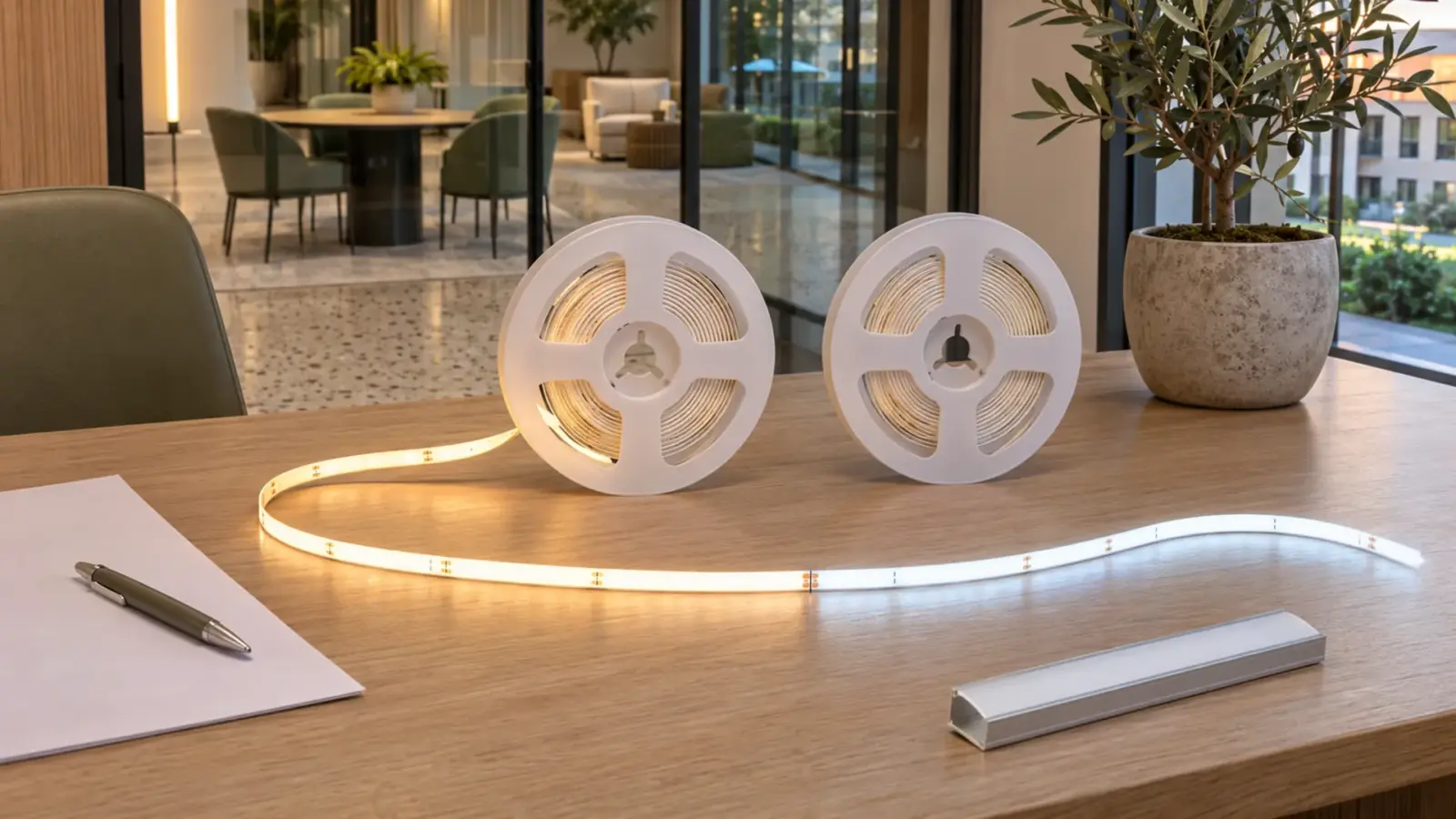
LED tape light and LED strip are the same product: a flexible circuit board with LEDs along it, usually with an adhesive back, cut at marked points. The name tells you who is selling it. The spec sheet tells you what it is, so compare two quotes line by line, never by name.
Five Names for One Product
Wikipedia files all of them under one article, “LED strip light”, and sends searches for “LED tape” and “LED ribbon” straight to it. All five names below describe the same flexible board:
| Name | Where you usually see it | What it tends to signal |
|---|---|---|
| LED strip | Spec sheets and product copy, ours included | The neutral term; says nothing about grade |
| LED strip lights | Product page titles, ours included, and consumer listings | The same board; kits are sold under it too |
| LED tape | Schedules and catalogs; Wikipedia redirects it to LED strip light | The same board, named for its thin, adhesive form |
| Tape light | US lighting catalogs: in late October 2026, page one for “led tape light” was catalog pages | Catalog naming; kits are sold under it too |
| Ribbon light | Rare in US catalogs; Wikipedia redirects “LED ribbon” | The same board |
Kits are sold under every one of these names, so the word does not tell you whether you are looking at one. A kit shows itself another way: a fixed length, a plug-in wall adapter and often a remote. It is the same kind of board, but not the same document set as strip sold by the reel with a spec sheet, a driver matched to it and a run limit per feed.
What the Name Does Not Tell You
Some guides say tape is thinner than strip, or that strip is brighter, or that strip comes with a diffuser. None of that follows from the name. Take only the flexible strip on our product pages, 327 models from the COB, SMD, CSP, SCOB, tunable white, RGB, addressable and outdoor pages, leaving out neon flex, wall washers and 120V strip, counted the same way as our LED strip lighting by the numbers page:
- Power runs from 0.7 to 12.8 W/ft across the 316 models that list it, with a median of 3.7 W/ft.
- Cut interval runs from 0.12 in to 6.56 in across 314 models, with a median of 1.97 in.
- Protection is IP20 on 287 of 316 models; the rest are rated IP54 to IP68.
- Color quality is Ra 90 or higher on 186 of the 237 models that list a CRI.
Every one of those is LED strip, and any of them could be sold as LED tape.
The spread matters on a quote. Say two quotes for a 48 ft cove both read “24V LED tape, 3000K”. One strip draws 2.4 W/ft, the other 4.4 W/ft, both inside the range above. The first loads about 115 W, the second about 211 W. With 60 W Class 2 drivers kept at 80%, which is 48 W each, the first needs three drivers and the second needs five, fed in sections of about 10 ft, with two more Class 2 circuits to pull. The quotes look alike on the cover page and differ by two drivers, two circuits and almost twice the load. Width, brightness and whether a lens or channel comes with it are set by the model, not by the word on the box. On commercial work the diffuser is usually a channel cover, ordered with the channel.
When a Different Name Means a Different Product
Some names do change the product, and these are the ones to catch on a quote:
- Rope light is a different build: LEDs sealed inside a round PVC tube, with long cut intervals and a lower output. Our guide on when neon rope light is enough sets it beside neon flex.
- LED neon flex is strip inside a silicone body that turns the dots into one even line. Same board inside, but a different product, with its own profiles and mounting.
- Light bar or linear fixture is a rigid, usually listed fixture with its own housing, and sometimes its own driver. It replaces strip in some places, which our guide to alternatives to LED strip lights walks through.
- 120V strip connects to line voltage through a rectifier plug with no LED driver. It is still called strip or tape, but the wiring, cutting and dimming change; our 120V vs 24V comparison covers it.
Write the Spec Line, Not the Name
A schedule line that says only “LED tape” lets almost anything through, including a consumer kit offered as a cheaper substitute. Write the lines that decide the product instead:
- Voltage and type: 12V, 24V or 48V constant voltage, or constant current.
- Power: W/ft, which sets the driver and the circuit count.
- Light and color: CCT, CRI or Ra, and R9 where color matters.
- Cut interval and run per feed: where it can be cut, and how far it runs from one feed.
- Protection: the IP rating for the location.
- Documents: the spec sheet, the test reports and the listing the job needs, for the strip and the driver.
On a schedule, that becomes one line, for example: “LED strip, 24V constant voltage, 3.2 W/ft, 3000K, Ra 90 or higher, cut interval 1.97 in or less, runs of 15 ft or less per feed, IP20 in channel, with matched Class 2 drivers; spec sheet and test reports at submittal.” Anything offered against that line can be checked line by line, and a kit with a plug-in adapter fails it on the first read.
Two quotes that match on those six lines are the same product, whatever they call it. Two that do not are not, even when both say “LED strip”. Our guide to reading a commercial LED strip spec sheet goes through the six questions a sheet must answer, and the one on spec-grade, contractor-grade and online strip shows what each grade usually documents.
Our SMD LED strip and COB LED strip pages list these lines model by model; send the schedule and request a quote to have the lines matched.