
A 120V rope light spool cut every 36 in cannot end at 23 ft. It ends at 21 ft or 24 ft: a dark gap at the corner or a foot of rope with nowhere to go. The cut interval settles most neon rope light versus LED A silicone or PVC extrusion with strip inside, lit as a continuous line like glass neon. Top-bend and side-bend versions bend in different planes. questions before looks or budget do.
Neon rope light suits temporary, plug-in lines where whole spools or its fixed cut steps fit the length. LED neon flex suits permanent signs, facade outlines and anything cut to a drawing, because it cuts every 1 to 2 in on most 24V profiles and is sealed after cutting.
Two Products Under One Name
“Neon rope light” is sold as two different things, and quotes rarely say which.
The first is classic rope light: a round PVC tube, usually 3/8 in or 1/2 in across, with small LEDs strung inside on two wires and spaced about 1 in apart. It runs on 120V from a plug-in power cord, and the LEDs show as a row of points through the clear or tinted tube.
The second is the PVC “LED neon rope light”: the same 120V spool idea, but in a flat neon-look profile with denser LEDs, so it reads closer to a line. One reference listing describes a 1.13 × 0.63 in profile with 36 LEDs per foot, 0.3 in apart.
LED neon flex is a different build: an LED strip inside a silicone body that diffuses it into one continuous line. Ours runs on 24V or 48V from a driver, with cut marks every 0.98 to 1.97 in (25 to 50 mm) on most 24V profiles, and a separate line-voltage range of eight silicone profiles that run straight off 110–120V AC. The LED neon flex page lists every profile, bend direction and run limit.
On a job, the real comparison is a 120V plug-in spool with fixed cut steps against a cut-to-length line sealed at every end.
Side by Side: What the Listings Say
Rope light numbers below come from makers’ listings on one US distributor’s site; ours come from our spec tables. Check the listing of the exact part you are offered.
| Classic rope light, 1/2 in (120V) | Classic rope light, 3/8 in (120V) | PVC neon rope light (120V) | LED neon flex, UT-N1010-TB (24V/48V) | 120V silicone neon flex, UT-H120-N1212-TB | |
|---|---|---|---|---|---|
| Cut interval | 36 in (one listing), 39 in (another) | 60 in | 18 in | 1.97 in (50 mm) at 24V, 3.94 in (100 mm) at 48V | Confirmed at quote |
| Longest run listed | 150 ft, 148 ft | 150 ft | 150 ft | 16 ft (5 m) per feed at 24V; 164 ft (50 m) on 48V CC at 5 W/m | Confirmed at quote |
| Power | 0.8 W/ft, 0.76 W/ft | 0.48 W/ft (listing also says 0.8) | 2.4 W/ft | 2.4 W/ft (8 W/m) | 3.7 W/ft (12 W/m) |
| What the eye sees | Points about 1 in apart | Points about 1 in apart | Points 0.3 in apart | One continuous line | One continuous line |
| White light quality | Not listed | Not listed | Not listed | Ra≥90 | Ra≥90, 2700–6000K |
| After a field cut | “voids the UL Listing” | “voids the UL listing” | “voids the UL listing”; wet location “if uncut” | Re-sealed with a matching silicone end cap | Cut and capped per the quote |
| Cold | PVC “can become brittle” below 50°F (10°C) (39 in listing) | Same warning | Not listed | See our silicone vs PVC guide | See our silicone vs PVC guide |
Those rope numbers suit what rope light is built for: a long, low-wattage decorative line on one plug.
Gate 1: Will the Run End Where the Drawing Ends?
Rope light can only be cut at its marks, and the marks are far apart. LED neon flex can be cut every 1.97 in (50 mm) on most 24V profiles, so the last cut lands within a couple of inches of any dimension.
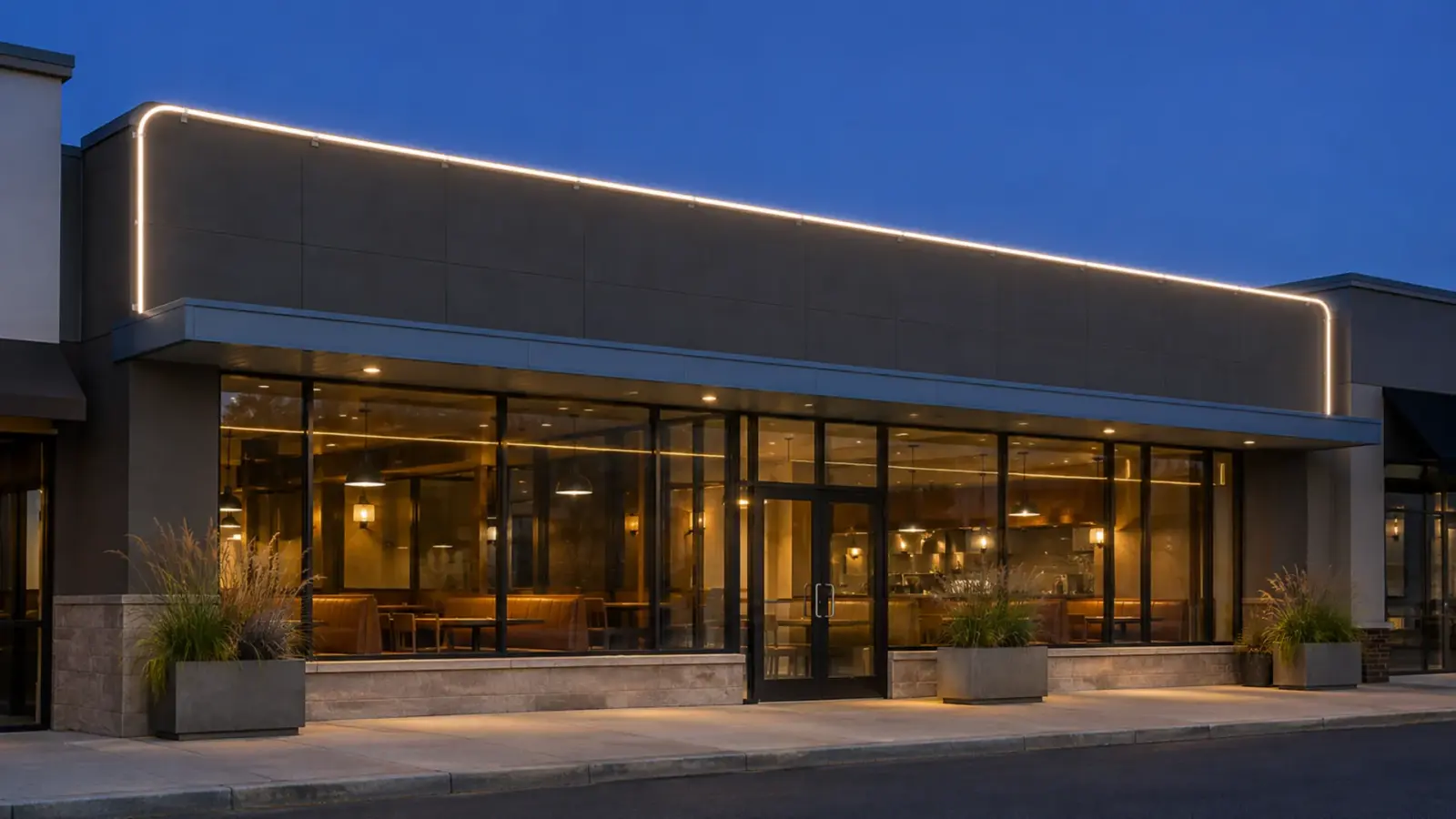
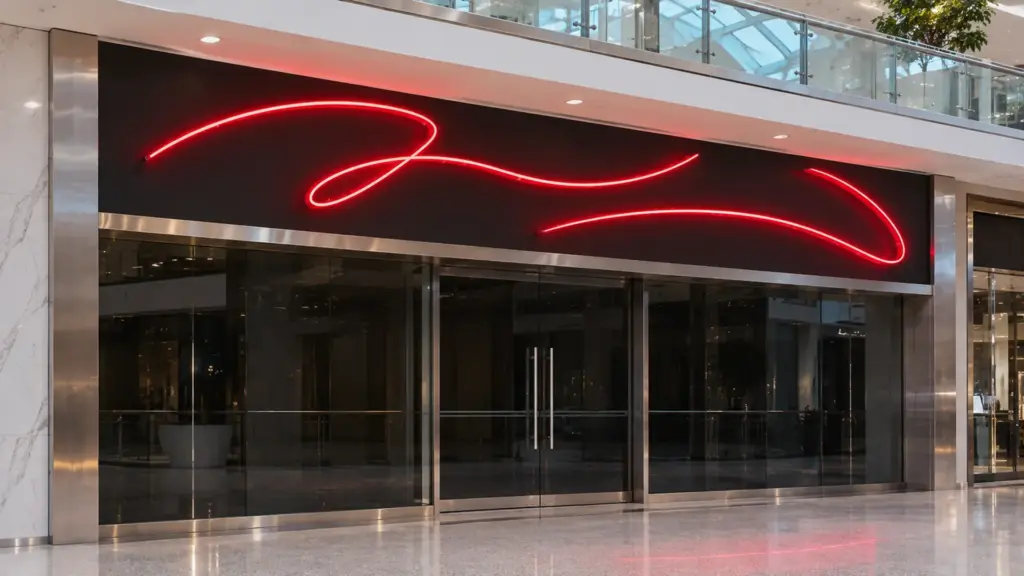
Here is a typical job: a restaurant fascia outline drawn at 23 ft (7.01 m) between two returns.
| Product | Cut interval | Nearest length under 23 ft | Nearest length over 23 ft | What happens on site |
|---|---|---|---|---|
| Rope light, 3/8 in | 60 in | 20 ft | 25 ft | 3 ft dark, or 2 ft of rope to loop or hide |
| Rope light, 1/2 in | 36 in | 21 ft | 24 ft | 2 ft dark, or 1 ft spare |
| Rope light, 1/2 in | 39 in | 22 ft 9 in | 26 ft | 3 in dark at one return |
| PVC neon rope light | 18 in | 22 ft 6 in | 24 ft | 6 in dark, or 1 ft spare |
| LED neon flex, 24V | 1.97 in (50 mm) | 22 ft 11.6 in (7.00 m) | 23 ft 1.6 in (7.05 m) | 0.4 in (10 mm) short of the drawing |
The 39 in rope gets close by luck; at 25 ft it runs 1 ft over or 2 ft 3 in short. A sign with letters and returns multiplies the problem, because every piece has to land on a mark.
LED neon flex fixes the fit and moves the work into the power plan. At 24V a standard profile runs 16 ft (5 m) per feed, so the 23 ft fascia is split into two runs or fed from both ends; 48V constant-current profiles go further. The reel is a supply length, not a run length, and our reel-versus-run guide shows how the feeds are laid out.
Gate 2: Does the Line Stay Listed After It Is Cut?
All four rope light listings we read say the same thing in nearly the same words: the full spool is UL listed, and cutting it in the field voids the listing. Two add that this holds “even following manufacturer instructions”. The PVC neon rope light listing gives its wet-location rating only “if uncut”.
For a temporary outline that is a known trade-off. For a permanent sign it usually ends the discussion, because the inspector looks at what is installed, not at what was on the spool. If the line is part of a sign, our guide to UL 48 and UL 879 for LED neon signs explains which listing covers what.
LED neon flex is cut on its marks and re-sealed with a matching silicone end cap, either on site or before it ships. For drawings with fixed lengths, we cut each piece on the mark, wire it, seal it, test it and label it to match the drawing, through our custom LED neon assemblies service. UL Listed options are available for neon flex, with the documentation sent for the submittal.
Gate 3: Is It Fixed to the Building?
Most rope light is a cord-and-plug product. Cord-and-plug rope light is typically evaluated as a portable flexible lighting product under UL 2388, and one maker’s manual says plainly “Not intended for hardwire use” and tells installers not to route the rope or cord through walls, ceilings, doors or windows.
That matters once the drawing shows the line fed from a facade junction box, or the cord run through the wall to a receptacle inside. A plug-in product fixed permanently to a building is what the NEC cord rules are about. Our cord rule guide walks through what inspectors cite.
LED neon flex on 24V or 48V is fed by a driver in an accessible location, and the low-voltage leads run to the line like any other strip. Our 120V silicone neon flex runs straight off line voltage with no driver, for long facade outlines where a driver location is the problem; its cut step and maximum run are confirmed on the quote, and hardwired installs go to a licensed electrician.
Gate 4: Dots or a Line at Viewing Distance
Classic rope light shows its LEDs. At about 12 points per foot, 1 in apart, a viewer sees beads in a tube: fine on a patio rail, wrong on a logo. The PVC neon rope profile packs 36 LEDs per foot, 0.3 in apart, and reads closer to a line, but the listings give no color rendering figure.
LED neon flex is built for the line. The silicone body hides the LEDs completely, white versions are Ra≥90, and the profile choice sets how the line bends: top bend for outlines in one plane, side bend for letters, 3D for both. A 6×12 mm side-bend profile goes round a 1.97 in (50 mm) diameter. Our top, side and 3D bend guide matches the profile to the curve.
Gate 5: Cold, Sun and Water
Two of the rope listings warn that “the PVC tubing can become brittle in temperatures below 50 deg. F” and say not to install or re-spool it below freezing. For a November facade install in a northern state, that is a schedule problem before it is a product problem.
Water is the other limit. The neon rope light listing is IP65 and wet location only while uncut. Our neon flex is IP67 as standard with sealed end caps, with IP68 profiles for submerged and in-ground lines. How silicone and PVC bodies hold up outdoors over years is covered in our silicone vs PVC neon flex guide.
Where Rope Light Is the Right Order
Rope light is a different product, and on some jobs the sensible order:
- Temporary and event outlines. A tent edge, a holiday outline on a hotel canopy, a pop-up retail front. The spool plugs in, comes down after the season, and nobody fixes it to the building.
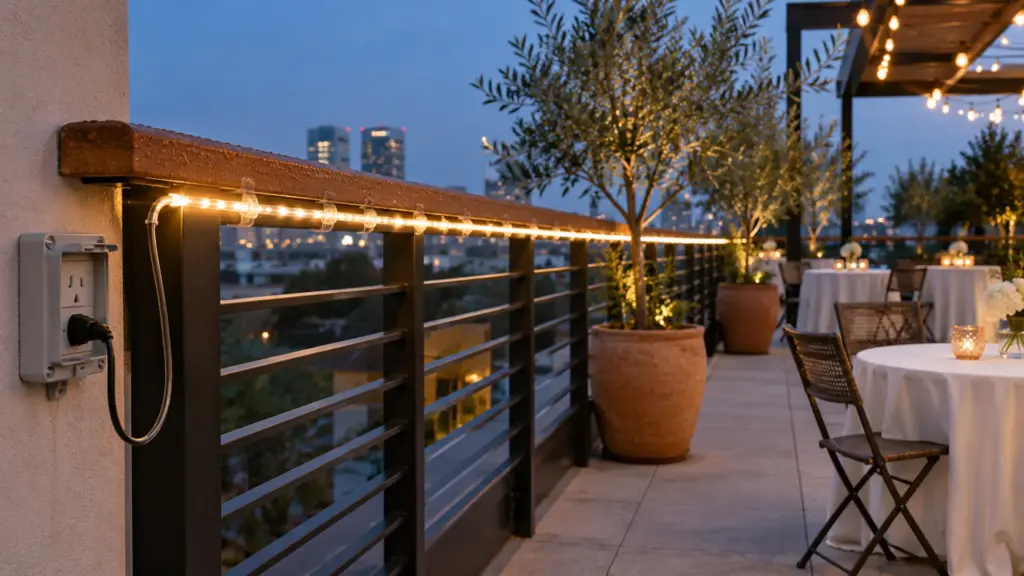
- Lengths that fit the spool. A patio rail or planter edge where a full spool or a whole number of cut steps fits, so nothing has to be cut off the mark.
- Low light, low load. At under 1 W/ft, a long decorative line on one plug-in circuit is easy to power.
Where the line is permanent, cut to a drawing, part of a sign or seen up close, neon flex is the order.
Which One by Job
| Job | Order | Why |
|---|---|---|
| Storefront sign letters or logo | LED neon flex, side bend | Pieces land on drawing lengths; line reads as one stroke; uncut-spool rule avoided in a listed sign build |
| Facade or fascia outline, permanent | LED neon flex (24V/48V), or 120V neon flex where no driver location exists | Cut to dimension, sealed ends, fixed wiring |
| Canopy edge on a hotel or retail center, permanent | LED neon flex, top bend | Long runs on 48V or 120V, IP67 |
| Holiday or event outline, removed after the season | Rope light, full spools | Plug-in, temporary, low load |
| Restaurant patio rail, seasonal | Rope light if the spool or cut steps fit; neon flex if the rail is permanent | Depends on whether it stays |
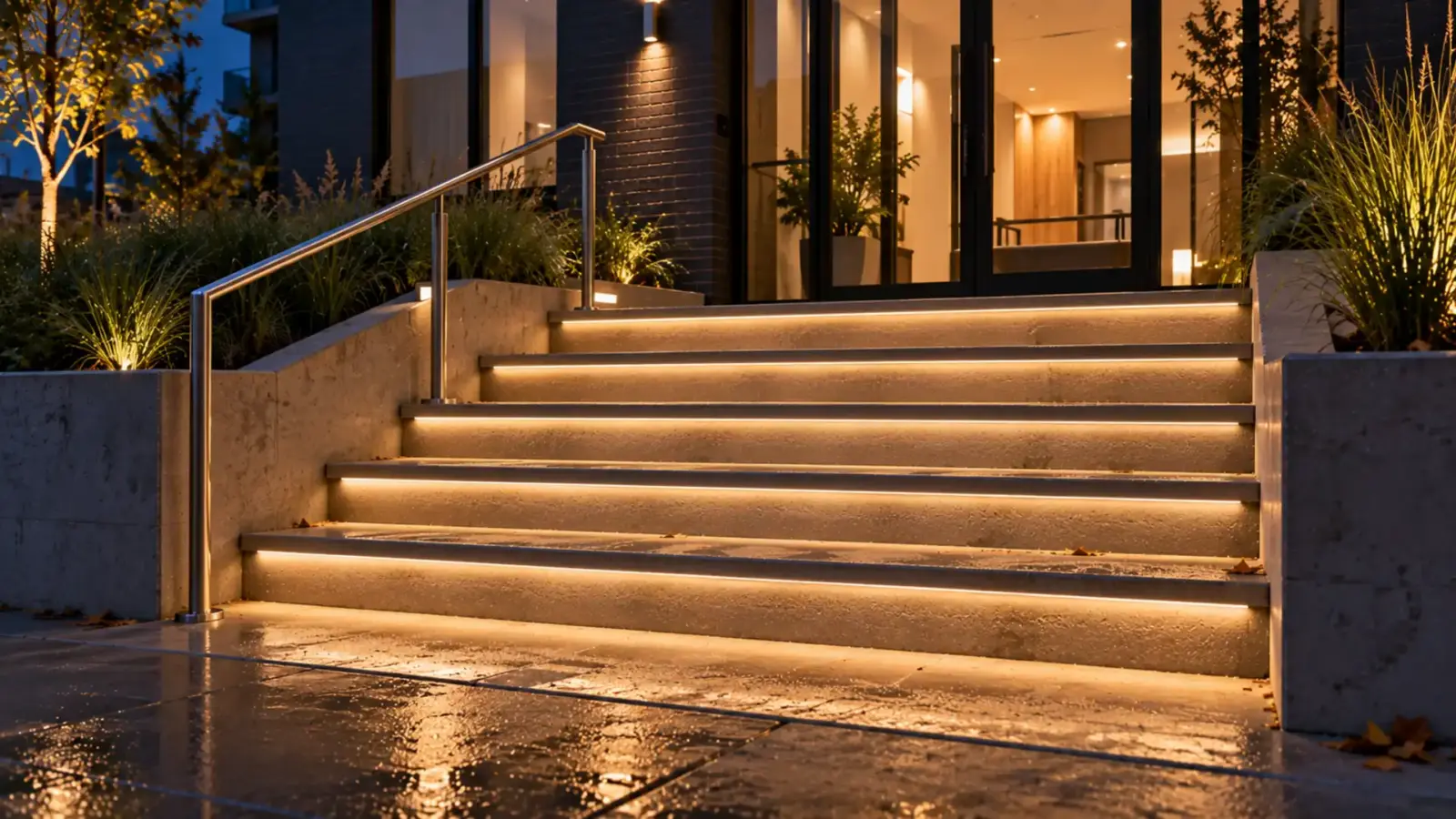
| Stair nosing or handrail in a public space | LED neon flex or strip in a channel | Seen up close; needs a clean line and protection |
| Fountain or water-feature edge | IP68 underwater neon flex, after the AHJ and the feature designer confirm the location | Rope listings are wet location at most, and only uncut |
Neon flex against strip in an aluminum channel is a separate question, answered in our neon flex vs strip in a channel guide.
FAQ
Is neon rope light the same as LED neon flex?
No. Neon rope light is usually a 120V PVC spool with LEDs inside, sold with a plug and cut only at marks 18 to 60 in apart. LED neon flex is an LED strip inside a diffusing silicone body, cut every 1 to 2 in on most 24V profiles and sealed at each end. Some sellers use both names for the same product, so read the cut interval and voltage on the listing.
Can LED rope light be cut to length?
Only at the marked cut points, which the listings we read put at 18, 36, 39 or 60 in apart depending on the product. Those same listings say a field cut voids the UL listing, and the neon rope listing keeps its wet-location rating only uncut. For a dimension that does not fall on a mark, 24V LED neon flex is cut to the nearest 1.97 in (50 mm) or closer.
Can rope light be hardwired?
Only if the product’s listing and instructions allow it, through the maker’s hardwire kit or listed connector. Many rope lights are cord-and-plug products, and one maker’s manual says “Not intended for hardwire use” and warns against routing the rope or cord through walls, ceilings, doors or windows.
Is rope light waterproof enough for outdoor signs?
Rope light is sold for outdoor use, but the listings we read limit it: one neon rope light is Ingress protection per IEC 60529: the first digit is solids, the second water. IP20 is dry interior, IP65 washdown, IP67 temporary immersion, IP68 continuous immersion to a stated depth. and wet location only while uncut, and two rope listings warn that the PVC can become brittle below 50°F (10°C). Permanent outdoor signs usually take IP67 neon flex with sealed end caps.
Decision Rule
Measure the drawing against the cut interval first. If the line is temporary, plugs in and fits whole spools or cut steps, rope light is a fair order. If it is permanent, cut to a dimension, part of a sign or fixed to the building, order LED neon flex.
Send us the drawing with the outline lengths, the corners and where power can reach the line. We lay out the cut pieces and feeds, match the neon profile to the bends, and quote it as pieces cut and sealed to your lengths: request a quote.