
What can go in place of LED strip lights? On a commercial drawing, eleven products: light bars, pucks, troffers, LED T5 tubes, rope light, neon flex, wall washers, downlights, light sheets, sign modules and in-grade fixtures. Each wins a job strip loses, and each moves something to you: a listing, a fixed length, a joint or a service call.
This page sorts the alternatives to LED strip lights by job and gives the fact that decides each. If a strip run failed, read the failed-strip section first: the usual cause is the build, and another product built the same way fails the same way.
Alternatives to LED Strip Lights, Side by Side
What each alternative does better, and what it hands to the contractor, the designer or the owner:
| Alternative | Jobs where it replaces strip | Better than strip at | What it moves to you | The fact that decides |
|---|---|---|---|---|
| Light bar (linkable, 120V or low voltage) | Under cabinets, shelves, workbenches | A finished housing, plug-and-link mounting, one spare part across many units | Fixed lengths, a joint at every link, a housing in view | Will the housing be seen, and do the cabinet widths match the bar lengths? |
| Puck light | Glass-front cabinets, display shelves, bar backs | A pool of light on one object | Scallops on a backsplash, one point per puck | Is the target an object or a surface? |
| Troffer or listed linear fixture | Open-office and classroom general light, a scheduled linear line | One listing and a measured IES file | Catalog lengths with joints | Does the schedule name a listed luminaire, or does the calculation need its IES file? |
| LED T5 tube | Existing T5 coves | A lamp change; the fixtures stay | The socket gaps and the ballast’s limits stay | Were the dark gaps the complaint? |
| Rope light | Temporary and event outlines | Plug-in, low watts per foot, whole spools | Cut steps 18 to 60 in apart; a field cut voids the listing, per the listings we read | Is the line temporary, and does it fit whole spools? |
| LED neon flex | Signs, visible outlines, a line seen as an object | A diffused body that is the design, tight bends | Usually less light per foot; the profile shows when off | Is the line itself the design? |
| Wall washer or grazer | Walls, facades, columns | A lensed beam that reaches up a wall | A setback from the wall and more watts per foot | Must the light reach the wall, or mark an edge? |
| Downlight or track | Art, merchandise, a reception desk | A beam aimed at a target from a distance | A fixture per target, points on the ceiling | Is the target a point you have to aim at? |
| Light sheet or edge-lit panel | Thin backlit stone, shallow light boxes | An even glow in a cavity too shallow for strip | Sheet sizes checked against the panel | How deep is the cavity behind the face? |
| Sign module | Channel letters, sign cabinets | The sign shop’s standard, set spacing and angle | The sign’s own listing and parts | Is the sign listed and built around modules? |
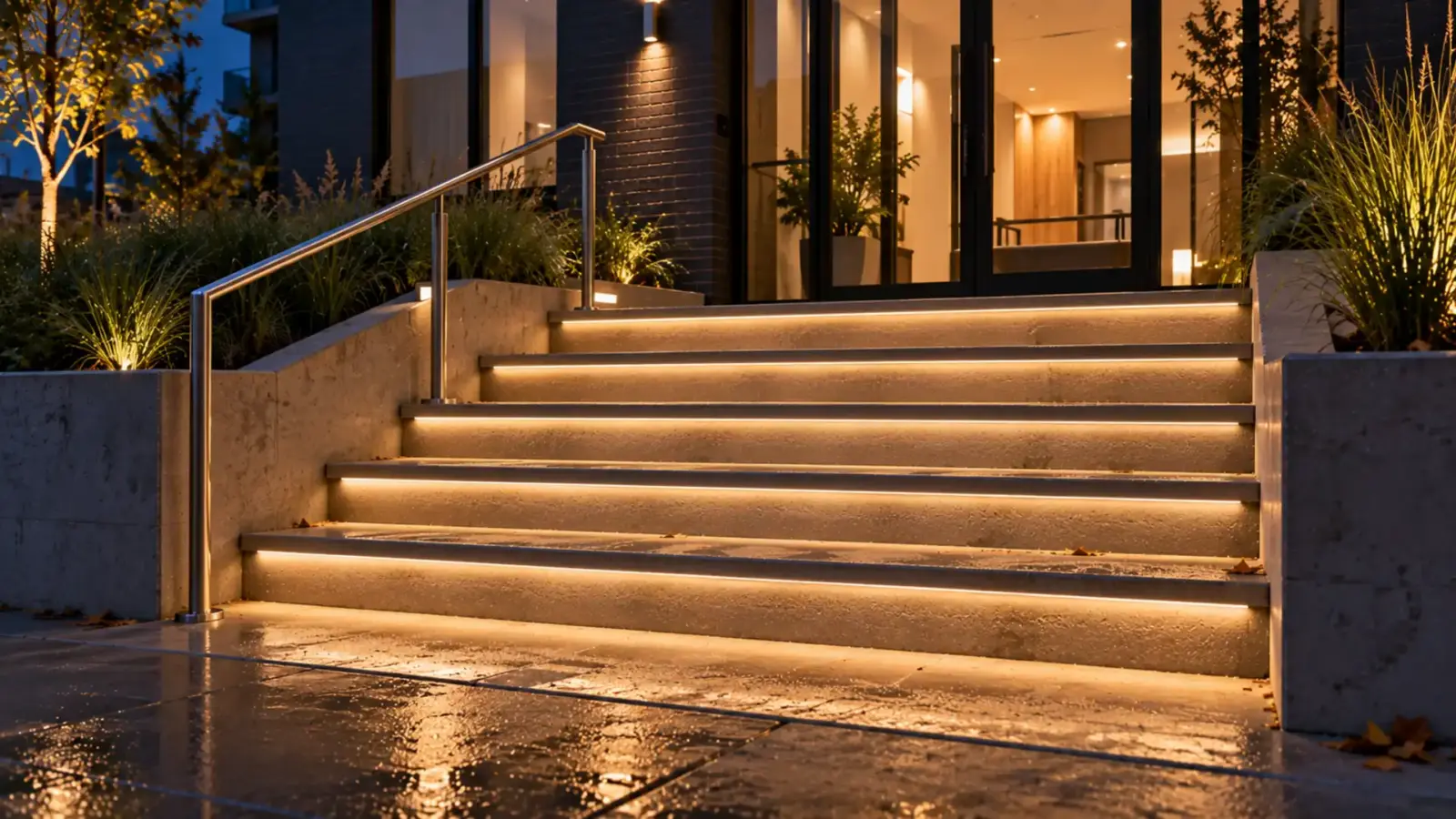
| Sealed in-grade linear fixture | Walkways, plazas, driveways | A load rating | A deeper pocket, fixed lengths | Will a heel or a wheel reach the line? |
Unitop Lighting supplies strip, neon flex, wall washers, channels and drivers. It does not supply luminaires, light bars, pucks, tubes, light sheets or sign modules, and the sections below say plainly where one of those is the better buy.
Under Cabinets: Light Bars and Pucks
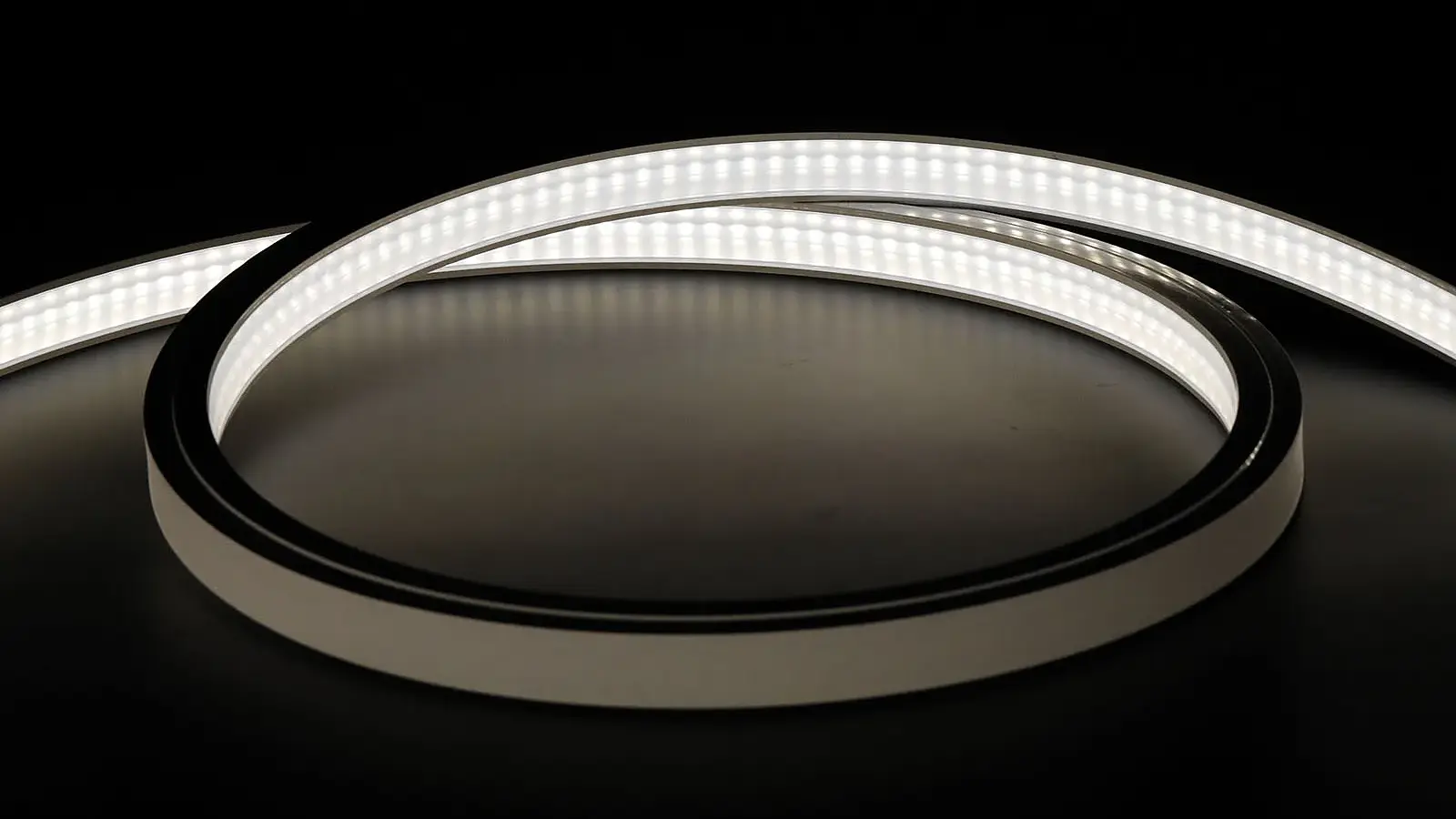
A light bar is a rigid fixture with its LEDs, diffuser and often its driver in one housing, in fixed lengths that link end to end. Its advantage is real on a large portfolio: a property manager who keeps one spare bar for 300 units may choose it on purpose, and the bar arrives listed as one product. What it costs is the fit and the look. One 120V linkable line our under cabinet lighting guide cites lists 9, 12, 18, 24, 33 and 42 in lengths at about 1 in tall, so a 30 in cabinet takes 18 in and 12 in bars with a joint between, or one 24 in bar and a 6 in dark end, and the housing stays in view. Which of the two hardwired builds, a bar or strip on a driver, suits each job is set out in our guide to the best hardwired under cabinet lighting.
Strip in a channel follows the cabinet instead of the catalog. Our UT-C480-8 COB strip cuts every 1.97 in (50 mm) at 24V, and the UT-CH1013 channel sits 0.39 in (10 mm) under the cabinet with an opal cover. The price is a driver someone must place and reach, which our under-cabinet driver guide ranks location by location.
A puck throws a pool of light: scallops on a tiled backsplash, exactly right on the glassware in a glass-front cabinet. Choose pucks where the target is an object, bars where the housing may show and the widths match, and strip where the line must run unbroken to the end of an odd-width cabinet.
General Light: Troffers and Listed Linear Fixtures
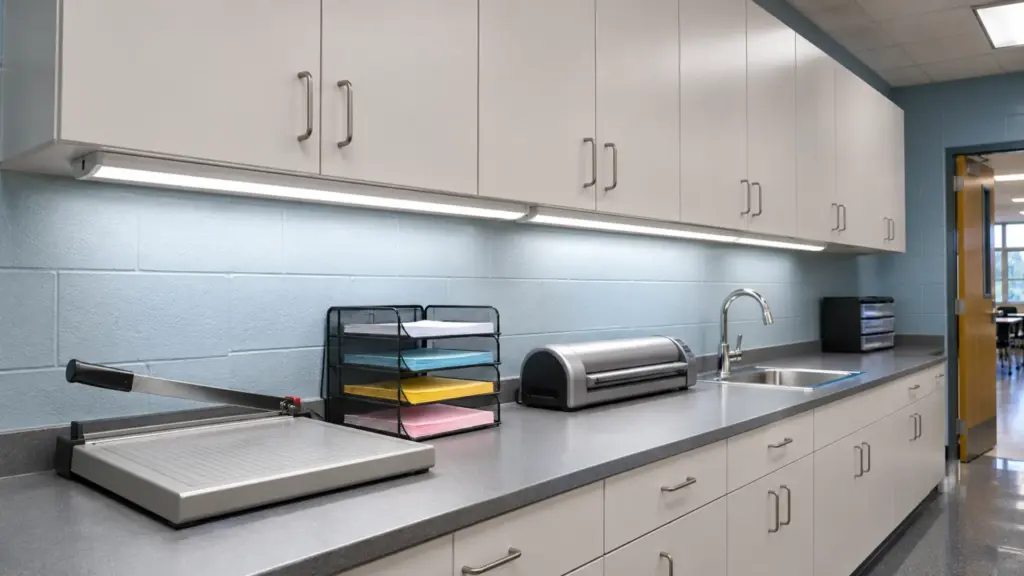
For the foot-candles on a desk or a classroom floor, a troffer or a listed linear fixture is usually the right product, not strip. The fixture arrives listed as one luminaire, with an A photometric data file in the IES LM-63 format that lighting software uses to model a fixture. Available for lensed products; bare strip is usually modeled as a line source. measured with its own housing and optics, and the designer’s calculation can use it as it is.
Strip in a channel can draw the same line, but our strip vs linear fixture guide counts six things that move to the contractor with that swap: the listing, the photometrics, the lengths, the heat, the service and the line items. The photometric gap is measurable: our channel page puts PC opal at roughly 70–80% transmission, so the light out of the channel is the strip’s output times the cover, checked on a mockup.
Strip stays where the fixture cannot go: a perimeter slot, a coffer edge, a run with corners, a pocket too shallow for a housing. Our linear lighting guide and office recessed linear guide show where each belongs.
Existing Coves: T5 Fixtures and LED Tubes
In an existing cove, the alternative to LED strip is often an LED tube in the T5 fixture already there: the cheapest afternoon on the job, keeping the sockets, the spacing and the dark band at every joint. If those gaps were never the complaint, the tube is a fair maintenance fix.
If the gaps were the complaint, strip in a channel replaces the fixtures with one continuous line. On 120V, our UT-H120-60 runs 98 ft (30 m) from one feed with no driver, IP65 and Ra≥80, at the cost of a 19.7 in (500 mm) cut interval that the end wall has to absorb; on 24V, the cut is finer, the CRI higher, and the driver plan longer. Our T5 vs LED strip guide works a 48 ft cove all three ways, and the fluorescent cove retrofit guide runs it floor by floor.
Rope Light for Temporary Lines
Rope light, a 120V plug-in spool of LEDs in a PVC tube, is a sensible order for a temporary outline: a tent edge, a holiday canopy line, a seasonal patio rail. The classic rope listings our rope light vs neon flex guide read draw under 1 W/ft, and a whole spool plugs into one receptacle.
Its limits arrive when the line is permanent. The listings we read cut only at marks 36, 39 or 60 in apart (18 in on a flat neon-rope version), so a 23 ft fascia ends short or long, and they state that a field cut voids the UL listing. Two warn that the PVC can become brittle below 50 °F (10 °C). A permanent line cut to a dimension goes to neon flex or strip in a channel.
Neon Flex: When the Line Is the Object
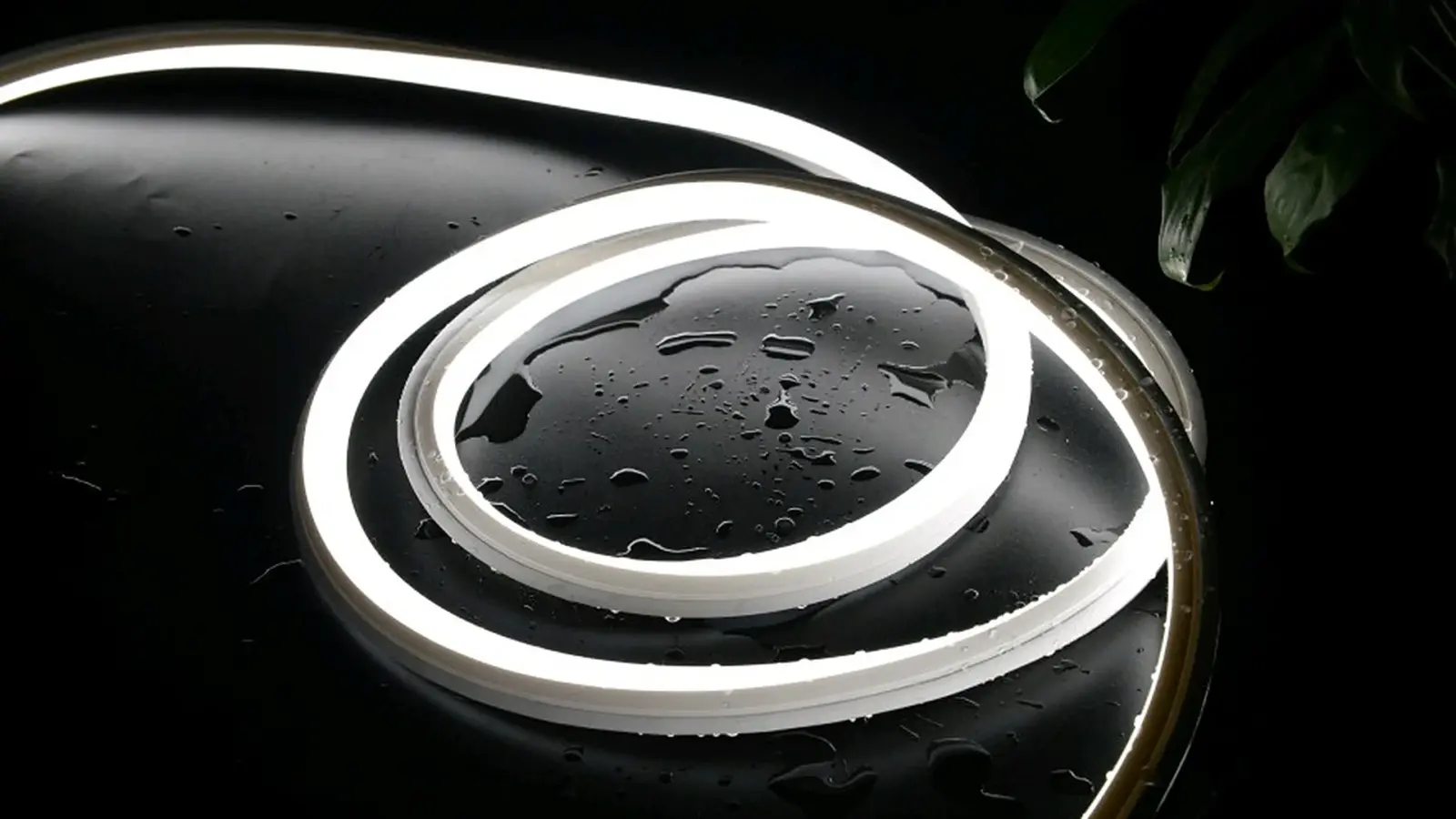
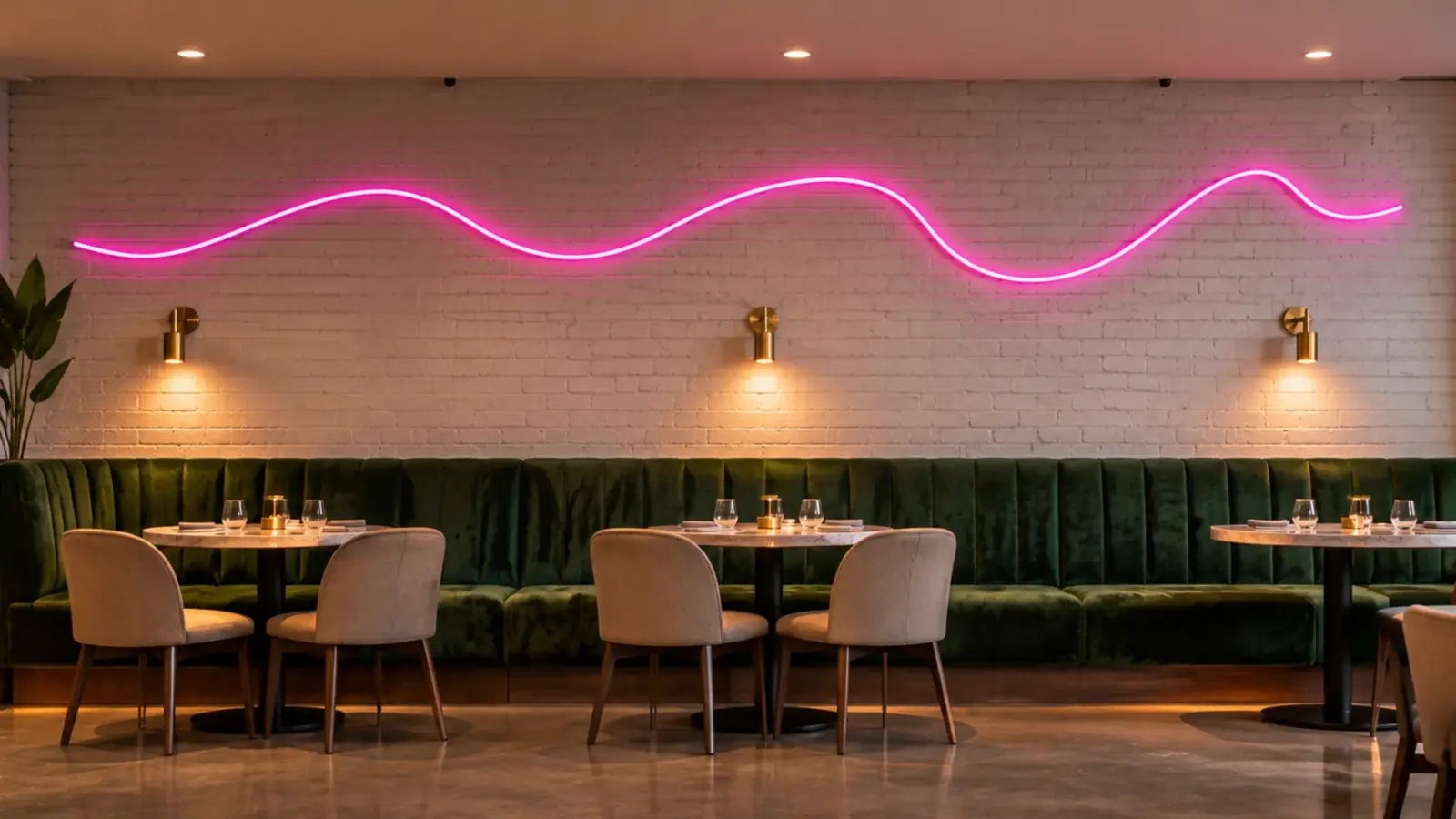
LED neon flex is the alternative for a reader who dislikes the look of bare tape on a visible line. It is LED strip inside a silicone body that diffuses it into one stroke, a profile meant to be seen. Our LED neon flex range includes side-bend profiles such as UT-N0612-SB, which bends to a 1.97 in (50 mm) diameter for letterforms.
The silicone body has no heat sink, so neon runs at lower power per foot than strip in aluminum, and the profile stays visible when it is off. Our neon flex vs strip in a channel guide puts the rule simply: if the owner wants a glowing tube, it is neon; if they want a clean line of light in the wall, it is a channel.
Wall Washers and Grazers
A wall lit top to bottom needs a lensed wall washer, not bare strip. Bare strip throws a wide fan, 140° or wider on our CSP tables, lighting the first foot of wall brightly and the top dimly, as our beam angle guide shows; a lens narrows the beam so the light reaches.
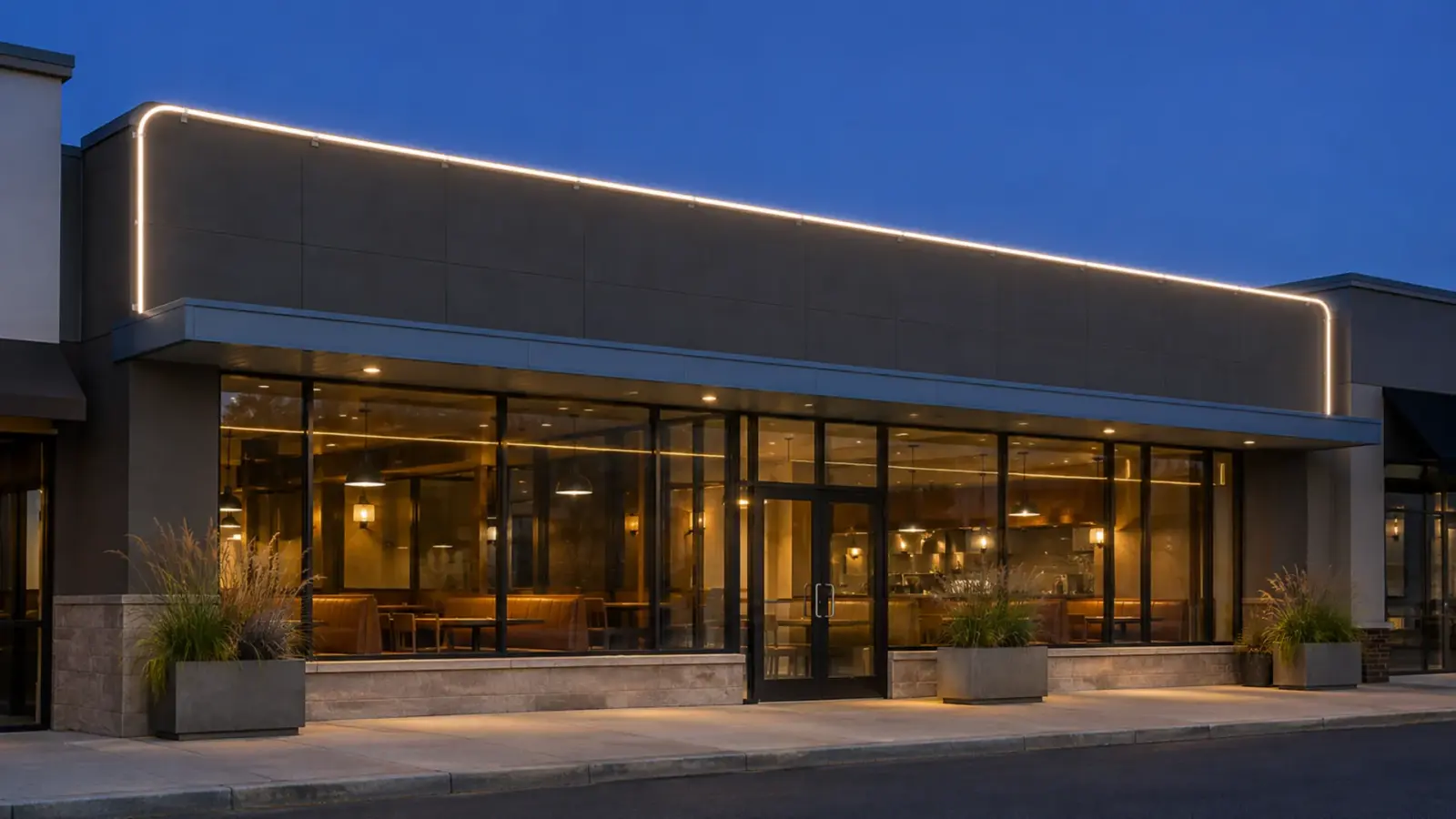
Our LED wall washer range includes UT-WB27-1060, a 10° × 60° optic giving 494 lm/ft at 8.2 W/ft, set within 6 in of the wall to graze stone or brick, and 45° optics set 6 to 12 in out to wash a smooth wall. The finish decides between the two (grazing vs washing); outdoors the mount decides whether it lasts (outdoor wall washers), and a tall straight elevation may take a rigid housing.
Downlights and Track for Accent
Strip lights a surface near it; it cannot aim. A painting, a product display or a reception desk seen across a lobby needs a beam from the ceiling, a downlight or a track head with an optic chosen for the throw, and no strip replaces that.
Strip keeps the places a few inches from the target, inside the case, under the shelf lip, behind the desk’s front panel, on the same CCT as the accent fixtures.
Backlit Stone and Light Boxes: Light Sheets and Edge-Lit Panels
Backlighting is decided by depth. Strip needs space for its light to blend before it reaches the face; vendor guidance collected in our backlit panel depth guide puts strip behind stone at about 6 in (about 4 in for wide-angle bar systems), while light sheets work with a gap of 0 to 40 mm depending on the face, according to Lite-House as cited there. When the wall gives you an inch, a light sheet or an edge-lit panel is the alternative that fits.
Where the cavity is deep enough for strip, rows on a white back cut to any panel and are easier to service; at the shallow end of that range, our dense UT-C1600-30 (30 mm COB, 12.2 W/ft, 10 ft (3 m) per feed) blends faster. Prove either on a mockup of the real face; see also stretch ceilings and sign faces.
Sign Modules in Letters and Cabinets
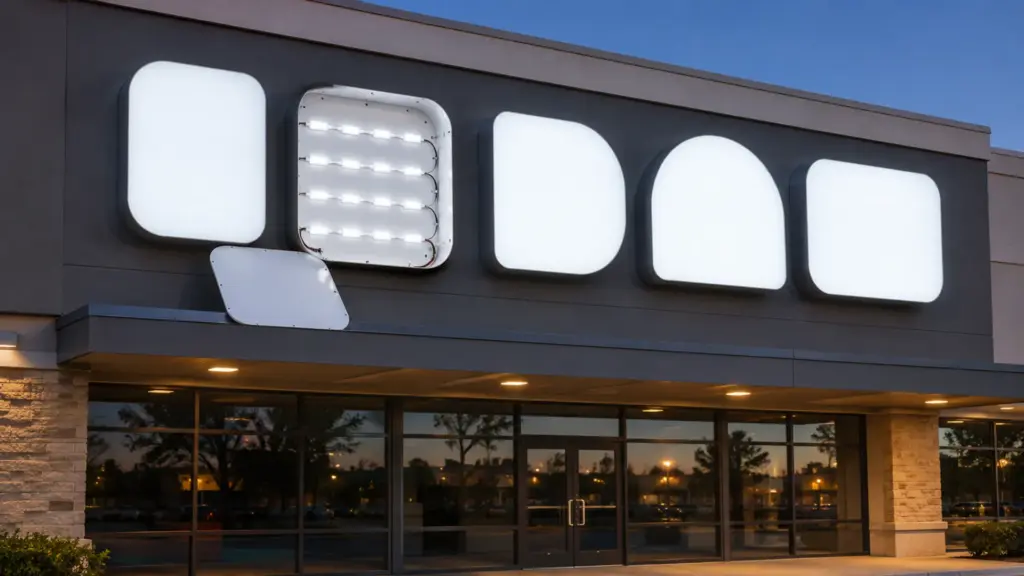
In channel letters and sign cabinets, LED modules are the sign shop’s usual source, and many letters are built around them. Strip has a continuous pitch that avoids the gaps of wrongly spaced modules, but a letter designed for modules should not be switched to strip without a mockup, as our halo-lit vs face-lit guide puts it.
The bigger fact is the listing: a listed sign’s parts belong to that listing, and swapping them can void it, as our neon sign power supply guide explains, so ask the sign shop first. Strip often wins in a fluorescent cabinet sign that is gutted anyway; our cabinet sign retrofit guide lays out rows by depth.
In-Grade and Walk-Over Lines
A line people walk on or drive over needs a product rated for that load. Our exterior recessed linear guide draws the boundary: a sealed fixture rated for the load where heels or wheels reach the line, an IP68, IK10 line such as our UT-N1616-68 neon where feet pass close, and strip in a channel where nothing touches it and the recess drains.
When the Strip Failed: Fix the Build First
Many searches for an alternative to LED strip lights start with a failed run. Most failures are in the build, and a bar or fixture mounted, fed or cooked the same way fails for the same reason. Find the cause first:
| Symptom | Usual cause | Would another product fix it? | Read |
|---|---|---|---|
| Strip peeling off | Dirty or dusty surface, heat, weight on the tape, cold or damp at install | Only by mounting it mechanically, which a channel also does | Adhesive failure guide |
| Whole run dead | Driver, its input, or the first joint | No; a fixture’s driver fails the same way | Strip troubleshooting, driver troubleshooting |
| Far end dim or warmer | Run longer than its rated feed | Partly: fixtures come in short lengths, each with its own feed, and strip fed within its rated length does the same | Voltage drop guide |
| Dark sections, burnt joints | High watts per foot with no aluminum, a loose joint | No; fix the heat path and the joint | Thermal guide |
| Black or yellow LEDs | Sulfur, sealant fumes, too much current | Not reliably; the same air reaches the LEDs in any product | Black or yellow strip guide |
Our thermal guide puts aluminum behind any strip at 6 W/ft or more, and our channel guide covers heat and adhesive together. A replacement reel on the same driver, the same tape and the same feed plan repeats the failure.
Where Strip Is Still the Answer
Strip stays where an alternative cannot do the job: a line that must run unbroken past every joint, a length cut to a schedule rather than a catalog, a pocket too shallow for a housing, a curve, or one detail that has to carry white in one room and color in the next. Which strip family wins each of those jobs is ranked in our guide to the best commercial LED strip lights. Our channel range covers recessed, surface, corner and plaster-in profiles, with the cover, clear or opal, named on the order.
It also stays where the lengths are odd. Standard strip starts at one full reel per SKU and is cut to the schedule, and custom builds are quoted per job with the minimum stated on the quote, where a fixture family comes in the lengths its maker builds. In return strip asks for a driver location, a feed plan and someone to service it.
FAQ
Is a listed fixture always the safer spec than LED strip?
For the paperwork, yes: one listing, one IES file, one line item. Not where the geometry rules it out, a curved cove, an odd cabinet width or a shallow reveal, because a fixture forced into that detail leaves gaps, dark ends or a visible housing.
Can LED strip and fixtures be mixed on one job?
Yes, if each visible space keeps one source type and the CCT, CRI and look match on a One section of the real product installed on site for approval before the full order. The cheapest way to settle CCT, brightness and diffuser questions., because covers and finishes shift color. Put fixtures where the schedule calls for a luminaire and strip where length or geometry rules a fixture out.
Are LED light bars brighter than LED strip?
Not as a class. Brightness depends on lumens per foot after the diffuser, and both bars and strip come at many outputs. Compare lumens per foot from the datasheets; for strip in a channel, multiply by the cover’s transmission, roughly 70–80% for PC opal on our channel page.
Decision Rule
Name the job first, then the alternative: an object to light takes a puck or a downlight, a wall a washer, a floor a fixture, a listed sign its own parts, a temporary line rope light, a shallow backlit face a light sheet. Strip keeps the details where the line must be continuous, cut to the drawing or hidden in a shallow pocket. If the strip failed, fix the build before you change the product.
If a detail on your drawings sits between strip and something else, send the section, the run lengths, where a driver can go and who will service it. We will mark which details we would build from strip, neon flex or a wall washer and which belong to a fixture, before anything is quoted: request a quote.