
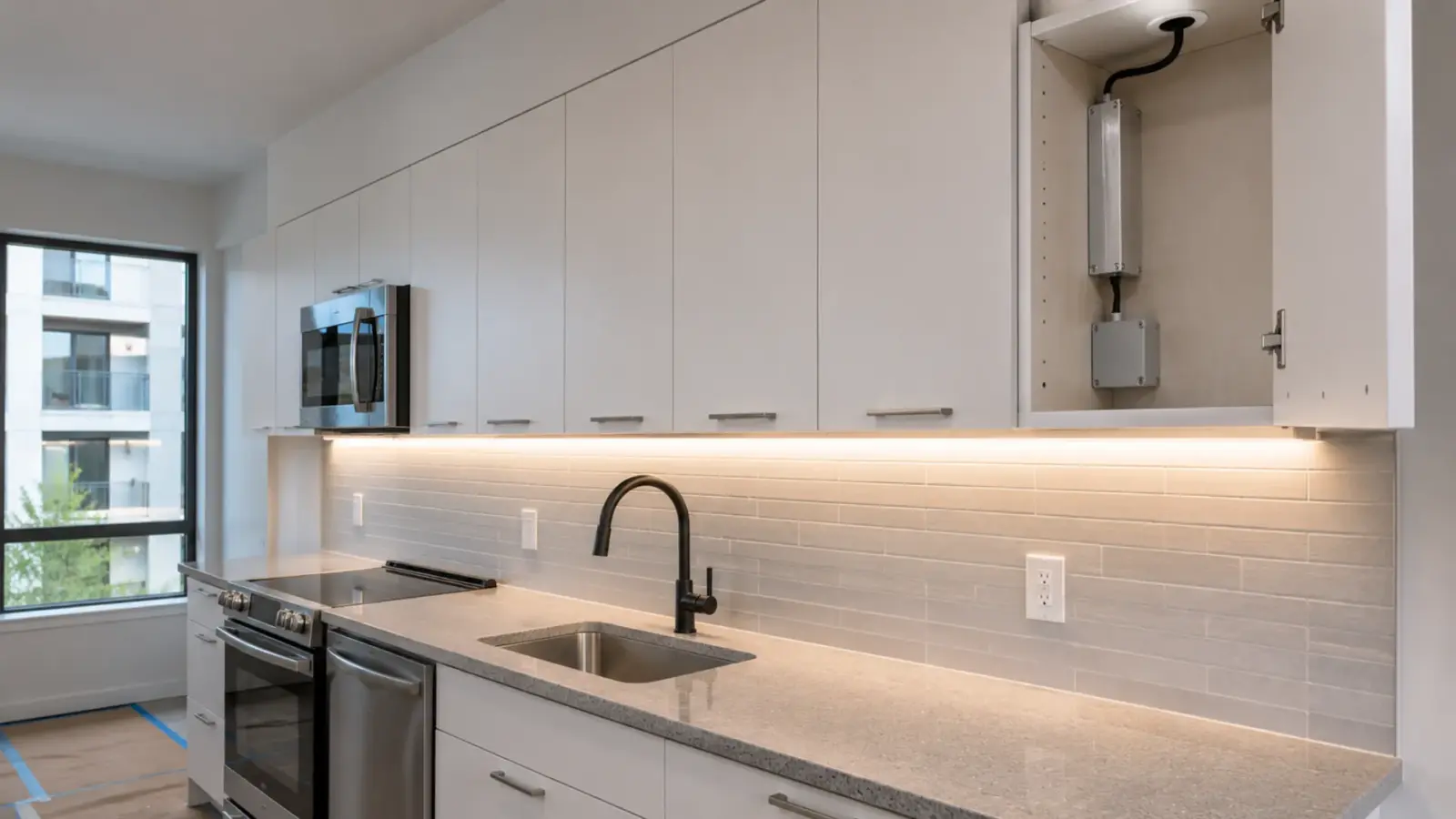
On most retail pages, “hardwired under cabinet lighting” means a 120V bar with its driver sealed inside. On most of the jobs we quote, the better build is a driver someone can reach, feeding 24V strip in a channel. Not on all six jobs below, though, and the bar wins one of them outright.
Who builds the cabinets, who services them and which dimmer is on the wall decide the best hardwired under cabinet lighting. Each verdict names the build, the runner-up and the fact that moves a job between them. Strip wiring is in our low voltage under cabinet lighting guide, driver placement in our under-cabinet driver guide.
Best Hardwired Under Cabinet Lighting by Job
| Job | Best hardwired build | Runner-up | What decides it |
|---|---|---|---|
| Multifamily new build, repeated unit types | 24V COB strip in a slim channel, Class 2 driver in a reachable cabinet | Direct-wire bars, when every cabinet width matches a bar length | A unit-type schedule and a driver location on the drawings before the cabinets are built |
| Occupied renovation or unit turn | 120V direct-wire bars from the existing box | Strip on a driver in the next cabinet, if that cabinet can take a box | Whether the walls and cabinet bottoms will be opened |
| Custom millwork (condo, executive suite, high-end amenity) | COB or free-cut COB strip in a recessed channel, driver outside the casework | Strip in a surface channel, when the cabinet bottom cannot be routed | Shop drawings and who installs the strip |
| Office break room or pantry | Strip on a Class 2 driver tied to the room’s lighting controls | Direct-wire bars on the same controlled circuit | The energy code’s shutoff rule for the room |
| Hotel suite kitchenette or wet bar | Dim-to-warm strip on a driver matched to the guestroom control | A fixed 2700K or 3000K bar on a phase dimmer | The room control system and the brand standard |
| Food-service line (servery, cafeteria, prep counter) | IP65 silicone-coated COB strip in a channel with a cover, driver out of the splash zone | A linear fixture listed for the wet or damp location | Washdown and the health department’s review |
Two builds win nowhere. 120V strip puts line voltage in the strip itself, and its 19.7 in cut on the SMD series and Ra≥75–80 suit wall cabinets poorly (our 120V LED strip page lists both). A plug-in kit with its cord fished out of sight is a cord problem, covered in our 120V cord rule guide.
What Hardwired Means at the Cabinet
“Hardwired” only says the fixture is not plugged in. The two builds that matter differ in where line voltage stops.
Build 1: the direct-wire bar. A 120V luminaire with its driver inside. The branch circuit lands in the bar’s own wiring compartment or a junction box accessory, and the bars link to each other with the maker’s joiners. One line we read lists 8, 12, 18, 24, 32 and 40 in lengths, a profile under 1 in high, links up to 400 W from one feed, and a listing for indoor dry locations only. Line voltage runs the full length of the cabinet run.
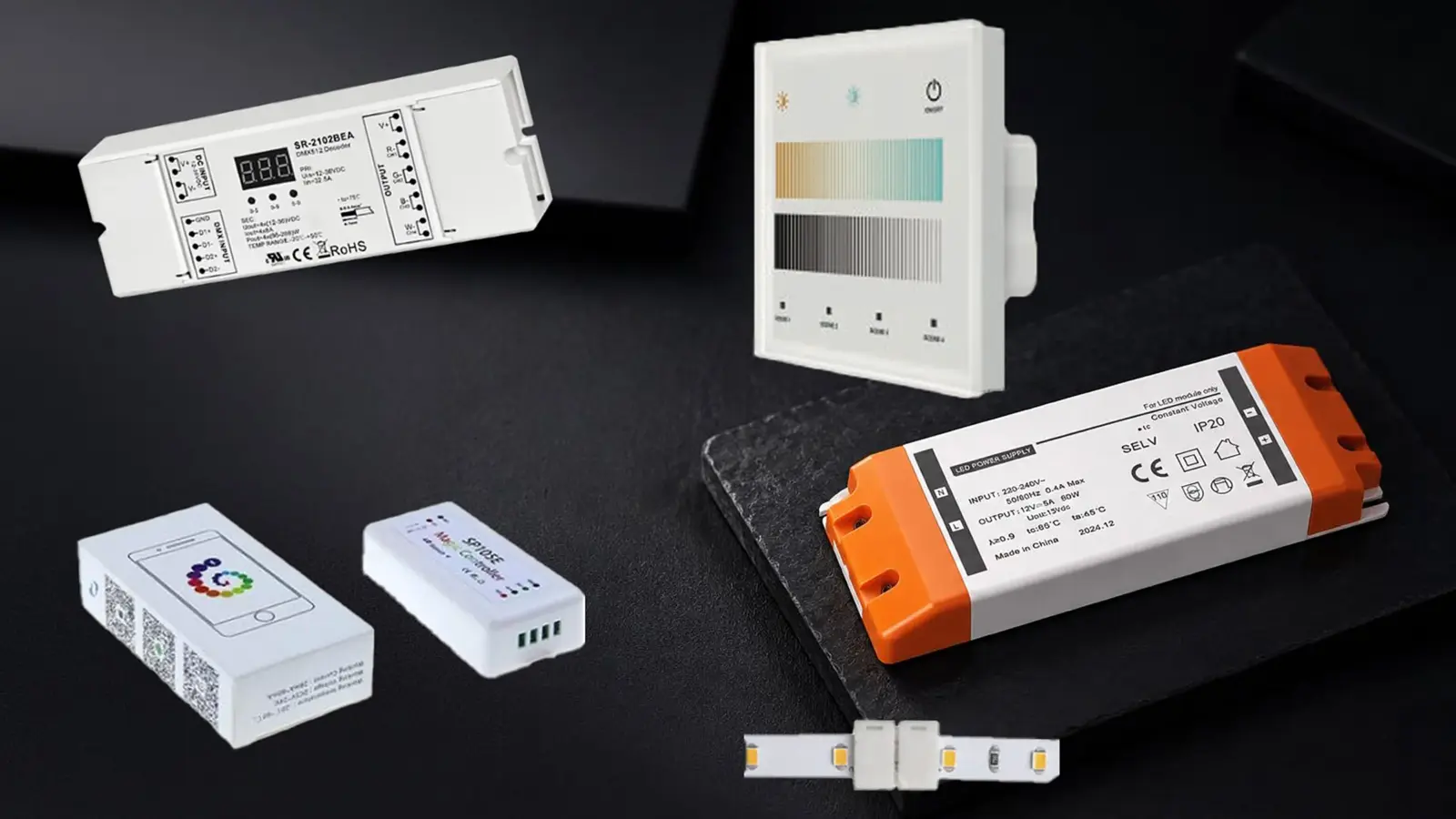
Build 2: a hardwired driver feeding 24V strip. The branch circuit ends at a driver in a box or the driver’s wiring compartment. Everything past the driver is 24V. With a An NEC Article 725 output class limited to 100 VA at up to 60 V DC, with the wiring relief that comes with it. Our Class 2 drivers are rated 60 W; a bigger load needs more outputs or a non-Class 2 driver. driver such as our 60 W UT-D60-24-C2, only its 24V output enters the cabinet bottom; the AHJ confirms the wiring method for that lead.
| Direct-wire bar | Hardwired driver + 24V strip | |
|---|---|---|
| Where line voltage ends | At the far end of the last bar | At the driver |
| Line-voltage splice | In the bar’s wiring compartment or its box accessory | In a junction box or the driver’s compartment, outside the casework if planned |
| What the inspector reads | The luminaire listing and its location rating | The driver’s listing and Class 2 marking, plus the strip’s listing |
| Lengths | The maker’s fixed lengths | Cut to the cabinet on the strip’s marks |
| Part replaced when the light fails | The whole bar | The driver or the strip run, separately |
| Spare to keep | One bar of each length | One driver model, plus strip from the same order |
A bar keeps every electrical part in one listed fixture a maintenance tech can swap. A driver build keeps line voltage out of the woodwork and runs the light the full width of any cabinet. Which matters more depends on the job, not the product.
Multifamily New Build: Strip on a Reachable Driver
On a new building with repeated unit types, the cabinet shop builds to a schedule, so the strip can be cut to that schedule too. Our low voltage guide works a 120-unit takeoff: 11.5 ft of 3.2 W/ft UT-C480-8 per unit, 36.8 W on one UT-D60-24-C2 at 61% of its rating. That is one driver model, one strip model and one channel across the building.
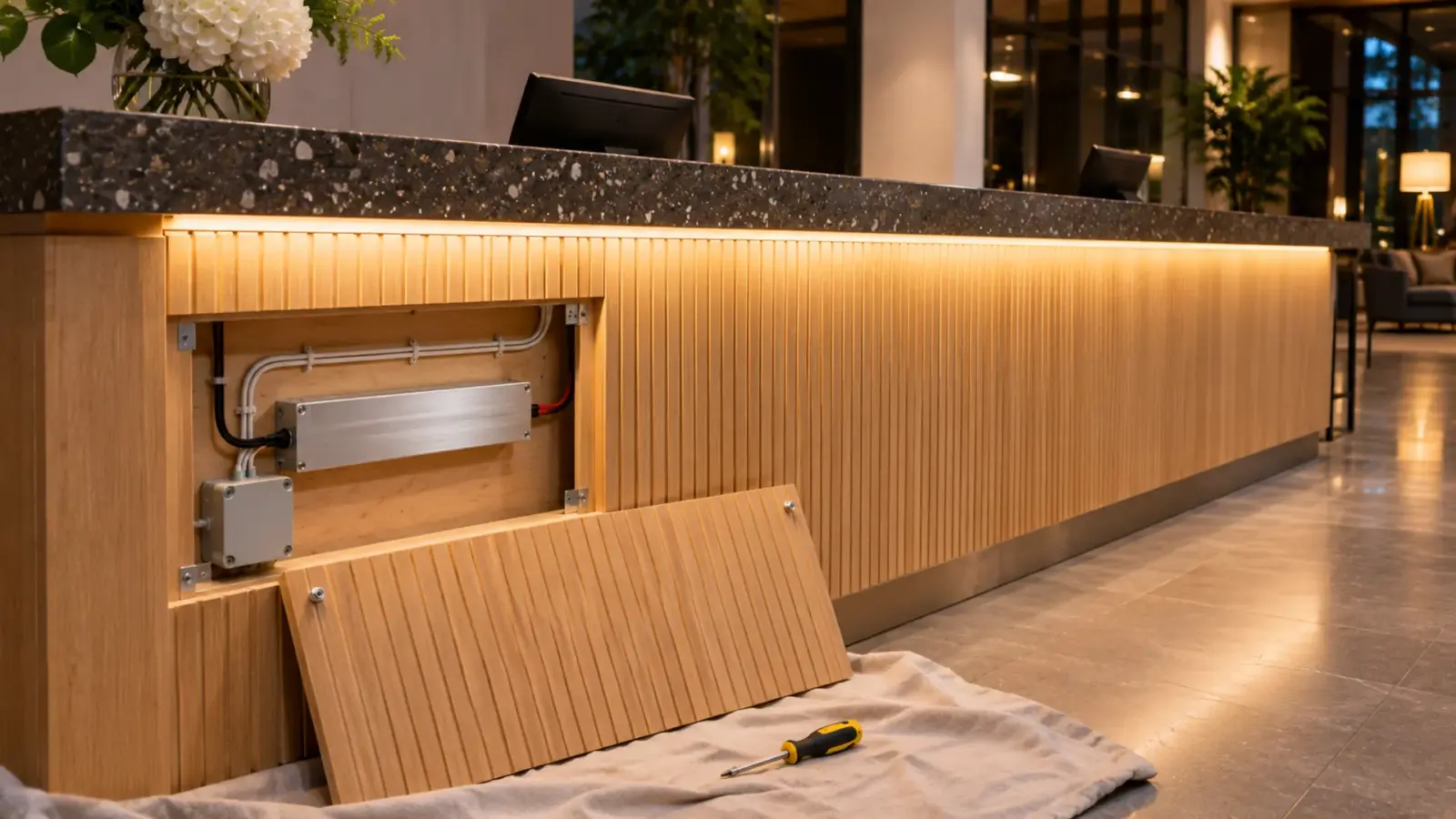
Bars take this row only when every cabinet width lands on a bar length and the owner values one spare part over a continuous line. Where no bar or linked pair matches a cabinet width, that cabinet gets a dark end. For strip, the driver location goes on the drawing for each unit type at rough-in, reachable without removing a finished panel; our driver location ranking puts the toe kick last.
Occupied Renovations and Unit Turns: Direct-Wire Bars
Here the bar wins clearly. In an occupied unit the cabinets and backsplash stay, and the work happens between tenants. A direct-wire bar lands on the box that fed the old fixture, mounts with screws and links across the run with its joiners. Nothing needs a feed hole, a second box or a new driver location.
For a portfolio turning hundreds of units a year, the maintenance tech carries one bar of each length and swaps a dead fixture. Strip on a driver asks that tech to find the driver first, easy on install day and hard six years later if nobody labeled it.
Two checks before ordering. Location rating: a cabinet beside the sink may need a damp listing, and the line quoted above is listed for indoor dry locations only, while another linkable 120V bar line we read is damp-location rated. And the circuit: a new box or an extended circuit in a dwelling kitchen brings Arc-fault circuit interrupter, a breaker that trips on arcing signatures. Some driver front ends mimic those signatures and trip it without a fault. protection (see the inspection section); ask the AHJ whether a like-for-like swap on an existing box does, before the first unit.
Custom Millwork: Ultra-Thin Means Recessed Channel
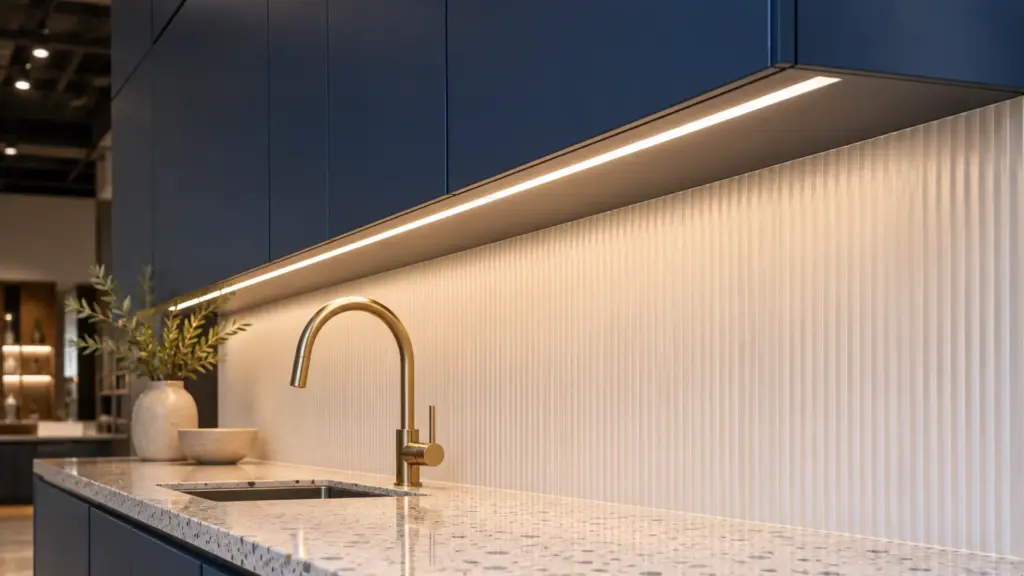
On a custom kitchen in a condo tower, an executive suite or an amenity bar, the fixture should disappear. A bar under 1 in high reads as a fixture from a seat. A recessed channel routed into the cabinet bottom does not read at all: our UT-CH1607 is 0.62 × 0.26 in (15.8 × 6.7 mm) and takes strip up to 11 mm, and the flanged UT-CH1708 is 0.67 × 0.31 in (17 × 8 mm) for strip up to 10 mm. The surface UT-CH1013, at 0.39 in (10 mm) high, is the fallback when the bottom cannot be routed.
This is the clearest strip job of the six. Use 8 mm COB LED strip at Ra≥90: UT-C480-8 for output, or UT-C528-8-FC, which cuts at any point, where a cabinet end never lands on a cut mark. Put the channels on the shop drawings and the driver outside the casework or behind a panel the electrician owns. Our millwork scope guide explains why only the 24V leads should enter the woodwork when the shop installs the strip, and the channel range lists every recessed profile with its strip width.
Office Break Rooms and Pantries
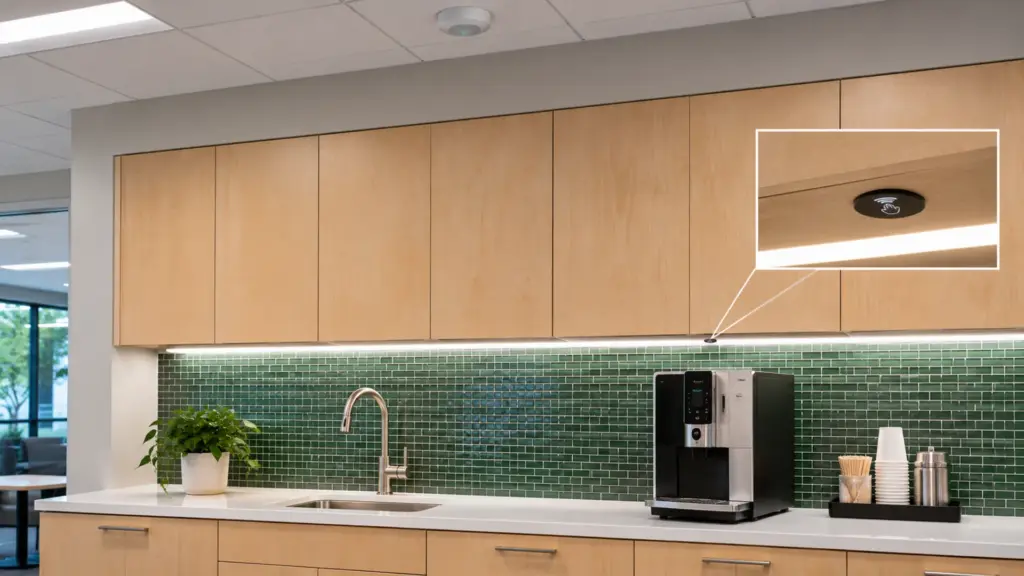
A break room is not a dwelling unit, so start from the energy code, not the dwelling kitchen rules (confirm with the AHJ). Where it requires automatic shutoff for the room, put the driver’s input on the room’s controlled lighting circuit. Our Title 24 guide covers the California text; other states have their own.
Strip on a Class 2 driver wins because pantry casework is rarely standard lengths. A typical 14 ft pantry wall of UT-C480-8 loads 44.8 W, 75% of one UT-D60-24-C2-010, which dims from the room’s 0-10V system. When the lights only switch, a non-dimming UT-D60-24-C2 is enough, and a DC cabinet switch can sit between driver and strip for a coffee nook: most of our door, hand-wave and motion switches are rated 60 W at 12/24V. Direct-wire bars are a fair runner-up when the cabinets are standard widths and the bars are on the same controlled circuit.
Hotel Suites and Wet Bars: Dim-to-Warm on the Room Control
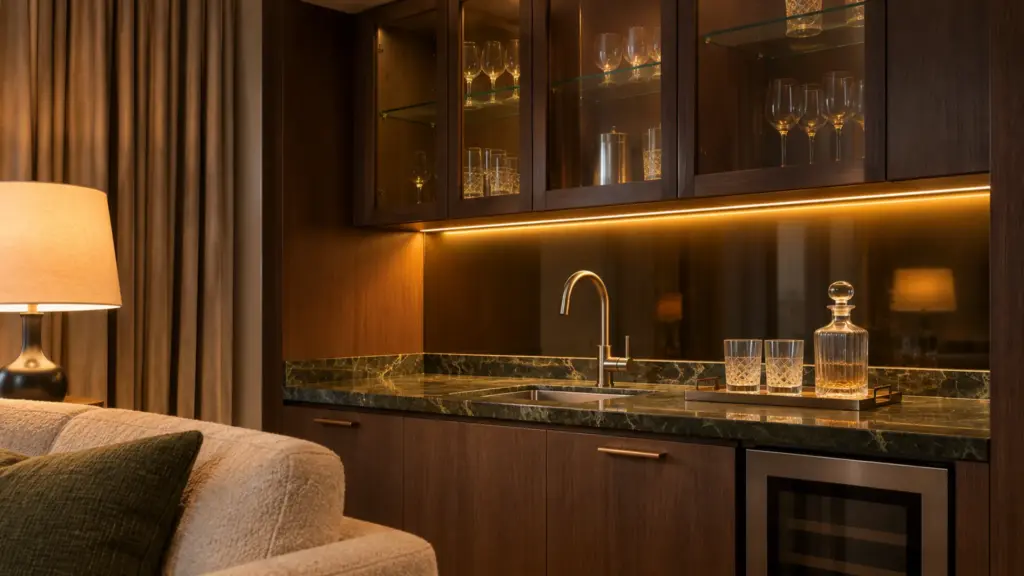
A suite kitchenette or wet bar is lit for the evening and seen from the sofa. Dim-to-warm strip shifts warmer as it dims: our UT-T672-10-DTW COB runs from 3000K at full to 1800K, Ra≥90, at 3.4 W/ft, so an 8 ft wet bar loads 27.2 W. The driver has to match both the strip and the guestroom control, so we pair them at quote. Our guestroom controls guide covers room controllers, keypads and vacancy sensors, and the dim-to-warm guide explains the curve.
Guest rooms and suites are also on the AFCI list: St. Paul’s inspection department reads 210.12(D) and (E) of the 2023 NEC as covering new, extended or modified 120V, 15 and 20 A branch circuits there that supply newly installed outlets and devices. A select-service brand with a fixed 3000K standard and a phase dimmer can take bars instead; dim-to-warm is the line where the tunable white strip build pulls ahead.
Food-Service Lines: Shielded, Washable, Driver Out of the Splash
A servery, cafeteria line or prep counter is the one job where the health department reads the light too. The FDA Food Code section 6-202.11, as Minnesota adopts it in Rule 4626.1375, requires light bulbs to be shielded, coated or otherwise shatter-resistant where there is exposed food, clean equipment, utensils and linens, or unwrapped single-service articles. Its lighting-intensity rule, 4626.1470, asks for at least 50 foot-candles (540 lux) at a surface where a food employee works with food or with utensils such as knives and slicers, and 20 foot-candles at customer self-service surfaces.
LED strip has no glass bulb, and a polycarbonate cover keeps it behind plastic; whether that satisfies the shielding rule is the health department’s call, so put it in the submittal. The build: IP65 outdoor LED strip such as UT-O320-8-65, a silicone-coated COB at 2.4 W/ft and Ra≥90, in a channel with a cover, and the driver out of the splash and washdown zone. Where it has to sit close, a potted IP67 driver such as UT-D100-24-67 is the choice; our Class 2 drivers are IP20 and stay dry. Our commercial kitchen guide covers heat, grease and cleaning in detail.
Dimming: The Wall Control Picks the Driver
“Dimmable” on a bid means little until the wall control is named. The control decides the driver, and on our range the driver decides whether the 24V side stays Class 2.
| Wall control | Direct-wire bar | Hardwired driver + strip (our models) |
|---|---|---|
| Existing phase dimmer (TRIAC, ELV) | A bar listed for that dimmer type; one line we read lists CL and ELV dimmers, another TRIAC | UT-D60-24-TRC, 60 W, 120 V input, forward and reverse phase; outside our Class 2 group |
| New 0-10V control | Check the bar’s sheet; both lines we read list phase dimming | UT-D60-24-C2-010, Class 2, 120–277 V input, with a 0-10V control such as the UT-CTP-010 panel |
| Switch only | Any bar | UT-D40-24-C2 or UT-D60-24-C2 |
| Switch at the cabinet | A rocker on the bar’s hardwire box, where the line offers one | A DC door, hand-wave or touch switch between driver and strip, 60 W max |
| Dim-to-warm | Neither line we read offers it | UT-T672-10-DTW (2-wire) on a single-channel dimmable driver matched to the control at quote |
The trap in apartments and suites is the familiar wall dimmer. Keeping it means a Leading-edge phase-cut dimming, the kind in most wall-box dimmers. Works with 120V strip and with drivers built for it; mismatches show as flicker or a narrow range. driver, and UT-D60-24-TRC is not in our Class 2 group; confirm the Class 2 status on its datasheet before the casework plan relies on a power-limited 24V lead. A 0-10V control keeps the driver Class 2 but needs its own control pair to the driver. Phase dimmers also have minimum loads that one short cabinet run can fall under; our dimming protocol guide covers both.
What the Inspector Reads
Settle these with the AHJ before rough-in; the adopted code edition and the AHJ decide.
- Listing and location. A bar is listed as a luminaire with a dry, damp or wet rating; a driver build has a listed driver and a listed strip. A cabinet beside a sink is where a dry-only listing gets questioned.
- Where the line-voltage splice sits. In the bar’s wiring compartment or box accessory, or in a junction box or the driver’s compartment for a strip build, as each product’s instructions allow.
- The circuit. St. Paul’s inspection department summarizes 2023 NEC 210.12(B) as requiring AFCI protection for newly installed 120V, 15 and 20 A outlets and devices in dwelling kitchens, luminaires included, extensions and modifications too. Our AFCI guide covers drivers that trip one. Whether the under-cabinet light may share the countertop circuits is in the wiring path section of our low voltage guide: plan a lighting circuit.
- Class 2 marking and the 24V lead. For a strip build, the driver’s label shows Class 2, and the AHJ confirms the wiring method for the lead through walls and cabinets.
- Driver access. Reachable without removing finished work. Our code notes give the NEC Article 100 definition of readily accessible.
- No cords where cords do not belong. A cord routed through a cabinet or a wall is a cord-rule problem, not a hardwired install.
Service: What Fails and Who Swaps It
The build decides who touches the light again and what they carry.
A bar fails as a unit, so the fix is a new bar of the same length. The risk is time: if the line’s lengths, joiners or tint change, a seven-year-old kitchen may get a bar that does not link or match. Keep spare bars of each length from the original order.
On a strip build, the driver is the part with heat and electrolytic capacitors. Our drivers page puts the effect plainly: capacitor life roughly halves for every 10°C (18°F) rise, which is why the driver needs air and why a sealed cavity is the wrong home for it. A driver mounted with screws and labeled is a screwdriver swap. A replacement strip run should be the same model and CCT; for color across a building, order from one production lot, as our multifamily guide explains. Put the model, CCT and driver map in the closeout package.
FAQ
Is hardwired under cabinet lighting better than plug-in?
On a project, yes. Hardwired under cabinet lighting has no cord to hide, no receptacle to find above or inside the cabinet, and no cord routed through casework, which is where plug-in kits get written up. Plug-in kits suit a single retrofit with a receptacle in the right place. Converting a plug-in product to direct wire depends on its listing and instructions, as our cord rule guide explains.
Do hardwired under cabinet lights need a junction box?
The line-voltage connection lands in a box or a wiring compartment, as the product’s instructions allow and the AHJ accepts. A direct-wire bar usually lands in its own compartment or the maker’s box accessory. A strip build lands the branch circuit at the driver, in a junction box or the driver’s compartment, and only the 24V leads run to the strip.
What is the thinnest hardwired under cabinet lighting?
LED strip in a recessed channel routed into the cabinet bottom, which sits nearly flush. Our UT-CH1607 is 0.26 in (6.7 mm) deep and takes strip up to 11 mm. Our slimmest surface channel, UT-CH1805, is 0.2 in (5 mm) high but is rated for strip up to 3.0 W/ft. The 120V bars we read are about 1 in high, with the driver inside.
Are hardwired under cabinet lights dimmable?
Most are, but only with the right wall control. A direct-wire bar dims on the dimmer types its sheet lists, usually phase dimmers. A strip build dims through its driver: a TRIAC driver for an existing phase dimmer, a 0-10V driver for a 0-10V control, and dim-to-warm strip on a single-channel dimmable driver matched to the control. Name the control before the driver is ordered.
Before You Order
Write one line per job type: the build, the wall control, the driver or bar model, where line voltage ends, the location rating at the sink, and who replaces it later. If two lines disagree with the table above, the job is telling you something about access or controls; follow it.
Unitop Lighting supplies the strip, channel and driver builds on this page, not under-cabinet light bars. Send the cabinet elevations, the unit-type schedule and the wall control you plan to use, and we will lay out the cut lengths, size each driver and match the dimming before anything is quoted: request a quote.