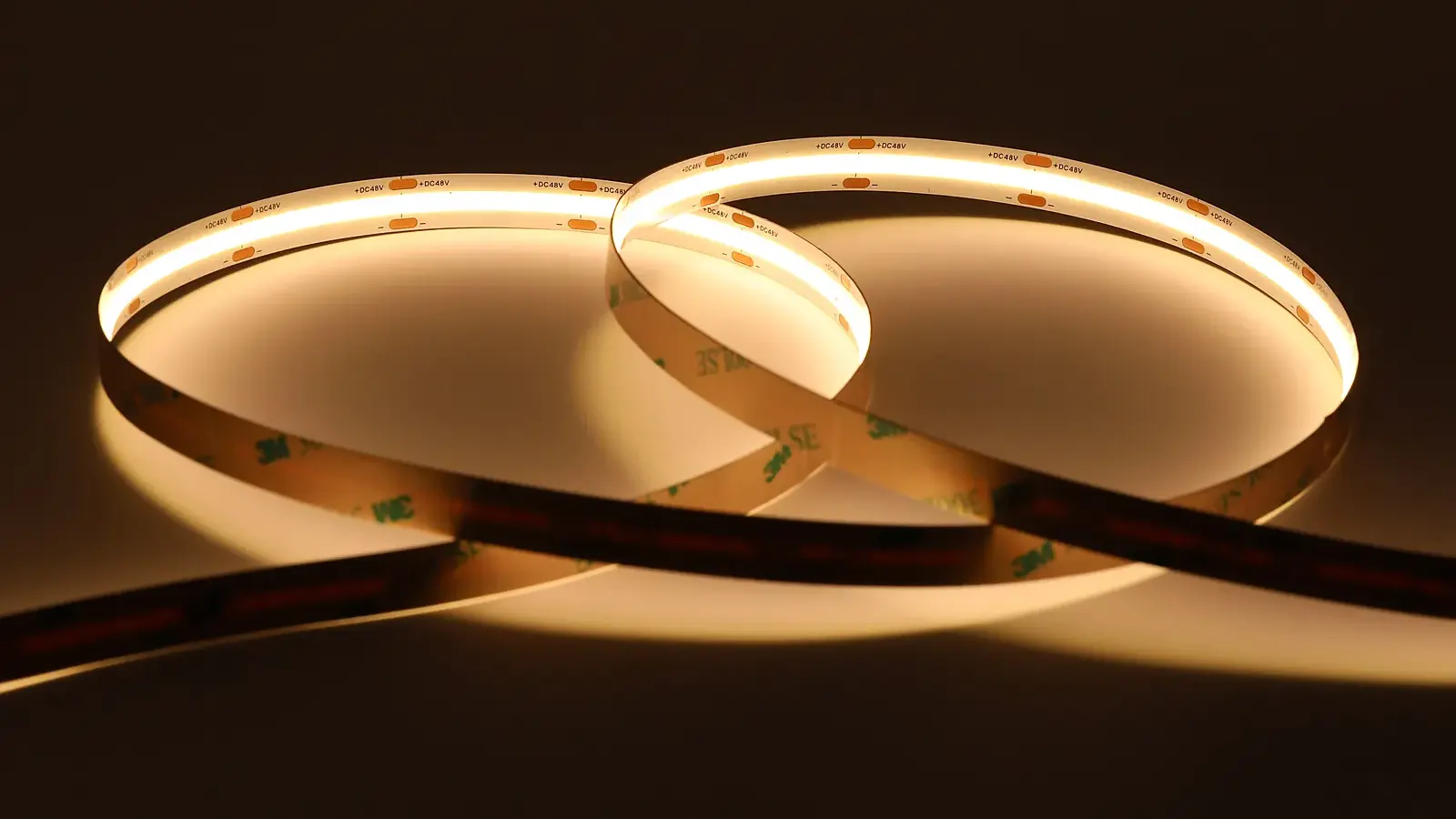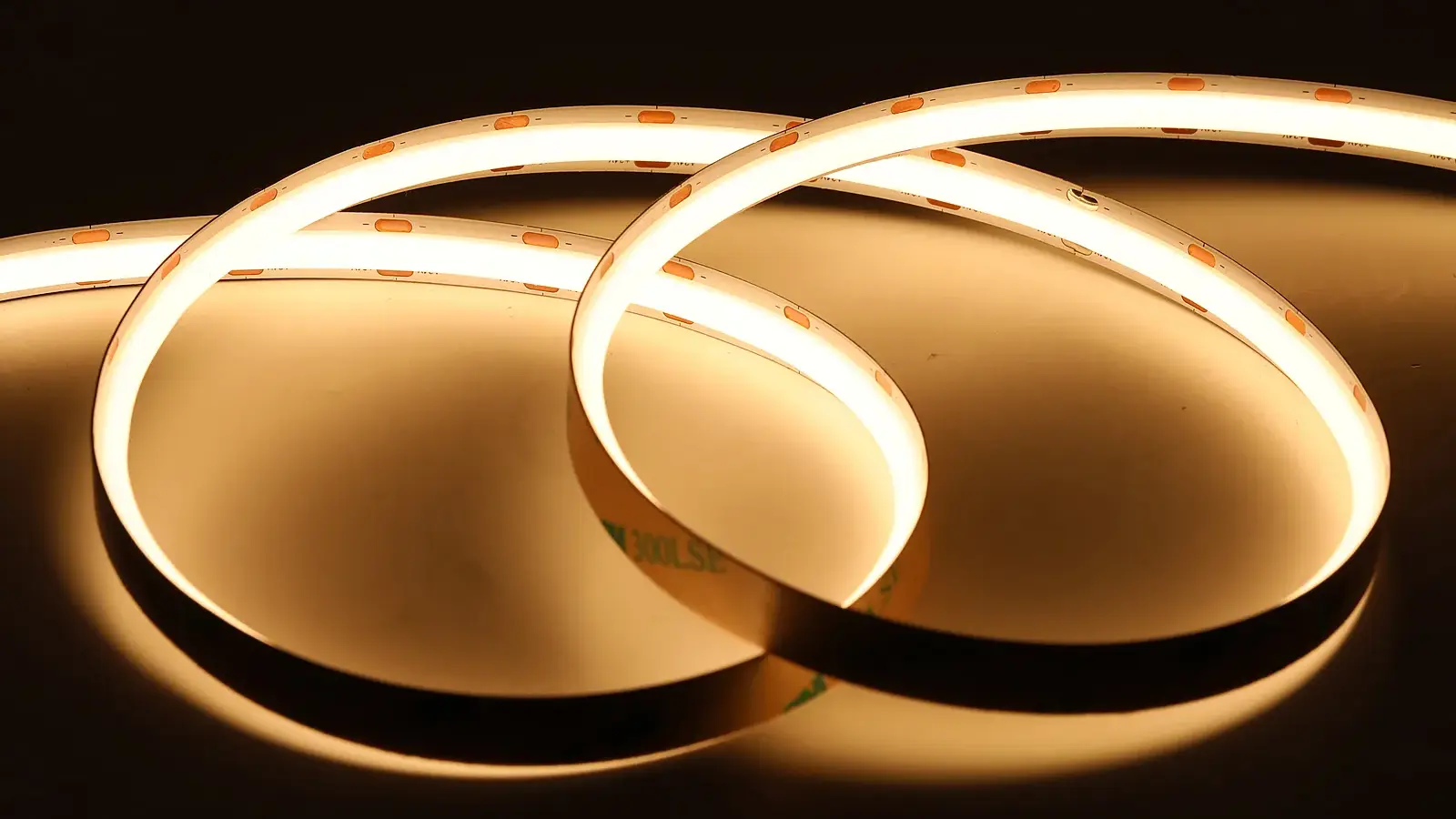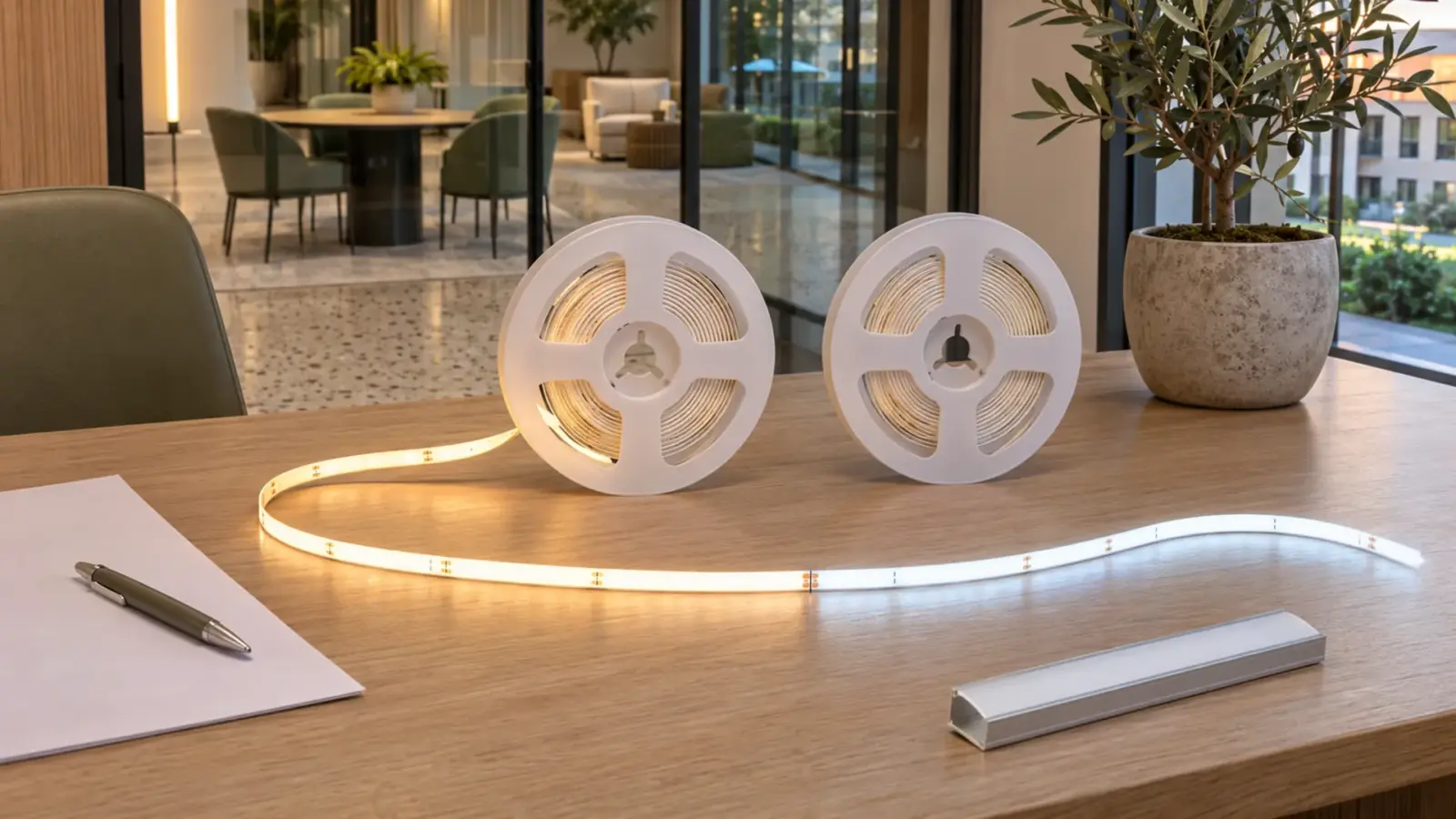


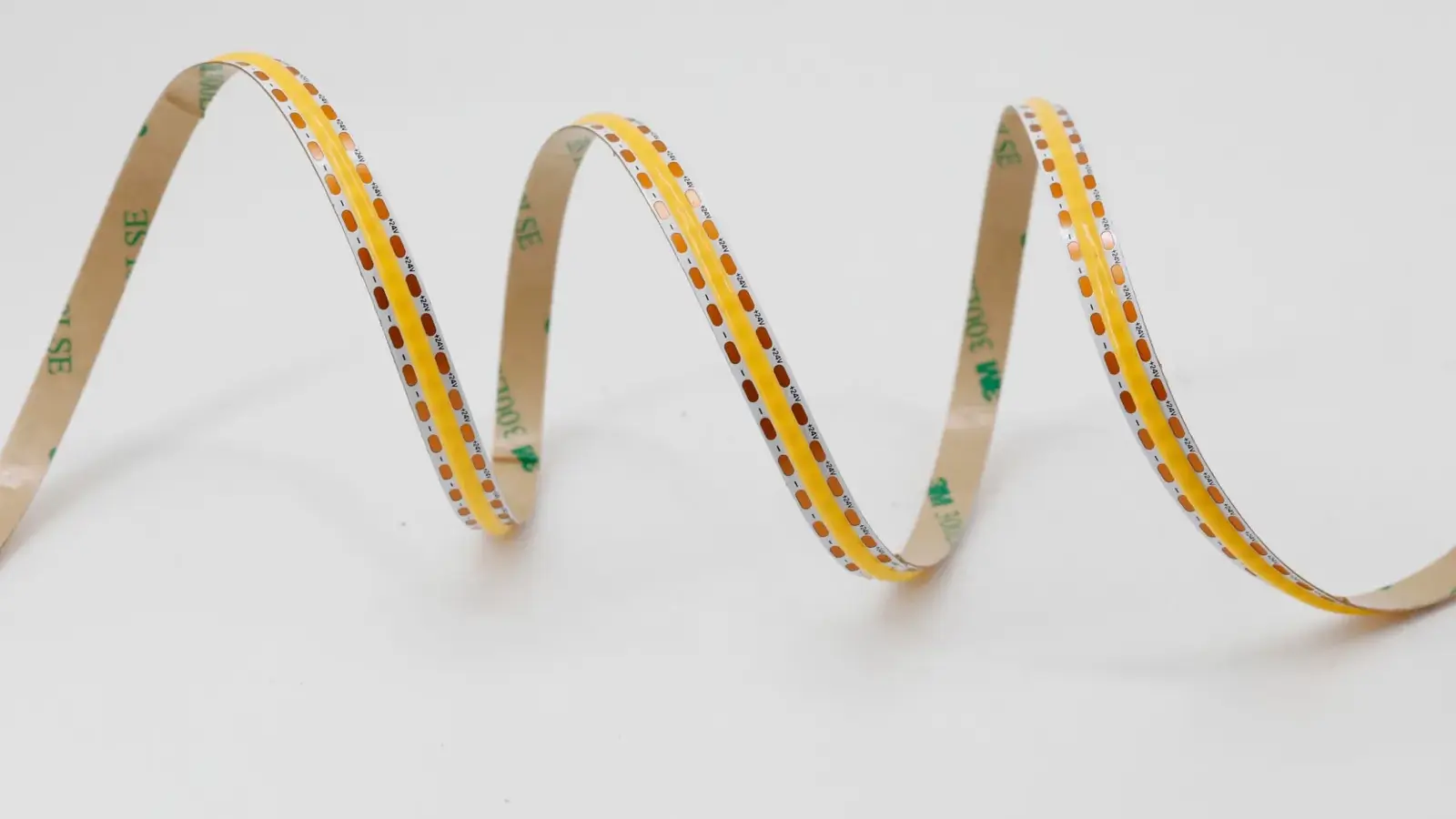
FCOB is not a better grade of COB. On flexible LED strip, FCOB and COB name the same build: bare LED chips bonded to a flexible circuit board under one continuous line of phosphor silicone. The F is read as flip chip or as flexible, and both readings describe the same reel.
What separates two COB quotes is density, board width, voltage, color rendering and how the chips are bonded, and none of that is in the name. This guide lists every name we found for chip-on-board strip, in search suggestions from nine markets and in product listings, sorts the names for the build from the names for the look, and ends with the numbers that decide whether two reels are interchangeable.
FCOB vs COB: One Strip, Two Readings of One Letter
COB stands for chip on board. The LED die is bonded to the strip’s own circuit board, instead of first being sealed in its own small package the way a 2835 SMD LED is. On a flexible strip, a line of phosphor silicone is dispensed over the whole row of chips, so the strip lights as one line instead of a row of points.
FCOB adds one letter, and the market reads it two ways:
- Flip chip on board. The die is mounted face down, with its contacts bonded straight to the copper pads of the strip. One strip maker writes that the names “were derived from the flip chip-on-board (FCOB) technology”.
- Flexible chip on board. Other sellers expand the F as flexible, after the flexible board.
Both readings land on the same product: a dense row of bare chips on a flexible board under one phosphor line. A third short form, FOB, shows up on sellers’ pages as another way to write flip-chip on board; Google suggests “fob cob strip” and “fob vs cob led” to people who type it, so buyers do meet it.
Google’s suggestions also show how often the question comes up. Type “fcob” in the US and the completions include “what does fcob stand for”, “fcob vs cob” and “fcob led meaning”. Our own COB LED strip page names the range “COB (also called FCOB)” for the same reason: buyers search both words for one product.
So when one quote says FCOB and another says COB, assume the same construction and compare the numbers further down this page. When a seller presents FCOB as an upgrade over COB, ask what is different on the datasheet. If nothing is, the difference is the label.
Under the Phosphor: Flip Chip or Wire-Bonded
The one real difference that can hide behind the names is how each bare die is connected to the board. There are two ways to do it.
A face-up, wire-bonded die sits on the board with its contacts on top. Fine gold wires arc from the top of the die to copper pads beside it. This is the traditional method.
A flip chip is mounted face down. Its contacts sit on its underside and are soldered or bonded straight to the pads, so there is no wire at all.
What flip chip changes on a strip, as manufacturers describe it:
- No bond wire in the bend. A flexible strip flexes on the reel, in the installer’s hands and around every cove corner. A flip chip has no wire loop to fatigue. LED display makers that sell flip-chip COB name the end of bond-wire breakage as a reason to switch, and a US patent on LED filaments (US 10,845,008) notes that wire bonds between densely packed chips can be damaged or broken when the filament bends, then describes a flip-chip version with no gold wire bonding. Those are manufacturers’ and patent statements; we have not seen a published bend-fatigue test that compares the two on strip.
- A shorter heat path. The flip chip’s contacts sit against the copper, so the same pads carry current and heat into the board.
- Closer pitch. With no wire loops beside each die, display makers say chips can sit closer together. On strip, density is a listed number: our COB range runs from 280 to 1,600 LEDs per meter.
The bonding method is not what sets the color temperature or the CRI, and two reels can look identical lit and still differ here.
On a quote, the useful question is direct: “Are the chips flip chip or wire-bonded?” Ask for the answer in writing with the datasheet, together with the minimum bend radius. For our own range the answer is flip chip: every reel on our COB page is the FCOB build.
Every Name for COB Strip
The names in circulation fall into two groups. Names for the build tell you the chips are bare dies on the board. Names for the look tell you the line has no visible dots, and other builds can look that way too.
| Name you will see | Group | What it tells you | Same build as COB strip? |
|---|---|---|---|
| COB LED strip, COB strip light, COB light strip | Build | Chip on board, the base name | Yes |
| COB LED tape, COB tape light, COB light tape | Build | “Tape” is a common trade word for flexible strip | Yes |
| Chip-on-board LED tape | Build | The term spelled out | Yes |
| FCOB (flip chip on board) | Build | Chips mounted face down | Yes |
| FCOB (flexible chip on board) | Build | A flexible board | Yes |
| FOB | Build | Flip-chip on board, shortened | Yes |
| Flexible COB, COB flex strip | Build | A flexible board, not a rigid COB module | Yes |
| High-density COB | Build and spec | More chips per meter; our series run 600 to 1,600 | Yes, a COB range |
| Free-cut or cut-anywhere COB | Feature | Cuts at any point, like UT-C528-8-FC | Yes, a COB series |
| Addressable, pixel, RGB or CCT COB | Control | Driver ICs or more color channels on a COB line | Yes, COB with more channels |
| Side-view COB, S-shape COB | Board form | Light from the edge; a board that bends flat | Yes |
| IP67 extruded COB | Sealing | COB inside a solid silicone extrusion | Yes |
| Spotless COB | Look | A line with no spots; the word COB settles the build | Yes, when COB is in the name |
| Linear COB, continuous-light COB | Look | A line light; the word COB settles the build | Yes, when COB is in the name |
| Dotless LED strip or tape | Look | No visible dots | Not always |
| Dot-free LED strip | Look | The same; the term on our product pages | Not always |
| Seamless LED strip | Look | One continuous line | Not always |
The rule that comes out of the table: a name with COB, FCOB or FOB in it tells you the build. A name with dotless, dot-free or seamless alone tells you only the look. SOB strip, close-pitch CSP strip and SMD strip behind a deep diffuser can all be sold as dotless, so ask which build is under the word.
Several rows are series inside the COB family rather than new products. Free-cut strip has its own limits, covered in free-cut LED strip for signs and millwork, and pixel control on a COB line is covered in addressable COB LED strip.
COB Strip in Nine Markets
Buyers type different words in different countries, and a distributor who sources abroad or a contractor who reads a foreign datasheet meets all of them. These are the phrases Google suggests to people typing in each market, collected on November 27, 2026. They show how people search, not how many search.
| Market | What buyers type | What it means |
|---|---|---|
| United States | COB LED strip, COB tape light, dotless LED strip, FCOB | Strip or tape; the look; the flip-chip name |
| United Kingdom | COB LED tape, alongside COB LED strip | Both words are in use |
| Australia | COB strip light | Strip light |
| Germany | COB LED Streifen, COB Lichtband, LED Streifen ohne Lichtpunkte | COB LED strip; COB light band; LED strip without light dots |
| France | ruban LED COB | COB LED ribbon |
| Spain | tira LED COB, tira LED COB sin puntos | COB LED strip; COB LED strip without dots |
| Italy | striscia LED COB, striscia LED linear COB | COB LED strip; linear COB |
| Brazil | fita LED COB, fita LED COB continua | COB LED tape; continuous |
| Poland | taśma LED COB | COB LED tape |
The same suggestion lists also carried “COB LED traka” (Croatian), “COB LED juosta” (Lithuanian) and “COB LED nauha” (Finnish), each a local word for strip or tape.
Three patterns stand out. The letters COB survive untranslated in every market; only the word for strip changes. In these suggestion lists, FCOB appears only in English phrases. And German, Spanish and Brazilian Portuguese add a “without dots” or “continuous” version, Italian a “linear” one: names for the look, not the build.
One more pattern matters on a US job. In Germany, France, Spain, Italy and Brazil, many of the suggestions are for mains-voltage reels: “COB LED Streifen 230V Direktanschluss” (direct connection), “striscia LED COB 220V senza trasformatore” (without a transformer). Those reels run on the local mains, 220 to 230V in most of Europe and 127V or 220V in Brazil. A listing copied from one of those markets can carry the right name and the wrong voltage for a 120V building.
Names That Sound Like COB but Are Something Else
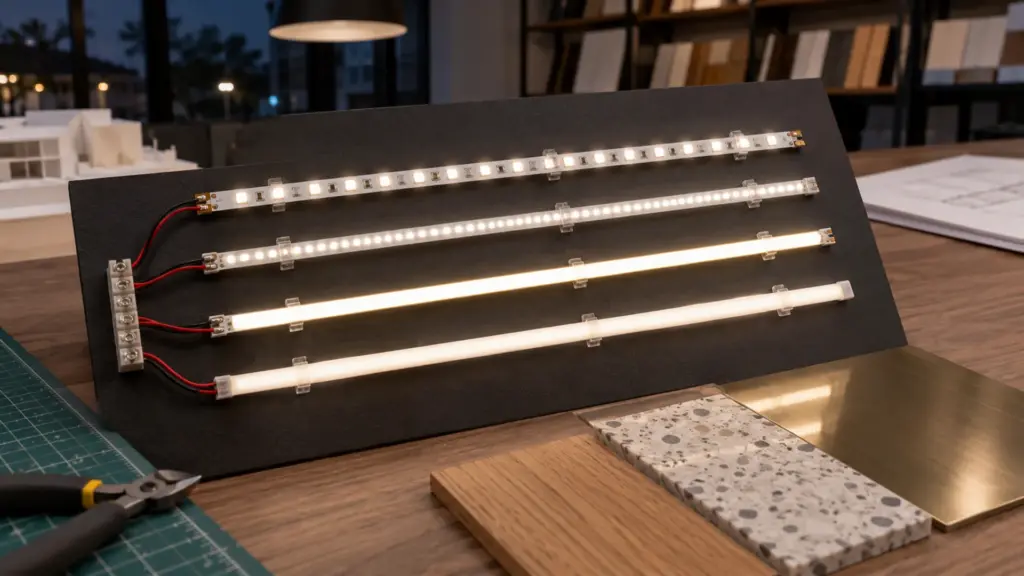
Some names share the letters or the look and point to a different product. Five come up often:
- COB light, COB downlight, COB chip. A rigid chip-on-board array inside a fixture, often sold by wattage. Same technology word, not a strip.
- COB LED display, GOB screen. Video-wall modules. The flip chip versus wire bond question lives here too, which is why display makers write so much about it.
- COB neon. Neon flex with a COB line inside a silicone profile. It is a neon product, specified like the rest of our LED neon flex range.
- SOB, SCOB, WCOB and DOB. Packaged SMD LEDs under one white silicone line. The lit line looks dot-free like COB, but the build is different: each LED is a sorted package, not a bare die. On our site these names share the SOB LED strip page, and the build difference is compared in SCOB beats COB on lumens per watt.
- CSP strip. Chip-scale packages, each barely larger than its die. At close pitch the line can look nearly dot-free; the trade-offs are in CSP vs COB LED strip.
If a submittal names one of these where the spec says COB, treat it as a substitution and compare the numbers, even when the lit samples look alike. The wider family tree, from DIP to SCOB, is in our guide to LED package types.
Same Name, Different Reel: The Numbers That Decide
Every reel in this table is COB, and every one could be listed as FCOB. The numbers come from our COB page.
| Number | Range in our COB line | What it decides on the job |
|---|---|---|
| LEDs per meter | 280 to 1,600 | How smooth the line looks up close; watts per foot and heat |
| PCB width | 2.7 to 30 mm | Which channel it fits |
| Voltage | 5V, 12V, 24V, 48V, 24V constant current | Run per feed, from 6.5 ft (2 m) on 5V to 65 ft (20 m) on 48V; the driver type |
| Cut step | any point (free-cut) up to 2.46 in (62.5 mm) | How close the ends land to the measured length |
Two examples from the same page show how far apart two “COB” reels can be. UT-C320-8 carries 320 LEDs per meter on an 8 mm board at 2.4 W/ft and runs 16 ft (5 m) per feed. UT-C1600-30 carries 1,600 per meter on a 30 mm board at 12.2 W/ft and runs 10 ft (3 m) per feed. Same name, about five times the watts per foot, a channel almost four times as wide, and a driver sized for a different load.
Read a listing the way the drawing does. The name tells you the build family and nothing else. The voltage sets the driver and the run length. The density sets the watts per foot and how the line looks from a few inches away. The width sets the channel. CRI and CCT set the color. The cut step sets how close the ends land to the wall. Two reels match when those numbers match, whatever each one is called.
Yellow When Off: The Quick Check on a Sample
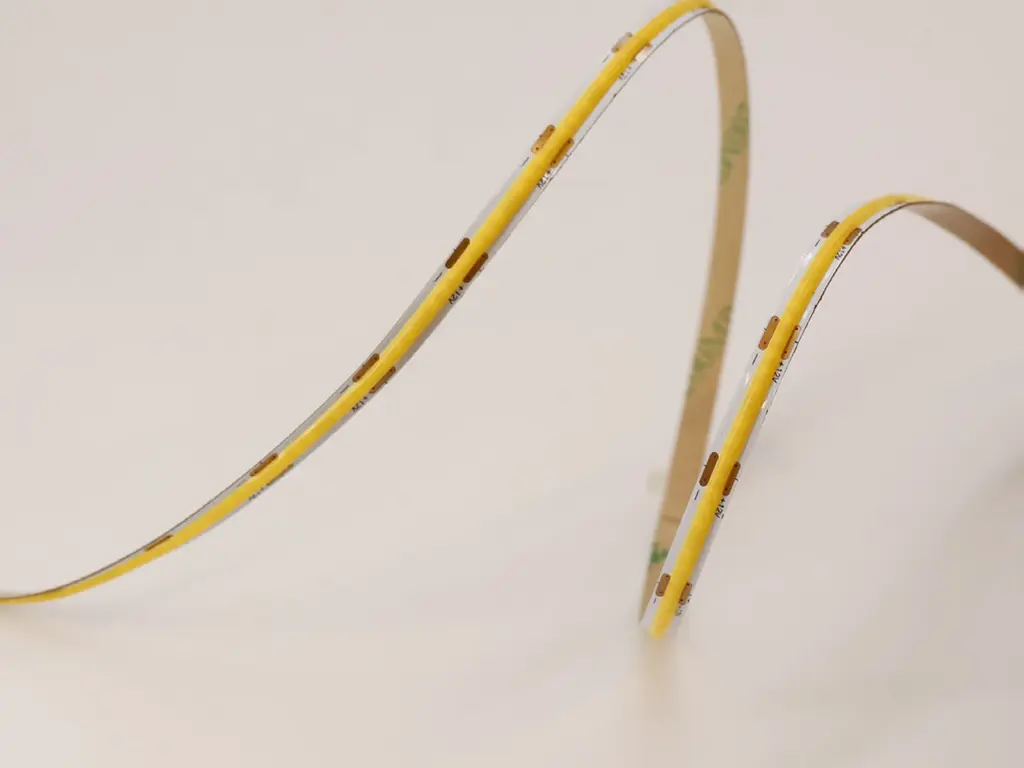
There is a one-second test that tells COB from its look-alikes on any sample, whatever the label says: look at the strip with the power off.
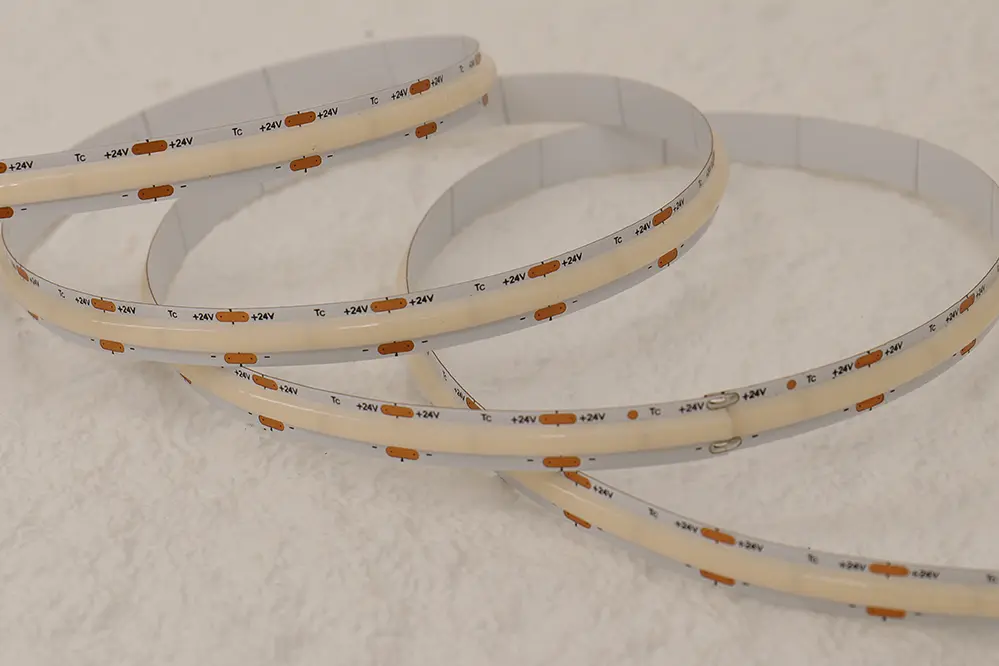
A white COB strip shows a yellow to orange line when it is unlit, because the phosphor line covers the bare chips. Colored COB shows a line tinted toward its color. An SOB strip (sold as SCOB, WCOB or DOB) usually shows a white, milky line when unlit; under clear silicone you see a row of small packages instead.
The check matters most at the submittal stage. If the spec says COB and the sample on the mockup board shows a white line when off, it belongs to the SOB family. That can be a good strip, often with higher lumens per watt, but it is a substitution, and its run length, cut step and output need checking against the spec before anyone approves it.
The Short Version
- COB, FCOB, FOB and flexible COB name one build. Compare the numbers, not the label.
- Dotless, dot-free and seamless name a look. Ask which build is under it.
- Ask every supplier the same six questions: flip chip or wire-bonded, LEDs per meter, PCB width, voltage and run per feed, cut step, CRI and CCT.
- Check an unlit sample: a yellow line is COB; a white or milky line, or a row of small packages, is the SOB family.
- Treat a foreign listing as a translation job: COB stays COB, but check the voltage.
Every COB model mentioned here is listed on our COB LED strip page by density, width, voltage, cut step and run per feed.