

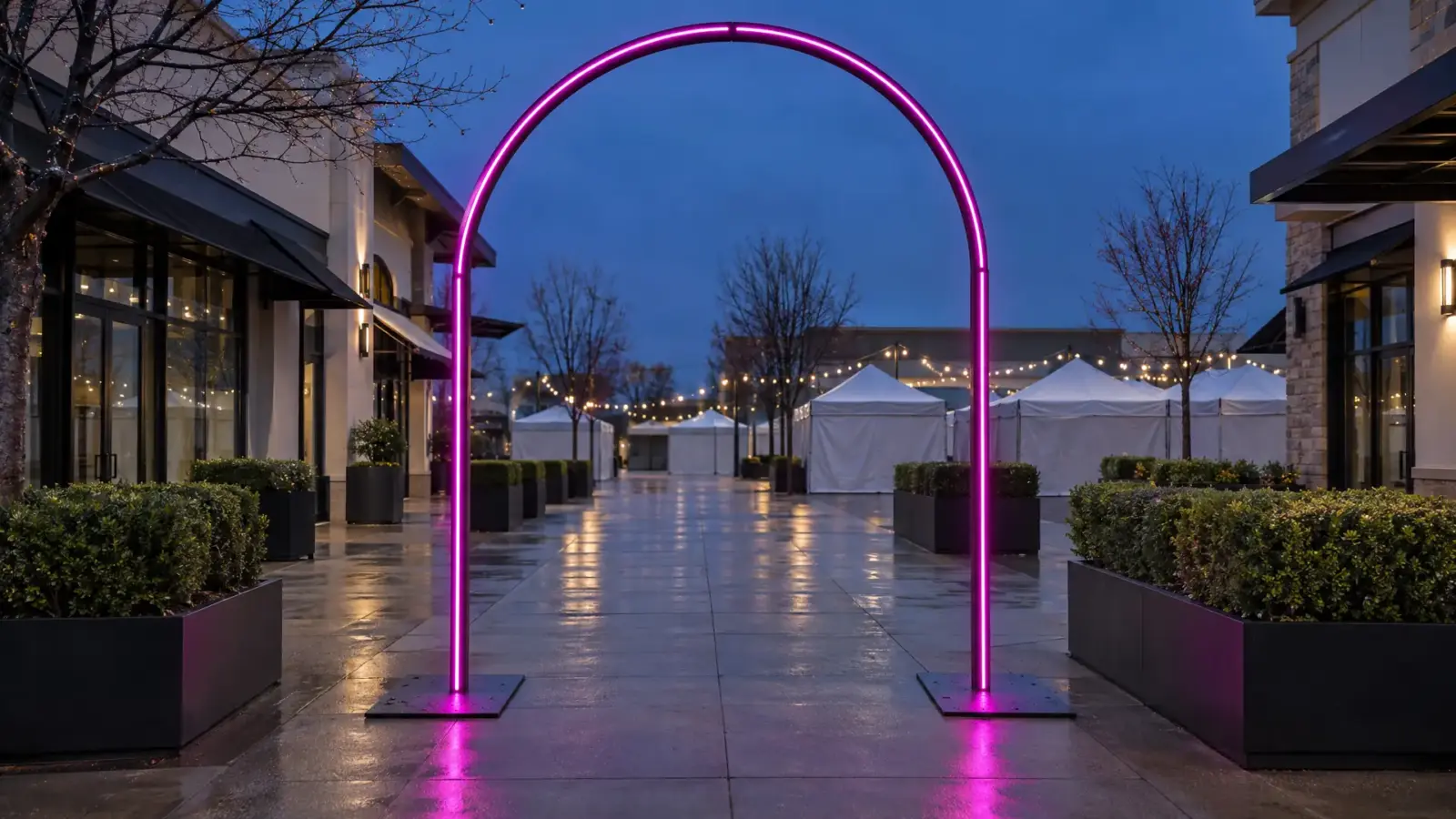
A cargo van, one 120V outlet at the venue, an hour to set up, and a client who wants a 30 ft neon arch at the entrance. That arch is four cut pieces of side-bend RGB neon on four frame sections, four plug-in feeds, one sealed 150 W driver and one controller with a remote.
The list below is worked from our LED neon flex spec tables, then the cut list, the plugs and how the arch travels.
The Arch: 10 ft Wide, 12 ft Tall, 29.7 ft of Neon
A typical job, not a real client: an event company’s entrance arch for weddings, school dances and shopping-center events, set up several times a month. Its fabricator builds the frame, two legs and a half-circle top; the neon runs along the front face.
| Decision | This job |
|---|---|
| Neon line | Two 7 ft legs plus a half circle of 5 ft radius: 29.7 ft (9.05 m), 10 ft wide, 12 ft tall |
| Seen from | The front, as guests walk up and as the photos are taken |
| Color | RGB, the whole arch one color at a time |
| Control | A handheld remote, the app as an extra |
| Power | One 120V outlet at the venue, near one leg |
| Transport | A cargo van; no piece of frame longer than about 8 ft |
A walk-through arch, a chase effect or a DJ’s console changes lines on the order; the sections below say which.
The Neon Arch Order, Line by Line
| # | Line | Model or spec | Qty | Supplied by |
|---|---|---|---|---|
| 1 | Neon, legs | UT-N1616-SB side bend, 16×16 mm, RGB, 24V, IP67 | 2 pieces at 6 ft 10.7 in (2.1 m) | Unitop, cut to length |
| 2 | Neon, top | UT-N1616-SB, as line 1 | 2 pieces at 7 ft 8.5 in (2.35 m) | Unitop, cut to length |
| 3 | Leads | Four-conductor lead at the lower end of each piece | 4 | Unitop, made to order |
| 4 | End caps | Sealed at both ends of every piece | 8, fitted | Unitop |
| 5 | Mounting clips | For UT-N1616-SB | Per piece, spacing from the install sheet | Ask at quote |
| 6 | Top extensions | Four-conductor cable down the back of each leg, plug at the top | 2 | Confirm at quote |
| 7 | Joint plugs | One plug type, one pinout, matched to the location | 1 pair per lead and joint | Named on the assembly drawing |
| 8 | Base splitters | One into two, four conductors | 2 | Confirm at quote |
| 9 | Cross cable | Four conductors, leg 1 base to leg 2 base | 1, length from the layout | Confirm at quote |
| 10 | Driver | UT-D150-1224-67S, 24V, 150 W, IP67, 100–240 VAC | 1 | Unitop |
| 11 | Controller | UT-CWF-RGB, Wi-Fi + Bluetooth (Tuya) | 1 | Unitop |
| 12 | Remote | UT-CRM4-RGB, handheld, 2.4G RF | 1 | Unitop |
| 13 | Box | Weatherproof box with cable glands, for the controller and splices | 1 | Electrician or sign maker |
| 14 | Input cord | Cord and plug on the driver input | 1 | Electrician |
| 15 | Frame | Four sections, couplers, bases or ballast | 1 set | Frame builder |
| 16 | Spares | One leg piece and one top piece, ordered with the set | 2 | Unitop, optional |
Checkpoint: every line has a name in the last column. Lines 6 to 9 go missing most often: an arch drawing shows the neon and the frame, nothing in between.
Profile: Light Toward the Guests
Mark where the light faces before choosing a model. On this arch the guests look at the front of the frame, so the emitting face points at them, and the line curves in the plane of the arch, edgewise to that face. That is a side-bend job. Our LED neon flex table lists UT-N1616-SB: 16×16 mm, RGB among its color options, 3.7 W/ft (12 W/m) at 24V, cut every 1.97 in (50 mm), 16 ft (5 m) per feed, IP65 or IP67, and a minimum bend diameter of 7.87 in (200 mm). For an outdoor event, order IP67.
A top-bend profile bends up and down along its face. On the same frame its face would point up and out from the curve, and guests walking up would see the side of the profile, not the line. Our guide to bend direction reads the family off the drawing.
The radius is not the limit: the top is a 10 ft diameter against a 7.87 in minimum, and the legs meet the curve on a tangent. Bend direction is, and so is twist; no neon profile is twisted along its length.
Checkpoint: the emitting face is marked on the frame drawing, and the order names a side-bend model.
Sections: Cut the Neon to the Frame
The frame sets the pieces. This arch breaks into four sections: two 7 ft legs and two quarter arcs, each 7 ft 10 in along the neon line and about 7 ft 1 in across. Each fits on a van floor. Six shorter sections would pack smaller but add two joints, and every joint is a dark gap, a pair of plugs and one more connection to make in a dark venue.
One piece per section, each cut on the 1.97 in grid at or below the section’s length:
| Section | Neon line | Cut units | Piece | Short of the section | Load at 3.7 W/ft |
|---|---|---|---|---|---|
| Leg (2) | 7 ft | 42 | 6 ft 10.7 in (2.1 m) | 1.3 in | 25.5 W each |
| Quarter arc (2) | 7 ft 10.2 in | 47 | 7 ft 8.5 in (2.35 m) | 1.7 in | 28.5 W each |
| Whole arch | 29.7 ft | 178 | 29.2 ft (8.9 m) | 6.1 in in all | 108 W |
Keep the shortfall away from the crown, where the photographer aims. Set each leg piece tight to the top of its leg, so its 1.3 in lands at the floor, behind the base. Set each top piece tight to the crown, so its 1.7 in lands at the shoulder. The crown then shows only the two end caps, and each shoulder about 1.7 in with no light, plus its end caps. Our guide to dark ends and joints explains where the unlit length comes from.
Order pieces, not a reel: a reel is a supply length, not a run, as our reel length vs run length guide explains. Ask for four pieces cut to these lengths, each with its lead fitted, both ends sealed, tested lit and labeled by section. That is how our custom neon assemblies are built, with one piece of each type sent for approval before the set is made. The quote states the minimum.
Feeds and Plugs: One Lead per Piece
UT-N1616-SB runs 16 ft per feed and no piece here passes 7 ft 8.5 in, so each piece takes one feed at one end. Feed the pieces in parallel, not a top piece chained off a leg piece: a chained pair goes dark together when one plug works loose.
- Each leg piece has its lead at the floor end.
- Each top piece has its lead at the shoulder, plugged into an extension cable fixed along the back of its leg section.
- At each leg base, the two leads join in a one-into-two splitter.
- The driver and controller sit behind leg 1; a cross cable carries the other half to leg 2.
| Cable | Feeds | Load | Current at 24V |
|---|---|---|---|
| Each leg lead | One leg piece | 25.5 W | 1.1 A |
| Each top lead and extension | One top piece | 28.5 W | 1.2 A |
| Cross cable to leg 2 | Leg 2 + top 2 | 54 W | 2.3 A |
| Controller output | All four pieces | 108 W | 4.5 A |
Those currents are red, green and blue at full, the case the cable must carry. RGB leads have four conductors, as on RGB strip: common positive, red, green and blue. Confirm the neon pinout at quote.
The cross cable is the one choice: about 10 ft across the opening under a cable protector rated for foot traffic, or about 30 ft up the back of the frame and over the top, with a plug at every joint and nothing on the floor. Put the real length and 2.3 A into our voltage drop calculator to choose the gauge.
Use one plug type with one pinout on every lead, extension and splitter, so any piece plugs into any socket and red stays red. Name the plug, its pin count and its rating on the assembly drawing at quote.
One Sealed Driver at the Base
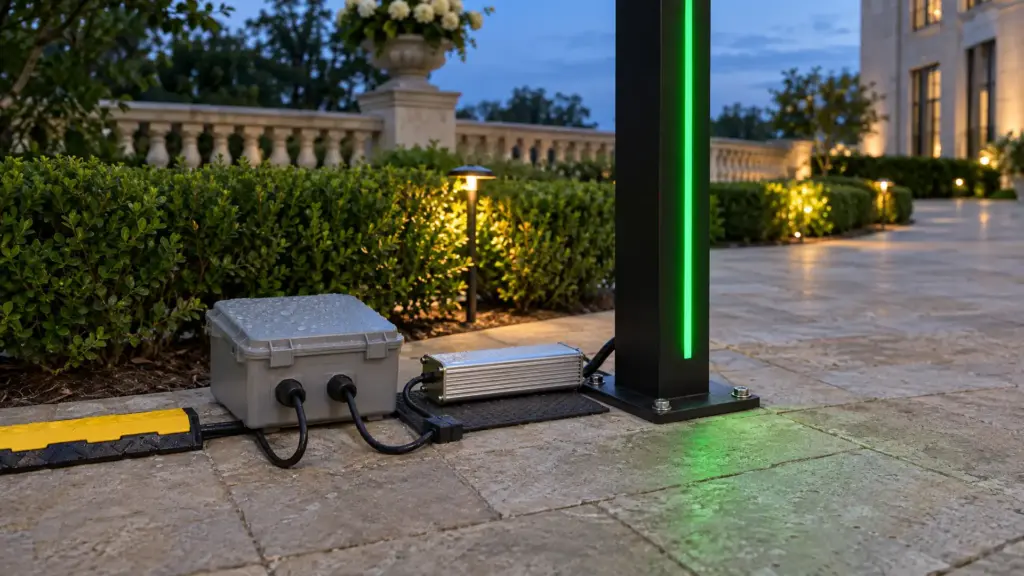
Size the driver on the full line: 29.7 ft × 3.7 W/ft = 110 W, or 4.6 A at 24V. At 80 percent loading that needs 137 W of rating. The list carries UT-D150-1224-67S from our drivers, controllers and connectors range: 24V, 150 W, IP67 in a sealed aluminum case, 100–240 VAC input, loaded to about 73 percent. At an outdoor event the driver sits at the foot of a leg, on wet grass or pavement.
This driver is not a Class 2 source. Our Class 2 drivers are rated 60 W or less each and are IP20 for dry spaces, so at 80 percent loading this arch would need three of them and a dry place for all three. How the sealed driver’s output is wired and protected is the electrician’s call, settled with the venue or the AHJ.
The controller is the weak point outdoors. UT-CWF-RGB lists no IP rating in our table, so it rides in a weatherproof box beside the driver. The remote reaches the controller by radio, so confirm at quote that it still reaches through the box you choose.
A standard 120V outlet runs the driver; the input cord and the outlet are the electrician’s and the venue’s lines. If the arch carries a logo or lettering, it may be read as a portable sign; our UL 48 and UL 879 guide sets out what that listing question looks like. Ask what the venue requires before the first booking.
Control at a Venue With No Wi-Fi
Every venue has a different network and some entrances have none, so the remote runs the arch and the app is the extra.
UT-CWF-RGB is our Wi-Fi and Bluetooth controller for RGB, on the Tuya Smart Life app. It lists 6 A per channel and 15 A in total, against the 4.6 A the driver is sized for (4.5 A connected). UT-CRM4-RGB is the handheld remote: four zones, two AAA cells, listed at 98 ft (30 m). Our 2.4G remotes pair with the UT-CWF controllers and talk to the controller directly, not through a phone. As our guide to ordering controllers by the app says for event sites, confirm at quote that the controller runs on the remote alone, so the arch works before anyone sets up the venue’s Wi-Fi.
UT-CRM8-RGB-LR is listed at 492 ft (150 m), but the controller rows list 98 ft of RF range; ask which receiver reaches that far before running the arch from a DJ booth across a field. If the arch is rented out, decide whose account the controller lives on; our guide to wireless controllers at handover covers who should hold the login.
A DJ or lighting tech with a DMX console takes the arch on DMX instead. Swap the controller for UT-CDMX-480, a four-channel DMX512 decoder rated 480 W: the arch uses three channels, red, green and blue, and follows the show. Our neon versions and controllers guide covers which controller each neon version takes.
Carry It, Set It Up, Strike It
The neon never comes off the frame. Each piece stays clipped to its section from the shop to the venue and back, so the curve is formed once and the sealed ends are not handled at every event. Our installation guide’s mounting section covers clip spacing on curves.
- Labels. Every piece carries its ID from the drawing, L1, L2, T1, T2, and the same ID goes on its plug and frame section.
- Packing. A padded case or cart per section, nothing resting on the neon face.
- Set-up. Legs, top sections, shoulder plugs, base splitters, cross cable, box, then the driver’s plug.
- Test by color. Red, then green, then blue, across all four pieces. A piece missing one color is a pin in a plug, not the neon.
- Strike. Unplug at the outlet first, then the joints, and cap every open plug between events.
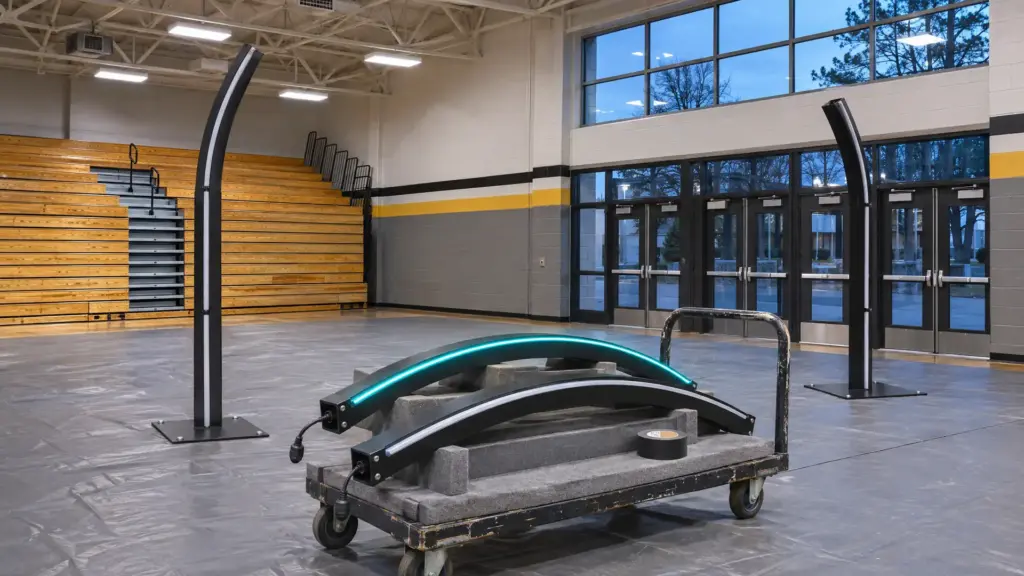
A spare leg and top piece, ordered with the set, make a damaged section a swap at the venue.
When the Client Changes the Neon
Three swaps from our neon flex range come up on arches, and each moves more lines than the neon line:
| Neon | Profile | Cut at 24V | Arch load | What else changes |
|---|---|---|---|---|
| UT-N1616-SB (this list) | Side bend, 16×16 mm | 1.97 in (50 mm) | 110 W | Nothing |
| UT-ND20-360 | 360° round, Ø20 mm, RGB or RGBW | 1.97 in (50 mm) | 110 W | Glows all round and bends in any direction, for an arch seen from both sides; never twisted along its length |
| UT-N1020-SB-SPI | Side bend, SPI pixel, 16 px/m RGB | 2.46 in (62.5 mm) | 110 W | Chases. Pieces 6 ft 11.7 in and 7 ft 9.5 in, about 144 pixels on UT-CSPI-2048. Confirm at quote how data passes between pieces: a data line in series, L1 to T1 to T2 to L2, needs a data joint at the crown and does not follow the four base feeds |
| UT-N1616-SB, 48V constant current | Side bend, 16×16 mm | 3.94 in (100 mm) | About 45 W at 5 W/m | A dimmer line, and its long single feed buys nothing on four pieces; constant-current driver matched at quote |
Run the Arch Through the Kit Builder
Our LED strip project kit builder lists our neon profiles and does the cut and load arithmetic. Enter two zones in place of the samples: Legs, UT-N1616-SB at 24V, 7 ft, 2 runs, no channel; and Top, UT-N1616-SB at 24V, 7.85 ft, 2 runs, no channel. Set the fit to round down, the loading rule to 80 percent and Class 2 outputs to No.
It returns the pieces above in decimal feet (6.9 and 7.7 ft), 29.2 ft of neon counted as one 164 ft reel, four feed points and 108 W connected. Change four things by hand:
- Replace the two per-zone drivers it picks, each an indoor 96 W unit, with one UT-D150-1224-67S on the whole arch, since the arch runs behind one controller.
- Turn the reel into four cut pieces with leads, sealed and labeled.
- Add the controller, remote, plugs, extensions, splitters, cross cable and clips; the builder lists none of them.
- Add the end caps: the builder counts caps only with a channel.
Spec Notes for the Arch
- Front only or both sides, marked on the frame drawing with the section breaks.
- Each section’s neon line length, measured on the frame.
- Color only or chases; remote, app or a DJ’s DMX console.
- Cross cable on the floor or over the top.
- Plug type, pinout and rating, on the assembly drawing.
- Who supplies the frame, the box, the input cord and the venue power.
Send the frame drawing with the length of each section and how the client will control it. We check the cut list against the profile’s grid, the bend direction, the feed and plug layout, the driver and the controller before anything is priced: request a quote.