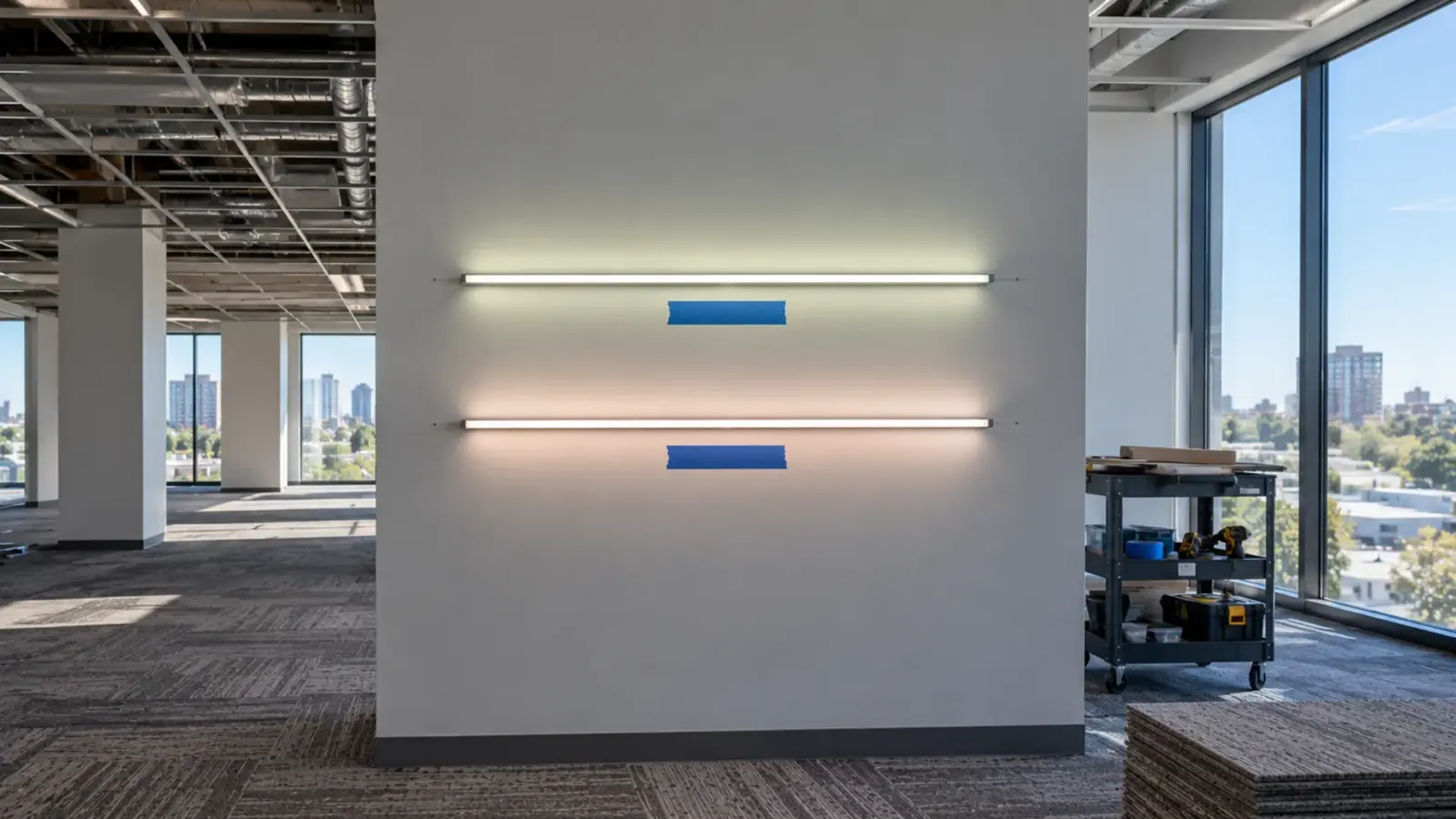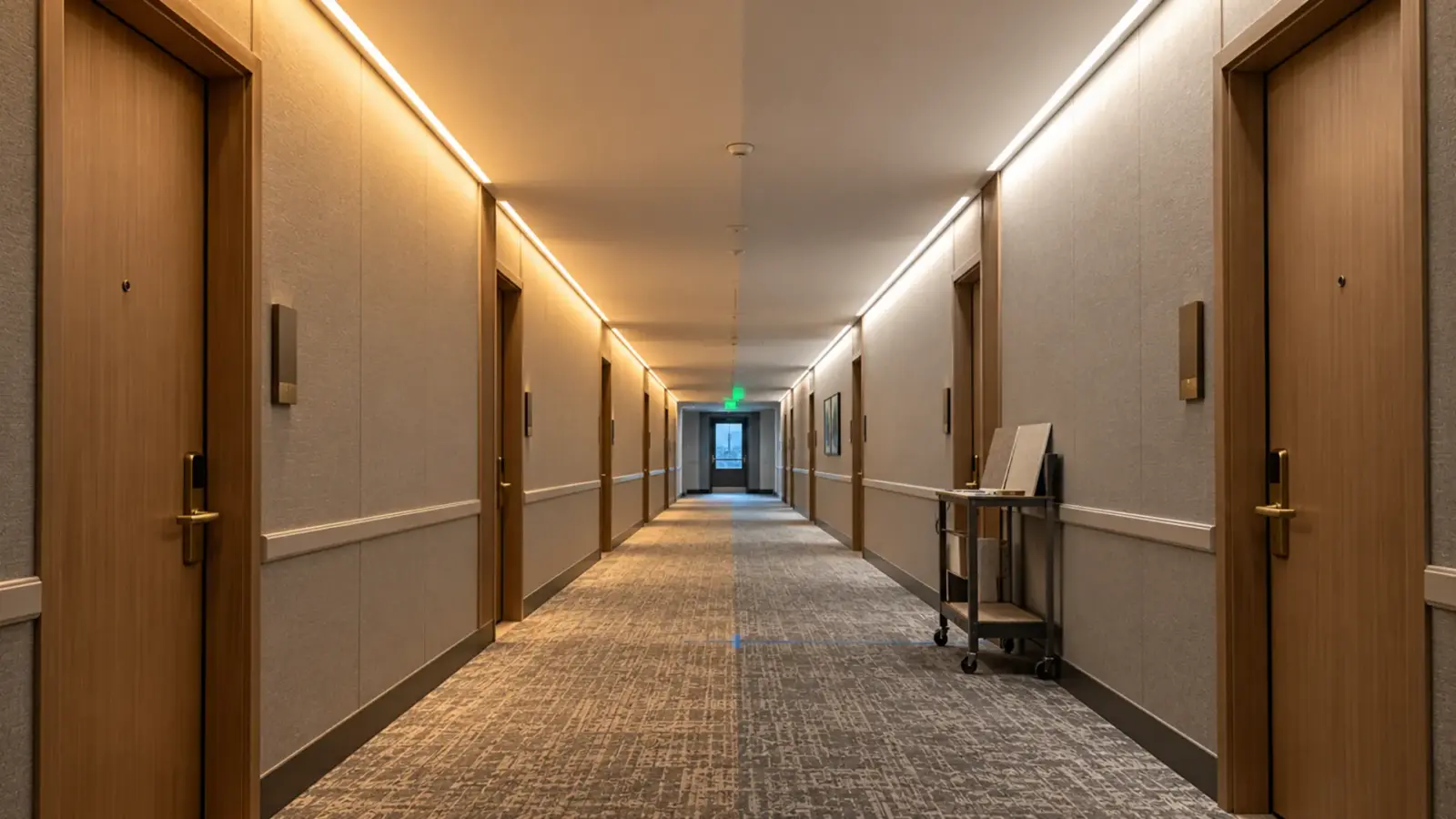
The strip is repaired, replaced or credited under warranty, and the contractor still pays to reach it. Our warranty page says removal, reinstallation, scaffolding, electrician labor and site costs are not covered. On a hard-to-reach ceiling or cove run those costs can outweigh the strip, so in our view you price the access, not the metre.
What Our Warranty Says About Labor
Our warranty policy is a limited warranty of up to 5 years. The period for an order is the one on the quotation and the order confirmation, and it varies by product series. It covers failure to light, section failure from a defect in materials or workmanship, lumen maintenance or color consistency falling materially below the published specification under rated conditions, and manufacturing defects in the PCB, solder joints or factory-fitted connections.
The exclusions table has a row for this exact question. Under “Labor & installation costs” it says: “Removal, reinstallation, scaffolding, electrician labor, and site costs are not covered.” The remedy for a valid claim is, at Unitop’s option, repair, replacement with the same or an equivalent product, or a credit for the affected quantity, and those are “your exclusive remedies under this warranty.”
Read the other rows as install steps. The table excludes improper installation, “cut ends not sealed as instructed”, electrical misuse including “incorrect driver pairing” and “exceeding rated load”, and cuts outside the marked cut points on strip not sold as free-cut. In our reading, a claim that fails on one of those leaves the contractor with the strip cost as well as the labor.
Other Warranties Draw the Same Line
This is not a Unitop quirk. ETI SSL’s warranty on LED retrofits says the customer “is solely responsible for labor costs of removal or installation of LED Retrofits.” MaxLite’s 2014 lamp warranty says it “will not be responsible for labor costs of Product removal or installation,” and that replacing the product does not include “any removal or reinstallation costs or expenses.” Both cover lamps and retrofits, not strip, but the split is the same. SloanLED, a lighting systems maker, says of typical LED warranties that “labor is not typically covered, resulting in added costs when the product needs to be serviced or replaced,” and offers a two-year service warranty that covers repair or replacement at the installation site, which it presents as an addition to the typical parts-only warranty.
In our view, assume the labor is yours.
Your Own Clock Can Run Longer Than the Strip’s
Your obligation to the owner can outlast what the supplier gives you. According to Miller Nash’s commentary on the AIA A201 form, Section 12.2.2.1 asks the contractor to correct nonconforming work found “within one year after the date of Substantial Completion,” on notice from the owner. The commentary adds that Section 3.5.1, the contractor’s warranty that the work conforms to the contract documents, carries no time limit, and that the correction duty ending at one year does not end that warranty. That is a law firm’s reading of one form, not your contract.
The same commentary quotes Section 12.2.2.1 as saying an owner who fails to notify the contractor and give an opportunity to make the correction waives the right to require it, in that period. In our advice, when an owner reports a dark section, answer in writing and open the supplier claim the same day.
The gap is the practical point. The strip can carry a supplier period of up to 5 years, stated on your quotation, and the labor is yours inside that period. If your own warranty to the owner runs longer, everything is yours after it. Read the subcontract and the specification for the warranty period, the correction period and who pays for access in year two, and ask counsel where it is unclear.
Where the Cost Comes From
A failed section costs more than the strip. In our reading, five lines make up the cost:
- Access: the lift, scaffold or tower, and the day it takes to set up.
- Opening and closing: removing a ceiling lid, a cover or a panel, and putting it back.
- The swap: cutting out the failed section, rejoining, sealing and testing.
- Finishes: paint, trim or ceiling repair after the opening.
- Site costs: after-hours work, escorts, infection-control setup in a hospital, or a return visit.
One timing point matters for access. Our warranty page says approved claims receive a remedy “typically within 10 business days of evaluation.” Evaluation comes first, and the remedy can be a repair, a replacement or a credit. In our advice, book the lift once the remedy is confirmed, not the day the report comes in, or you pay for a lift that waits.
In our reading access is the swing item. The same failed section behind a removable cover is a ladder and an hour. Behind a hard lid in a 14 ft lobby ceiling it is a day of scaffold and a paint patch.
Price the Exposure Into the Bid
Price by access type, not by footage. For each run on the job, write three numbers: the labor-hours of one replacement, the access days it needs, and the finish repair it leaves. Then multiply by how many replacements your own history says to expect. We cannot give that rate, because it depends on the product, the install and your record.
An illustrative example, with assumed numbers and the same few feet of strip in each install, shows why the access type matters more than the rate.
| Install | Access | Assumed hours per replacement | Assumed access days | Finish repair |
|---|---|---|---|---|
| Cove behind a removable cover, 9 ft corridor | Ladder | 2 | 0 | None |
| Cove behind a hard drywall lid, 14 ft lobby | Scaffold or lift | 9 | 1 | Patch and paint |
| Exterior soffit, 14 ft | Lift | 5 | 1 | Sealant and touch-up |
For one replacement on each, the corridor run costs about two labor-hours, the soffit five hours and a lift day, and the lobby nine hours, a scaffold day and a paint visit. The bid carries the difference as a line for the runs that need a lift, not a percentage spread over the whole job.
Here is the same method on a small job. The job has 12 lobby runs behind hard lids, 20 corridor runs behind removable covers and 8 soffit runs. For the arithmetic only, assume one replacement for every 20 runs of each type over the warranty period. That is 0.6 lobby events, 1.0 corridor events and 0.4 soffit events.
| Type | Runs | Expected events (assumed) | Labor-hours | Access days |
|---|---|---|---|---|
| Hard lid, lobby | 12 | 0.6 | 5.4 | 0.6 |
| Removable cover, corridor | 20 | 1.0 | 2.0 | 0 |
| Exterior soffit | 8 | 0.4 | 2.0 | 0.4 |
| Total | 40 | 2.0 | 9.4 | 1.0 |
The reserve is 9.4 labor-hours and one access day, which you price at your own rate. Half of the events and all of the access sit in the 20 lobby and soffit runs, so a design change in the lobby moves the reserve more than anything done to the corridor.
Who Else Can Carry It
The labor has to sit somewhere, and in our view there are two places other than the bid line. One is the owner’s maintenance contract, where a service plan can price access in advance; our maintenance plan guide covers the run register, spares and access design that make such a plan possible. The other is the subcontract, which can state who pays for access after the correction period. Neither is automatic, and each needs a written line before the job starts. Our warranty page lists no labor allowance, so do not price one in.
Cut the Exposure Before It Happens
Three habits reduce the number of replacements and their cost.
Design for access. Put the strip behind a cover that comes off, and the driver where a ladder reaches it. Our remote driver layout guide covers where the driver goes so it can be serviced without opening a finished ceiling.
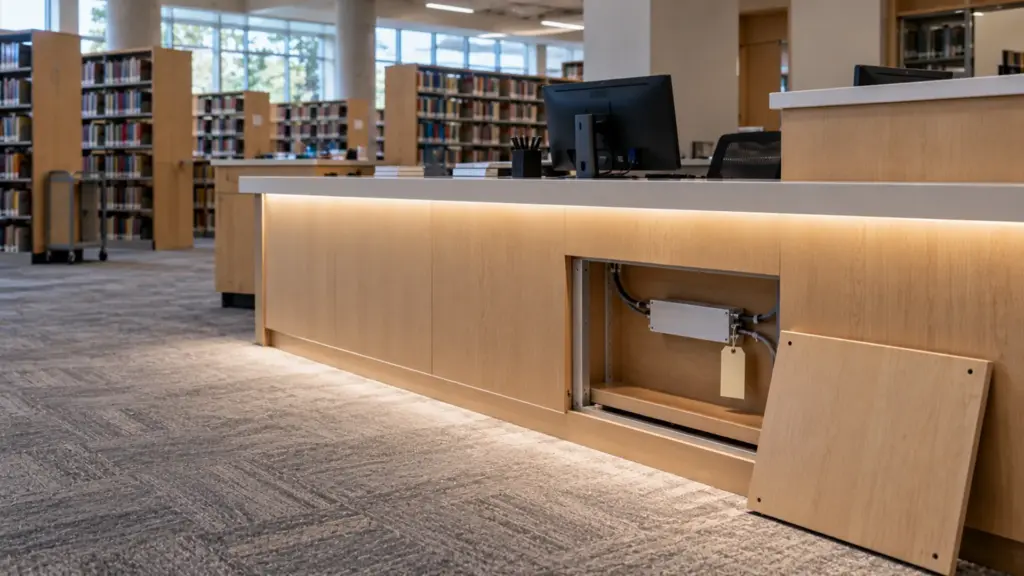
Keep matching spares. Keep spare sections from the same lot as the original order, as our handover guide advises for color matching, so a swap can use a matching piece.
Install to the exclusions. Cut at the marked cut points, seal every cut end as instructed, pair the driver as specified and keep each run inside its rated load. Those four are exclusions on our warranty page.
Test before closing. Energize the run at full, test the low end of the dimming range and walk it before the lid goes on. Our commissioning and handover guide covers the walk and the low-end test, and our punch list guide covers what an inspection looks for. A failure found with the cover off costs minutes; the same failure found after the ceiling is closed costs the line items above.
When a Failure Happens
Our claim steps are four: email sales with your order number and a description, include photos or video of the affected product and the installation, be ready to be asked for samples, and receive a remedy for an approved claim, “typically within 10 business days of evaluation.” Our claim documentation guide lists what to gather first.
Keep the failed section, tagged with the run it came from, because the warranty page says we may request affected samples for inspection; in our practice, keep its driver too. Keep your own record as well: hours, lift days and materials for the replacement, with photos of the opening. The warranty does not cover the labor or the lift time, but your estimator will want them for the next bid and your owner may ask for them under your contract.
Before You Bid
- Read the warranty period on the quotation and the order confirmation for each product series.
- Read your subcontract for the warranty period, the correction period and who pays for access in year two.
- List each run by access type, and price a lift or scaffold line for the runs that need one.
- Put the strip behind a cover that comes off, and the driver within a ladder’s reach.
- Cut, seal and pair to the exclusions, and test before the ceiling closes.
- Keep matching spares from the same lot as the original order.
- Keep a time and cost log for any replacement, with the date of the report, the date the part arrived and the lift days used.
The channels and drivers named here are on our LED channels and diffusers and drivers, controllers and connectors pages.