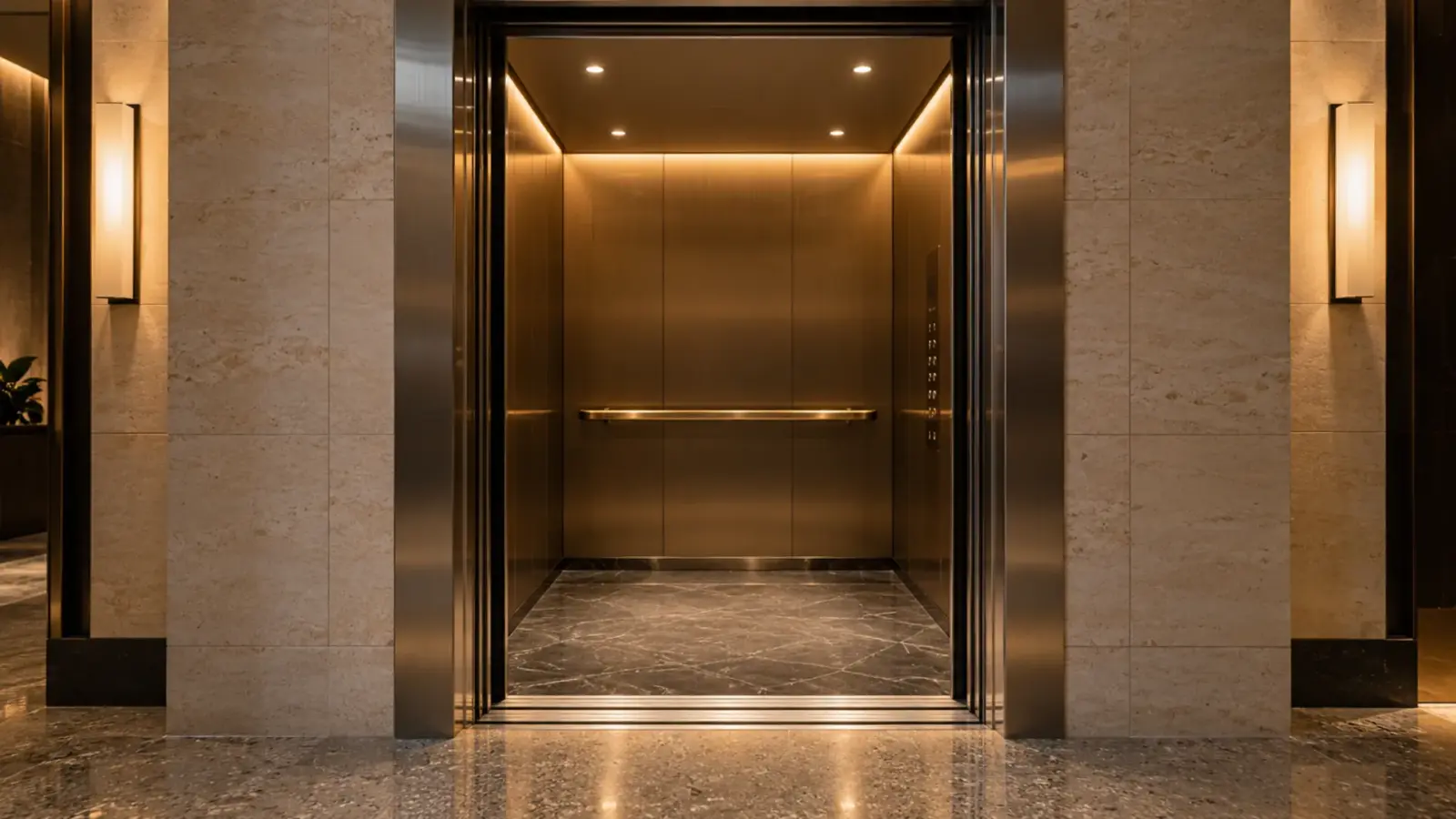
The renovation drawing shows a perimeter LED cove in the elevator cab ceiling, the electrician has a machine-room circuit, and the car must pass the elevator inspector. Elevator cab LED lighting answers to the elevator code: a threshold light level, an auxiliary light on the car, a branch circuit of its own and in California a power cap.
None of that rules strip out; it is thin, even and easy to hide in a ceiling reveal. But the car is elevator equipment, inspected under ASME A17.1, not a room on the electrical plans. The rules below come in the order a cab job meets them.
Whose Work It Is: Circuit, Car and Ceiling
Three trades touch a cab light, and the line between them sits further back than most electricians expect. The electrical code puts the car-light circuit’s breaker in the machine room or control space, and past that point the car is elevator equipment. States license the car side separately. Maryland’s licensing FAQ says interior work “involving the removal or installation of the nonstructural surface” “of the elevator’s wall, ceiling, floor, rail, or handle, and that does not affect the elevator’s moving operation” needs an elevator renovator mechanic license, and its elevator mechanic license covers wiring.
The usual split, which varies by state and by contract:
| Part | Usually supplied by | Usually installed by | Inspected under |
|---|---|---|---|
| Car-light branch circuit and its overcurrent device | Electrical contractor | Electrical contractor | NEC Article 620, electrical inspector |
| Traveling cable and car-top junction | Elevator contractor | Licensed elevator mechanic | ASME A17.1, elevator inspector |
| Ceiling panels, cove, channel, strip and driver on the car | Cab interior shop or elevator contractor | Elevator mechanic or licensed renovator, by state | ASME A17.1, acceptance or alteration inspection |
| Auxiliary light and its battery unit | Elevator contractor | Elevator mechanic | ASME A17.1 2.14.7.1.3 |
So the strip buyer is usually the cab interior shop or the elevator contractor, and the submittal goes to the elevator side. Asked to “just add strip” to an existing car, call the elevator contractor that holds the maintenance contract, then ask the elevator authority whether the change is an alteration that needs a permit.
The Branch Circuit Has Its Own Breaker
The car’s lights have their own circuit by code. A 2013 memo from California’s elevator unit quotes the state’s electrical code of the time, 620.22(A): “A separate branch circuit shall supply the car lights, receptacle(s), auxiliary lighting power source, and ventilation on each elevator car.” The overcurrent device sits in the machine room, control room or control space; for a machine-room-less car with no such space, Mike Holt’s 2020 NEC Q&A for EC&M says it goes “outside the hoistway and accessible to qualified persons only”. The 620.22(A) paragraph ends: “Required lighting shall not be connected to the load side of a ground-fault circuit interrupter.” In California the memo treats other devices on the car lighting circuit, such as door reopening devices or display panels, as “not in conformance” with the state’s elevator safety orders and sends them to circuits of their own under 620.25; the 2020 NEC, per the same Holt Q&A, allows accessory equipment such as alarm devices on the car-light circuit.
Two consequences for strip follow. First, the strip’s driver is a car light, so it belongs on this circuit, and its inrush counts against the same breaker as the downlights and fan; our inrush guide shows how to check that. Second, the driver does not plug into the car-top receptacle. According to that Q&A, 620.6 requires GFCI protection for 15 A and 20 A, 125 V receptacles on cars, and the 620.22(A) text above keeps required lighting off the load side of a GFCI. The same Q&A notes that the main elevator disconnect “is not permitted to disconnect power to the branch circuits required in Sec. 620.22…”, so the cab stays lit while the machine is down.
Light at the Threshold: 5 Foot-Candles
The ADA figure for every cab is 5 foot-candles. The 2010 ADA Standards, 407.4.5, read: “The level of illumination at the car controls, platform, car threshold and car landing sill shall be 5 foot candles (54 lux) minimum.” The existing-elevator code, ASME A17.3-2015 3.4.5, sets the same 5 fc (54 lx) at the car threshold with the door closed for passenger cars, 2.5 fc (27 lx) for freight, and asks for “not less than two lamps”. For new cars the figure sits in A17.1 2.14.7.1; read it in the edition your state has adopted.
The threshold is measured on the floor at the door, where a ceiling cove is weakest: its light reaches the floor only after bouncing off the ceiling, and a brushed stainless or dark wood ceiling returns little of it. In most cabs the downlights or a lit ceiling panel carry the 5 fc and the strip is the accent. If the strip is meant to be the only light, mock up one car and put a meter on the threshold before the rest of the strip is ordered.
The two-lamp rule needs a decision too. One strip on one driver is one point of failure; where the strip is the main light, feed it as two runs on two drivers and ask the inspector early whether that counts as two lamps.
The Auxiliary Light Lives on the Car
When normal power fails, a light on the car has to come on. ASME A17.1-2016 2.14.7.1.3, as reproduced in the National Elevator Industry’s code matrix, sets it out: auxiliary lighting “having its power source located on the car”; not less than 2 lx (0.2 fc) measured between 35 and 48 in above the floor, about 12 in in front of the car operating panel; switched on automatically; held for at least 4 h; and “not less than two lamps of approximately equal illumination”. Battery units comply with UL 924 or CSA C22.2 No. 141, carry a 4 h rating, are “permanently connected to the car light branch circuit”, and have an output rating that includes the auxiliary lights. Item (h) allows the auxiliary lamps to be the same lamps used for normal light.
Item (h) is where strip gets expensive. Suppose the cab’s perimeter strip is also its auxiliary light: 24 ft of UT-S2835-60 at 1.5 W/ft draws 36 W. Four hours at full output is 144 Wh at the strip, before the driver’s losses, from a battery that has to live on the car. Two small lamps aimed at the operating panel need a fraction of that, since 0.2 fc is a low bar, so the usual answer is to keep the decorative strip off the battery.
This is not the building’s emergency lighting. A corridor strip on a UL 924 transfer device, the subject of our emergency power guide, runs from the building’s emergency source; the car’s auxiliary light runs from its own battery on the car.
California’s Cab Power Cap
California adds a watt limit. The Energy Commission’s fact sheet on the 2022 Energy Code (August 2023), Title 24 Part 6 120.6(f), says “the light power density for luminaires inside the elevator cab must be no more than 0.6 watts per square foot”, with signal and display lighting excluded; its 2019 sheet gives the same figure, and the 2025 edition now in force is the one to check. The rule covers new nonresidential buildings and existing elevators in major alterations involving mechanical equipment, lighting or controls; elevators in healthcare facilities are exempt. Our Title 24 guide covers the rest of the code.
A common 3,500 lb passenger car, in Mitsubishi’s planning table, measures 6 ft 8 in by 5 ft 4 3/4 in inside: about 36 sq ft. At 0.6 W/sq ft, that is 21.6 W for every luminaire in the cab. The ceiling perimeter is about 24 ft.
| Layout | Strip | Length | Rated load | Against 21.6 W |
|---|---|---|---|---|
| Full perimeter | UT-S2835-60, 1.5 W/ft | 24 ft | 36.0 W | 14.4 W over |
| Full perimeter | UT-C400-3, 2.1 W/ft | 24 ft | 50.4 W | 28.8 W over |
| Front and rear edges | UT-S2835-60, 1.5 W/ft | 13.3 ft | 20.0 W | 1.6 W left |
| Front and rear edges | UT-C400-3, 2.1 W/ft | 13.3 ft | 28.0 W | 6.4 W over |
| Rear edge only | UT-C400-3, 2.1 W/ft | 6.7 ft | 14.0 W | 7.6 W left |
The budget buys about 14 ft of a 1.5 W/ft strip with nothing else in the car, or about 10 ft at 2.1 W/ft. Any downlight counts against the same 21.6 W.
The same section has a control rule. When the cab is stopped and unoccupied with the doors closed for over 15 minutes, the interior lighting and fans must switch off, and they must stay on if passengers are stuck. The acceptance test checks that they “turn on immediately upon occupancy”. A driver with a long start-up delay can fail that line, so test the driver on the controller’s cab-light relay before the ceiling closes. Our occupancy sensor guide explains why a switched driver lights a moment late.
Materials and Mounting in a Moving Box
What lines the car has a fire rule. A 2001 circular from California’s elevator unit quotes the older A17.1 Rule 204.2a: materials exposed to the car interior “shall be metal, laminated glass” or meet ASTM E84, UL 723 or NFPA 255 with a “flame spread index of 0 to 75” and “smoke development of 0 to 450”. New York City’s 2022 modification of A17.1-2013 2.14.2.1.1 tightens that to 0 to 50 and 0 to 100. An aluminum channel is metal; a polycarbonate cover or a translucent ceiling panel is a plastic exposed to the car interior, so ask whoever supplies it, the cab maker or the strip supplier, for its E84 result in the end-use configuration before the submittal goes out.
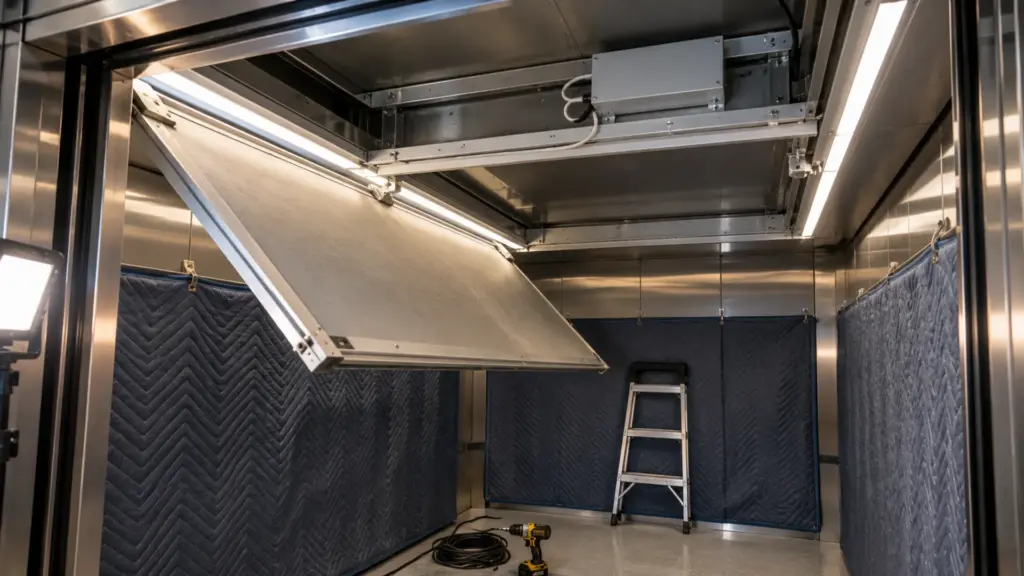
The car moves, stops hard and takes door slams all day, so adhesive alone will not hold strip. Seat the strip in an aluminum profile, such as the corner UT-CH1616 at a 45° aim or the compact surface UT-CH1207, and screw the profile to the ceiling frame. Use soldered or screw-terminal joints; our troubleshooting guide notes that vibration near doors and elevators can loosen a clip-on connector until it opens. Put the driver, such as a 40 W UT-D40-24-C2 Class 2 unit, on the car top or above the ceiling where the mechanic can reach it from the car top, clamp its leads, and keep every fixed light and cable clear of any ceiling panel the cab maker’s drawing shows as opening.
High-Rise and Evacuation Elevators
In a high-rise the car light circuit is an emergency load. The 2018 IBC, 403.4.8.4, lists “Elevator car lighting” among the emergency power loads for high-rise buildings, and the occupant evacuation elevator rules in NFPA 5000 list car lighting among the features supplied by both normal and standby power. The strip’s driver then has to restart cleanly after a transfer to the generator; watch it do so at the generator test.
FAQ
How many foot-candles does an elevator cab need?
The 2010 ADA Standards set 5 foot-candles (54 lux) minimum at the car controls, platform, car threshold and landing sill. ASME A17.3 sets 5 fc at the threshold for existing passenger cars and 2.5 fc for freight. New cars follow the A17.1 edition your state has adopted.
Can LED strip be the emergency light in an elevator?
It can, if it meets the auxiliary-light rule: power on the car, 0.2 fc at the operating panel, 4 h, two lamps and a battery rated for the load. Most designs keep the strip off the battery because of the watt-hours.
Can an electrician install LED strip in an elevator cab?
The electrician usually supplies the car-light branch circuit to the machine room or control space. Wiring and ceiling work on the car is usually elevator work under the elevator contractor, and some states license cab interiors separately.
Can the strip’s driver plug into the car-top receptacle?
No. Car receptacles are GFCI-protected under NEC 620.6, and required car lighting may not be on the load side of a GFCI. The driver is wired to the car-light branch circuit like the cab’s other lights.
What to Verify With the Elevator Inspector
- The A17.1 edition and local amendments your state enforces, and its threshold figure for new cars.
- Whether a strip on two drivers counts as the two lamps the car needs.
- Who holds the permit for the cab work, and whether adding strip is an alteration.
- E84 flame and smoke results for every plastic cover, lens or panel in the ceiling.
- In California, the cab’s lighting watts on the compliance form against 0.6 W/sq ft, and the 15-minute shutoff test.
- In a high-rise, which emergency source feeds the car light circuit.
The 1.5 W/ft strip in the California example is in our SMD LED strip range and the profiles are on our LED channel page; send the cab ceiling drawing and we will list the watts against the cab’s budget.