
The fifty codes, standards and programs below can reach an LED strip job, and most were written for other products. The NEC sets the voltage and the wiring, a UL standard sits behind each listing, Title 24 or the IECC sets the controls, and the rest arrive with the building type, the control system or the owner’s green-building goal.
This list names each one, says what it covers and when it comes up on a strip job, and links the guide where we work through it. The edition your jurisdiction has adopted decides the numbers, so treat every line as a reason to check, not as the requirement itself.
Electrical and Building Codes: 1 to 11
These are the documents the inspector enforces. They are adopted by the state or the city, edition by edition.
- NFPA 70, the National Electrical Code. Section 411.3 of the 2023 edition limits low-voltage lighting systems to 30 V ac or 60 V dc, and to 15 V ac or 30 V dc where wet contact is likely; our NEC guide for low-voltage LED strip reads the article.
- NEC Class 2 limits (Chapter 9 tables). A Class 2 source at 24V is limited to about 100 VA, so a large strip load splits into several Class 2 circuits, as our guide to Class 2 and non-Class 2 drivers explains.
- NEC 300.22(C), spaces used for environmental air. As EC&M and Legrand read it, equipment above a ceiling that carries return air needs a metal enclosure or a nonmetallic one listed for the use, which decides whether an LED driver can sit in a plenum ceiling.
- NEC 210.12, AFCI protection. It lists the rooms whose 120V circuits need arc-fault protection, which is where an AFCI breaker that trips on LED drivers gets diagnosed before it gets swapped.
- NEC 410.10(D), luminaires in bathtub and shower areas. It sets the zone and the marking for any light near the spray, the first question for LED strip in a shower niche.
- NEC Article 680, pools, spas and fountains. It sets the low-voltage contact limit, distances and GFCI rules near water, covered for LED strip at pools and water features.
- NEC Article 600, electric signs. Section 600.3 covers signs whether fixed, mobile or portable, so a neon logo needs a listing as a sign, as our guide to the LED neon sign power supply explains.
- NEC Article 517, health care facilities. In the 2023 edition, according to IAEI Magazine, section 517.13 covers the grounding of wiring serving patient care spaces, settled with the engineer before rough-in in hospital and clinic LED strip lighting.
- International Building Code (IBC). It requires the means of egress to be lit while the building is occupied, and stairs need more than corridors; stair lighting code for LED strip walks the gates.
- NFPA 101, Life Safety Code. Where adopted, it permits listed automatic controls on egress lighting under conditions, which decides how far a hotel corridor can dim at night.
- 2010 ADA Standards, section 307. Objects with leading edges 27 to 80 in above the floor may protrude no more than 4 in into a circulation path, the measurement behind LED channel and the ADA protruding object rule.
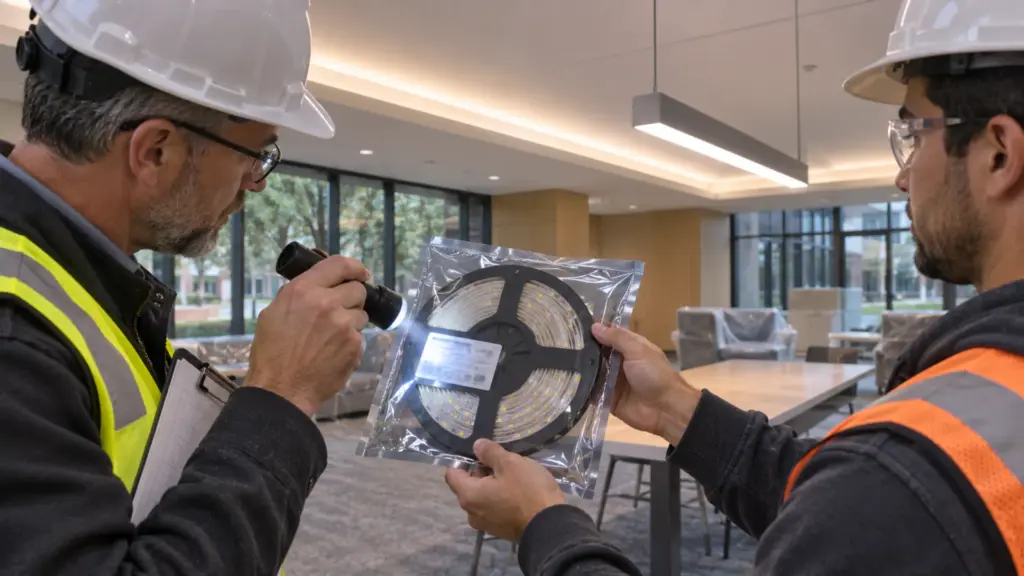
Product Safety Standards: 12 to 23
Most of these sit behind a listing mark. The product standards (12 to 20) each cover a different product form, so the first question on a submittal is which standard the certificate names; 21 to 23 are a device standard, a field-swap program and a fire test.
- UL 2108, low-voltage lighting systems. LED strip sold as a low-voltage lighting system under NEC Article 411 is normally listed to it, as our guide to the UL listing for LED strip shows.
- UL 8750, LED equipment for lighting products. It covers LED modules, packages and drivers, so a UL 8750 certificate describes the parts inside a strip system, not the strip run (entry 12’s guide).
- UL 1598, luminaires. A finished fixture with its own housing and connection is a UL 1598 product, not a strip system (entry 12’s guide).
- UL 1310, Class 2 power units. It covers the power limiting; a driver built to UL 8750 is not Class 2 unless that limit is also met and marked (entry 2’s guide).
- UL 48, electric signs. A finished LED neon sign is listed under it, usually by the shop that builds it, as our guide to UL 48 and UL 879 for LED neon signs explains.
- UL 879, electric sign components. Neon flex, modules and drivers used in signs are components under it or carry their own listings, and a kit converting an existing sign falls under UL 879A (entry 16’s guide).
- UL 924, emergency lighting and power equipment. Strip and its drivers carry no such listing, so LED strip on emergency power needs a listed relay, battery driver or inverter on its path.
- UL 1994, luminous egress path marking. Self-luminous materials listed to it mark steps and landings, and a powered strip on a nosing does not replace them where the code requires them (entry 9’s guide).
- UL 2043. It is the usual listing test for nonmetallic equipment in air-handling spaces, and a passing product receives the “Plenum Rated” mark, according to Legrand (entry 3’s guide).
- UL 1449, surge protective devices. As Mersen’s guide puts it, SPDs are sorted by UL 1449 type: Type 1 at the service, Type 2 on branch panels and Type 3 at the point of use, the starting point when LED drivers on a facade or in a garage need surge protection.
- UL Class P driver program. A driver designated Class P may be swapped in the field without the luminaire maker, at the same or lower power, according to Signify, a point our replacement LED driver guide covers.
- ASTM E84 / UL 723, surface burning. Older A17.1 rules quoted by California’s elevator unit cap flame spread and smoke for materials exposed to the car interior other than metal or laminated glass (ASTM E84, UL 723 or NFPA 255), which reaches any plastic cover or lens in an elevator cab with LED strip.
Ratings and Test Methods: 24 to 32
These do not approve anything. They define how a number on a datasheet was measured, so they decide whether two datasheets can be compared.
- IEC 60529, IP codes. The IP code is a lab result for dust and water, not a wet location rating, which our wet location LED strip guide separates.
- IEC 62262, IK impact ratings. Impact and water are separate ratings; IK10 lines appear where feet pass close in exterior recessed linear lighting.
- IES LM-79, photometric testing of the finished product. It measures one sample’s light, power, efficacy and color when new, and only for that model, as our LM-79 report guide shows.
- IES LM-80, lumen maintenance of LED packages. It is run on the package, by part number, so a strip claim rests on the packager’s report; LED chip brands in LED strip shows how to trace it.
- IES TM-21, projecting lumen maintenance. It projects LM-80 data forward, no further than six times the test duration for 20 or more samples, as quoted in our LED strip lighting by the numbers reference.
- IES TM-30, color rendition. It reports Rf for fidelity and Rg for gamut, specified for gallery and high-end retail work beside Ra and R9 in high-CRI LED strip.
- ANSI C78.377, chromaticity of white LEDs. It keeps quality white light near an absolute Duv of 0.006 or less, according to the summary our guide to LED strip green tint and Duv cites.
- IEEE 1789, flicker recommended practice. It is one of three documented flicker results WELL accepts, beside JA-10 and Pst/SVM, as our LEED and WELL lighting credits guide lists.
- ASTM B117, salt spray. UL 1598A sets 200 hours of it for ferrous parts of outside-type marine luminaires, the first of the four tests behind marine-grade LED strip.
Energy Codes and Programs: 33 to 38
Energy codes reach strip mostly through its circuit: controls, dimming and power allowances. JA8 is the exception, certifying the strip with its driver.
- California Title 24, Part 6. It sets controls and power limits for the lighting system, and the 2025 edition applies to permit applications on or after January 1, 2026; our Title 24 LED strip guide reads it.
- Title 24 Joint Appendix JA8. It certifies high-efficacy light sources, strip and driver together, for both dwelling units and hotel guest rooms; the 20-minute vacancy shutoff is what splits hotel guest rooms and apartments under Title 24.
- Title 24 Joint Appendix JA10. Its test defines “reduced flicker operation,” one of the flicker results WELL accepts (entry 31’s guide).
- International Energy Conservation Code (IECC). Outside California it asks a cove that provides general light for automatic off, a way to reduce the light, daylight dimming and a functional test, as our guide to IECC and ASHRAE 90.1 lighting controls explains.
- ASHRAE 90.1. States adopt it, the IECC or both, and amend them; it asks the same kinds of controls of the strip circuit (entry 36’s guide).
- DLC Qualified Products List. Flexible strip used as an architectural line is not a standard category on it, so a strip run rarely earns a utility rebate, as our DLC listing and utility rebates guide explains.
Control Protocols: 39 to 41
Protocols decide which driver or decoder the strip needs, so they belong on the drawings before the strip is chosen.
- IEC 60929 Annex E, 0-10V dimming. Our reading: full output at 10V, minimum at or below 1V, and up to 2 mA of control current per driver, which sets how many drivers one dimmer can carry in a 0-10V dimming wiring diagram.
- IEC 62386, DALI (DT8 for tunable white). A DT8 decoder takes one address for level and color temperature, and the strip knows nothing about DALI, as our DALI DT8 tunable white guide explains.
- DMX512. One universe carries 512 channels, 128 RGBW zones at four channels each, while one daisy chain carries only 32 devices, the limit our DMX LED strip control guide plans around.
Fire Protection, Design Guidelines and Green Building: 42 to 46
NFPA 13 and 72 are enforced through the fire code, often by the fire marshal. The FGI Guidelines and RP-28 apply where a state adopts them, and LEED and WELL where the owner pursues them.
- FGI Guidelines. A majority of states base senior living rules on them, according to the LightNOW summary our guide to senior living and memory care LED strip cites.
- ANSI/IES RP-28. With the FGI Guidelines, it asks for glare-free light, low night lighting no higher than 2 ft and CRI 80 or higher, according to the same LightNOW summary; RP-28 has been revised since 2016, so check the edition (entry 42’s guide).
- NFPA 13. Sprinkler spacing and obstruction rules sit there, applied by the sprinkler designer, which decides the clearance between LED strip and sprinkler heads.
- NFPA 72. Detector placement sits there; we found no NFPA 72 distance for lighting, so the detector maker’s instructions and the AHJ decide (entry 44’s guide).
- LEED and WELL. Strip earns no credit by itself; it can be part of the lighting that earns WELL’s color, flicker, glare and circadian points and LEED v5’s quality electric lighting point (entry 31’s guide).
Disclosure, Market and Trade: 47 to 50
These arrive with the owner, the distributor or the importer, and a UL listing answers none of them.
- HPD, EPD and Declare. A Health Product Declaration, an Environmental Product Declaration and a Declare label answer different questions, and a supplier should say which it can provide; our guide to HPD, EPD and Declare for LED strip sorts them.
- FCC Part 15. It covers the radio-frequency emissions of drivers and controllers, with a test report or declaration for the exact model, as our guide to FCC, Prop 65 and labels beyond UL explains.
- California Proposition 65. It is a separate assessment for cable jackets and components, and its conclusion depends on a product, a chemical and an exposure (entry 48’s guide).
- The Harmonized Tariff Schedule. There is no single HS code for LED strip: a reel sold as a lighting product has followed the line that became 9405.42 in 2022, an LED module goes to 8539.51, and a 2014 ruling used 8543.70, as our LED strip HS code guide traces.
How to Use the List
Read the list against the drawings, not front to back. A cove in a California hotel room meets entries 1, 2, 12, 33 and 34; a facade sign meets 1, 7, 16, 17, 21 and 24; a hospital corridor meets 1, 9, 10 and 36 (33 in California), plus 8 where its wiring serves patient care spaces. Where the edition matters, the linked guide says so. To walk them through the job stage by stage, use the 100-check LED strip job checklist.
If a submittal needs the certificate, test report or declaration behind one of these lines for our products, documentation and listing information are available upon request: request a quote with the model numbers.